
Abstract
This study analyzes Indonesia's energy research landscape via bibliometric analysis of 19,588 Scopus publications. Findings reveal a dominant shift towards renewables (72.2% of publications), led by bioenergy, and high institutional specialization. Thematic mapping identifies robust themes like biomass but underexplored areas such as ocean energy. The study underscores the need for strategic collaborations and policy support to bridge research gaps, foster innovation, and guide Indonesia toward energy self-sufficiency, providing a data-driven foundation for future research and policy development.
Keywords: bibliometric analysis, energy studies, fossil fuels, renewable energy, research collaboration, thematic research map
Outline
1. Introduction
Research in developed countries prioritises high-tech innovations and often serves as the foundation for long-term energy policy development, positively contributing to the achievement of energy transitions1). Developed nations have demonstrated the effectiveness of energy transitions and other environmental technological innovations in reducing their emissions2,3). Consequently, developing countries often adopt energy policies and technological advancements modelled by developed nations. However, this collective global effort to reduce emissions faces challenges, particularly due to the United States' decision under the Trump administration to withdraw from the Paris Agreement. This move could not only encourage developing countries to follow suit by opting for cheaper fossil fuels but also reduce international support for those countries to pursue innovation in energy transitions4).
Developing countries have learned extensively from developed nations regarding clean energy technologies and policies since the adoption of the United Nations Framework Convention on Climate Change (UNFCCC) in 1992. Among these, China stands out as the developing country with the largest capacity and production of renewable energy. Moreover, it has successfully become the world's leading exporter of clean energy technology5). Another notable example is Vietnam, which has made significant progress through the adoption of feed-in tariff policies inspired by developed nations6). However, many developing countries have yet to achieve success in advancing renewable energy, including Indonesia.
Under the new leadership of President Prabowo Subianto, energy policies in Indonesia are being directed toward energy self-sufficiency to addressing global geopolitical challenges. Energy self-sufficiency refers to a country’s ability to meet its energy needs without relying on imports. However, Indonesia has not yet achieved this status, as domestic energy production is still insufficient to meet national consumption. For instance, in 2023, total domestic liquefied petroleum gas (LPG) demand reached 8.7 million tons, while production was only 1.9 million tons, indicating a significant deficit and heavy reliance on imports7). This also highlights Indonesia’s continued dependence on fossil fuels. Additionally, Indonesia has set a net zero emission target for 2060 which will increase the risk to energy security8). Thus, Indonesia faces the dual challenge of achieving energy self-sufficiency while ensuring a sustainable energy transition. For this, Indonesia can learn from developed countries to enhance clean energy transition9,10). Increasing renewable energy production will make Indonesia more resilient to fossil fuel price increases11). In this light, a highly skilled workforce is fundamental to technological self-reliance12), as it enables the adaptation, enhancement, and innovation of energy technologies tailored to Indonesia’s unique needs and resources. Without strong capabilities in research, engineering, and technical expertise, the country will continue to depend on foreign expertise, which may hinder its ability to develop competitive and sustainable energy solutions.
Despite this global context and Indonesia's specific challenges, a systematic, quantitative overview of the nation's entire energy research ecosystem is lacking. Existing bibliometric studies on Indonesia, as shown in Table 1, are fragmented, focusing on specific energy types like solar or bioenergy. This fragmentation obscures the broader research landscape, hindering the identification of cross-sectoral synergies, institutional strengths, and critical gaps. Without a holistic map, policymakers and researchers cannot efficiently allocate resources or foster the collaborations necessary to accelerate the energy transition.
To address this gap, this study conducts a comprehensive bibliometric analysis of energy supply research in Indonesia with the following objectives: (1) To quantify the volume, growth trajectory, and distribution of publications across all major energy sources (fossil fuels, nuclear, and renewables).(2) To identify the most prolific and impactful authors, institutions, and international collaborations shaping Indonesia's energy research. (3) To map the thematic evolution and current research fronts within each energy sector using trend topic and thematic map analyses. (4) To derive actionable insights and policy recommendations for enhancing research collaboration and aligning Indonesia's energy research agenda with its goals of self-sufficiency and sustainable development.
2. Literature Review
Bibliometric analysis serves as a valuable tool to map research developments within the energy sector. For instance, in the domain of solar energy, Lyu et al. (2024)13) conducted a global review of solar-related studies, while Abdul Jabar et al. (2023)14) focused specifically on solar photovoltaic–thermal hybrid systems. Regarding energy utilization, Afrane et al. (2022)15) mapped global research trends on clean cooking technologies. Other bibliometric studies on clean energy have addressed topics such as energy resilience16), emissions from the power generation sector17), renewable energy in South Africa18), bioenergy19), energy subsidies20), green finance and the impact of carbon trading on renewable energy21,22), sustainable energy supply chains23), the integration of renewable energy and circular economy principles24), systems thinking and artificial intelligence (AI) applications25,26), barriers to renewable energy adoption in ASEAN27), micro-electro-mechanical systems (MEMS) for energy harvesting28), and organic Rankine cycle (ORC) technology29).
Bibliometric studies in the oil and gas sector have been expanding. Research on oil fuels, for example, encompasses the application of artificial intelligence for crude oil projection30), investigations into hydrocarbon pollution31), analyses of oil and gas production32), examinations of the economic impacts of oil crises33), and studies addressing heavy oil34). In parallel, bibliometric investigations in gas research have concentrated on the conversion of natural gas hydrates into energy35), evaluations of natural gas combined cycle power plants36,37), assessments of shale gas38), and other related topics39,40).
Global research on coal and nuclear energy has similarly been examined using bibliometric review methodologies. Studies on coal have reviewed literature concerning trace elements in coal and ash41), coal combustion42,43), coal seam hydraulic fracturing44), coal gasification45), circulating fluidized bed technology46), coal modelling47), and coal-fired flue gas48), among other topics49,50). For nuclear energy, bibliometric studies have addressed issues such as nuclear disasters51), nuclear desalination52), small modular reactor53), human factors on nuclear power plant operations54), and emerging trends and innovations in nuclear research55–58).
The overall body of bibliometric literature covering various energy types remains relatively limited. For instance, Harichandan et al. (2022)59) employed the query “energy transition” alongside related terms, retrieving 2,169 articles for bibliometric analysis. Their study examined research trends, leading authors, highly cited articles, prominent journals, and principal publishing countries, ultimately identifying key knowledge gaps and proposing recommendations for future inquiry toward an achievable energy transition. Similarly, Chen et al. (2016)60) used the query “energy and fuels” to analyze 19,089 articles produced by Chinese authors, focusing on leading journals, top institutions, international collaborations, major keywords, and central research topics.
In light of these studies, our work aims to enrich the current literature by reviewing the evolution of fossil and renewable energy supply research in Indonesia. To the best of our knowledge, no bibliometric study has yet provided a comprehensive review of energy supply research and its future directions in the Indonesian context. Table 1 lists
Table 1: Energy supply related bibliometric studies by Indonesia institutions
bibliometric studies conducted by Indonesian institutions. While many of these adopt a global perspective, some focus on Indonesia as a case study. Nevertheless, bibliometric analyses in Indonesia have thus far been limited to specific energy types. For an example, Madsuha et al. (2021)61) reviewed three decades of solar energy research in Indonesia. Damayanti and Dinaseviani (2024)62) examined the adoption of solar PV systems by Indonesian households, while Setyanansyach et al. (2023)63) focused on biogas power plants. Shafii et al. (2024)64) reviewed global studies on nuclear energy policy from 2002 to 2022 and discussed their implications for Indonesia, which currently does not have nuclear power plants yet. As an exception, Akbar et al. (2020)65) conducted a bibliometric study addressing five types of renewable energy in Indonesia. A non-bibliometric literature reviews on Indonesia context are also limited to one type of energy resources, such as rooftop solar power66,67), and wave energy converter68).
The extant bibliometric literature provides valuable insights into global energy research trends and isolated snapshots of specific technologies in Indonesia. However, a critical synthesis reveals a significant lacuna: the absence of an integrated analysis that places Indonesia's diverse energy research efforts within a single, comparable framework. Global studies often lack the granularity to inform national policy, while Indonesia-focused studies are too narrow to reveal the relative priorities and interdependencies between different energy sectors. This study bridges this divide by applying a unified bibliometric methodology to the entire spectrum of Indonesia's energy supply research, enabling a comparative assessment of maturity, focus, and collaboration patterns across all key energy domains.
3. Methods
3.1. Literature Search
The methodology involves sequential steps: The first step is the literature search in the Scopus database using keywords in Table A.1 from December 13 to 28, 2024. The files downloaded from Scopus are in BibTeX and CSV formats. The BibTeX file is used for analysis in the Bibliometrix application, which is an open-source tool designed for conducting comprehensive science mapping analyses of scholarly literature84). It is developed in R and offers flexibility and seamless integration with various statistical and graphical packages85).
3.2. Data Collection and Cleaning
The literature search was conducted in the Scopus database from December 13 to 28, 2024. Scopus was selected for its comprehensive coverage of high-quality, peer-reviewed literature in the scientific and technical fields. The search query consisted of keywords related to twelve energy topics (Table A.1) combined with "Indonesia" or Indonesian affiliations. The initial search yielded 21,364 documents.
To ensure a non-redundant dataset, duplicate articles were removed. This was performed by first organizing the articles by the pre-defined topic order (as listed in Table 2: Wind, Solar, Geothermal, etc.). Records were then sequentially checked, and duplicates were identified and removed based on matching titles, authors, and publication years, prioritizing the first occurrence according to the topic order. This process resulted in a final corpus of 19,588 unique publications for analysis.
The chosen keywords were broad and technology-specific (e.g., "solar energy," "bioenergy," "oil fuel") to capture the maximum relevant literature for each sector. While this approach ensures breadth, it may exclude publications that use non-standard terminology. The analysis covers all publications in the database up to the search date, capturing the historical evolution of research from the earliest relevant publication to the present.
3.3. Bibliometrix analysis
The next step is the analysis in Bibliometrix to extract data on the most relevant authors, most relevant affiliations, most globally cited documents, most frequent words, trend topics, thematic maps, and countries' collaboration world maps. For the thematic map analysis in Bibliometrix, we used a minimum cluster frequency of 5 and a number of labels set to 3 for each quadrant to ensure clarity and interpretability. The map is based on a co-word network analysis, where centrality indicates the degree of interaction with other themes, and density indicates the internal development of the theme
3.4. Trend topics analysis and top author
The involves analyzing trend topics and consecutively specialty of top authors is discussed in the next step.
3.5. Recommendation discussion
The final step involves discussing recommendations related to the research agenda to support energy self-sufficiency based on thematic map analysis. The thematic map is a diagram with four quadrants: emerging or declining themes, basic themes, niche themes, and motor themes. The discussion of recommendations also addresses countries that should be partners in research and innovation in the energy sector.
4. Results and Discussions
Table 2 shows the number of articles obtained from each keyword. The total number of articles across all topics is 21,364, with the highest number being on bioenergy (29%). Duplicate articles were then removed by organizing articles by topic order as shown in Table 1, resulting in 19,588 articles. Around 56% of these articles are conference papers, and 40% are journal articles. Research institutions in Indonesia have been involved in the preparation of 14 energy-related books.
Figure 1 shows the annual publication growth per technology. The oldest article in the Scopus database is about the development of a double stage soda sweetening process to sweeten the 6-8 copper number gasoline at the Palembang Refinery86).
The number of publications was only 11 articles during 1970 to 1979, then increased to 72 articles during 1980 – 1989, and 200 articles during 1990 – 1999. The number of publications exceeded 100 articles per year since 2009, reaching more than 1,000 articles in 2017. The establishment of the Indonesia Endowment Fund for Education Agency (LPDP) in 2011 and various international publication requirements at universities and research institutions contributed to the increase in Scopus-indexed publications. However, the publication trend declined in 2021 to 2022 during the COVID-19 pandemic, which prevented students from attending physical classes, especially abroad, and redirected government and private budgets to address the pandemic. As a result, research and publications focused on the pandemic, leading to a decrease in publications in other fields87). After the pandemic, the number of publications increased again,
Table 2: The number of articles analyzed
| Topic | Original | No duplicate |
|---|---|---|
| Wind | 1,106 | 1,106 |
| Solar | 3,221 | 3,012 |
| Geothermal | 1,475 | 1,419 |
| Hydro | 584 | 507 |
| Ocean | 204 | 183 |
| Bioenergy | 6,164 | 5,978 |
| WtE | 506 | 334 |
| Other RE | 1,767 | 1,609 |
| Coal | 2,271 | 1,846 |
| Oil | 2,829 | 2,762 |
| Gas | 899 | 519 |
| Nuclear | 338 | 313 |
| Total | 21,364 | 19,588 |
reaching over 2,500 articles. The number of publications for the 2025 edition has already reached 78 articles, mostly related to bioenergy (35%) and solar energy (23%).
4.1. Fossil Energy & Nuclear
Publications related to fossil energy significantly dominated from 1950 to 2010, with a total of 613 articles, compared to 273 articles on renewable energy.
4.1.1. Oil Fuel
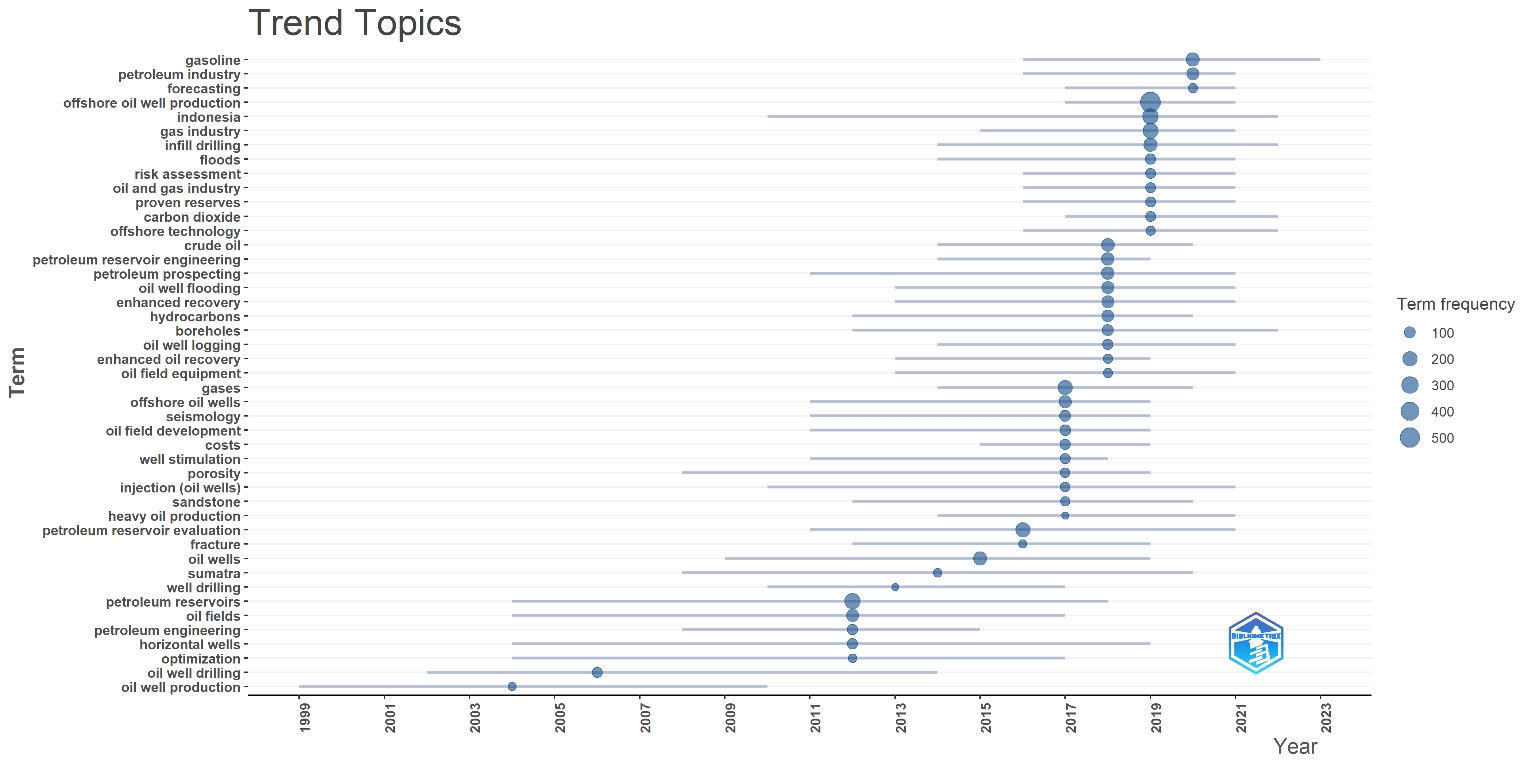
Figure 2 illustrates a shift in research topics from oil well production and drilling (in 1990 – 1999) to petroleum reservoirs, offshore oil well, infill drilling, heat exchanger, and enhanced recovery. For an example, Suhadi et al. (2023)88) investigate the degradation of structural integrity in refinery heat exchangers by examining how deposit-induced corrosion affects their tube walls.

Hartono et al. (2024)89) analyzed the impact of CO2 flooding on oil production and concluded that higher injection temperatures improve oil recovery, asphaltene, and resin fractions. One of the most frequently discussed topics is offshore oil well production, including exploration efforts in the offshore Southern Ardjuna Northwest Java basin90) and performance evaluation of electric submersible pumps in an offshore Natuna field91).
The top author is Rini Setiati, from the University of Trisakti, who contributed 41 articles since 2018. Rini's research encompassed various enhanced oil recovery techniques (e.g., terrafloc polymer, eco-enzyme, artificial neural networks), surfactants, and sandstone formation. The institution with the highest number of oil fuel publications is Bandung Institute of Technology (ITB) (431 articles), with two primary authors being Asep Kurnia Permadi and Taufan Marhaendrajana. Some of their publications analyzed oil well performance92), and the impact of CO2 injection/flooding89,93). The University of Indonesia (UI) ranks second with 257 articles, with the primary author being Abdul Haris, whose publications include reservoir and facies modeling94,95). Two other authors with significant contributions are from the University of Trisakti (USAKTI), one of whose publication topics is related to surfactants96–98).
4.1.2. Natural Gas
The topics of natural gas publications have experienced a trend shift from petroleum geology to infill drilling (2011 – 2017), to the use of machine learning (2023 – 2024) as shown in Figure 3. Examples are the application of machine learning to predict natural gas transmission pipeline failures99). Another important issue is to design efficient gas transportation mode, such as Budiyanto et al. (2024)100) who optimizes the principal hull dimensions of small-scale LNG carriers by applying spiral design theory to balance volume, mass, and linear dimensions. The top author is Semin from Sepuluh Nopember Institute of Technology (ITS) with 29 articles since 2008. Semin’s publications were mainly related to dual-fuel diesel engine, marine fuels, and lateral swirl combustion system101–103). The University of Indonesia (UI) and ITS lead in natural gas-related publications, with 178 and 149 articles respectively. Two top authors from UI are Widodo W. Purwanto and Nasruddin, whose research topics include the optimization of gas production104) and the conversion of CO2 from natural gas into chemicals and fuels105) as well as activated carbon106)
4.1.3. Coal
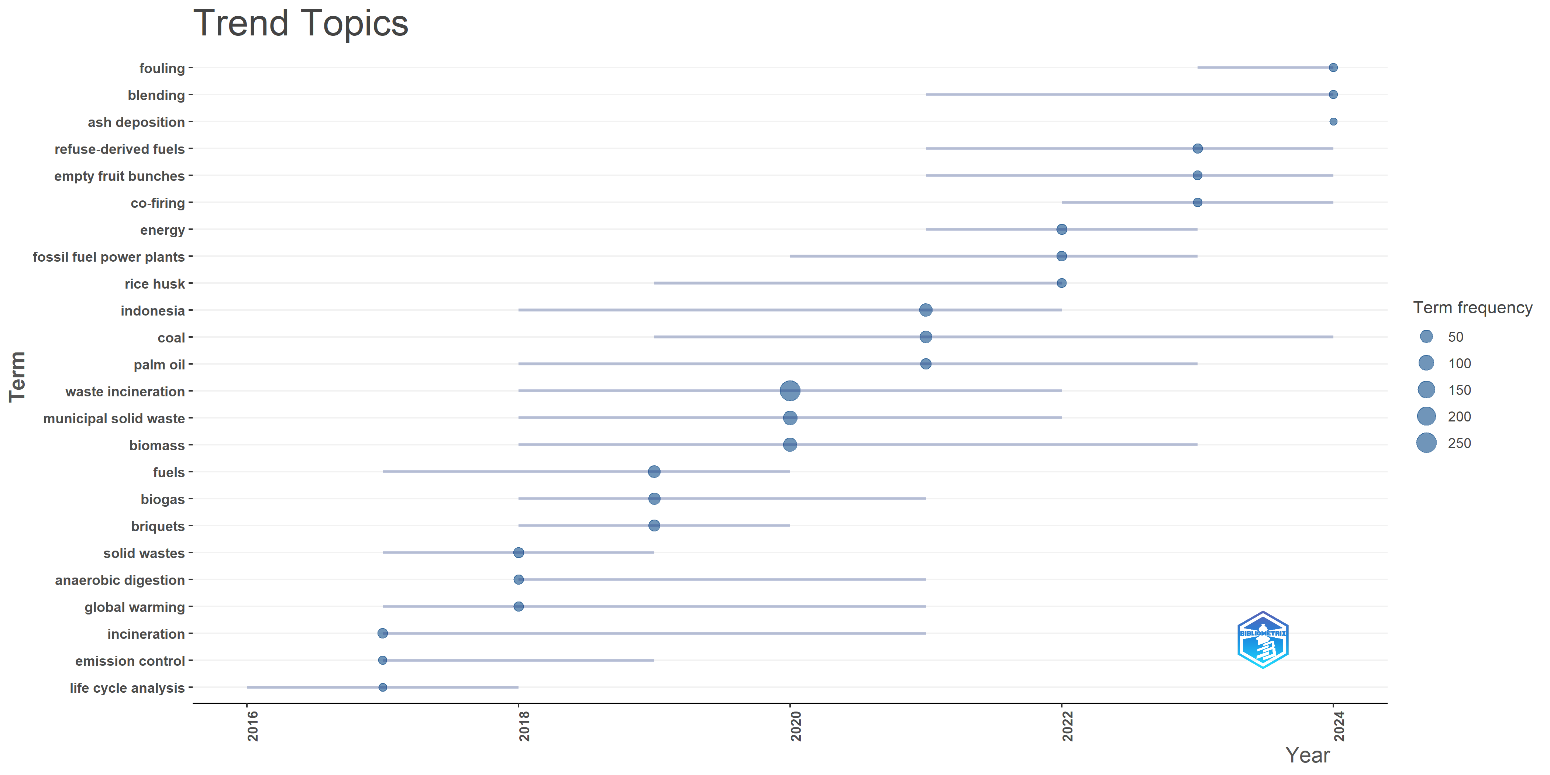
One of the publication topics that remains relevant from the 1990s is peat, as shown in Figure 4. Generally, the trend of publication topics has evolved from upstream issues, such as sedimentation107) and upgraded coal108), to coal combustion in coal-fired power plants, including co-firing with biomass and fouling issues109,110). Other frequently researched topics include the utilization of coal fly ash111) and coal deposits112). Yudha et al. (2024)113) developed a synthesis pathway for crystalline silicon (c-Si) from coal fly ash via carboxylic acid-assisted gel formation, producing high-purity Si suitable for lithium-ion battery anodes.


Additional investigations addressed the socio-economic and ecological multiplier effects of coal mining Sutriadi et al. (2024)114), as well as the structural strength and durability of flat carriage coal transporters115). Figure 4 also shows topics related to certain countries (such as Australia and Malaysia), indicating increased involvement of Indonesian researchers in analyzing coal issues in other countries116,117).
Coal research is led by the University of Gadjah Mada (UGM) and ITB, contributing 283 and 275 articles respectively. two top authors from UGM focus on topics such as fly ash118,119) and CO2 injection into coal reservoirs120). Another top author is Hariana from the National Research and Innovation Agency (BRIN) (43 articles since 2021). His publications focus on coal co-combustion and its issues, such as slagging, fouling, and other ash-related problems.
4.1.4. Nuclear
Figure 5 shows the trend of nuclear research. In the late 2010s, trending publication topics included heavy water and plutonium. Between 2017 and 2024, the most widely published topics focused on nuclear power plants and fuels, particularly gas-cooled reactors.
Juarsa et al. (2024) examined transient natural circulation flow, a critical mechanism during failures of active cooling systems in nuclear power plants. Meanwhile, Santosa et al. (2023) utilized the LEAP model to conduct a scenario analysis evaluating the potential role of nuclear power in advancing Indonesia’s net-zero emissions vision.
Nuclear-related publications are predominantly led by BRIN, with 247 articles. Their research topics encompass the assessment and enhancement of nuclear power plant safety. Additionally, Zaki Su’ud from ITB ranks first, contributing 18 articles since 2008. His research focuses on the design and optimization of small and long-life nuclear reactors, fuel recycling, fuel cycles, reactor safety and performance, thermal hydraulics and neutronics analysis, and integration with renewable energy systems.
4.2. Renewable Energy
The total number of articles analyzing renewable energy has reached 14,148, which is approximately 72.2% of the articles reviewed. Publication topics related to renewable energy have undergone significant transformations, as shown in Figures 6 to 13. This evolution reflects shifts in research priorities and advancements in technology and policies.
4.2.1. Solar Energy
The first solar energy publication in Indonesia was an analysis of solar radiation in Jakarta121). As shown in Figure 6, early solar energy publications focused on heat exchangers for absorption cooling systems122) and solar tunnel dryers123). The trend of publication topics then evolved to supporting components of solar energy systems, such as power converters124) and inverter125). Research trends in the past five years have centered on solar concentrators126) and improving the efficiency and performance of solar energy systems127).


Publications on the use of machine learning for solar energy applications have increased since 2022128). Other publication topics include hybrid floating photovoltaic systems129), PV rooftop systems130), incentive policies131), optimal sizing and placement of battery energy storage systems (BESS) in photovoltaic-rich networks132), and the feasibility of PV rooftop systems to reduce electricity subsidies133).
Publications related to solar energy are dominated by ITS (349 articles) and UI (312 articles). Meanwhile, the top authors in this field are Ahmad Fudholi (62 articles) from BRIN and Zainal Arifin (60 articles) from the University of Sebelas Maret (UNS). Publications by Ahmad Fudholi were mainly related to photovoltaic thermal134) and cooling systems135). Similarly, publications by Zainal Arifin were mainly related to photovoltaic thermal136), cooling systems137), and also hybrid solar-wind energy systems138).
4.2.2. Geothermal
The trend in geothermal publication topics in Figure 7 initially focuses on subduction139) and evolving to reservoir analysis140,141), geothermal field modeling142–144), geothermal silica145), and the Organic Rankine cycle146). Other publication topics include lithium recovery from geothermal brine147), geothermal potential map using remote sensing148), geothermal polygeneration149), projection uncertainty150), and socio-economics-environmental issues on geothermal developments151–153).
Three institutions dominate geothermal-related publications: ITB (398 articles), UI (241 articles), and UGM (241 articles). The top contributing author is Yunus Daud from UI with 52 articles mainly focusing on geochemistry154), and geological and structural characterization155). Leading authors from ITB are Heru Berian Pratama and Suryantini who focus on numerical reservoir simulation and optimization156), geological and structural characterization157), geochemistry and hydrothermal processes158), and resource assessment159).
4.2.3. Hydropower
Figure 8 shows the topic trends on hydropower publications. Topics that have remained relevant from 20 decades ago include small-scale hydropower160) and turbine technology development161,162). The topic of publications later evolved to large hydroelectric sustainability163) power plants, environmental impacts, water availability, climate change, and disaster risk assessment164,165). Other topics include the development and mapping of hydro energy potential166).
The National Research and Innovation Agency (BRIN) comprising the Indonesian Institute of Sciences (LIPI), the Agency for the Assessment and Application of Technology (BPPT), and the Indonesian Space Agency (LAPAN) leads in hydropower-related publications, with a total of 79 articles. Among BRIN’s contributors.
Pudji Irasari and Anjar Susatyo have each authored nine publications, covering topics such as feasibility studies167,168), water vortex turbines161), permanent magnet generators169), watershed management170,171), and satellite-based site selection for hydropower development172). The most prolific individual author is Syamsul Hadi from Universitas Sebelas Maret (UNS), with 12 articles focusing on various water turbine technologies, including horizontal axis turbines173), Savonius turbines174), and Vortex turbines175).
4.2.4. Bioenergy
Publication topics in bioenergy in Figure 9, initially focused on jatropha in the early 2010s176), reaching a peak with topics such as biodiesel, biogas, ethanol, biomass, and palm oil from 2017 – 2022. The most impactful article (2,504 citations) discusses three methods to reduce oxygen content in carbohydrates in biomass: removal of small oxidized carbon molecules, hydrogenolysis, and


dehydration177). Other bioenergy publication topics include performance analysis of diesel power plants using a 30% biodiesel and 70% high-speed diesel blend178) and crude palm oil179) as well as the importance of biofuels for energy supply security180). Emerging topics include carbon sequestration based on microalgae181) and tree182), biofuel production 183), and biogas system183).
Universitas Gadjah Mada (UGM) leads bioenergy-related research in Indonesia, contributing 814 publications. Among its most prolific researchers is Arief Budiman, with 73 publications on biodiesel production from a variety of feedstocks, including algae184), biogas185), bio-avtur fuel186), and biomass187). The University of Diponegoro (UNDIP) ranks second with 674 publications, led by two prominent authors: Hadiyanto (81 publications) and Widayat (67 publications). Hadiyanto has contributed extensively to research on biodiesel production188), and catalytic processes189). Additional notable topics include the use of microalgae as biodiesel feedstock190), waste-to-energy conversion191), life cycle and energy assessments192), and the application of machine learning to optimize engine performance for bioenergy use193). Notably, the most prolific author is Arridina Susan Silitonga from Medan State Polytechnic, with 82 publications focusing on biodiesel and bioethanol production from diverse feedstocks—such as rice bran oil194) and Reutealis Trisperma oil195) —as well as on engine performance when utilizing biofuels196).
4.2.5. Waste to Energy
Figure 10 illustrates a shift in waste-to-energy research trends, from life cycle analysis (LCA) toward refuse-derived fuel (RDF) applications. For instance, Sari et al. (2024)197) employed LCA to compare the environmental impacts of unmanaged landfills with five waste-to-energy technologies. Meanwhile, Farahdiba et al. (2024)198) conducted material flow analysis (MFA) to illustrate food waste steam to energy recovery facilities. Research on RDF spans various topics, including feedstock trials199), supply chain assessments200), and policy lessons from countries with successful RDF implementations201). The most frequently discussed topic is incineration with studies addressing incinerator design202), performance evaluations203), emissions characteristics204), and the integration of Internet of Things (IoT) technologies205). Among institutions, the University of Diponegoro (UNDIP) leads with 78 publications, although none of the top contributing authors are affiliated with UNDIP. BRIN, including its predecessors LIPI and BPPT, ranks second with 58 publications. The most prolific author in this field is Muhammad Aziz from the University of Tokyo, who frequently collaborates with two leading BRIN researchers. Their work predominantly focuses on the co-firing of solid waste with coal206–208), positioning them as key contributors to both waste-to-energy and coal-related research. Other notable authors hail from the University of Pertamina and Universitas Sebelas Maret (UNS), often collaborating on RDF-related studies197).
4.2.6. Wind Energy
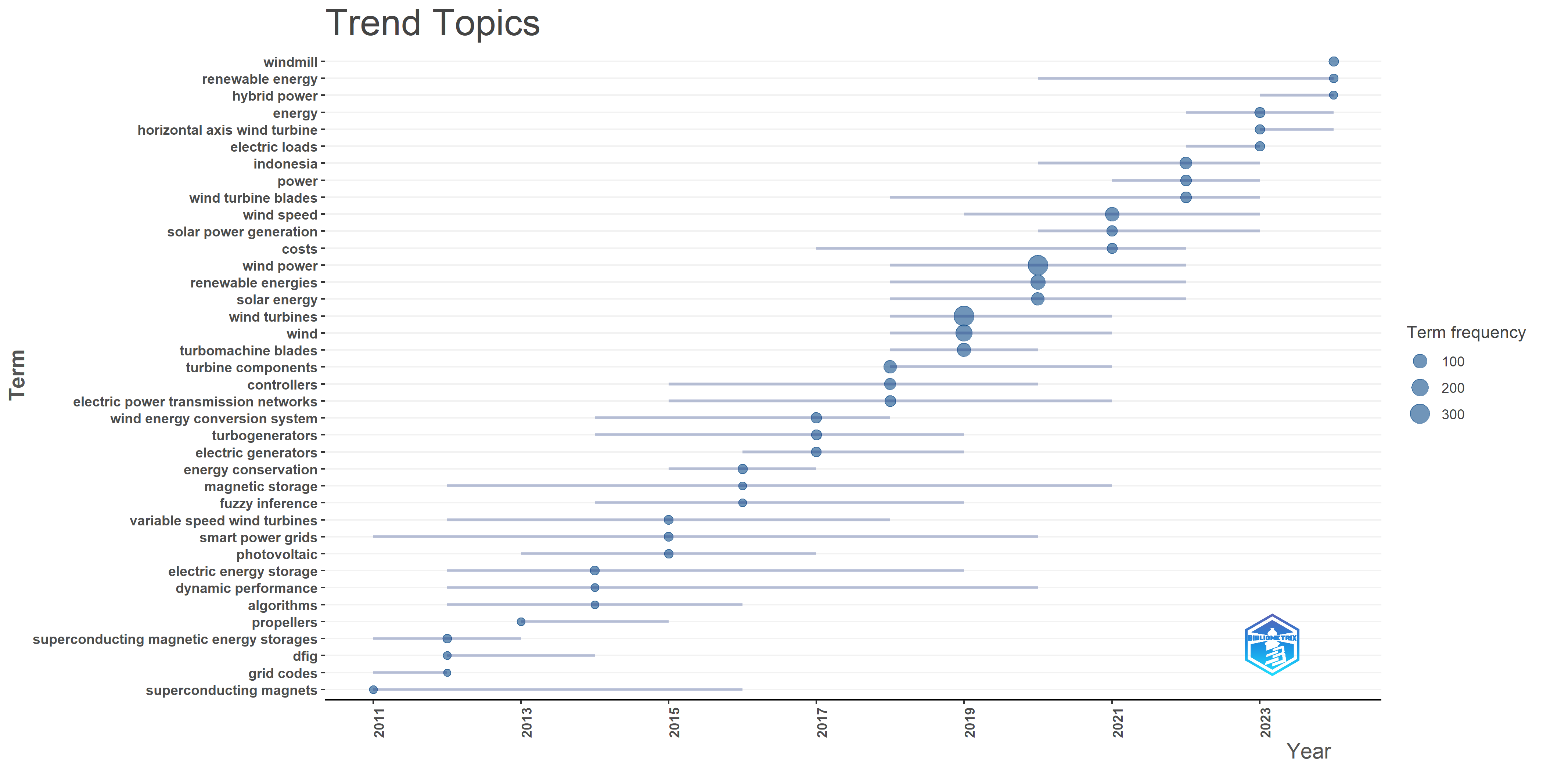
Figure 11 highlights evolving trends in wind energy research. Between 2011 and 2015, key topics included superconducting magnets209), propeller systems210), and smart power grid211). From 2018 to 2021, the focus shifted toward wind turbines212). Since 2020, emerging areas of interest have included wind turbines213,214), windmills215), and hybrid systems138). Additional growing topics include wind energy potential mapping216,217), power plant

expansion218), and the application of wind energy for hydrogen production219).
The Institut Teknologi Sepuluh Nopember (ITS) leads in wind energy publications, contributing 178 articles and featuring three authors among the top contributors. Mochamad Ashari and Soedibyo have explored control systems to stabilize electricity production from variable renewable energy220) and developed multi-input DC-DC converters221,222). Ratna Ika Putri has also focused on control systems for optimizing hybrid renewable energy, including the design of multi-input SEPIC converters223).
The most prolific author is Dominicus D.D.P. Tjahjana from Universitas Sebelas Maret (UNS), whose research emphasizes both electrical and mechanical components, such as turbines212,224), flat winglet deflector138), and generator138,225). Another prominent contributor is Langlang Gumilar from Malang State University (UM), whose work focuses on wind turbine inertia and pitch angle control226,227).
4.2.7. Ocean Energy
Figure 12 illustrates that ocean-energy research over the past decade has coalesced around three primary themes: wave energy (2017 – 2020), marine current energy (2017 – 2024) and tidal power (2019 – 2024). Wave-energy studies have spanned technology design228,229); numerical modelling and experimental studies230,231); resource-potential assessments232,233); stability and control systems234,235); integration and policy frameworks236,237), oceanography characterization238); and education and dissemination239). Marine-current research has focused on blade design240), mooring systems241,242), prototype testing243,244), as well as self-starting and pitch mechanisms245). Tidal-power publications similarly center on turbine design and augmentation, material innovations, blade configurations and performance optimization246–248).
Leading institutions in this field include Institut Teknologi Sepuluh Nopember (ITS), which accounts for 70 publications. Its three most prolific authors Mukhtasor (19 publications), Dendy Satrio (18), and I. Ketut Aria Pria Utama (12) together with Erwandi (11) from BRIN, have driven advances in vertical-axis tidal current turbines249,250), cross-flow Savonius turbine251), straight-bladed hydrokinetic turbine252), and ocean thermal energy conversion252). Another key contributor is Nining Sari Ningsih of Institut Teknologi Bandung (ITB), whose work maps wave-energy potential at diverse coastal sites253).

4.2.8. Other Renewable Energy
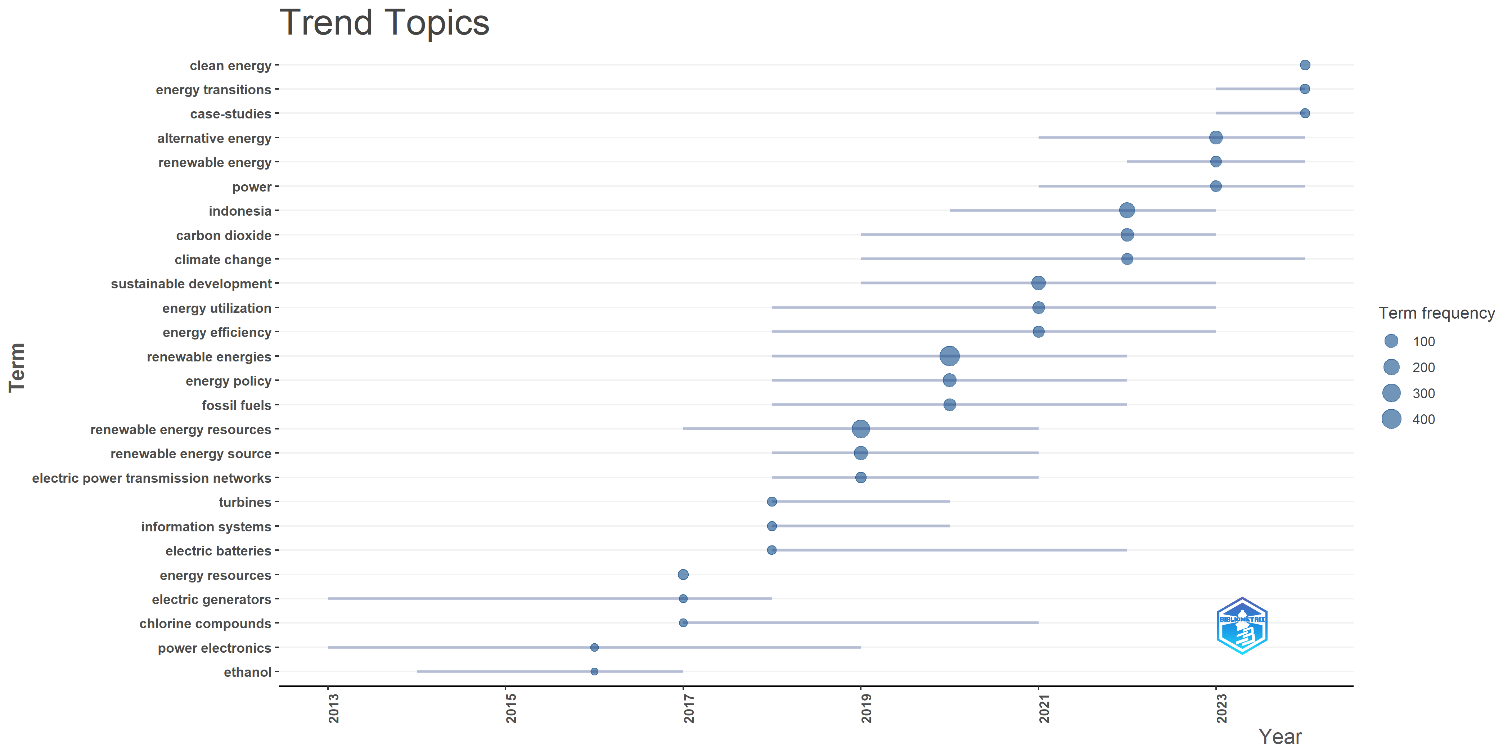
Publications related to renewable energy, in general, do not contain keywords for Sections 4.2.1 through 4.2.7. However, publications in these sections may include those categorized under Other Renewable Energy. Figure 13 shows that the most prominent trend—particularly from 2017 to 2020—is the assessment of renewable energy resources. Notable examples include studies on wave energy potential in the Natuna Islands (Idris and Gammaranti, 2018) the energy potential of Calophyllum inophyllum254). Additional topics span energy policy modeling83), plastic-to-liquid fuel conversion255), energy storage materials256,257), and sustainable development258). Since 2019, there has also been growing attention to the role of renewable energy in decarbonizing the energy sector259,260).
Leadership in this publication category is held by Universitas Gadjah Mada (UGM) with 172 articles, followed by Universitas Indonesia (UI) with 162. UGM’s leading contributors include Sarjiya (34 articles since 2012), Lesnanto Multa Putranto (21 since 2018), and Sasongko Pramono Hadi (15 since 2012), with research covering renewable energy integration in power systems261,262), expansion planning263), system reliability264,265), as well as environmental and policy implications266). Miguel Angel Esquivias of Universitas Airlangga (UNAIR) ranks third with 16 publications since 2022, focusing on energy and environmental economics267,268). Another notable contributor is Arif Nur Afandi from Universitas Negeri Malang (UM), whose work centers on power quality evaluation for renewable plants213) and power system modelling269).
4.3. Most Impactful Paper
Table 3 highlights the most impactful publications across various energy sources. In the oil sector, Peters et al. (1999)270) conducted geochemical analyses of 27 crude oil samples from eastern Indonesia, distinguishing Tertiary- and Triassic–Jurassic-sourced oils based on latitude and depositional environments. Their findings indicate that Tertiary oils—primarily from Irian Jaya and Sulawesi—originate from suboxic marlstones and account for 16% of the region’s recoverable reserves.
In natural gas research, Khalil et al. (2017)271) discussed the design, applications, and challenges of using advanced nanomaterials in the oil and gas industry. As a result, Khalil et al. (2017) identified key deployment barriers such as particle aggregation, instability in harsh conditions, and limited knowledge of nanoparticle transport mechanisms.
In the coal domain, Wibowo et al. (2007)272) used a coal-based activated carbon F-400 to analyze the influence of surface chemistry and solution pH on the adsorption of benzene and toluene. They demonstrated that thermal treatment enhances carbon basicity and dispersive interactions, yielding the highest adsorption performance, especially under varied pH conditions.
In nuclear publications, Purba et al. (2014)273) explored the development of a fuzzy reliability algorithm to estimate failure probabilities in nuclear power plants where quantitative historical data is unavailable. By converting expert linguistic evaluations into fuzzy numbers, the proposed algorithm enables qualitative estimation of basic event failure probabilities, demonstrating strong agreement with actual failure data.
Gonzalez-Pedro et al. (2014)274) presented a detailed investigation into the underlying mechanisms governing CH₃NH₃PbX₃ perovskite solar cells, revealing that both
compact thin films and nanostructured configurations share a common photovoltaic operation dominated by the perovskite absorber. Moreover, the research results are useful to establish a comprehensive model of the optimal working process of perovskite solar cells.
In geothermal publications, Herdianita et al. (2000)275) discussed temporal changes in the mineralogy and texture of 29 silica sinter samples ranging from modern to Miocene age. Over time, silica sinter undergoes crystallization from opal-A to opal-C, and finally to microcrystalline quartz, displaying an aging profile that can serve as a guide for understanding the paleohydrology of geothermal systems.
Hasan et al. (2012)276) assessed Indonesia’s energy landscape, highlighting a continued dependence on fossil fuels despite the nation's vast renewable energy potential, including hydro power. Thus, Hasan et al. (2012) emphasized the urgent need for more proactive, collaborative action across government, institutions, and the public to ensure long-term energy security and environmental resilience.
Van Putten et al. (2013)177) discussed hydroxymethylfurfural (HMF) as a pivotal bio-based platform chemical derived from hexose dehydration, with significant potential for conversion into fuels and value-added chemicals. They emphasized persistent challenges in scaling up to economically viable industrial processes particularly those based on glucose or lignocellulosic feedstocks due to HMF's instability and the complexity of separation and recycling systems.
In waste-to-energy publications, Nizami et al. (2017)277) explored the transformative role of waste biorefineries in advancing circular economies within developing countries, where unmanaged waste can become a valuable feedstock for energy and material recovery.
In wind energy publications, Tjiu et al. (2015)278) comprehensively evaluated Darrieus vertical axis wind turbine configurations, tracing their evolution from early curved-blade designs with guy-wires to modern cantilevered structures. Tjiu et al. (2015) highlighted how contemporary variants—such as Helical and Tilted H-rotors—offer improved reliability and lower energy costs.
In ocean energy publications, Sprintall et al. (2010)279) provides definitive observational evidence of the South Java Current (SJC) and its deeper undercurrent (SJUC) flowing eastward through the Savu Sea into the Ombai Strait. Drawing on three years of moored velocity data, it distinguished the mechanisms driving surface and subsurface currents, including Kelvin waves, Ekman dynamics, monsoonal shifts, and regional topographic influences.
In other renewable energy publications, Erdiwansyah et al. (2021)280) evaluated the complex integration of variable renewable energy (VRE) sources—like wind, solar, and hydro—into modern power systems, emphasizing both the
Table 3: A summary of most impactful papers
| Sectors | Articles (citations) | Topics |
|---|---|---|
| Oil fuel | Peters et al. (1999) (235) | Geochemistry of crude oils270) |
| Natural gas | Khalil et al. (2017) (235) | Advanced nanomaterials271) |
| Coal | Wibowo et al. (2007) (301) | Coal-based activated carbon272) |
| Nuclear | Purba et al. (2014) (94) | Failure probabilities273) |
| Solar energy | Gonzalez-Pedro et al. (2014) (802) | Perovskite solar cells274) |
| Geothermal | Herdianita et al. (2000) (232) | Silica sinter275) |
| Hydropower | Hasan et al. (2012) (221) | Energy supply276) |
| Bioenergy | Van Putten et al. (2013) (2,504) | Hydroxymethylfurfural (HMF)177) |
| Waste to Energy | Nizami et al. (2017) (433) | Waste biorefineries277) |
| Wind Energy | Tjiu et al. (2015) (227) | Darrieus vertical axis wind turbine278) |
| Ocean Energy | Sprintall et al. (2010) (61) | Current system279) |
| Other Renewable Energy | Erdiwansyah et al. (2021) (330) | The integration of renewable energy280) |
technical challenges and potential technological solutions. By proposing a structured matrix of solutions tailored to specific integration barriers, the study offers a roadmap for improving system reliability, economic viability, and policy transparency in the global transition to sustainable energy.
5. Discussions
The trends in energy supply publication topics continue to evolve. Table 4 divides these topics into four quadrants based on the number of themes (referred to as density or development degree) on the y-axis and the correlation of these themes with other topics (referred to as centrality or relevance degree) on the x-axis. The four quadrants provide a strategic framework for identifying areas of strength and opportunity within the field. By fostering connections between niche and motor themes, revitalizing emerging or declining topics, and innovating within basic themes, the renewable energy sector can enhance its overall impact and contribute to a more self-sufficiency energy future.
5.1. Motor Themes
Themes in this quadrant exhibit high density and interconnectivity, indicating that they have developed rapidly and are closely linked to various other studies. These themes play a key role in the energy transition and innovation
One example in this category is biomass and biogas, which
Table 4: Thematic publication map
| Niche themes | Motor themes | |
|---|---|---|
| Development degree (density) | Oil fuel: diesel engines and fuels | Oil fuel: gases, gasoline |
| Natural gas: - | Natural gas: carbon dioxide, natural gasoline plants | |
| Coal: deposits, mines, mining, fly ash, coal ash, soils | Coal: - | |
| Solar energy: dry-sensitized solar cells, titanium dioxide, semiconductor | Solar energy: energy policy, power transmission networks | |
| Geothermal: - | Geothermal: fields, systems | |
| Hydropower: electronic load controller, load management, sustainable development | Hydropower: - | |
| Bioenergy: activated carbon, carbonization, supercapacitor | Bioenergy: biomass, biogas, biofuels | |
| Waste to energy: incineration process, circular economy, plastic bottles | Waste to energy: municipal solid waste, sustainable development | |
| Wind energy: asynchronous generators, turbogenerator, electric fault currents, controllers, dc-dc converters, permanent magnets | Wind energy: solar energy | |
| Ocean energy: energy conversion, electric generators | Ocean energy: Indian ocean, current and flow velocity | |
| Other renewables: alternative energy, carbon dioxide | Other renewables: resources, source, power | |
| Nuclear: small modular reactors, nano particles, scanning electron microscopy, x-ray diffraction | Nuclear: fast reactors, reactors, fuels, nuclear power plants, cesium | |
| Emerging or declining themes | Basic themes | |
| Oil fuel: crude oils, oil well flooding, enhanced recovery, offshore well production, gas industry, cost | Oil fuel: petroleum reservoirs and their evaluations, oil wells | |
| Natural gas: gases, gas industry | Natural gas: - | |
| Coal: - | Coal: power plants, carbon dioxide, combustion, coal industry | |
| Solar energy: PV systems, maximum power point trackers, inverters, efficiency, performance, | Solar energy: power generation, PV cells | |
| Geothermal: power plants | Geothermal: - | |
| Hydropower: - | Hydropower: fossil fuels, solar energy, energy policy, power plants | |
| Bioenergy: ethanol, bioethanol, fermentation, biodiesel, catalyst | Bioenergy: palm oil, diesel engines | |
| Waste to energy: briquets, combustion, fly ash | Waste to energy: waste incineration, biomass, calorific value | |
| Wind energy: turbomachine blade, turbine components, computational fluid dynamics | Wind energy: sources/ resources, power transmission networks, turbines | |
| Ocean energy: simulation | Ocean energy: ocean currents, tidal power, waves, wave energy conversion | |
| Other renewables: calorific values, hydroelectric power plants, turbomachine blades | Other renewables: sustainable development | |
| Nuclear: zirconium alloys, linear calibration, zircaloy, safety engineering, fault tree analysis, probabilistic safety assessment | Nuclear: power plant sites, risk assessment, nuclear energy | |
| Relevance degree (Centrality) | ||
are central topics in bioenergy research. Studies in this field cover various aspects, from raw material optimization and improving energy conversion efficiency to integration with energy storage technologies and distribution systems. Biomass and biogas serve as crucial solutions for diversifying renewable energy sources and reducing dependence on fossil fuels281). Additionally, the development of renewable energy-based power grid systems is also a critical driving theme, considering the need for more flexible and reliable systems to support the integration of renewable energy into the national grid.
The dominance of biomass and biogas as motor themes directly aligns with Indonesia's national biofuel policy (B30/B35) and its vast agricultural resources. This reflects a successful alignment of research with policy and economic opportunity, contributing directly to SDG 7 (Affordable and Clean Energy) and SDG 9 (Industry, Innovation, and Infrastructure). However, the focus on combustion and conversion efficiency suggests research must now also intensify on sustainability aspects (SDG 12: Responsible Consumption and Production) to ensure long-term viability
As a driving theme, research in this field tends to be the primary driver for technological and energy policy advancements, thereby accelerating the transformation of Indonesia's energy system toward greater sustainability and self-sufficiency. This quadrant does not include publications on coal and hydropower, indicating that while these energy sources are still widely used, they are not currently at the forefront of innovation in energy research.
5.2. Niche Themes
This quadrant includes themes with high density but low connectivity to other research areas. This indicates that while these topics have been extensively studied, they remain specific and have not been widely integrated into broader energy research.
Some themes in this category include carbon-based supercapacitors in bioenergy (e.g., Diantoro et al., 2024a282)) and the use of titanium dioxide microparticles to prevent dust accumulation on solar panels (e.g., Syafiq et al., 2024283)). These topics have undergone in-depth research but have not yet been significantly integrated with other themes in the energy sector.
Although still specific, these themes have the potential to expand if linked to more applied research. For example, the development of biomass-based supercapacitors could be connected to energy storage technologies284), while innovations in solar panel cleaning could contribute to improving solar power plant efficiency283). Therefore, research in these fields could further develop if supported by cross-disciplinary collaboration.
However, this quadrant does not include publications on natural gas and geothermal energy, indicating that while these energy sources hold significant potential in Indonesia’s energy mix, related research is more interconnected with other themes and does not fall into a highly specific niche category. This suggests that natural gas and geothermal energy have already established broader research networks and are not confined to a particular specialized scope.
5.3. Emerging or Declining Themes
Themes in this quadrant have low density and connectivity, indicating that they are either in the early stages of development or are being phased out. This could be due to various factors, such as changes in energy policies, technological limitations, or a lack of investment supporting further research.
One example in this category is offshore oil well production, which, although still a subject of research, has been declining as energy policies shift toward energy transition and reducing dependence on fossil fuels. In many countries, including Indonesia, the government and industry sectors are beginning to focus more on renewable energy and energy efficiency as part of efforts to achieve decarbonization and net-zero emissions targets285). This shift has made research on offshore oil exploration and production less relevant compared to previous decades.
Additionally, some studies on nuclear energy utilization are still in the early exploratory stages in Indonesia. Although nuclear energy holds significant potential as a long-term clean energy source, regulatory challenges, safety concerns, and investment constraints remain major obstacles to its development286,287). As a result, research in this field remains sporadic and has not yet become a primary focus in national energy policy. If stronger policy support and investment in safe and efficient nuclear technology emerge, this theme could become more significant in the future.
Interestingly, this quadrant does not include research on coal and hydropower. This suggests that these energy sources are no longer classified as emerging or declining themes but have instead secured a more established position in energy research. Coal, despite remaining a dominant energy source in Indonesia, is increasingly discussed in the context of efficiency, co-firing with biomass, and decarbonization strategies, meaning it does not fall under the category of emerging or declining themes. This indicates that research on coal has already built a strong foundation and is more integrated with other topics, such as energy transition and carbon emission reduction.
Meanwhile, hydropower is also absent from this category, which could indicate that hydropower technology and research are already mature and have broader connections with other renewable energy studies. However, it may also suggest that hydropower research in Indonesia is stagnating, with little new innovation to place it in the emerging themes category. Given the increasing demand for clean energy, Indonesia still holds vast potential for hydropower development, particularly in small-scale and micro-hydro power plants, which are more suitable for remote areas. If research and investment in hydropower technology are enhanced, this theme could regain prominence in national energy research.
5.4. Basic Themes
The Basic Themes quadrant includes topics with high connectivity but still low density, indicating that these topics have broad relevance in energy research but remain underexplored in-depth. Themes in this category serve as foundational elements for energy technology development but have not yet become a primary focus in national energy research.
One key example in this category is ocean currents, tidal energy, and wave energy conversion. Although marine energy holds significant potential as a renewable energy source in Indonesia288,289), research in this field remains relatively limited. Ocean energy conversion technologies, such as tidal turbines and wave energy systems, are still in the early stages of development and have yet to be integrated into the national power grid. The main challenges in this research include high technology development costs, limited supporting infrastructure, and a lack of investment in research and innovation. The classification of ocean energy as a 'basic theme' is high relevance but low development highlights a critical strategic gap. Indonesia, as the world's largest archipelago, possesses immense ocean energy potential, yet research remains nascent. Prioritizing investment and international collaboration in this area is not just a research imperative but a national strategic one to enhance energy security (SDG 7) and build climate resilience (SDG 13).
Additionally, themes in this quadrant require greater attention to ensure that research in these areas progresses and contributes to the national energy system. With further support from the government, industry, and academic collaborations, research in this field could serve as a foundation for future energy innovations. Developing policies that support marine energy exploration, including incentives for industries and research partnerships with international institutions, could accelerate the adoption of these technologies in Indonesia.
Interestingly, this quadrant does not include natural gas and geothermal topics. There are several possible reasons for their absence from this category. Natural gas already has a well-established research ecosystem and has been integrated into various energy studies. Research on natural gas is typically not considered a "basic theme" but is more often linked to energy transition, emissions reduction, and integration with renewable energy. Additionally, natural gas research tends to focus on technical aspects such as exploration and production optimization, efficient utilization, and liquefied natural gas (LNG) processing technologies. As a result, natural gas is more likely to be found in research categories that are already well-developed or undergoing transformation, rather than as a basic theme still in its early exploration stages.
Meanwhile, geothermal energy is also absent from the Basic Themes category because Indonesia already has extensive research and experience in geothermal exploration and utilization. As one of the world's largest geothermal energy producers290,291), research in this field has advanced further and is well-integrated into national energy policies. Current geothermal research focuses more on resource optimization, drilling technology, improving energy conversion efficiency, and co-generation potential (using waste heat for purposes beyond electricity generation). Therefore, geothermal research has already established a strong foundation and is no longer categorized as a basic theme requiring extensive new exploration.
5.5. Collaboration
Collaboration with institutions in other countries helps in determining research topics. Table A.3 in the Appendix shows that the frequency of collaboration with foreign institutions has reached 1,735 times. Foreign partners mainly come from Malaysia (23%), Japan (15%), and China, USA, and Australia, each about 7%. Publications with partners from Malaysia generally relate to natural gas, wind energy, solar energy, hydro power, bioenergy, waste-to-energy, and other renewable energy. Partners from Japan are usually involved in coal, nuclear, and geothermal publications, while partners from the USA often collaborate on oil and ocean energy publications. These partnerships are not limited to universities but also include industries. For an example, Texaco Energy Technology has several publications with its subsidiary in Indonesia292). Domestic companies have also been significantly involved in research and publications, such as the use of bleaching earth to improve the performance of biodiesel-cooking oil plants293).
To enhance energy research collaboration with international partners, a more proactive strategy is needed to expand academic and industrial networks, increase funding schemes, and simplify regulations for cross-border research. Moreover, research in Indonesia should be aligned with globally relevant issues that attract foreign collaborators, such as energy transition, energy storage technologies, and industrial decarbonization, to encourage greater international participation in research partnerships.
5.6. Implications for Policy and Research
The bibliometric trends offer clear, data-driven guidance for Indonesian policymakers and research institutions. Firstly, the success in bioenergy research should be leveraged, with policies encouraging cross-institutional collaboration to address sustainability challenges. Secondly, the significant potential in solar and geothermal is not fully matched by research density, suggesting a need for targeted funding and public-private partnerships to overcome technical and economic barriers to deployment. Thirdly, the 'basic themes' of ocean, wind, and advanced nuclear technologies represent strategic frontiers. Establishing national research consortia with international partners from Japan, the USA, and Australia (as shown in our collaboration analysis) could accelerate development in these high-potential but underexplored areas. Finally, achieving energy self-sufficiency requires integrating these research strands into a coherent national energy innovation strategy that explicitly links research outputs to the targets of the Sustainable Development Goals.
6. Conclusions
Our study provides the first comprehensive bibliometric map of Indonesia's energy supply research, revealing a dynamic and specialized landscape rapidly shifting towards renewable energy. The analysis demonstrates that no single institution holds a monopoly on expertise; instead, a distributed network of universities and research agencies drives progress in specific domains. This presents both a challenge and an opportunity for coordinated national action.
Based on our findings, we propose three actionable recommendations:
Foster Strategic Collaboration: The government should establish a national energy research and innovation council to facilitate partnerships between leading institutions (e.g., ITB in geothermal, UGM in bioenergy, ITS in ocean energy) and the private sector, focusing on translating research into deployable technologies.
Prioritize Underfunded Frontiers: National research grants should be strategically allocated to develop 'basic themes' with high strategic relevance, particularly ocean current and wave energy, where Indonesia's natural endowment is unmatched but research is sparse.
Enhance International Linkages: Building on existing ties with Malaysia and Japan, Indonesia should proactively seek research partnerships with countries leading in specific technologies (e.g., Denmark for wind, Germany for solar storage) to fast-track technological learning and innovation.
By adopting a more integrated and strategic approach to energy R&D, informed by this bibliometric landscape, Indonesia can better leverage its intellectual capital to achieve energy self-sufficiency and secure a sustainable, resilient energy future. Future research should incorporate non-Scopus publications, project data, and analysis of energy storage and conservation to provide an even more complete picture.
Acknowledgments
We gratefully acknowledge the invaluable contributions of our colleagues who enriched the development of this work through thoughtful discussions, critical feedback, and technical assistance.
References
- U.K. Pata, S. Karlilar, and M.T. Kartal, “On the road to sustainable development: the role of ICT and R&D investments in renewable and nuclear energy on energy transition in Germany,” Clean Technol. Environ. Policy, 26 (7) 2323–2335 (2024). doi:https://doi.org/10.1007/s10098-023-02677-y. [DOI]
- F.F. Liza, F. Ahmad, L. Wei, K. Ahmed, and A. Rauf, “Environmental technology development and renewable energy transition role toward carbon-neutrality goals in G20 countries,” Clean Technol. Environ. Policy, 26 (10) 3369–3390 (2024). doi:https://doi.org/10.1007/s10098-024-02804-3. [DOI]
- J. Li, Z. Liu, X. Li, and N. Guo, “Research on the low-carbon effect of technological innovation,” Clean Technol. Environ. Policy, 26 (9) 3127–3149 (2024). doi:https://doi.org/10.1007/s10098-024-02787-1. [DOI]
- A. Swain, C. Bruch, T. Ide, P. Lujala, R.A. Matthew, E. Weinthal, and T. Deligiannis, “The US withdrawal from the Paris agreement—implications for global climate governance and security,” Environ. Secur., 3 (1) 3–7 (2025). doi:https://doi.org/10.1177/27538796251322680. [DOI]
- F. Groba, and J. Cao, “Chinese renewable energy technology exports: the role of policy, innovation and markets,” Environ. Resour. Econ., 60 (2) 243–283 (2015). doi:10.1007/s10640-014-9766-z.
- T.N. Do, P.J. Burke, H.N. Nguyen, I. Overland, B. Suryadi, A. Swandaru, and Z. Yurnaidi, “Vietnam’s solar and wind power success: policy implications for the other asean countries,” Energy Sustain. Dev., 65 1–11 (2021). doi:https://doi.org/10.1016/j.esd.2021.09.002. [DOI]
- MEMR, “Handbook of energy & economic statistics of indonesia 2023,” (2024). https://www.esdm.go.id/en/publication/handbook-of-energy-economic-statistics-of-indonesia-heesi.
- A.P. Muyasyaroh, “Rethinking energy security in indonesia from a net zero perspective,” Indones. J. Energy, 7 (1) 16–26 (2024). doi:https://doi.org/10.33116/ije.v7i1.197. [DOI]
- A. Soemanto, and R.H.T. Koestoer, “Scenario insight of energy transition,” Indones. J. Energy, 6 (1) 48–59–48–59 (2023). doi:https://orcid.org/0000-0003-1701-0419.
- T.W.S. Panjaitan, A.H. Pandyaswargo, T.D. Atmaja, F.A. Firman, and M.I. Al Irsyad, “Drawing insights from Japan’s energy efficiency policies for Indonesia’s progress,” Indones. J. Energy, 7 (2) 107–123 (2024). doi:https://doi.org/10.33116/ije.v7i2.212. [DOI]
- M.I. Al Irsyad, A. Halog, R. Nepal, and D.P. Koesrindartoto, “The impacts of emission reduction targets in Indonesia electricity systems,” Indones. J. Energy, 2 (2) 118–130 (2019). doi:https://doi.org/10.33116/ije.v2i2.42. [DOI]
- L. Li, “Reskilling and upskilling the future-ready workforce for industry 4.0 and beyond,” Inf. Syst. Front., 26 (5) 1697–1712 (2024). doi:https://doi.org/10.1007/s10796-022-10308-y. [DOI]
- X. Lyu, T. Ruan, W. Wang, and X. Cai, “A bibliometric evaluation and visualization of global solar power generation research: productivity, contributors and hot topics,” Environ. Sci. Pollut. Res., 31 (5) 8274–8290 (2024). doi:https://doi.org/10.1007/s11356-023-31715-x. [DOI]
- M.H. Abdul Jabar, R. Srivastava, N. Abdul Manaf, S. Thangalazhy-Gopakumar, F.E. Ab Latif, M.T. Luu, and A. Abbas, “The solar end game: bibliometric analysis, research and development evolution, and patent activity of hybrid photovoltaic/thermal—phase change material,” Environ. Sci. Pollut. Res., 30 (55) 116934–116951 (2023). doi:https://doi.org/10.1007/s11356-023-27641-7. [DOI]
- S. Afrane, J.D. Ampah, and E.A. Mensah, “Visualization and analysis of mapping knowledge domains for the global transition towards clean cooking: a bibliometric review of research output from 1990 to 2020,” Environ. Sci. Pollut. Res., 1–28 (2022). doi:https://doi.org/10.1007/s11356-021-17340-6. [DOI]
- Y. Yu, K. Chen, J. Liao, and W. Zhu, “Detecting the research trends and evolution of energy resilience: a bibliometric analysis,” Environ. Sci. Pollut. Res., 30 (8) 21797–21814 (2023). doi:https://doi.org/10.1007/s11356-022-23768-1. [DOI]
- K. Liang, W. Li, J. Wen, W. Ai, and J. Wang, “Research characteristics and trends of power sector carbon emissions: a bibliometric analysis from various perspectives,” Environ. Sci. Pollut. Res., 30 (2) 4485–4501 (2023). doi:https://doi.org/10.1007/s11356-022-22504-z. [DOI]
- S. Afrane, J.D. Ampah, and E.M. Aboagye, “Investigating evolutionary trends and characteristics of renewable energy research in Africa: a bibliometric analysis from 1999 to 2021,” Environ. Sci. Pollut. Res., 29 (39) 59328–59362 (2022). doi:https://doi.org/10.1007/s11356-022-20125-0. [DOI]
- Y. Zhang, Q. Yu, and J. Li, “Bioenergy research under climate change: a bibliometric analysis from a country perspective,” Environ. Sci. Pollut. Res., 28 26427–26440 (2021). doi:https://doi.org/10.1007/s11356-021-12448-1. [DOI]
- Z. Wang, Y. Wang, S. Peng, B. Niu, C. Cui, and J. Wu, “Mapping the research of energy subsidies: a bibliometric analysis,” Environ. Sci. Pollut. Res., 26 28817–28828 (2019). doi:https://doi.org/10.1007/s11356-019-06025-w. [DOI]
- R. Rachmad, M.I. Irawan, and S. Hanoum, “Renewable energy and carbon trading: A bibliometric analysis,” in: AIP Conf. Proc., AIP Publishing, 2024. doi:https://doi.org/10.1063/5.0235602. [DOI]
- R. Suciati, S. Hidayati, and A.A.S. Mashuri, “Green finance’s impact on renewable energy: a comprehensive review and bibliometric analysis,” Int. J. Green Econ., 18 (4) 390–409 (2024). doi:https://doi.org/10.1504/IJGE.2024.142401. [DOI]
- B.K. Ngetich, N. Nuryakin, and I.N. Qamari, “How research in sustainable energy supply chain distribution is evolving: bibliometric review,” J. Distrib. Sci., 20 (7) 47–56 (2022). doi:https://doi.org/10.15722/jds.20.07.202207.47. [DOI]
- K. Kristia, and M.F. Rabbi, “Exploring the synergy of renewable energy in the circular economy framework: a bibliometric study,” Sustainability, 15 (17) 13165 (2023). doi:https://doi.org/10.3390/su151713165. [DOI]
- F.I. Maulana, P.D.P. Adi, N.H. Hari, M. Hamim, and D. Lestari, “Applications of artificial intelligence in renewable energy: a bibliometric analysis of the scientific production indexed in Scopus,” in: E3S Web Conf., EDP Sciences, 2024: p. 1016. doi:https://doi.org/10.1051/e3sconf/202450101016. [DOI]
- D. Nasrudin, A. Setiawan, D. Rusdiana, and Liliasari, “Systems thinking on renewable energy: A bibliometric analysis,” in: AIP Conf. Proc., AIP Publishing LLC, 2023: p. 120004. doi:https://doi.org/10.1063/5.0156393. [DOI]
- F. Kuok, S. Sdok, S. Ho, and I.A. Muhamad, “Barriers to ASEAN renewable energy: a systematic review and bibliometric analysis,” CET Journal-Chemical Eng. Trans., 113 (2024). doi:https://doi.org/10.3303/CET24113086. [DOI]
- I. Hamidah, R.E. Pawinanto, B. Mulyanti, and J. Yunas, “A bibliometric analysis of micro electro mechanical system energy harvester research,” Heliyon, 7 (3) (2021). doi:https://doi.org/10.1016/j.heliyon.2021.e06406. [DOI]
- T. Widianti, and H. Firdaus, “A decade of organic rankine cycle research trends and evolution: a bibliometric analysis,” Evergreen, 11 (3) 2479–2503 (2024). doi:https://doi.org/10.5109/7236890. [DOI]
- A. Saxena, J. Mahajan, V. Bhagat, M. V Subha, B.P. Paul, and V. Jain, “The intellectual structure of application of artificial intelligence in forecasting methods: a literature review using bibliometric thematic analysis,” Artif. Intell. Forecast., 283–303 (2024). doi:https://doi.org/10.1201/9781003399292-18. [DOI]
- G. Verasoundarapandian, C.-Y. Wong, N.A. Shaharuddin, C. Gomez-Fuentes, A. Zulkharnain, and S.A. Ahmad, “A review and bibliometric analysis on applications of microbial degradation of hydrocarbon contaminants in arctic marine environment at metagenomic and enzymatic levels,” Int. J. Environ. Res. Public Health, 18 (4) 1671 (2021). doi:https://doi.org/10.3390/ijerph18041671. [DOI]
- J.K. Tamala, E.I. Maramag, K.A. Simeon, and J.J. Ignacio, “A bibliometric analysis of sustainable oil and gas production research using Vosviewer,” Clean. Eng. Technol., 7 100437 (2022). doi:https://doi.org/10.1016/j.clet.2022.100437. [DOI]
- T.A. Mim, C. Kathiravan, and B. Maniam, “The 50-year-old oil crisis and its impact on the global economy: a bibliometric analysis,” Int. J. Energy Econ. Policy, 14 (4) 81–91 (2024). doi:https://doi.org/10.32479/ijeep.16028. [DOI]
- O. Omoregbe, and A. Hart, “Global trends in heavy oil and bitumen recovery and in-situ upgrading: a bibliometric analysis during 1900–2020 and future outlook,” J. Energy Resour. Technol., 144 (12) 123007 (2022). doi:https://doi.org/10.1115/1.4054535. [DOI]
- L. Tan, F. Liu, S. Dai, and J. Yao, “A bibliometric analysis of two-decade research efforts in turning natural gas hydrates into energy,” Energy, 299 131440 (2024). doi:https://doi.org/10.1016/j.energy.2024.131440. [DOI]
- M. Malekli, A. Aslani, Z. Zolfaghari, R. Zahedi, and A. Moshari, “Advanced bibliometric analysis on the development of natural gas combined cycle power plant with CO2 capture and storage technology,” Sustain. Energy Technol. Assessments, 52 102339 (2022). doi:https://doi.org/10.1016/j.seta.2022.102339. [DOI]
- R. Zahedi, A. Aslani, M.A.N. Seraji, and Z. Zolfaghari, “Advanced bibliometric analysis on the coupling of energetic dark greenhouse with natural gas combined cycle power plant for co2 capture,” Korean J. Chem. Eng., 39 (11) 3021–3031 (2022). doi:https://doi.org/10.1007/s11814-022-1233-x. [DOI]
- T.L. Baiyegunhi, C. Baiyegunhi, and B.K. Pharoe, “Global research trends on shale gas from 2010–2020 using a bibliometric approach,” Sustainability, 14 (6) 3461 (2022). doi:https://doi.org/10.3390/su14063461. [DOI]
- P. Zhang, Y. Du, S. Han, and Q. Qiu, “Global progress in oil and gas well research using bibliometric analysis based on Vosviewer and citespace,” Energies, 15 (15) 5447 (2022). doi:https://doi.org/10.3390/en15155447. [DOI]
- M. Mehrpooya, C.-M. Chang, S.A. Mousavi, M.R. Ganjali, and Y.-S. Ho, “Research trends and performance evaluation of natural gas in the web of science category of energy and fuels: a bibliometric study,” J. Therm. Anal. Calorim., 148 (17) 8747–8763 (2023). doi:https://doi.org/10.1007/s10973-023-12287-x. [DOI]
- L. Yang, Q. Wang, X. Bai, J. Deng, and Y. Hu, “Mapping of trace elements in coal and ash research based on a bibliometric analysis method spanning 1971–2017,” Minerals, 8 (3) 89 (2018). doi:https://doi.org/10.3390/min8030089. [DOI]
- F. Yang, and D. Qiu, “Exploring coal spontaneous combustion by bibliometric analysis,” Process Saf. Environ. Prot., 132 1–10 (2019). doi:https://doi.org/10.1016/j.psep.2019.09.017. [DOI]
- Q. Zhang, B. Wu, J. Wu, Y. Qi, W. Chu, L. Qiao, B. Zhang, P. Shen, and T. Tang, “Study on arsenic, selenium, and lead produced in coal combustion: bibliometric method,” Environ. Sci. Pollut. Res., 28 (25) 32190–32199 (2021). doi:https://doi.org/10.1007/s11356-021-14197-7. [DOI]
- C. Xu, T. Yang, K. Wang, S. Ma, M. Su, and A. Zhou, “Research on the evolution law of hot spots in the field of coal seam hydraulic fracturing based on bibliometric analysis: review from a new scientific perspective,” Environ. Sci. Pollut. Res., 30 (37) 86618–86631 (2023). doi:https://doi.org/10.1007/s11356-023-28589-4. [DOI]
- S.S. Seyıtoglu, and A. Kılıçarslan, “The related study tendencies in the field of gasification: a bibliometric approach,” Gazi Univ. J. Sci., 35 (3) 980–995 (2022). doi:https://doi.org/10.35378/gujs.874093. [DOI]
- Q. Chen, Y. Gou, T. Wang, P. Liu, and J. Zhu, “The evolutionary path and emerging trends of circulating fluidized bed technology: an integrated analysis through bibliometric assessment and data visualization,” Energies, 17 (14) 3514 (2024). doi:https://doi.org/10.3390/en17143514. [DOI]
- A. Saramak, and D. Saramak, “Coal modeling investigations in international collaboration in the light of bibliometric analysis of the problem,” Energies, 15 (16) 6040 (2022). doi:https://doi.org/10.3390/en15166040. [DOI]
- H. Wang, Z. Fu, W. Lu, Y. Zhao, and R. Hao, “Research on sulfur oxides and nitric oxides released from coal-fired flue gas and vehicle exhaust: a bibliometric analysis,” Environ. Sci. Pollut. Res., 26 17821–17833 (2019). doi:https://doi.org/10.1007/s11356-019-05066-5. [DOI]
- J. Misiak, and B. Uliasz-Misiak, “Coal research trends-a bibliometric approach,” Gospod. Surowcami Miner., 40 (2024). doi:https://doi.org/10.24425/gsm.2024.152715. [DOI]
- B. Peng, D. Guo, H. Qiao, Q. Yang, B. Zhang, T. Hayat, A. Alsaedi, and B. Ahmad, “Bibliometric and visualized analysis of China’s coal research 2000–2015,” J. Clean. Prod., 197 1177–1189 (2018). doi:https://doi.org/10.1016/j.jclepro.2018.06.283. [DOI]
- M. Batur, and R.M. Alkan, “Bibliometric analysis of the greatest nuclear disasters: what is known so far and what are the prospects?,” Int. Arch. Photogramm. Remote Sens. Spat. Inf. Sci., 48 61–68 (2024). doi:https://doi.org/10.5194/isprs-archives-XLVIII-4-W9-2024-61-2024. [DOI]
- N. Apriandi, K. Rozi, M.H. Kusuma, B.F.T. Kiono, R. Raharjanti, Y.D.S. Pambudi, M. Yunus, S.L. Butarbutar, S. Hatmoko, and A. Pramesywari, “A pager framework-enhanced bibliometric analysis of global nuclear desalination research trends (2005–2024),” Desalination, 118564 (2025). doi:https://doi.org/10.1016/j.desal.2025.118564. [DOI]
- P. Fernández-Arias, D. Vergara, and Á. Antón-Sancho, “Bibliometric review and technical summary of pwr small modular reactors,” Energies, 16 (13) 5168 (2023). doi:https://doi.org/10.3390/en16135168. [DOI]
- A.K. Khakimova, O. V Zolotarev, and M.A. Berberova, “Visualization of bibliometric networks of scientific publications on the study of the human factor in the operation of nuclear power plants based on the bibliographic database dimensions,” Sci. Vis., 12 (2) (2020). doi:https://doi.org/10.26583/SV.12.2.10. [DOI]
- E. Adar, “The state of the art of nuclear energy and its bibliometric analysis,” Environ. Res. Technol., 4 (2) 102–107 (2021). doi:https://doi.org/10.35208/ert.840369. [DOI]
- I. Dutt, A. Kumar, and N. Singh, “Published research documents of India in nuclear and high energy physics: A bibliometric analysis,” in: AIP Conf. Proc., AIP Publishing, 2022. doi:https://doi.org/10.1063/5.0086113. [DOI]
- L. Obregon, C. Orozco, J. Camargo, J. Duarte, and G. Valencia, “Research trend on nuclear energy from 2008 to 2018: a bibliometric analysis,” Int. J. Energy Econ. Policy, 9 (6) 542–551 (2019). doi:https://doi.org/10.32479/ijeep.8515. [DOI]
- T.N. Van Leeuwen, and R.J.W. Tijssen, “Assessing multidisciplinary areas of science and technology: a synthetic bibliometric study of Dutch nuclear energy research,” Scientometrics, 26 115–133 (1993). doi:https://doi.org/10.1007/BF02016796. [DOI]
- S. Harichandan, S.K. Kar, R. Bansal, S.K. Mishra, M.S. Balathanigaimani, and M. Dash, “Energy transition research: a bibliometric mapping of current findings and direction for future research,” Clean. Prod. Lett., 3 100026 (2022). doi:https://doi.org/10.1016/j.clpl.2022.100026. [DOI]
- C.-R. Chen, M.-C. Chen, C.-J. Chou, C.-Y. Lee, and C.-C. Chen, “Promoting the surge immunity techniques of an uninterruptible hydro plant power system under the surge environment of high exposure,” 82 274–280 (2016). doi:10.1016/j.ijepes.2016.03.029.
- A.F. Madsuha, E.A. Setiawan, N. Wibowo, M. Habiburrahman, R. Nurcahyo, and S. Sumaedi, “Mapping 30 years of sustainability of solar energy research in developing countries: Indonesia case,” Sustainability, 13 (20) 11415 (2021). doi:https://doi.org/10.3390/su132011415. [DOI]
- S. Damayanti, and A. Dinaseviani, “Mapping of Household Photovoltaic Research in Indonesia: A literature review using bibliometric analysis,” in: IOP Conf. Ser. Earth Environ. Sci., IOP Publishing, 2024: p. 12014. doi:10.1088/1755-1315/1344/1/012014.
- D.I. Setyanansyach, M. Setiyo, and T. Raja, “Review and bibliometric analysis of biogas power plants in Indonesia,” Adv. Sustain. Sci. Eng. Technol., 5 (3) 2303015 (2023). doi:https://doi.org/10.26877/asset.v5i3.16806. [DOI]
- M.A. Shafii, A.G. Abdullah, S. Pramudtya, T. Setiadipura, and K. Anzhar, “Two decades of nuclear energy policy and its impact on Indonesia: a bibliometric review,” 2024, (2024). doi:10.24294/jipd.v8i7.4449.
- I. Akbar, D. Arisaktiwardhana, and P. Naomi, “How does Indonesian scientific production on renewable energy successfully support the policy design? a journey towards sustainable energy transition,” Probl. Ekorozwoju, 15 (2) 41–52 (2020). doi:https://doi.org/10.35784/pe.2020.2.05. [DOI]
- I. Fitriana, N. Niode, A. Darmawan, A. Hadi, and A. Nurrohim, “Rooftop solar power system for EV charging station of household customers in indonesia: a review and an opportunity for developing countries,” Evergreen, 11 (2) 24 (2024). doi:https://doi.org/10.5109/7183364. [DOI]
- N. Nurwidiana, B.M. Sopha, and A. Widyaparaga, “Modelling photovoltaic system adoption for households: a systematic literature review,” Evergreen, 8 (1) 12 (2021). doi:https://doi.org/10.5109/4372262. [DOI]
- M.A. Santoso, Y. Wijayanti, R.B. Prasetyo, O. Setyandito, A. Subandriya, A.T. Kurniawan, A. Sudaryanto, and B. Sutejo, “A mini review: wave energy converters technology, potential applications and current research in Indonesia,” Evergreen, 10 (3) 8 (2023). doi:https://doi.org/10.5109/7151712. [DOI]
- D. Aji, N. Darsono, L. Roza, D.S. Khaerudini, and G.E. Timuda, “Bibliometric analysis of carbon-based electrode perovskite solar cells progress,” Sol. Energy, 274 112587 (2024). doi:https://doi.org/10.1016/j.solener.2024.112587. [DOI]
- M. Choifin, A.F. Rodli, A.K. Sari, T. Wahjoedi, and A. Aziz, “A study of renewable energy and solar panel literature through bibliometric positioning during three decades,” Libr. Philos. Pract., (2021). doi:https://digitalcommons.unl.edu/libphilprac/5749.
- D.I. Permana, D. Rusirawan, and I. Farkas, “A bibliometric analysis of the application of solar energy to the organic rankine cycle,” Heliyon, 8 (4) (2022). doi:https://doi.org/10.1016/j.heliyon.2022.e09220. [DOI]
- H.B. Tambunan, “A Bibliometric Study of Solar Photovoltaic,” in: 2022 Int. Conf. Technol. Policy Energy Electr. Power, IEEE, 2022: pp. 180–185. doi:https://doi.org/10.1109/ICT-PEP57242.2022.9988834. [DOI]
- H.B. Tambunan, W. Digwijaya, and A. Nurfanani, “Global research trends in building-integrated photovoltaics: a bibliometric analysis (1971-2022),” Bull. Electr. Eng. Informatics, 14 (1) 43–59 (2025). doi:https://doi.org/10.11591/eei.v14i1.7453. [DOI]
- A.A. Abd, M.R. Othman, Z. Helwani, and J. Kim, “An overview of biogas upgrading via pressure swing adsorption: navigating through bibliometric insights towards a conceptual framework and future research pathways,” Energy Convers. Manag., 306 118268 (2024). doi:https://doi.org/10.1016/j.enconman.2024.118268. [DOI]
- E. Krisnaningsih, Marimin, Y. Arkeman, and E. Hambali, “Bibliometric mapping of biomass for energy supply chain model: Review and future research agenda,” in: AIP Conf. Proc., AIP Publishing LLC, 2023: p. 130007. doi:https://doi.org/10.1063/5.0105064. [DOI]
- D. Mangindaan, E.R. Kaburuan, and B. Meindrawan, “Black soldier fly larvae (hermetia illucens) for biodiesel and/or animal feed as a solution for waste-food-energy nexus: bibliometric analysis,” Sustainability, 14 (21) 13993 (2022). doi:https://doi.org/10.3390/su142113993. [DOI]
- J.H. Pratama, Z. Rahmawati, A.R. Widyanto, T. Gunawan, W.N.W. Abdullah, N.L.A. Jamari, A. Hamzah, and H. Fansuri, “Advancements in green diesel production for energy sustainability: a comprehensive bibliometric analysis,” RSC Adv., 14 (48) 36040–36062 (2024). doi:https://doi.org/10.1039/d4ra06262k. [DOI]
- N.R. Putra, I. Veza, and I. Irianto, “Harnessing wood waste for sustainable biofuel: a bibliometric analysis and review of valorisation strategies,” Waste Manag. Bull., (2024). doi:https://doi.org/10.1016/j.wmb.2024.11.006. [DOI]
- M. Setiyo, D. Yuvenda, and O.D. Samuel, “The concise latest report on the advantages and disadvantages of pure biodiesel (B100) on engine performance: literature review and bibliometric analysis,” Indones. J. Sci. Technol., 6 (3) 469–490 (2021). doi:https://doi.org/10.17509/ijost.v6i3.38430. [DOI]
- A.G. Abdullah, D.L. Hakim, N.T. Sugito, and D. Zakaria, “Investigating evolutionary trends of hybrid renewable energy systems: a bibliometric analysis from 2004 to 2021,” Int. J. Renew. Energy Res., 13 (1) 376–391 (2023). doi:https://doi.org/10.20508/ijrer.v13i1.13766.g8690. [DOI]
- S. Sarjana, J.R. Widokarti, H. Fachri, and D. Pranita, “Hybrid energy to drive renewable energy diversity in bibliometric analysis,” Int. J. Energy Econ. Policy, 12 (1) 500–506 (2022). doi:10.32479/ijeep.11956.
- J.P.M. Yanuar, P.N. Bambang, A. Saleh, and F.W. Akhmad, “The suitable location for a hybrid renewable energy wind-solar power plant: A review by bibliometric,” in: IOP Conf. Ser. Earth Environ. Sci., IOP Publishing, 2023: p. 12090. doi:https://doi.org/10.1088/1755-1315/1266/1/012090. [DOI]
- M.I. Al Irsyad, A.B. Halog, R. Nepal, and D.P. Koesrindartoto, “Selecting tools for renewable energy analysis in developing countries: an expanded review,” Front. Energy Res., 5 (34) (2017). doi:https://doi.org/10.3389/fenrg.2017.00034. [DOI]
- M. Aria, C. Cuccurullo, M. Misuraca, M. Spano, A. Belfiore, L. D’Aniello, and A. Gnasso, “BIBLIOMETRIX,” 2024 (24 December) (2024). https://www.bibliometrix.org/home/.
- M. Aria, and C. Cuccurullo, “Bibliometrix: an r-tool for comprehensive science mapping analysis,” J. Informetr., 11 (4) 959–975 (2017). doi:https://doi.org/10.1016/j.joi.2017.08.007. [DOI]
- E.C. Campioni, and J.P. Cordia, “Gasoline sweetening operations, Palembang Refinery,” in: World Pet. Congr. Proc., 1951: pp. 254–262. https://www.scopus.com/pages/publications/85058171226?inward.
- M. Raynaud, V. Goutaudier, K. Louis, S. Al-Awadhi, Q. Dubourg, A. Truchot, R. Brousse, N. Saleh, A. Giarraputo, and C. Debiais, “Impact of the covid-19 pandemic on publication dynamics and non-covid-19 research production,” BMC Med. Res. Methodol., 21 1–10 (2021). doi:https://doi.org/10.1186/s12874-021-01404-9. [DOI]
- A. Suhadi, A. Aprilio, and E. Febriyanti, “Structural strength degradation of oil and gas refinery equipment. case study: heat exchanger tubes of hydrocarbon vapor,” Evergreen, 2449–2455 (2023). doi:https://doi.org/10.5109/7162005. [DOI]
- K.F. Hartono, A.K. Permadi, U.W.R. Siagian, A.L.L. Hakim, S. Paryoto, A.H. Resha, Y. Adinugraha, and E.A. Pratama, “The impacts of co2 flooding on crude oil stability and recovery performance,” J. Pet. Explor. Prod. Technol., 14 (1) 107–123 (2024). doi:10.1007/s13202-023-01699-y.
- M.S. Indah, A. Haris, and M. Natsir, “Integrated of sequences seismic stratigraphy, accoustic impedance invertion, and petrophysical for resources exploration in offshore southern Ardjuna northwest Java basin, Indonesia,” IOP Conf. Ser. Mater. Sci. Eng., 546 (7) 6–11 (2019). doi:10.1088/1757-899X/546/7/072002.
- D. Rosadi, S. Kasmungin, and R. Setiati, “Evaluation of engineering in esp installation with various reservoir properties in the offshore x field,” IOP Conf. Ser. Earth Environ. Sci., 802 (1) (2021). doi:10.1088/1755-1315/802/1/012029.
- T. Marhaendrajana, T. Ariadji, and A.K. Permadi, “Performance prediction of a well under multiphase flow conditions,” SPE Asia Pacific Oil Gas Conf. Exhib., SPE-80534-MS (2003). doi:10.2118/80534-MS.
- P.A. Aziz, T. Marhaendrajana, and U.W.R. Siagian, “Sanding phenomena vulnerability observations due to CO2 injection at the air benakat reservoir in south sumatera,” J. Phys. Conf. Ser., 2734 (1) (2024). doi:10.1088/1742-6596/2734/1/012015.
- M.R. Luthfan, A. Haris, D. Hernadi, and R.M. Zainal, “3D facies modelling of tuban formation, north east Java basin,” Eur. Conf. Math. Geol. Reserv. 2022, ECMOR 2022, (2022). doi:10.3997/2214-4609.202244005.
- N. Isniarny, A. Haris, and S. Nurdin, “Fractured-basement reservoir modeling using continuous fracture modeling (cfm) method,” AIP Conf. Proc., 1711 (1) 70004 (2016). doi:10.1063/1.4941645.
- J. Tetelepta, O. Firdaus, R. Setiati, M.T. Fathaddin, P.A. Rakhmanto, and I. Sumirat, “The effectiveness of fir wood lignosulphonate surfactant stability on intermediate oil as biomaterial engineering,” AIP Conf. Proc., 3019 (1) 90006 (2024). doi: https://doi.org/10.1063/5.0226331. [DOI]
- R. Setiati, S. Siregar, T. Marhaendrajana, and D. Wahyuningrum, “Influence of middle phase emulsion and surfactant concentration to oil recovery using SLS surfactant synthesized from bagasse,” IOP Conf. Ser. Earth Environ. Sci., 212 (1) 0–8 (2018). doi:10.1088/1755-1315/212/1/012076.
- M.T. Fathaddin, A. Nugrahanti, P.N. Buang, and K.A. Elraies, “Surfactant-polymer flooding performance in heterogeneous two-layered porous media,” IIUM Eng. J., 12 (1) 31–38 (2011). doi:10.31436/iiumej.v12i1.37.
- H.Z.R.R.A.I. Andy Noorsaman Dea Amrializzia, “Machine learning algorithms for failure prediction model and operational reliability of onshore gas transmission pipelines,” Int. J. Technol., 14 (3) 680–689 (2023). doi:https://doi.org/10.14716/ijtech.v14i3.6287. [DOI]
- M.A. Budiyanto, T.W. Pribadi, G. Kurnia, and T. Shinoda, “Optimization of principal dimensions of the ship hull for small-scale LNG carrier,” Evergreen, 11 (2) 1383–1388 (2024). doi:https://doi.org/10.5109/7183450. [DOI]
- Semin, A.R. Ismail, and R.A. Bakar, “Comparative performance of direct injection diesel engines fueled using compressed natural gas and diesel fuel based on gt-power simulation ,” Am. J. Appl. Sci., 5 (5) (2008). doi:10.3844/ajassp.2008.540.547.
- E.C.W. Pribadi, Semin, A. Santoso, B. Cahyono, A. Iswantoro, H. Prasutiyon, and F.M. Felayati, “Lateral swirl combustion system development of dual fuel diesel engine piston to improve efficiency and reduce nox emission ,” A Br. Rev. , 12 (4) 218–225 (2024). doi:10.15866/irea.v12i4.23008.
- F.M. Felayati, Semin, B. Cahyono, and R.A. Bakar, “Numerical investigation of dual-fuel engine improvements using split injection natural gas coupled with diesel injection timings at low load condition,” Int. J. Eng. Appl., 9 (1) 31–38 (2021). doi:10.15866/irea.v9i1.19622.
- S. Soemardan, W.W. Purwanto, and Arsegianto, “Optimization of the gas production rate by marginal cost analysis ,” Influ. Sales Gas Press. Gas Price Durat. Gas Sales Contract , 18 396–404 (2014). doi:10.1016/j.jngse.2014.03.017.
- M. Nizami, H.M.U. Ayub, Slamet, M. Lee, and W.W. Purwanto, “Exploring optimal pathways of the high-co2 content natural gas source to chemicals and fuels using superstructure multi-objective optimization,” J. Clean. Prod., 435 140576 (2024). doi:https://doi.org/10.1016/j.jclepro.2024.140576. [DOI]
- A. Muhammad Idrus, Nasruddin, Senoadi, M.B. Perdana, Ratiko, and N. Muhammad Idrus Alhamid Senoadi , M. Bayu Perdana, Ratiko, “Effect of methane gas flow rate on adsorption capacity and temperature distribution of activated carbon,” Int. J. Technol., 6 (4) 291–319 (2015). doi:https://doi.org/10.14716/ijtech.v6i4.1019. [DOI]
- C.B. Cecil, F.T. Dulong, J.C. Cobb, and Supardi, “Allogenic and autogenic controls on sedimentation in the central Sumatra basin as an analogue for Pennsylvanian coal-bearing strata in the Appalachian basin,” Spec. Pap. Geol. Soc. Am., 286 3–22 (1993). doi:10.1130/SPE286-p3.
- A. Suwono, “Upgrading the Indonesian’s low rank coal by superheated steam drying with tar coating process and its application for preparation of cwm,” Coal Prep., 21 (1) 149–159 (1999). doi:10.1080/07349349908945614.
- Hariana, A. Prismantoko, G.A. Ahmadi, and A. Darmawan, “Ash evaluation of Indonesian coal blending for pulverized coal-fired boilers,” J. Combust., 2021 (2021). doi:10.1155/2021/8478739.
- S. Suyatno, H. Hariana, A. Prismantoko, H. Prida Putra, N. Mayang Sabrina Sunyoto, A. Darmawan, H. Ghazidin, and M. Aziz, “Assessment of potential tropical woody biomass for coal co-firing on slagging and fouling aspects,” Therm. Sci. Eng. Prog., 44 (March) 102046 (2023). doi:10.1016/j.tsep.2023.102046.
- H.T. Petrus, M. Olvianas, M.F. Shafiyurrahman, I.G. Pratama, S.N. Jenie, W. Astuti, M.I. Nurpratama, J.J. Ekaputri, and F. Anggara, “Circular economy of coal fly ash and silica geothermal for green geopolymer: characteristic and kinetic study,” Gels, 8 (4) (2022). doi:10.3390/gels8040233.
- F. Anggara, A.A. Patria, B. Rahmat, H. Wibisono, M.Z.J. Putera, H.T.B.M. Petrus, F. Erviana, E. Handini, and D.H. Amijaya, “Signature characteristics of coal geochemistry from the Eocene Tanjung formation and the miocene warukin formation, barito basin: insights into geological control on coal deposition and future critical element prospection,” Int. J. Coal Geol., 282 104423 (2024). doi:https://doi.org/10.1016/j.coal.2023.104423. [DOI]
- C.S. Yudha, E. Apriliyani, M. Arinawati, and T. Paramitha, “Carboxylic acid assisted synthesis of crystalline silicon derived from coal fly-ash for li-ion batteries anode material,” Evergreen, 11 (3) 8 (n.d.). doi:https://doi.org/10.5109/7236882. [DOI]
- R. Sutriadi, M.I. Yudanto, R.A. Romdan, B.A. Araminta, and I. Alifa, “The multiple effects of mining activities on the ecology and economic development in East Kalimantan province, Indonesia,” Evergreen, 11 (2) 11 (n.d.). doi:https://doi.org/10.5109/7183384. [DOI]
- M. Gozali, M. Nuramin, D.W. Karmiadji, W. Sulistiyo, and H. Purnomo, “Structural strength analysis of 57-ton capacity flat carriage coal transporter with 2x20 feet container subjected to operation conditions,” Evergreen, 10 (3) 2029–2037 (2023). doi:10.5109/7151770.
- T.S.B. Abd Manan, S. Beddu, D. Mohamad, N.L. Mohd Kamal, W.H.M. Wan Mohtar, T. Khan, H. Jusoh, A. Sarwono, M.M. Ali, Z. Che Muda, F. Mohamed Nazri, M.H. Isa, A.A.J. Ghanim, A. Ahmad, N. Wan Rasdi, and N.A.N. Basri, “Physicochemical and leaching properties of coal ashes from Malaysian coal power plant,” Chem. Phys. Lett., 769 138420 (2021). doi:https://doi.org/10.1016/j.cplett.2021.138420. [DOI]
- A.K. Permana, C.R. Ward, Z. Li, and L.W. Gurba, “Distribution and origin of minerals in high-rank coals of the south walker creek area, Bowen basin, Australia,” Int. J. Coal Geol., 116–117 185–207 (2013). doi:10.1016/j.coal.2013.03.001.
- H.T.B.M. Petrus, T. Hirajima, Y. Oosako, M. Nonaka, K. Sasaki, and T. Ando, “Performance of dry-separation processes in the recovery of cenospheres from fly ash and their implementation in a recovery unit,” Int. J. Miner. Process., 98 (1) 15–23 (2011). doi:https://doi.org/10.1016/j.minpro.2010.09.002. [DOI]
- S.C. Wijayanti, F. Anggara, and H.T.B.M. Petrus, “Effect of Fly Ash (FA) Characteristic on Geopolymer Product Quality BT - Recent Research on Sedimentology, Stratigraphy, Paleontology, Geochemistry, Volcanology, Tectonics, and Petroleum Geology,” in: A. Çiner, S. Naitza, A.E. Radwan, Z. Hamimi, F. Lucci, J. Knight, C. Cucciniello, S. Banerjee, H. Chennaoui, D.M. Doronzo, C. Candeias, J. Rodrigo-Comino, R. Kalatehjari, A.A. Shah, M. Gentilucci, D. Panagoulia, H.I. Chaminé, M. Barbieri, Z.A. Ergüler (Eds.), Springer Nature Switzerland, Cham, 2024: pp. 95–98. doi:https://doi.org/10.1007/978-3-031-48758-3_22. [DOI]
- F. Anggara, K. Sasaki, and Y. Sugai, “Mineral dissolution/precipitation during CO2 injection into coal reservoir: a laboratory study,” Energy Procedia, 37 6722–6729 (2013). doi:https://doi.org/10.1016/j.egypro.2013.06.605. [DOI]
- H. Poesposeotjipto, A.G. Harsono, and H. Nugroho, “Review and analysis of the global and diffuse solar radiations in Jakarta, Indonesia,” Sol. Wind Technol., 1 (3) 135–152 (1984). doi:https://doi.org/10.1016/0741-983X(84)90001-8. [DOI]
- B. Wardono, and R. Nelson, “Simulation of a double-effect libr/h{sub 2}o absorption cooling system,” 38 (1996). doi:https://doi.org/10.1016/j.applthermaleng.2009.01.006. [DOI]
- E.J. Amir, K. Grandegger, A. Esper, M. Sumarsono, C. Djaya, and W. Mühlbauer, “Development of a multi-purpose solar tunnel dryer for use in humid tropics,” Renew. Energy, 1 (2) 167–176 (1991). doi:doi:10.1016/0960-1481(91)90072-W,.
- M. Facta, Hermawan, N.A.K. Umiati, Z. Salam, and Z. Buntat, “Implementation of photovoltaic and simple resonant power converter for high frequency discharge application,” ICITACEE 2015 - 2nd Int. Conf. Inf. Technol. Comput. Electr. Eng. Green Technol. Strength. Inf. Technol. Electr. Comput. Eng. Implementation, Proc., 193–196 (2016). doi:10.1109/ICITACEE.2015.7437797.
- M.S. Chye, J.A. Soo, Y.C. Tan, M. Aizuddin, S. Lee, M. Faddle, S.L. Ong, T. Sutikno, and J.H. Leong, “Single-phase multilevel inverter with simpler basic unit cells for photovoltaic power generation,” Int. J. Power Electron. Drive Syst., 7 (4) 1233–1239 (2016). doi:10.11591/ijpeds.v7.i4.pp1233-1239.
- Z. Arifin, M.L. Baharuddin, W.E. Juwana, Suyitno, D.D.D.P. Tjahjana, M. Muqoffa, and S.D. Prasetyo, “The effect of adding heatsink cooling with concentrator on increasing photovoltaic performance,” AIP Conf. Proc., 2674 (1) 30047 (2023). doi:10.1063/5.0114139.
- B. Bahtiar, M. Zohri, and A. Fudholi, “Experimental investigation of photovoltaic thermal solar air collector with exergy performance comparison,” Indones. J. Electr. Eng. Comput. Sci., 19 (2) 652 (2020). doi:10.11591/ijeecs.v19.i2.pp652-658.
- F.D. Lestary, Syafaruddin, and I.S. Areni, “Deep learning implementation for snail trails detection in photovoltaic module,” 2022 FORTEI-International Conf. Electr. Eng. FORTEI-ICEE 2022 - Proceeding, (December) 41–46 (2022). doi:10.1109/FORTEI-ICEE57243.2022.9972952.
- B. Pranoto, M.I. Al Irsyad, A.L.S.M. Sihombing, and V. Nurliyanti, “Hybrid floating photovoltaic-hydropower potential utilization in Indonesia,” in: IOP Conf. Ser. Earth Environ. Sci., IOP Publishing, 2022: p. 12004. doi:10.1088/1755-1315/1105/1/012004.
- V. Nurliyanti, K. Ahadi, R. Muttaqin, B. Pranoto, G.P. Srikandi, and M.I. al Irsyad, “Fostering Rooftop Solar PV Investments Toward Smart Cities through e-SMART PV,” in: 2021 5th Int. Conf. Smart Grid Smart Cities, IEEE, 2021: pp. 146–150. doi:10.1109/ICSGSC52434.2021.9490406.
- M.I. Al Irsyad, A. Halog, and R. Nepal, “Estimating the impacts of financing support policies towards photovoltaic market in Indonesia: a social-energy-economy-environment model simulation,” J. Environ. Manage., 230 464–473 (2019). doi:https://doi.org/10.1016/j.jenvman.2018.09.069. [DOI]
- C.H.B. Apribowo, S.P. Hadi, and F.D. Wijaya, “Optimal sizing and siting of fresh and second-life battery energy storage systems based on linearized optimal power flow for high photovoltaic penetration: a comparative study,” Evergreen, 11 (3) 14 (n.d.). doi:https://doi.org/10.5109/7236864. [DOI]
- V. Nurliyanti, M. Pandin, G.T. Setiadanu, H. Al Rasyid, D.G. Cendrawati, A. Halog, and M.I. Al Irsyad, “Exploring Alternative Policies to Reduce Electricity Subsidies in Indonesia,” in: 6th Int. Conf. Sustain. Renew. Energy Eng., IEEE, 2021: pp. 1–6. doi:10.1051/e3sconf/202129402005.
- A. Rajani, D.M. Said, Z.A. Noorden, N. Ahmad, S.A. Ginting, and T.D. Atmaja, “U-turn shape effect on effective thermal conductivity of double pass photovoltaic thermal (pvt) systems configuration,” CFD Lett., 17 (5) 12–25 (2024). doi:https://doi.org/10.37934/cfdl.17.5.1225. [DOI]
- A. Kristi, E. Susanto, A. Risdiyanto, A. Junaedi, R. Darussalam, N.A. Rachman, and A. Fudholi, “Energy analysis of active photovoltaic cooling system using water flow,” Int. J. Electr. Comput. Eng., 15 (1) (2025). doi:https://doi.org/10.11591/ijece.v15i1.pp1-14. [DOI]
- Z. Arifin, M.F. Hakimi, S. Hadi, S.D. Prasetyo, and W.B. Bangun, “The impact of cuo nanofluid volume fraction on photovoltaic-thermal collector (pv/t) performance,” Evergreen, 11 (3) 8 (n.d.). doi:https://doi.org/10.5109/7236877. [DOI]
- D.B. Seto, Z. Arifin, B. Kristiawan, and S.D. Prasetyo, “Nanoparticle-enhanced phase change materials (nepcm) in passive cooling systems to improve solar panel efficiency,” Int. Rev. Mech. Eng., 18 (1) 20–27 (2024). doi:10.15866/ireme.v18i1.24149.
- M. Hijriawan, Z. Arifin, D.D.D.P. Tjahjana, and I.W. Kuncoro, “Performance analysis of flat winglet deflector on hybrid solar pv-wind turbine system: case study on twisted savonius turbine,” J. Appl. Eng. Sci., 22 (1) 69–80 (2024). doi:10.5937/jaes0-44759.
- K. Miyazaki, I. Zulkarnain, J. Sopaheluwakan, and K. Wakita, “Pressure-temperature conditions and retrograde paths of eclogites, garnet-glaucophane rocks and schists from South Sulawesi, Indonesia,” J. Metamorph. Geol., 14 (5) 549–563 (1996). doi:10.1046/j.1525-1314.1996.00381.x.
- D. Yunus, S. Sudarman, and K. Ushijima, “Imaging reservoir structure of the Sibayak geothermal field (Indonesia) based on magnetotelluric observations,” Trans. - Geotherm. Resour. Counc., 419–423 (2002). doi:https://gbank.gsj.jp/ld/resource/geolis/200300091.html.
- H.B. Pratama, and N.M. Saptadji, “Numerical simulation for natural state of two-phase liquid dominated geothermal reservoir with steam cap underlying brine reservoir,” IOP Conf. Ser. Earth Environ. Sci., 42 (1) 12006 (2016). doi:10.1088/1755-1315/42/1/012006.
- C.R.I. Ponggohong, Suryantini, and B.P. Angga, “3D geological and isothermal model of geothermal field based on the integration of geoscience and well data,” IOP Conf. Ser. Earth Environ. Sci., 417 (1) (2020). doi:10.1088/1755-1315/417/1/012001.
- H. Soekarno, B. Pranoto, A.F. Azzahra, S. Emo, N. Hudayat, and Widhiatmaka, “Application of gravity data ggmplus for identification of geological fault in the Bittuang geothermal prospect area, Tana Toraja,” AIP Conf. Proc., 3069 (1) (2024). doi:10.1063/5.0207865.
- H. Soekarno, B. Pranoto, A. Restiana, A. Adi Martha, T. Azhar Prakoso Setiadi, N. Hudayat, A. Fachrudin Rais, Y. Suwarno, T. Turmudi, and B. Sutejo, “Identifying geological fault structures using GGMplus satellite data and derivative methods to characterize mount Endut geothermal systems via 3d-inversion gravity modeling,” Geomatics Environ. Eng., 19 (3) 31–62 (2025). doi:https://doi.org/10.7494/geom.2025.19.3.31. [DOI]
- S.N.A. Jenie, A. Ghaisani, Y.P. Ningrum, A. Kristiani, F. Aulia, and H.T.M.B. Petrus, “Preparation of silica nanoparticles from geothermal sludge via sol-gel method,” AIP Conf. Proc., 2026 (1) 20008 (2018). doi:10.1063/1.5064968.
- F. Pratama, N. Reyseliani, A. Syauqi, Y. Daud, W.W. Purwanto, P.P.D.K. Wulan, and A. Hidayatno, “Thermoeconomic assessment and optimization of wells to flash–binary cycle using pure r601 and zeotropic mixtures in the sibayak geothermal field,” Geothermics, 85 (December 2019) 101778 (2020). doi:10.1016/j.geothermics.2019.101778.
- P.C.B.W. Mustika, W. Astuti, S. Sumardi, H.T.B.M. Petrus, and Sutijan, “Separation characteristic and selectivity of lithium from geothermal brine using forward osmosis,” J. Sustain. Metall., 8 (4) 1769–1784 (2022). doi:10.1007/s40831-022-00602-z.
- A. Saepuloh, W.C. Dewi, A.B. Harto, and Agustan, “Occurrence of Geothermal Features Based on Surface Roughness and Geobotanical Analyses derived by ALOS-2 PALSAR-2 and Sentinel-2 Images,” in: 2021 7th Asia-Pacific Conf. Synth. Aperture Radar, 2021: pp. 1–6. doi:10.1109/APSAR52370.2021.9688361.
- L. Putriyana, M. Nuriyadi, E. Djubaedah, Y. Gunawan, and N. Nasruddin, “Investigating techno-economic feasibility of geothermal polygeneration in Nusalaut island, central Maluku district, Maluku province,” Evergreen, 10 (4) 12 (2023). doi:https://doi.org/10.5109/7162007. [DOI]
- M.I. Al Irsyad, A. Halog, and R. Nepal, “Renewable energy projections for climate change mitigation: an analysis of uncertainty and errors,” Renew. Energy, 130 536–546 (2019). doi:https://doi.org/10.1016/j.renene.2018.06.082. [DOI]
- I.M.A.D. Susila, I. Negara, M.I. Al Irsyad, H. Al Rasyid, and A. Ladiba, “Model design of geothermal development plan in conservation forest: A case study in Mount Ciremai National Park,” in: IOP Conf. Ser. Earth Environ. Sci., IOP Publishing, 2022: p. 12034. doi:10.1088/1755-1315/1108/1/012034.
- A.F. Ladiba, G.P. Srikandi, A.L. Sihombing, H.A. Rasyid, I. Susila, and M.I.A. Irsyad, “Economic value of carbon sequestration in conservation forests for geothermal power plant development areas,” in: IOP Conf. Ser. Earth Environ. Sci., IOP Publishing, 2022: p. 12025. doi:10.1088/1755-1315/1108/1/012025.
- N.A. Pambudi, V.S. Pramudita, M.K. Biddinika, and S. Jalilinasrabady, “So close yet so far - how people in the vicinity of potential sites respond to geothermal energy power generation: an evidence from Indonesia,” Evergreen, 9 (1) 1–9 (2022). doi:10.5109/4774210.
- R. Prasetio, J. Hutabarat, Y. Daud, and H. Hendarmawan, “Distribution of 222rn and co2 across faults and its origin in wayang windu geothermal area, West Java-Indonesia,” Geothermics, 110 102691 (2023). doi:https://doi.org/10.1016/j.geothermics.2023.102691. [DOI]
- Y. Daud, W.A. Nuqramadha, A. Fitriastuti, D. Darmawan, F. Fahmi, M.A. Tifani, S. Tarmidi, C. Iskandar, and R.F. Ibrahim, “Investigation of deep-seated heat source through 3-d magnetotelluric inversion in arjuno-welirang volcanic complex (east java),” Geothermics, 113 102768 (2023). doi:https://doi.org/10.1016/j.geothermics.2023.102768. [DOI]
- H.B. Pratama, K. Koike, A.B. Pratama, B.A. Kusumasari, A. Ashat, and T.A.F. Soelaiman, “Numerical simulation–based optimization of an integrated framework for the efficient development and sustainable utilization of geothermal resources: application to the Bedugul geothermal field,” Geothermics, 127 103208 (2025). doi:https://doi.org/10.1016/j.geothermics.2024.103208. [DOI]
- P.V. Tongkeles, Suryantini, and A.B. Pratama, “The Application of Electrical Resistivity Tomography using Wenner-Schlumberger Arrays Configuration to Identify the Geological Structure in Kancah Warm Spring, West Java Indonesia,” in: IOP Conf. Ser. Earth Environ. Sci., IOP Publishing, 2022: p. 12015. doi:https://doi.org/10.1088/1755-1315/1047/1/012015. [DOI]
- N.D. Kobare, and I. Iskandar, “Geochemical investigation on the implications of fluid origin, subsurface processes and recharge on the tangkuban perahu geothermal conceptual model,” Geothermics, 110 102685 (2023). doi:https://doi.org/10.1016/j.geothermics.2023.102685. [DOI]
- B.W. Jatmiko, M.H. Assiddiqy, P. Ediatmaja, R. Prabowo, H.B. Pratama, M.R. Hamdani, Sutopo, H.B. Pratama, and M.R. Hamdani, “Resource Assessment of Ungaran Geothermal Field Using Numerical model and Monte Carlo Simulation,” in: IOP Conf. Ser. Earth Environ. Sci., IOP Publishing, 2022: p. 12021. doi:https://doi.org/10.1088/1755-1315/1031/1/012021. [DOI]
- R. Huwae, H. Sudibyo, R.A. Subekti, A. Susatyo, and D.S. Khaerudini, “A Review: Gravitational Water Vortex Power Plant,” in: 2020 Int. Conf. Sustain. Energy Eng. Appl., 2020: pp. 1–7. doi:10.1109/ICSEEA50711.2020.9306140.
- R.A. Subekti, F. Mohd-Zawawi, K. Ismail, G. Pikra, A. Susatyo, H. Sudibyo, E. Riyanto, A. Fudholi, D.G. Subagio, A. Rajani, P. Irasari, T.D. Atmaja, Y. Radiansah, and S.K. Wijaya, “Analysis of vortex turbine performance improvement: a review,” AIP Conf. Proc., 3069 (1) 20042 (2024). doi:10.1063/5.0207861.
- D.M. Prabowoputra, S. Hadi, D.D.D.P. Tjahjana, and A.C. Rizqulloh, “Computational fluid dynamics method for predicting savonius water turbine performance with fin-blade,” Math. Model. Eng. Probl., 11 (6) 1649–1654 (2024). doi:10.18280/mmep.110627.
- B. Pranoto, E. Hartulistiyoso, M.N. Aidi, D. Sutrisno, H. Soekarno, L. Efiyanti, D.A. Indrawan, Y.I. Rahmila, M.A. Anwar, Y. Gunawan, and M. Yulianti, “Sustainability assessment of hydropower: a comprehensive systematic literature review of environmental, social, economic, and technical dimensions,” J. Sustain. Sci. Manag., 20 (3) 575–612 (2025). doi:10.46754/jssm.2025.03.010.
- B. Pranoto, E. Hartulistiyoso, M.N. Aidi, D. Sutrisno, H. Soekarno, A.A. Martha, Q. Zahro, Y.I. Rahmila, and V. Nurliyanti, “Assessing the sustainability of small hydropower potential in the threats of natural disasters: an analytic hierarchy process-based approach,” Evergreen, 11 (3) 8 (2024). doi:https://doi.org/10.5109/7236910. [DOI]
- B. Pranoto, H. Soekarno, E. Hartulistiyoso, M.N. Aidi, D. Sutrisno, D. Pohan, B. Sutejo, A.H. Kuncoro, and I. Nahib, “Integrating flood early warning system (FEWS) for optimizing small hydropower sites: a West Java case study,” Evergreen, 11 (3) 2691–2699 (2024). doi:https://doi.org/10.5109/7236908. [DOI]
- B. Pranoto, H. Soekarno, D.G. Cendrawati, I.F. Akrom, M.I.A.A. Irsyad, N.W. Hesty, Aminuddin, I. Adilla, L. Putriyana, A.F. Ladiba, Widhiatmaka, R. Darmawan, S.R. Fithri, R. Isdiyanto, V.J. Wargadalam, M. Magdalena, and M. Aman, “Indonesian hydro energy potential map with run-off river system,” IOP Conf. Ser. Earth Environ. Sci., 926 (1) 12003 (2021). doi:https://doi.org/10.1088/1755-1315/926/1/012003. [DOI]
- H. Sudibyo, R.A. Subekti, and A. Susatyo, “Feasibility study of energy conversion system of minihydro scale in Garut Regency, West Java,” in: 2017 Int. Conf. Sustain. Energy Eng. Appl., 2017: pp. 98–105. doi:10.1109/ICSEEA.2017.8267693.
- Widhiatmaka, B. Pranoto, H. Soekarno, A. Nurrohim, and S. Emo, “Micro-hydro potential assessment in Kali Ombak, Maybrat regency, West Papua province,” AIP Conf. Proc., 3069 (1) (2024). doi:10.1063/5.0205756.
- P. Irasari, M. Kasim, M. Hikmawan, and ..., “Optimization of modular stator construction to improve permanent magnet generator characteristics for very low head hydro power application,” 2017 Int. …, (2017). doi:10.1109/ICSEEA.2017.8267702.
- Y. Susilowati, P. Irasari, Y. Kumoro, W.H. Nur, and Yunarto, “Watershed Management for Micro Hydropower Plant Sustainability: Malabar, Indonesia,” in: 2020 Int. Conf. Sustain. Energy Eng. Appl., 2020: pp. 151–158. doi:10.1109/ICSEEA50711.2020.9306141.
- B. Pranoto, E. Hartulistiyoso, M. Nur, D. Sutrisno, and I. Nahib, “Assessing the sustainability of small hydropower sites in the citarum watershed , Indonesia employing ca-markov and SWAT models,” 24 (9) 3253–3268 (2024). doi:10.2166/ws.2024.209.
- Y. Kumoro, Y. Susilowati, P. Irasari, W.H. Nur, and Yunart, “Geological aspect analysis for micro hydro power plant site selection based on remote sensing data,” 12 (3) 2300–2312 (2022). doi:10.11591/ijece.v12i3.pp2300-2312.
- H. Prasetyo, E.P. Budiana, D. Tjahjana, and S. Hadi, “The simulation study of horizontal axis water turbine using flow simulation solidworks application,” IOP Conf. Ser. Mater. Sci. Eng., 308 (1) 2–7 (2018). doi:10.1088/1757-899X/308/1/012022.
- I. Hamzah, A. Prasetyo, D.D.D.P. Tjahjana, and S. Hadi, “Effect of blades number to performance of savonius water turbine in water pipe,” AIP Conf. Proc., 1931 (July) 1–6 (2018). doi:10.1063/1.5024105.
- R. Handoko, M.D. Septiyanto, D.D.D.P. Tjahjana, D.A. Himawanto, I. Yaningsih, and S. Hadi, “Performance testing and analysis of gravitational water vortex turbine: a modified experimental study on blade arc and inclination angle,” J. Adv. Res. Fluid Mech. Therm. Sci., 109 (1) 147–161 (2023). doi:10.37934/arfmts.109.1.147161.
- A.S. Silitonga, A.E. Atabani, T.M.I. Mahlia, H.H. Masjuki, I.A. Badruddin, and S. Mekhilef, “A review on prospect of jatropha curcas for biodiesel in Indonesia,” Renew. Sustain. Energy Rev., 15 (8) 3733–3756 (2011). doi:doi:10.1016/j.rser.2011.07.011,.
- R.-J. Van Putten, J.C. Van Der Waal, E.D. De Jong, C.B. Rasrendra, H.J. Heeres, and J.G. de Vries, “Hydroxymethylfurfural, a versatile platform chemical made from renewable resources,” Chem. Rev., 113 (3) 1499–1597 (2013). doi:10.1021/cr300182k.
- N.K. Supriatna, D. Suntoro, M.I. Al Irsyad, G.P. Srikandi, T. Khaldun, and R. Anggarani, “Performance and emission effects of biodiesel 30%(B30) usage in oil-fired power plants and gas engine power plants,” in: IOP Conf. Ser. Earth Environ. Sci., IOP Publishing, 2021: p. 12056. doi:10.1088/1755-1315/749/1/012056.
- Y. Gunawan, A.I. Firmansyah, N.K. Supriatna, M.I. al Irsyad, D.G. Cendrawati, K. Ahadi, I. Adilla, and A.S. Silitonga, “Comprehensive assessment using preheat crude palm oil on endurance test engine diesel: technical and supply chain scheme,” Ind. Crops Prod., 204 117286 (2023). doi:https://doi.org/10.1016/j.indcrop.2023.117286. [DOI]
- A. Soemanto, E. Mohi, M.I. al Irsyad, and Y. Gunawan, “The role of oil fuels on the energy transition toward net zero emissions in indonesia: a policy review,” Evergr. Jt. J. Nov. Carbon Resour. Sci. Green Asia Strateg., 10 (04) 2074–2083 (2023). doi:https://doi.org/10.5109/7160867. [DOI]
- R. Rame, P. Purwanto, and S. Sudarno, “Sustainable energy harnessing: microalgae as a potential biofuel source and carbon sequestration solution,” Renew. Energy Focus, 47 100498 (2023). doi:https://doi.org/10.1016/j.ref.2023.100498. [DOI]
- A.A. Almulqu, “Carbon Sequestration Dynamics of Tree Species in Dry Forest BT - Economics and Policy of Energy and Environmental Sustainability,” in: N.N. Dalei, A. Gupta (Eds.), Springer Nature Singapore, Singapore, 2022: pp. 315–322. doi:10.1007/978-981-19-5061-2_17.
- S. Steven, N.T.U. Culsum, I.C. Sophiana, I. Febijanto, E. Syamsudin, N. Ghazali, N. Nadirah, E.S.A. Soekotjo, and I.M. Hidayatullah, “Potential of corn cob sustainable valorization to fuel-grade bioethanol: a simulation study using superpro designer®,” Evergreen, 10 (4) 12 (n.d.). doi:https://doi.org/10.5109/7160904. [DOI]
- N. Dewayanto, K. Adhi, N.A.K. Negara, B.R. Sadewo, A.F. Nisya, O. Prakoso, Hariyadi, U. Sigit, E.A. Suyono, and A. Budiman, “Study of low cost of microalgae chlorella sp. harvesting using cationic starch flocculation technique for biodiesel production,” IOP Conf. Ser. Earth Environ. Sci., 1151 (1) (2023). doi:10.1088/1755-1315/1151/1/012042.
- I.A.A. Suwandhi, Sajidan, A. Budiman, and M. Masykuri, “Enhancing biogas production of tofu wastewater by co-digestion,” AIP Conf. Proc., 3074 (1) 20011 (2024). doi:10.1063/5.0211284.
- T. Erfianti, K.Q. Maghfiroh, R. Amelia, D. Kurnianto, B.R. Sadewo, S. Marno, I. Devi, N. Dewayanto, A. Budiman, and E.A. Suyono, “Nitrogen sources affect the growth of local strain euglena sp. isolated from Dieng peatland, Central Java, Indonesia, and their potential as bio-avtur,” IOP Conf. Ser. Earth Environ. Sci., 1151 (1) (2023). doi:10.1088/1755-1315/1151/1/012059.
- A.A. Anugrah, R. Febrino, M.E. Toif, R. Ringgani, and A. Budiman, “Kinetic studies of levulinic acid production from acid-catalyzed hydrolysis of sugar cane bagasse,” AIP Conf. Proc., 2751 (January 2023) (2023). doi:10.1063/5.0151957.
- D. Widayat, H.N. Aulia, D. Hadiyanto, and S.B. Sasongko, “Kinetic study on ultrasound assisted biodiesel production from waste cooking oil,” J. Eng. Technol. Sci., 47 (4) 374–388 (2015). doi:10.5614/j.eng.technol.sci.2015.47.4.3.
- Widayat, H. Satriadi, P.W. Setyojati, D. Shihab, L. Buchori, H. Hadiyanto, and F.A. Nurushofa, “Preparation cao/mgo/fe3o4 magnetite catalyst and catalytic test for biodiesel production ,” Results Eng. , 22 (2024). doi:10.1016/j.rineng.2024.102202 .
- K. Kusmiyati, H. Hadiyanto, and A. Fudholi, “Treatment updates of microalgae biomass for bioethanol production: a comparative study,” J. Clean. Prod., 383 135236 (2023). doi:https://doi.org/10.1016/j.jclepro.2022.135236. [DOI]
- H. Prasetiawan, D.S. Fardhyanti, W. Fatrisari, and H. Hadiyanto, “Preliminary study on the bio-oil production from multi feed-stock biomass waste via fast pyrolysis process,” J Adv Res Fluid Mech Therm Sci, 103 (2) 216–227 (2023). doi:https://doi.org/10.37934/arfmts.103.2.216227. [DOI]
- Y. Wahyono, H. Hadiyanto, S.H. Gheewala, M.A. Budihardjo, J. Adiansyah, W. Widayat, and M. Christwardana, “Life cycle assessment for evaluating the energy balance of the multi-feedstock biodiesel production process in Indonesia,” Int. J. Ambient Energy, 44 (1) 1255–1270 (2023). doi:https://doi.org/10.1080/01430750.2023.2171485. [DOI]
- P. Sharma, B.B. Sahoo, Z. Said, H. Hadiyanto, X.P. Nguyen, S. Nižetić, Z. Huang, A.T. Hoang, and C. Li, “Application of machine learning and box-behnken design in optimizing engine characteristics operated with a dual-fuel mode of algal biodiesel and waste-derived biogas,” Int. J. Hydrogen Energy, 48 (18) 6738–6760 (2023). doi:https://doi.org/10.1016/j.ijhydene.2022.04.152. [DOI]
- F. Kusumo, T.M.I. Mahlia, A.H. Shamsuddin, A.R. Ahmad, A.S. Silitonga, S. Dharma, M. Mofijur, F. Ideris, H.C. Ong, R. Sebayang, J. Milano, M.H. Hassan, and M. Varman, “Optimisation of biodiesel production from mixed sterculia foetida and rice bran oil,” Int. J. Ambient Energy, 43 (1) 4380–4390 (2022). doi:10.1080/01430750.2021.1888802.
- T.M. Riayatsyah, R. Thaib, A.S. Silitonga, J. Milano, A.H. Shamsuddin, A.H. Sebayang, Rahmawaty, J. Sutrisno, and T.M. Mahlia, “Biodiesel production from reutealis trisperma oil using conventional and ultrasonication through esterification and transesterification,” Sustainability, 13 (6) (2021). doi:10.3390/su13063350.
- S. Thanikodi, J. Milano, A.H. Sebayang, A.H. Shamsuddin, S.M. Rangappa, S. Siengchin, A.S. Silitonga, A.H. Bahar, H. Ibrahim, and S.M. Benu, “Enhancing the engine performance using multi fruits peel (exocarp) ash with nanoparticles in biodiesel production,” Energy Sources, Part A Recover. Util. Environ. Eff., 45 (1) 2122–2143 (2023). doi:https://doi.org/10.1080/15567036.2023.2185317. [DOI]
- M.M. Sari, T. Inoue, N.H. Putri, I.Y. Septiariva, R. Mulyana, W. Prayogo, N.N. Arifianingsih, and I.W.K. Suryawan, “Advancing towards greener healthcare: innovative solutions through single-use mask waste to refuse-derived fuel utilization,” Clean. Responsible Consum., 13 100194 (2024). doi:https://doi.org/10.1016/j.clrc.2024.100194. [DOI]
- A.U. Farahdiba, Y. Franciscus, A. Yuniarto, and J. Hermana, “Food waste flows for energy recovery: a material flow analysis approach in urban cities of Indonesia (study case: surabaya city),” Evergreen, 11 (3) 13 (2024). doi:https://doi.org/10.5109/7236912. [DOI]
- N.L. Zahra, I. Rahmalia, F.D. Qonitan, I.W.K. Suryawan, and A. Sarwono, “Characterization and Potential Analysis of Paper Waste as Raw Material for Refuse Derived Fuel (RDF) Pellet Substitution BT - Proceedings of the International Conference on Emerging Smart Cities (ICESC2022),” in: B.S. Mohammed, T.H. Min, M.H. Sutanto, T.B. Joewono, S. As’ad (Eds.), Springer Nature Singapore, Singapore, 2024: pp. 165–180. doi:https://doi.org/10.1007/978-981-99-1111-0_15. [DOI]
- I.A. Marie, S. Herliana, E. Sari, R. Ruhiyat, and T.N.A.B. Raja Mamat, “Sustainable lean supply chain design in the refuse derived fuel production process at teaching factory Gunung Putri district,” AIP Conf. Proc., 3215 (1) 90015 (2024). doi:10.1063/5.0235651.
- S.A. Aziz, N. Astrini, E. Rianawati, A. Halog, and M.I. Al Irsyad, “Challenges in Adopting Successful Waste-to-Energy Policies in EU Countries: Indonesia study case,” in: 2022 IEEE Electr. Power Energy Conf., IEEE, 2022: pp. 278–283. doi:10.1109/EPEC56903.2022.10000255.
- A.A. Jumhur, Sirojuddin, Y.B. Garendi, and P. Chandra, “Design of a thermally resistant and safe door for a medical waste pyrolysis incinerator in a green environment,” J. Phys. Conf. Ser., 2866 (1) (2024). doi:10.1088/1742-6596/2866/1/012091.
- I. Febijanto, S. Steven, N. Nadirah, H. Bahua, A. Shoiful, P.D. Dian, A.K. I P, A.H. Khalda, M. Yuliani, and M. Hanif, “Municipal solid waste (msw) reduction through incineration for electricity purposes and its environmental performance: a case study in Bantargebang, West Java, Indonesia,” Evergreen, 11 (1) 13 (n.d.). doi:https://doi.org/10.5109/7172186. [DOI]
- F.M. Redfern, S.-L. Lin, L.-C. Wang, J.-L. Wu, and M.P. Endah Mutiara, “PBDE emissions during the start-up procedure of an industrial waste incinerator by the co-combustion of waste cooking oil and diesel fuel,” Aerosol Air Qual. Res., 17 (4) 975–989 (2017). doi:10.4209/aaqr.2017.02.0066.
- M. Sarosa, R.I. Hapsari, S. Adhisuwignjo, D. Moentamaria, B. Irawan, R.I. Putri, and S. Wirayoga, “Internet of Things (IoT) Based Garbage Incinerator Monitoring System,” in: 2022 Int. Conf. Electr. Inf. Technol., 2022: pp. 146–149. doi:10.1109/IEIT56384.2022.9967906.
- H. Hariana, H. Ghazidin, A. Darmawan, E. Hilmawan, and M. Aziz, “Effect of additives in increasing ash fusion temperature during co-firing of coal and palm oil waste biomass,” Bioresour. Technol. Reports, 23 101531 (2023). doi:https://doi.org/10.1016/j.biteb.2023.101531. [DOI]
- H.P. Putra, F.M. Kuswa, H. Ghazidin, and A. Darmawan, “Slagging-fouling evaluation of empty fruit bunch and palm oil frond mixture with bituminous ash coal as co-firing fuel,” Bioresour. Technol. Reports, 22 101489 (2023). doi:https://doi.org/10.1016/j.biteb.2023.101489. [DOI]
- H.P. Putra, E. Hilmawan, A. Darmawan, K. Mochida, and M. Aziz, “Theoretical and experimental investigation of ash-related problems during coal co-firing with different types of biomass in a pulverized coal-fired boiler,” Energy, 269 126784 (2023). doi:https://doi.org/10.1016/j.energy.2023.126784. [DOI]
- A.M. Shiddiq Yunus, A. Abu-Siada, and M.A.S. Masoum, “Improving dynamic performance of wind energy conversion systems using fuzzy-based hysteresis current-controlled superconducting magnetic energy storage,” IET Power Electron., 5 (8) 1305–1314 (2012). doi:10.1049/iet-pel.2012.0135.
- Sudarsono, Purwanto, and J. Wahyuadi, “Optimization design of airfoil propellers of modified naca 4415 using computational fluids dynamics,” Adv. Mater. Res., 0 (March 2016) 403–407 (2013). doi:10.4028/www.scientific.net/amr.0.403.
- Syafii, and K.M. Nor, “Renewable distributed generation models in three-phase load flow analysis for smart grid,” Telkomnika, 11 (4) 661–668 (2013). doi:10.12928/telkomnika.v11i4.1152.
- M. Hijriawan, I.W. Kuncoro, D.D.D.P. Tjahjana, and Z. Arifin, “Performance improvement on savonius helix wind turbine: an endplate effect in the configuration of hybrid solar PV-wind turbine system,” AIP Conf. Proc., 3124 (1) 60006 (2024). doi:10.1063/5.0227758.
- L. Gumilar, A.A.B.A. Samat, M.A. Habibi, Sujito, and A.N. Afandi, “Power Quality Evaluation in Electrical Power System after Interconnection with Wind Farm,” in: 2023 6th Int. Conf. Inf. Commun. Technol., 2023: pp. 23–28. doi:10.1109/ICOIACT59844.2023.10455948.
- Y.D. Herlambang, Supriyo, B. Prasetiyo, A.S. Alfauzi, T. Prasetyo, Marliyati, and F. Arifin, “Experimental and simulation investigation on savonius turbine: influence of inlet-outlet ratio using a modified blade shaped to improve performance,” Evergreen, 9 (2) 7 (2022). doi:https://doi.org/10.5109/4794172. [DOI]
- N. Shobah, N. Suprapto, E. Hariyono, H.N. Hidaayatullaah, B.K. Prahani, F.C. Wibowo, and L.A. Sanjaya, “Development of generator windmills with dynamo torch as steam learning on energy conversion materials,” AIP Conf. Proc., 3116 (1) 100013 (2024). doi:10.1063/5.0210457.
- N.W. Hesty, D.G. Cendrawati, R. Nepal, and M.I. Al Irsyad, “Wind energy potential assessment based-on wrf four-dimensional data assimilation system and cross-calibrated multi-platform dataset,” IOP Conf. Ser. Earth Environ. Sci., 897 (1) 012004 (2021). doi:10.1088/1755-1315/897/1/012004.
- Aminuddin, N.W. Hesty, N.K. Supriatna, K. Akhmad, Arief Heru Kuncoro, V. Nurliyanti, M.B. Rahardja, S. Sudarto, W. Mulyadi, and P.A Utama, “Promoting wind energy by robust wind speed forecasting using machine learning algorithms optimization,” Evergreen, 11 (1) 354–370 (2024). doi: https://doi.org/10.5109/7172293. [DOI]
- M.I. Al Irsyad, A. Halog, R. Nepal, and D.P. Koesrindartoto, “Economical and environmental impacts of decarbonisation of Indonesian power sector,” J. Environ. Manage., 259 109669 (2020). doi:https://doi.org/10.1016/j.jenvman.2019.109669. [DOI]
- N.W. Hesty, N.K. Supriatna, D.G. Cendrawati, V. Nurliyanti, A. Nurrohim, S.R. Fithri, N. Niode, and M.I. Al Irsyad, “Unlocking development of green hydrogen production through techno-economic assessment of wind energy by considering wind resource variability: a case study,” Int. J. Hydrogen Energy, (2024). doi:https://doi.org/10.1016/j.ijhydene.2024.09.294. [DOI]
- Soedibyo, A.L.S. Budi, M. Ashari, D.C. Riawan, and F.A. Pamuji, “Wind Turbine Penetration Power Stability on Standalone Photovoltaic Hybrid Storage System,” in: 2022 2nd Int. Conf. Electron. Electr. Eng. Intell. Syst., 2022: pp. 89–93. doi:10.1109/ICE3IS56585.2022.10010190.
- Harmini, M. Ashari, and F.A. Pamuji, “A new Multi-Input DC-DC Converter integrated MPPT system for Hybrid Renewable Energy and Battery Storage,” in: 2022 Int. Semin. Intell. Technol. Its Appl., 2022: pp. 434–439. doi:10.1109/ISITIA56226.2022.9855355.
- H. Suryoatmojo, T.B. Priambodo, Soedibyo, A.F. Rosyidi, Prabowo, and D.A. Asfani, “Power Management in PV-Wind Hybrid with Storage System Based on Multi-input DC-DC Converter,” in: 2022 10th Int. Conf. Smart Grid Clean Energy Technol., 2022: pp. 20–25. doi:10.1109/ICSGCE55997.2022.9953593.
- R.I. Putri, M. Rifa’i, F. Ronilaya, I.N. Syamsiana, and S. Riskitasari, “Design of multi input sepic converter for wind/ pv hybrid energy system application,” ARPN J. Eng. Appl. Sci., 18 (9) 1046–1051 (2023). doi: https://doi.org/10.59018/0523136. [DOI]
- B. Anggara, E.P. Budiana, C. Harsito, K. Enoki, K.-S. Kim, I. Yaningsih, and D.D.D.P. Tjahjana, “Performance improvement of h-darrieus wind turbine with high efficiency vortex structure attachment,” Evergreen, 10 (1) 7 (2023). doi:https://doi.org/10.5109/6782153. [DOI]
- I. Yaningsih, D.D.D.P. Tjahjana, E.P. Budiana, M. Muqoffa, Z. Arifin, K. Enoki, and T. Miyazaki, “Numerical study on the effect of rectangular and triangular counter-rotating vortex generators on the h-rotor wind turbine performance,” Evergreen, 10 (1) 11 (2023). doi:https://doi.org/10.5109/6781073. [DOI]
- L. Gumilar, A.A.B.A. Samat, D. Monika, S.N. Rumokoy, and D.E. Cahyani, “Study of current and voltage stability as a result of inertia settings in wind power plants,” in: 2023 Int. Semin. Appl. Technol. Inf. Commun., 2023: pp. 75–79. doi:10.1109/iSemantic59612.2023.10295296.
- L. Gumilar, I.J. Permana, and S.N. Rumokoy, “Variation of wind power plant pitch angle setting to short circuit fault current variations level,” in: 2023 10th Int. Conf. Inf. Technol. Comput. Electr. Eng., 2023: pp. 106–110. doi:10.1109/ICITACEE58587.2023.10277605.
- M.F. Hikmawan, and B. Azhari, “Magnets’ shape variation of flat linear permanent magnet generator for wave energy conversion,” in: AIP Conf. Proc., AIP Publishing, 2024. doi:https://doi.org/10.1063/5.0207990. [DOI]
- K.T. Waskito, A. Geraldi, A.C. Ichi, G.P. Rahardjo, and I. Al Ghifari, “Design of hydraulic power take-off systems unit parameters for multi-point absorbers wave energy converter,” Energy Reports, 11 115–127 (2024). doi:https://doi.org/10.1016/j.egyr.2023.11.042. [DOI]
- V.V.R. Repi, and A.T. Diputra, “Simulation and validation of floating-point absorber (FPA) wave energy converter (WEC) using open-source WEC-Sim simulation,” in: AIP Conf. Proc., AIP Publishing, 2022. doi:https://doi.org/10.1063/5.0108138. [DOI]
- E.M. Suyanto, S.P. Fitri, D. Rahuna, and A. Kasharjanto, “Experimental Study of the Influence Wave Period on the Performance Darrieus Turbine with Modification of the Blade Angle,” in: IOP Conf. Ser. Earth Environ. Sci., IOP Publishing, 2023: p. 12020. doi:https://doi.org/10.1088/1755-1315/1166/1/012020. [DOI]
- F.O. Setyawan, A. Sartimbul, M.A.Z.Z. Fuad, Q. Ussania, F. Hidayatullah, N.A. Haq, and D. Satrio, “Ocean wave energy potential in southern waters of Malang,” in: IOP Conf. Ser. Earth Environ. Sci., IOP Publishing, 2024: p. 12009. doi:https://doi.org/10.1088/1755-1315/1328/1/012009. [DOI]
- A.W. Pertala, I.H. Suherman, A.H.P.P. Kesumajana, and H. Kurnio, “Assessing the optimal location for Sipora wave energy power generator site placement from a geological perspective,” in: IOP Conf. Ser. Earth Environ. Sci., IOP Publishing, 2022: p. 12036. doi:https://doi.org/10.1088/1755-1315/1047/1/012036. [DOI]
- R. Hantoro, E. Septyaningrum, Y.R. Hudaya, and I. Utama, “Stability analysis for trimaran pontoon array in wave energy converter–pendulum system (wec-ps),” Brodogr. An Int. J. Nav. Archit. Ocean Eng. Res. Dev., 73 (3) 59–68 (2022). doi:https://doi.org/10.21278/brod73304. [DOI]
- M. Yusup, S. Dwijayanti, H. Hikmarika, Z. Husin, and B.Y. Suprapto, “Gyroscope control system in wave power plant using PID controller,” in: 2021 Int. Conf. Converging Technol. Electr. Inf. Eng., IEEE, 2021: pp. 54–58. doi:https://doi.org/10.1109/ICCTEIE54047.2021.9650656. [DOI]
- H. Juliani, M. Azhar, K.C. Susila Wibawa, and A. Natalis, “Energizing Indonesia: enhancing national energy security through ocean wave power plant renewable energy policies,” Pakistan J. Criminol., 15 (4) (2023). https://www.pjcriminology.com/publications/energizing-indonesia-enhancing-national-energy-security-through-ocean-wave-power-plant-renewable-energy-policies/.
- A. Nurfadhilah, “Design Optimization of Hybrid Generation System Using Solar Energy and Ocean Waves With Elephant Herding Optimization Method,” in: 2023 Int. Conf. Comput. Sci. Inf. Technol. Eng., IEEE, 2023: pp. 546–550. doi:https://doi.org/10.1109/ICCoSITE57641.2023.10127677. [DOI]
- O. Candra, A. Putra, D.G. Priyambodo, R. Revina, and Elfizon, “Variability between wind and sea waves based on environmentally friendly as renewable energy in Pariaman city,” J. Sustain. Sci. Manag., 19 (10) 39–47 (2024). doi:https://doi.org/10.46754/jssm.2024.10.004. [DOI]
- M. Satriawan, L. Liliasari, W. Setiawan, and A.G. Abdullah, “Low-cost ocean wave energy converter kit as a teaching tool of a new alternative energy source,” Phys. Educ., 55 (5) 55019 (2020). doi:https://doi.org/10.1088/1361-6552/ab9b35. [DOI]
- A.I. Firmansyah, N.K. Supriatna, and B. Pranoto, “Design of ocean current blade turbine 100 kw using hydrodynamics simulation approach,” J. Adv. Res. Fluid Mech. Therm. Sci., 101 174–185 (2023). doi:https://doi.org/10.37934/arfmts.101.1.174185. [DOI]
- S. Junianto, S.R. Kaswarie, W. Wardhana, W.N. Fadilah, N.R. Arini, and J. Prastilastiarso, “The effect of co-rotating twin turbines on mooring line tension in quad-spar tidal current power plant,” in: 2024 Int. Electron. Symp., IEEE, 2024: pp. 77–82. doi:https://doi.org/10.1109/IES63037.2024.10665844. [DOI]
- R.W. Prastianto, S. Junianto, N.R. Arini, J. Pratilastiarso, and W.N. Fadilah, “Preliminary investigation of the mooring line tension of the quad-spar tidal current power plant prior to operation,” in: 2022 IEEE Ocean Eng. Technol. Innov. Conf. Manag. Conserv. Sustain. Resilient Mar. Coast. Resour., IEEE, 2022: pp. 70–73. doi:https://doi.org/10.1109/OETIC57156.2022.10176222. [DOI]
- M. Madi, M. Mukhtasor, D. Satrio, T. Tuswan, A. Ismail, R. Rafi, P. Yunesti, S. Wira Buana, and J. Jarwinda, “Experimental study on the effect of foil guide vane on the performance of a straight-blade vertical axis ocean current turbine,” NAŠE MORE Znan. Časopis Za More i Pomor., 71 (1) 1–11 (2024). doi:https://doi.org/10.17818/NM/2024/1.1. [DOI]
- H. Mutsuda, S. Rahmawati, N. Taniguchi, T. Nakashima, and Y. Doi, “Harvesting ocean energy with a small-scale tidal-current turbine and fish aggregating device in the Indonesian archipelagos,” Sustain. Energy Technol. Assessments, 35 160–171 (2019). doi:https://doi.org/10.1016/j.seta.2019.07.001. [DOI]
- D. Satrio, and I.K.A.P. Utama, “Experimental investigation into the improvement of self-starting capability of vertical-axis tidal current turbine,” Energy Reports, 7 4587–4594 (2021). doi:https://doi.org/10.1016/j.egyr.2021.07.027. [DOI]
- E.E. Ambarita, R. Azhari, and R. Irwansyah, “Experimental study on the optimum design of diffuser-augmented horizontal-axis tidal turbine,” Clean Energy, 6 (5) 776–786 (2022). doi:https://doi.org/10.1093/ce/zkac039. [DOI]
- E.E. Ambarita, I.R. Harinaldi, and Nasruddin, “Computational study on multi-objective optimization of the diffuser augmented horizontal axis tidal turbine,” J. Mar. Sci. Technol., 26 1237–1250 (2021). doi:https://doi.org/10.1007/s00773-021-00812-2. [DOI]
- M. Ari, Y.S. Hadiwidodo, and M. Mukhtasor, “Evaluating mechanical strength in vertical-axis tidal turbines: a comparative study of internal blade structure and material selection through CFD simulation,” in: E3S Web Conf., EDP Sciences, 2024: p. 3004. doi:https://doi.org/10.1051/e3sconf/202447303004. [DOI]
- D. Satrio, I.K.A.P. Utama, and Mukhtasor, “Numerical investigation of contra rotating vertical-axis tidal-current turbine,” J. Mar. Sci. Appl., 17 (2) 208–215 (2018). doi:10.1007/s11804-018-0017-5.
- E. Erwandi, A. Kasharjanto, D. Satrio, D. Rahuna, E.M. Suyanto, C.S.J. Mintarso, Z. Irawanto, and M.A. Ramadhani, “Numerical analysis of resistance and motions on trimaran floating platform for tidal current power plant,” Int. Rev. Model. Simulations (IREMOS); Vol 17, No 1, (2024). doi:https://doi.org/10.15866/iremos.v17i1.24366. [DOI]
- D. Satrio, F.Y. Muhammad, Mukhtasor, S. Rahmawati, S. Junianto, and S. Musabikha, “Numerical simulation of cross-flow savonius turbine for locations with low current velocity in Indonesia,” J. Brazilian Soc. Mech. Sci. Eng., 44 (8) 315 (2022). doi:10.1007/s40430-022-03620-w.
- M. Madi, Mukhtasor, S. Rahmawati, D. Satrio, T. Tuswan, and A. Ismail, “Experimental study on the effect of single flow disturber on the performance of the straight-bladed hydrokinetic turbine at low current speed,” Pomorstvo, 38 (1) 43–54 (2024). doi:10.31217/p.38.1.4.
- A.M. Rizal, and N.S. Ningsih, “Description and variation of ocean wave energy in indonesian seas and adjacent waters,” Ocean Eng., 251 111086 (2022). doi:https://doi.org/10.1016/j.oceaneng.2022.111086. [DOI]
- A.I. Putri, B. Leksono, E. Windyarini, and T.M. Hasnah, “Tissue culture sterilization of callophylum inophyllum: renewable energy resources,” AIP Conf. Proc., 2120 (July) (2019). doi:10.1063/1.5115608.
- T. Martini, M. Anda, N.A. Sasongko, A. Octavian, and T. Mumpuni, “Circular economy for sustainable management of plastic waste to produce liquid fuel and the environmental impact of the whole life cycle (case study in Banjarnegara, Central Java, Indonesia),” SSRN, 19 (2023). doi:https://dx.doi.org/10.2139/ssrn.4631180. [DOI]
- E.R. Dyartanti, T. Paramitha, A. Jumari, A. Purwanto, A. Nur, A.W. Budiman, S.S. Nisa, and R. Dinastuti, “Tuning of nickel content in high-layered lini_xmn_yco_zo_2 (nmc) from spent catalyst,” Evergreen, 11 (3) 7 (2024). doi:https://doi.org/10.5109/7236869. [DOI]
- M. Diantoro, R. Suryana, A.S.N. Hidayah, N.C. Nurmayanti, and W. Meevasana, “Addition of al_2o_3 to the al_2o_3/ac//si electrode to enhance the performance of supercapattery,” Evergreen, 11 (3) 9 (2024). doi:https://doi.org/10.5109/7236853. [DOI]
- H. Wahyudi, U. Ciptawaty, and A. Ratih, “Planning and policy direction for utilization of renewable energy in sustainable development in Indonesia,” WSEAS Trans. Bus. Econ., 21 (May) 1083–1094 (2024). doi:10.37394/23207.2024.21.90.
- A. Respitawulan, and A.Y.S. Rahayu, “The role of renewable energy to reduce climate change: perspective of policy content and context,” IOP Conf. Ser. Earth Environ. Sci., 328 (1) 12005 (2019). doi:10.1088/1755-1315/328/1/012005.
- L. Nurhidayah, S. Alam, N.A. Utomo, and A. Suntoro, “Indonesia’s just energy transition: the societal implications of policy and legislation on renewable energy,” Clim. Law, 14 (1) 36–66 (2024). doi:https://doi.org/10.1163/18786561-bja10047. [DOI]
- A. Hanun, Sarjiya, L.M. Putranto, Tumiran, I. Savitri, and D. Farel, “Impact of coal supply constraint and renewable energy mixed target on a power system planning a case study of Southern Sulawesi System,” in: 2023 15th Int. Conf. Inf. Technol. Electr. Eng., 2023: pp. 87–92. doi:10.1109/ICITEE59582.2023.10317640.
- Tumiran, L.M. Putranto, R. Irnawan, Sarjiya, A. Priyanto, S. Isnandar, and I. Savitri, “Transmission expansion planning for the optimization of renewable energy integration in the Sulawesi electricity system,” Sustainability, 13 (18) 10477 (2021). doi:https://doi.org/10.3390/su131810477. [DOI]
- Sarjiya, L.M. Putranto, R.F.S. Budi, D. Novitasari, Deendarlianto, and Tumiran, “Role of the energy-carbon-economy nexus and CO2 abatement cost in supporting energy policy analysis: a multi-scenario analysis of the Java-Bali system,” Renew. Sustain. Energy Rev., 187 113708 (2023). doi:https://doi.org/10.1016/j.rser.2023.113708. [DOI]
- Tumiran, L.M. Putranto, Sarjiya, and E.Y. Pramono, “Maximum penetration determination of variable renewable energy generation: a case in Java–Bali power systems,” Renew. Energy, 163 561–570 (2021). doi:https://doi.org/10.1016/j.renene.2020.08.048. [DOI]
- Y.S. Wijoyo, S.P. Hadi, and Sarjiya, “Applied power wheeling concept considering site-specific and variability of VRE under contingency events,” Sustainability, 15 (18) (2023). doi:10.3390/su151813285.
- D. Novitasari, Sarjiya, S.P. Hadi, and R. Budiarto, “Generation expansion planning by considering climate-land use-energy-water (CLEW) nexus,” in: 2021 Int. Conf. Technol. Policy Energy Electr. Power, IEEE, 2021: pp. 424–429. doi:https://doi.org/10.1109/ICT-PEP53949.2021.9600910. [DOI]
- M. Sultana, and M.A. Esquivias, “Interactions among the primary causes of carbon dioxide emissions in selected south Asian countries: does renewable energy mitigate carbon dioxide emissions?,” Humanit. Soc. Sci. Lett., 12 (4) 913–927 (2024). doi:DOI: ,.
- M.H. Rahman, L.C. Voumik, M.J. Islam, M.A. Halim, and M.A. Esquivias, “Economic growth, energy mix, and tourism-induced EKC hypothesis: evidence from top ten tourist destinations,” Sustainability, 14 (24) (2022). doi:10.3390/su142416328.
- A.N. Afandi, I. Fadlika, and L. Gumilar, “Partial model development of power grid structures considering sectionalizing scenarios for the controlling electric system expansion,” Int. J. Innov. Comput. Inf. Control, 15 (1) 129–142 (2019). doi:10.24507/ijicic.15.01.129.
- K.E. Peters, T.H. Fraser, W. Amris, B. Rustanto, and E. Hermanto, “Geochemistry of crude oils from eastern Indonesia,” Am. Assoc. Pet. Geol. Bull., 83 (12) 1927–1942 (1999). doi:https://doi.org/10.1306/E4FD4643-1732-11D7-8645000102C1865D. [DOI]
- M. Khalil, B.M. Jan, C.W. Tong, and M.A. Berawi, “Advanced nanomaterials in oil and gas industry: design, application and challenges,” Appl. Energy, 191 287–310 (2017). doi:https://doi.org/10.1016/j.apenergy.2017.01.074. [DOI]
- N. Wibowo, L. Setyadhi, D. Wibowo, J. Setiawan, and S. Ismadji, “Adsorption of benzene and toluene from aqueous solutions onto activated carbon and its acid and heat treated forms: influence of surface chemistry on adsorption,” J. Hazard. Mater., 146 (1) 237–242 (2007). doi:https://doi.org/10.1016/j.jhazmat.2006.12.011. [DOI]
- J.H. Purba, J. Lu, G. Zhang, and W. Pedrycz, “A fuzzy reliability assessment of basic events of fault trees through qualitative data processing,” Fuzzy Sets Syst., 243 50–69 (2014). doi:https://doi.org/10.1016/j.fss.2013.06.009. [DOI]
- V. Gonzalez-Pedro, E.J. Juarez-Perez, W.-S. Arsyad, E.M. Barea, F. Fabregat-Santiago, I. Mora-Sero, and J. Bisquert, “General working principles of ch3nh3pbx3 perovskite solar cells,” Nano Lett., 14 (2) 888–893 (2014). doi:10.1021/nl404252e.
- N.R. Herdianita, P.R.L. Browne, K.A. Rodgers, and K.A. Campbell, “Mineralogical and textural changes accompanying ageing of silica sinter,” Miner. Depos., 35 48–62 (2000). doi:https://doi.org/10.1007/s001260050005. [DOI]
- M.H. Hasan, T.M.I. Mahlia, and H. Nur, “A review on energy scenario and sustainable energy in Indonesia,” Renew. Sustain. Energy Rev., 16 (4) 2316–2328 (2012). doi:https://doi.org/10.1016/j.rser.2011.12.007. [DOI]
- A.S. Nizami, M. Rehan, M. Waqas, M. Naqvi, O.K.M. Ouda, K. Shahzad, R. Miandad, M.Z. Khan, M. Syamsiro, I.M.I. Ismail, and D. Pant, “Waste biorefineries: enabling circular economies in developing countries,” Bioresour. Technol., 241 1101–1117 (2017). doi:https://doi.org/10.1016/j.biortech.2017.05.097. [DOI]
- W. Tjiu, T. Marnoto, S. Mat, M.H. Ruslan, and K. Sopian, “Darrieus vertical axis wind turbine for power generation i: assessment of Darrieus VAWT configurations,” Renew. Energy, 75 50–67 (2015). doi:https://doi.org/10.1016/j.renene.2014.09.038. [DOI]
- J. Sprintall, S. Wijffels, R. Molcard, and I. Jaya, “Direct evidence of the south java current system in Ombai strait,” Dyn. Atmos. Ocean., 50 (2) 140–156 (2010). doi:https://doi.org/10.1016/j.dynatmoce.2010.02.006. [DOI]
- Erdiwansyah, Mahidin, H. Husin, Nasaruddin, M. Zaki, and Muhibbuddin, “A critical review of the integration of renewable energy sources with various technologies,” Prot. Control Mod. Power Syst., 6 (1) 3 (2021). doi:10.1186/s41601-021-00181-3.
- M. Silaen, R. Taylor, S. Bößner, A. Anger-Kraavi, U. Chewpreecha, A. Badinotti, and T. Takama, “Lessons from Bali for small-scale biogas development in Indonesia,” Environ. Innov. Soc. Transitions, 35 (September) 445–459 (2020). doi:10.1016/j.eist.2019.09.003.
- M. Diantoro, N.I. Muthi Aturroifah, J. Utomo, I. Luthfiyah, I. Hamidah, B. Yuliarto, A. Rusydi, W. Meevesana, S. Maensiri, and P.K. Singh, “Optimizing sponge-like activated carbon from manihot esculenta tubers for high-performance supercapacitors,” Arab. J. Chem., 18 106068 (2024). doi:10.1016/j.arabjc.2024.106068.
- A. Syafiq, J.A. Awalin, M.S. Ali, M.A. Mohd Sarjidan, N.A. Rahim, and A.K. Panday, “Development of hydrophilic self-cleaning and ultraviolet-shielding coatings incorporating micro-titanium dioxide/nano-calcium carbonate (µ-tio2)/(nano-caco3),” J. Nano Res., 83 79–89 (2024). doi:10.4028/p-4HWb6k.
- I. Hamidah, R. Ramdhani, A. Wiyono, B. Mulyanti, R.E. Pawinanto, L. Hasanah, M. Diantoro, B. Yuliarto, J. Yunas, and A. Rusydi, “Biomass-based supercapacitors electrodes for electrical energy storage systems activated using chemical activation method: a literature review and bibliometric analysis,” Indones. J. Sci. Technol., 8 (3) 439–468 (2023). doi:10.17509/ijost.v8i3.60688.
- B. Resosudarmo, J. Rezki, and Y. Effendi, “Prospects of energy transition in Indonesia,” Bull. Indones. Econ. Stud., 59 (2) 149–177 (2023). https://econpapers.repec.org/RePEc:taf:bindes:v:59:y:2023:i:2:p:149-177.
- T. Sainati, G. Locatelli, and N. Smith, “Project financing in nuclear new build, why not? the legal and regulatory barriers,” Energy Policy, 129 (June 2020) 111–119 (2019). doi:10.1016/j.enpol.2019.01.068.
- N.I. Kurniawan, M. Hasanah, and W.A. Pamungkas, “The challenges of nuclear power plant development in Indonesia: a case of thorium power plant in Bangka Island, Indonesia,” IOP Conf. Ser. Earth Environ. Sci., 1199 (1) (2023). doi:10.1088/1755-1315/1199/1/012014.
- A. Kasharjanto, Erwandi, C.S. Jati Mintarso, E.M. Suyanto, and D. Rahuna, “Study of supply chain management of industrial plan manufacturing development of marine power turbine in Indonesia,” IOP Conf. Ser. Earth Environ. Sci., 1166 (1) 12018 (2023). doi:10.1088/1755-1315/1166/1/012018.
- A. Ribal, A. V. Babanin, S. Zieger, and Q. Liu, “A high-resolution wave energy resource assessment of Indonesia,” Renew. Energy, 160 1349–1363 (2020). doi:10.1016/j.renene.2020.06.017.
- S.W. Yudha, B. Tjahjono, and P. Longhurst, “Unearthing the dynamics of Indonesia’s geothermal energy development,” Energies, 15 (14) (2022). doi:10.3390/en15145009.
- S. Mohammadzadeh Bina, S. Jalilinasrabady, H. Fujii, and N.A. Pambudi, “Classification of geothermal resources in Indonesia by applying exergy concept,” Renew. Sustain. Energy Rev., 93 (C) 499–506 (2018). doi:doi:10.1016/j.rser.2018.05.018,.
- Y. Pan, M.H. Hui, W. Narr, G. King, T.H. Tankersley, S.D. Jenkins, E.A. Flodin, P.W. Bateman, C. Laidlaw, and H.X. Vo, “Integration of pressure-transient data in modeling Tengiz field, Kazakhstan-a new way to characterize fractured reservoirs,” SPE Reserv. Eval. Eng., 19 (1) 5–17 (2016). doi:10.2118/165322-pa.
- A. Adiarso, E. Hermawan, A. Nelly, D.E.P. Wicaksana, R.A. Wijono, A.L. Ferabianie, H. Setiawan, S. Setiadi, E.D. Setiyadi, Lenggogeni, Sunartono, A. Marsudi, Y.R. Dewi, Saparudin, I.D. Handayani, and K. Kaseno, “Optimized utilization of spent bleaching earth to enhance economic performance of integrated biodiesel-cooking oil plants,” Case Stud. Chem. Environ. Eng., 10 100784 (2024). doi:https://doi.org/10.1016/j.cscee.2024.100784. [DOI]