
Abstract
This study examines the effects of vaccination and medication on bacterial contamination in milk and evaluates the potential of ozone technology for bacterial reduction. A total of 52 milk samples were collected, representing 26 paired observations analyzed statistically from dairy cows aged 2–9 years in Subang, West Java, were analyzed before and after ozonation. Bacterial counts were assessed for compliance with SNI 3141.1:2011. Non-parametric statistical methods were applied because the microbial data did not follow a normal distribution, as indicated by Shapiro-Wilk and Kolmogorov-Smirnov normality tests (p < 0.05). After ozonation, a statistically significant reduction in bacterial counts was observed. Paired analysis using the Wilcoxon Signed-Rank test (paired N = 26) showed a significant decrease in Total Plate Count (Z = 4.198, p < 0.001), with a large effect size (r = 0.82). Mean TPC decreased from 6.07 × 10⁸ CFU/mL (log₁₀ = 8.78) before treatment to 1.68 × 10⁷ CFU/mL (log₁₀ = 7.23) after 15 minutes of ozonation, corresponding to an average reduction of 1.55 log₁₀ CFU/mL. Following ozonation, compliance with SNI 3141.1:2011 increased from 3.8% to 26.9%. These findings demonstrate that ozone treatment effectively improves the microbiological quality milk from vaccinated and medicated dairy cows and can serve as a residue-free post- harvest intervention to enhance milk safety and quality in herds that are undergoing therapeutic treatments.
Keywords: antibiotic, bacterial count, dairy cow, milk, ozonation, vaccination
Outline
1. Introduction
During disease outbreak in cattle farms, local government livestock service typicaly implements vaccination program, while farmers supported by local government health service and animal health assistants, administer medication to sick dairy cows. Treatment commonly includes the use of antibiotics1,2) and antimicrobials3) or antibacterials4) depending on the specific disease affecting the animals. In addition, herbal supplements and enhanced nutrition support are often provided to accelerate recovery, as dairy cows represent essential economic assets for farmers and dairy product producers5).
Antibiotics are known to control and reduce bacterial populations in raw milk6). However, studies by Nurmala7) and Amalia8) highlight the importance of proper antibiotic use and the potential risks associated with misuse, which may contribute to the development of antibiotic resistance. The impact of drug administration on bacterial counts in milk is a complex issue influenced by multiple factors9). Moreover, these findings underscore the need to consider potential interactions among vaccination programs, pharmaceuticals treatments, and herbal therapies. Collectively, they emphasize the importance of responsible drug use, well-managed vaccination programs, and further research to better understand their effects on bacterial contamination in milk.
Although technology is considered cost-effective and has significant potential for further development, its effectiveness in dairy applications has not been fully evaluated. Ozone technology is relatively inexpensive, easy to operate, and environmentally friendly. Ozone rapidly decomposes into oxygen and leaves no chemical residues on surfaces that come into direct contact with the surrounding environment10). Several studies have investigated ozone and its applications in the dairy industry particularly its potential for sterilization and microbial suppression. As a result of Sydykova’s study11) demonstrated that disinfection, deodorization, and sterilization processes using ozone technology can significantly improve quality and operational efficiency when considering time and economic factors. Afonso's study reported that ozonation is more effective in milk samples with lower fat content, highlighting the need for methodological standardization to improve the reliability and comparability of research findings12). Ozone is widely classified as a green technology and as part of advanced oxidation processes (AOPs) due to its high antimicrobial efficacy, short half-life, and ability to rapidly decompose back into oxygen without generating secondary waste. Therefore, the application of ozone technology aligns with sustainability principles and environmentally friendly food processing strategies, particularly in dairy production systems that require both food safety assurance and reduced environmental impact.
Dairy cows are the primary source of milk production worldwide; however, they are highly susceptible to various diseases. To treat sick dairy cattle, farmers commonly administer medications, often in combination with herbal supplements. The use of pharmaceuticals and vaccination in livestock management can influence the bacterial load in the milk produced.
This study involved a literature review, fields observations of farm practices, and an investigation into the impact of vaccination and medication on bacterial counts in milk. Ozonation treatment was applied to milk samples, followed by a comparative analysis of bacterial level before and after treatment. The Indonesian national standard for fresh milk, SNI 3141.1:2011 was used as the reference for evaluation.
The objective of this study was to evaluate the effectiveness, potential, and limitations of ozone technology as a residue-free post-harvest intervention for improving the microbiological quality of milk from vaccinated and medicated dairy cows under field conditions. Specifically, this study aimed to (i) assess changes in bacterial contamination before and after ozonation using Total Plate Count (TPC) and evaluate the compliance of ozonated milk with the Indonesian National Standard (SNI 3141.1:2011); (ii) examine factors influencing ozonation performance, including cow age and field-based operational constraints.
1.1. Foot-and-Mouth Disease and Mastitis
Indonesia experienced an outbreak of Foot and Mouth Disease (FMD) affecting cloven-hoofed livestock, particularly cattle, after having been declared FMD-free without vaccination for 40 years13). The spread of FMD was rapid and reached most provinces in Indonesia. This disease also affects livestock in many countries worldwide. The clinical symptoms of FMD are similar to those observed in cattle with other respiratory diseases14). However, a key distinguishing feature is the presence of lesions, such as blisters, in the oral cavity and around the hooves. Infected cattle often develop erosions in the mouth, leading to a marked reduction in feed intake. The economic and social impacts of FMD pose substantial challenges for farmers. Particularly in dairy production, where FMD infection can reduce in milk yield by up to 44%15).
In addition to FMD, mastitis, commonly referred to as inflammation to the mammary gland, frequently affects dairy cattle. Bacteria associated with subclinical mastitis include Streptococcus agalactiae, Staphylococcus aureus, Staphylococcus epidermidis, Escherichia coli16). Cows affected by mastitis, often exhibit abnormal udder swelling, which leads to a decline in both milk yield and quality, resulting in a thinner milk consistency17). A common preventive practice is post-milking teat dipping using chemical disinfectants. However, such disinfectants have several drawbacks, including the potential development of microbial resistance and the presence of chemical residues in milk. Consequently, natural plant-based substances have been explored as alternative teat disinfectants18).
Mastitis and FMD represent two major challenges for the dairy industry in Subang. Mastitis primarily alters milk quality through increased somatic cell counts, higher bacterial loads, and variations in fat, protein, and lactose content, while FMD significantly affects herd health and productivity through fever, lameness, and systemic stress. Vaccination and medication are often necessary to control both diseases and maintain milk production; however, improper drug use or insufficient withdrawal periods may result in antibiotic residues in milk. Therefore, strict disease management, hygienic milking practices, and effective post-harvest handling are essential to ensure high-quality milk production from vaccinated and treated animals19).
Ozone technology offers an alternative approach to address these challenges by reducing microbial loads in raw milk and disinfecting water systems and equipment without leaving chemical residues. When used alongside vaccination programs and prudent antibiotic use, ozonation can improve shelf life, microbiological safety, and overall milk quality in Subang, where smallholder dairy farms are frequently affected by both mastitis and FMD. Ozonation should be regarded as a complementary, rather than a substitutive, technology, as it does not eliminate veterinary drug residues or treat mastitis infections directly20).
1.2. Antibiotic
In sick dairy cows, antibiotics are commonly used as the primary treatment for bacterial infections. Antibiotic administration can influence bacterial counts in milk. A study conducted by Jarto21) Found that dairy cows treated with antibiotics had lower bacterial counts in their milk compared to those that did not receive antibiotics. This suggests that antibiotic administration can effectively reduce the presence of pathogenic bacteria in milk.
In this study, an analysis was conducted to examine the impact of drug administration in sick dairy cows bacterial level in milk. Relevant literature was systematically selected and reviewed using predefined inclusion and exclusion criteria. The reviewed studies included investigations into the effects of antibiotics and non-steroidal anti-inflammatory drugs NSAIDs (Nonsteroidal Anti-Inflammatory Drugs) on bacteria counts in milk.
Previous research has demonstrated that administering antibiotics to sick dairy cows can reduce bacterial contamination in milk. For example, Jarto21) reported a reduction in bacterial counts following antibiotic treatment in cows with clinical mastitis. However, other studies have observed insignificant or variable changes in bacterial counts after antibiotic administration, indicating that treatment outcomes may depend on factors such as disease severity, drug type, dosage, and management practices
In addition to antibiotics, NSAIDs are frequently administered to dairy cows to manage inflammation and pain associated with mastitis. Several studies suggest that NSAIDs may influence bacterial loads in the milk of cows with mastitis. Trimboli22) reported that NSAID administration in dairy cows with clinical mastitis was associated with reduced bacterial count in milk. Nevertheless, the mechanisms by which antibiotics and NSAIDs affect bacterial levels in milk remain incompletely understood. Beyond antibiotics and NSAIDs, some studies have also examined the effects of other therapeutic agents, including antiseptics and additional antimicrobial compounds.
Antibiotic therapy is a routine strategy for controlling mastitis and other infections in dairy cows, particularly in herds experiencing stress related to FMD. While antibiotics are effective in reducing bacterial loads in milk, improper use or insufficient withdrawal periods may result in antibiotic residues that pose risks to milk safety and consumer health23). In the Subang case study, nearly all sampled cows had received medications during illness, which contributed to lower bacterial counts in raw milk but also increased the likelihood of prolonged residue presence. This situation highlights a dual challenge: antibiotics support udder health and bacterial control while simultaneously requiring strict monitoring and adherence to withdrawal periods to ensure milk safety and compliance with SNI regulations.
Ozone technology offers a complementary, post-harvest intervention that reduces microbial contamination without introducing chemical residues. In Subang, ozonation significantly reduced TPC values and improved compliance with national standards, although it did not affect antibiotic residues in milk. These findings indicate that while antibiotics act at the animal level to suppress infection, ozone treatment acts at the milk level to further reduce microbial loads and extend shelf life. The combined use of responsible antibiotic management and ozonation therefore represents a practical strategy to improve milk quality from vaccinated and medicated dairy cows, provided that residue monitoring and farmer training remain central to dairy herd management24).
1.3. Anti-inflammation
In addition to antibiotics, anti-inflammatory drugs are commonly used to treat dairy cows with mammary gland inflammation. While these medications are effective in reducing inflammation, their impact on bacterial counts in milk should also be considered. Research reported by22) concluded that administering anti-inflammatory drugs to dairy cows did not significantly affect the number of bacteria in the milk.
Anti-inflammatory drugs are widely used to manage mastitis and other inflammatory conditions in dairy cows, particularly in herds affected by FMD25). By reducing udder swelling, alleviating pain, and lowering physiological stress, these drugs support recovery and help maintain milk production. However, unlike antibiotics, anti-inflammatory drugs have limited effects on reducing bacterial contamination in milk. Therefore, microbial loads may remain elevated even after clinical symptoms subside26). The Subang case study demonstrated that cows receiving vaccination and anti-inflammatory treatment often produced milk with bacteria counts exceeding the limits set by SNI 3141.1:2011. These findings indicate an urgent need for additional post-harvest interventions to safeguard milk quality.
Ozone technology provides an effective means of reducing milk borne pathogens, regardless of farm management conditions. In this study, ozonation increased compliance with SNI standards from 3.8% to 26.9% and reduced bacterial counts by 1.68 x 10⁷ CFU/mL. These results demonstrate that ozonation is effective even when anti-inflammatory drugs do not directly reduce bacterial loads. While anti-inflammatory drugs play an essential role in maintaining animal health and productivity, ozone treatment enhances milk safety and quality at the post-harvest stage27). The combined application of both approaches enables the production of microbiologically safer milk while ensuring appropriate animal care.
1.4. Antimicrobial/Antibacterial
In addition to antibiotics, various antimicrobial agents, such as antifungal and antiparasitic agents, are used to treat sick dairy cows. Although limited research has specifically examined the effects of these antimicrobial agents on bacterial counts in milk, several studies indicate that their administration does not significantly alter the overall bacterial load in milk28).
The use of antimicrobial agents in cattle must be authorized, administered at the prescribed dosage. Additionally, and based on a veterinary recommendation29). Antimicrobial use plays a critical role in the emergence of resistant bacterial strains. Pyorala30) compiled evidence from multiple studies indicating a strong association between the routine use of standard antimicrobial doses in livestock and the development of antimicrobial resistance31). Acquired resistance to certain antimicrobials has become increasingly widespread, reducing their effectiveness against specific infections. Bacteria exposed to antimicrobial agents may develop resistance, and under selective pressure, transfer resistance genes to other bacterial population32).
Dairy herds commonly use antibiotics in combination with other antimicrobial and antibacterial agents, such as antifungal and antiparasitic drugs, to control infections maintain animal health33). In the Subang case study, nearly all sampled cows had a history of disease followed by therapeutic treatment, which contributed to reduced bacterial loads at the the animal-level. However, excessive or improper use of these agents may promote antimicrobial resistance and does not always guarantee that milk meets microbiological safety standards. Furthermore, residues from antimicrobial treatments may persist in milk, posing risks to consumers and complicating compliance with quality standards such as SNI 3141.1:2011.
Ozone technology serves as supplementary post-harvest intervention that reduces microbial contamination without leaving chemical residues. In Subang, ozonation substantially reduced TPC values and improved compliance with national standards, while having no effect on antibiotic residues in milk. This finding suggests that, while pharmaceuticals act at the animal level to suppress infection, ozone treatment acts at the milk level to further reduce microbial loads and extend shelf life. The synergy between responsible antimicrobial use therefore offers a practical strategy for improving milk quality from vaccinated and treated dairy cows, provided that residue monitoring and farmer training remain central to herd management34).
1.5. Effect of Dairy Cows' Age and Ozonation
The result of Botondi’s study34) demonstrated that the age of dairy cows plays a crucial role in the reduction of microbial counts in milk following the ozonation process, thereby influencing milk preservation and shelf life. An inverse relationship was observed between cow age and the percentage reduction in microbial load after ozonation: younger cows exhibited a higher percentage reduction in microbial counts, whereas older cows showed a lower reduction. This phenomenon can be explained by differences in immune status among cows of different ages. Younger cows generally have lower antibody levels, resulting in a higher initial microbial load in their milk, which subsequently leads to a greater reduction in microorganisms after ozonation. In contrast, older cows typically possess higher antibody levels, leading to lower initial microbial contamination and, consequently, a smaller decrease in microbial counts following ozonation15). Based on these findings, the hypothesis of the present study is that a statistically significant difference in bacterial counts will be observed in cow's milk before and after ozonation treatment.
1.6. Previous Research Result
Ozone (ozonation) is a promising non-thermal antimicrobial approach in dairy processing: systematic reviews and experimental studies show that ozone can reduce microbial counts in milk and dairy products, though efficacy depends strongly on parameters (dose, exposure time, organic load, temperature, pH)12). Intramammary and other veterinary ozone applications have shown therapeutic effects for mastitis in some experimental/field reports and may avoid antibiotic residues, but reported outcomes vary and are not uniformly superior to antibiotics35).
Antibiotic use in dairy herds reduces pathogen loads but creates concerns about residues and resistance; NSAIDs/anti-inflammatories reduce clinical signs (swelling/pain) but do not reliably reduce bacterial concentrations in milk36). In Indonesia the SNI 3141.1:2011 standard (TPC ≤ 1×10⁶ CFU/mL) is frequently unmet in field-collected raw milk, including milk from medicated or vaccinated herds (Subang case study). This underlines a real, local need for post-harvest interventions37).
1)Clear Statements Comparing Previous Work with What Subang Shows: Actionable Research Gaps Effectiveness of ozone on milk that contains veterinary drug residues or altered microbiota
Prior work demonstrates ozone’s antimicrobial effect on general raw milk, but no robust data quantify whether ozone is equally effective on milk containing antibiotic/NSAID residues or on microbial communities selected by veterinary treatments. The Subang study shows medicated/vaccinated herds still produce milk with high TPC — the missing question is: does drug presence or drug-selected microbiota reduce ozone efficacy (or produce resistant subpopulations)?12).
2)Ozone Parameterization Specific To Medicated/Vaccinated-Herd Milk
Studies report widely varying ozone doses, modes (intramammary gas, ozonated saline, ozonated water), and exposure times. There is no consensus on optimal ozonation parameters targeted to milk from animals recently treated (antibiotics/NSAIDs/vaccines). Subang indicates a practical problem (TPC > SNI) that requires field-validated ozonation recipes tuned to that milk type38).
3)Chemical fate: ozone interactions with veterinary drug residues and formation of oxidation products
Limited evidence exists on whether ozonation degrades antibiotic/NSAID residues into benign products, toxic metabolites, or assay-interfering compounds. For safety and regulatory acceptance, we need LC-MS/MS profiling of parent drugs and oxidation products pre- and post-ozonation. Subang’s medicated-herd context makes this gap urgent39).
4)Microbial ecology: which taxa survive ozonation in medicated herd milk?
Prior research often reports total counts or common pathogens; few studies use culture-independent (16S/shotgun metagenomics) methods to map community shifts after ozonation — especially in milk whose baseline microbiota has been altered by antibiotic or vaccine use. Subang’s results (persistent high TPC) imply selective survival may explain non-compliance; this needs metagenomic mapping12).
5)Field-scale validation against local standards and supply-chain constraints
Many ozone studies are lab-scale or small clinical trials. There are few pragmatic pilot trials that test ozonation’s ability to bring real farm-collected milk into compliance with local standards (SNI 3141.1:2011) while considering cold chain, costs, and handling practices — exactly the operational context in Subang40).
Although various studies have demonstrated the effectiveness of ozone in reducing the number of microorganisms in milk, some have also reported limitations in its application. Ozone effectiveness is affected by the content of organic matter, particularly fat and protein, which can react with ozone, reducing its availability for microbial inactivation. Furthermore, excessive ozone exposure can trigger lipid oxidation, potentially affecting the sensory characteristics of milk. Variations in ozonation process parameters and milk matrix conditions lead to differences in results across studies, necessitating method standardization to ensure the safety and effectiveness of this technology.
1.7. The Novel findings of this research are compared to previous research
This study provides the first field-based evaluation of ozone technology applied to milk from vaccinated and medicated dairy cows, specifically in disease-managed Subang herds. Although previous studies have shown that ozone has antibacterial qualities in raw milk, its efficacy in milk containing veterinary medication residues or microbiota affected by exposure to antibiotics and vaccines has not been investigated. The Subang Case Study demonstrates that a 15-minute ozonation treatment decreased the Total Plate Count (TPC) by 97.2%, raising SNI 3141.1:2011 compliance from 3.8% to 26.9% even in the presence of pharmaceutical residues. This study closes significant gaps by identifying potential microbial persistence linked to prior drug exposure, improving ozone conditions for post-treatment milk, and highlighting the need for more residue oxidation product research. By fusing real farm-scale conditions with local regulatory standards, this study advances ozone technology as a residue-free, field-adaptable intervention to improve the microbiological quality and safety of milk from vaccinated and medicated dairy cows.
2. Material and Method
2.1. Study Design and Hypothesis
This study employed a field-based observational design combined with laboratory experimentation to evaluate the effect of ozonation on microbiological quality of milk obtained from vaccinated and medicated dairy cows. Based on the fact, in some cases twice16) and the assumption that all cows had received routine vaccination according to farmer reports, had experienced illness and subsequent veterinary treatment prior to sampling. The working hypothesis was that vaccination and therapeutic drug administration influence baseline bacterial counts in milk, and that post-harvest ozonation significantly reduces bacterial contamination, even in milk derived from treated animals. The following methodological approach is designed to ensure precise and reliable data collection and analysis. This study is structured as a field-based pre–post intervention model, in which ozonation is applied as a controlled post-harvest treatment to milk obtained from vaccinated and medicated dairy cows. The conceptual model follows a causal sequence comprising veterinary intervention (vaccination and medication), baseline microbial load, ozonation exposure, bacterial reduction, and subsequent compliance with SNI 3141.1:2011 microbiological standards
2.2. Study Area and Sample Collection
Milk samples were collected from smallholder dairy farms located in Subang Regency, West Java, Indonesia. Sampling was conducted under field conditions following standard hygienic procedures to minimize contamination.
Prior to sampling, udders and teats were cleaned using alcohol wipes, and the first milk streams were discarded. Approximately 150 mL of midstream milk was aseptically collected into sterile bottles. Sample collectors wore gloves and masks, and all sampling equipment was sterilized before use. Each sample was labeled with cow identification information (age, ear tag, and vaccination history) and immediately placed in a cool box at 4 ± 2 °C for transport to the laboratory.
2.3. Sample Characteristics
A total of 52 milk samples were collected, originating from 26 dairy cows, each providing paired samples before and after ozonation. The cows ranged in age from 2 to 9 years, representing adult dairy cattle. Based on official records from the IDENTIK PKH application (Ministry of Agriculture, Indonesia), all sampled cows had received two doses of Foot-and-Mouth Disease (FMD) vaccine, with injection intervals of approximately 2–3 months.
According to farmer interviews and field observations, most cows had experienced illness, primarily FMD and mastitis, and had received veterinary treatment. However, detailed records on drug type, dosage, and withdrawal time were not available; therefore, treatment history was recorded qualitatively (treated vs. untreated), representing a limitation of this study.
The identity and vaccination history of dairy cattle were obtained based on ear tags registered with the Directorate General of Animal Husbandry and Animal Health, Ministry of Agriculture16). Based on the age of dairy cattle, these cattle can be described: 15% of cattle samples were 6 years old, 4% of cattle samples were 7 years old, 22% of livestock were 4 years old, 15% were 3 years old, 11% were 2 years old, 22% were 5 years old, and the remaining 11% of cattle were 9 years old (see Figure 1). Dairy cattle are considered adults since they are 2 years old.


The dairy cattle samples in this study were sourced from two types of herds: Friesian cattle (96%) and Aceh cattle (4%) (see Figure 2). The Friesian Holstein breed has been widely studied for its characteristics and genetic advantages in producing high milk yields21). When managed properly—through appropriate feeding, effective health care, and efficient reproductive management—Holstein cattle can achieve optimal milk production22). Meanwhile, the Aceh cattle breed is recognized for its high-quality milk and distinctive traits17). Factors such as the use of nutrient-rich local green fodder, adequate water availability18), genetic influences45) and reproductive planning and management of Ongole crossbreeds46) can contribute to increased milk production in Aceh cattle. The dairy farming locations in this study were spread across several villages in Subang, including Jagarnaek-Cisaat-Ciater (70%), Babakan Waru-Palasari-Ciater (15%), Cigeureung-Cicadas-Sagalaherang (11%), and Babakan Ampera-Jayagiri-Lembang (4%). While these areas have different environmental conditions, the study does not explore their direct impact in greater detail.
2.4. Ozonation Treatment
Ozonation was applied as a post-harvest intervention to fresh milk samples. Each 150 mL milk sample was subjected to ozonation for 15 minutes using an ozone generator with a production capacity of 600 mg h⁻¹. The ozone concentration was based on the generator output setting as specified by the manufacturer and was not measured directly during treatment. Based on Cavalcante10) Ozone treatment for 5 minutes or less is not effective in reducing the microbial count in milk
Following ozonation, samples were allowed to rest for 3–5 hours to ensure ozone decomposition before microbiological analysis. The selection of a 15-minute exposure time was based on previous studies demonstrating that shorter ozonation durations (<10 minutes) are insufficient to achieve meaningful microbial reduction in milk.
Ozone quickly destroys bacteria without leaving chemical residues by damaging cell membranes, oxidizing fatty acids, and disrupting enzymes41,42,43). Ozonation for 10 minutes remains less effective compared to a 15-minute ozone treatment. A 15-minute ozone treatment resulted in a reduction of Enterobacteriaceae (0.96 log), mesophilic aerobes (0.60 log), psychotropic bacteria (0.13 log), molds and yeasts (0.48 log), and Staphylococcus sp. (1.02 log). Finally, a comparison of the results of the TPC value test of untreated and treated milk is carried out. Since the testing was conducted in a laboratory using ELSA and following standard laboratory procedures, the control group was not accessible to the researchers.
Ozone treatment greatly improved the microbiological quality of milk from cows that had been vaccinated and given medication. The Total Plate Count (TPC) test showed that the average bacterial count dropped from 6.07 × 10⁸ CFU/mL before treatment to 1.68 × 10⁷ CFU/mL after 15 minutes of ozonation at about 3 ppm. This means there was a 97.2% reduction in bacteria, and the number of milk samples meeting the SNI 3141.1:2011 microbial standard rose from 3.8% to 26.9%. The Wilcoxon Signed-Rank test showed a significant decrease in TPC after ozonation (paired N = 26, Z = 4.198, p < 0.001), with a rank statistic value (Sum of Ranks) of 276.
The Wilcoxon Signed-Rank test showed a significant difference between before and after ozonation (paired N = 26, Z = 4.198, p < 0.001)., which suggests that ozonation was effective even when the milk contained residues from veterinary drugs.
The ozone’s antimicrobial action is attributed to its strong oxidative capacity, which damages bacterial cell membranes, proteins, and nucleic acids, leading to rapid inactivation without leaving chemical residues. These findings are consistent with previous studies showing that ozone exposure of 3–9 minutes can reduce bacterial counts by 0.45–1.42 log CFU/mL42,44).
Ozone treatment resulted in only minor changes to milk composition, with slight reductions in fat and protein content. These findings align with previous research by Harjanti42), which noted gradual decreases in these nutrients with extended ozone exposure. Importantly, nutrient levels remained within the acceptable range specified by SNI 3141.1:2011 standards. Controlled ozonation therefore enhances milk safety while preserving nutritional quality, providing a residue-free and sustainable option for improving milk from medicated and vaccinated herds.
2.5. Microbiological Analysis
Microbiological quality was assessed using the Total Plate Count (TPC) method in accordance with SNI ISO 4833-1:2015. Milk samples were serially diluted using sterile diluent, plated onto appropriate culture media, and incubated under standard conditions. Colony-forming units (CFU) were counted and expressed as CFU/mL.
The TPC method was selected to quantify overall bacterial load; however, it does not differentiate bacterial species or detect non-cultivable microorganisms. Positive and negative controls were used solely to validate media and procedures, not for statistical comparison with samples.
Microbial quality was evaluated against SNI 3141.1:2011, which specifies a maximum acceptable TPC of 1 × 10⁶ CFU/mL for fresh milk. This microbiological analysis was conducted under controlled laboratory conditions at the Biotechnology Laboratory, National Research and Innovation Agency (BRIN), Indonesia.
The determination of bacterial counts in milk was conducted in the laboratory using the Bacterial Culture method. This approach involves isolating and cultivating bacteria from milk samples. The samples were inoculated onto appropriate culture media and examined to quantify and identify the bacterial species present. The bacterial count was determined using serial dilution or direct dilution techniques, followed by inoculation onto culture media and observation of the resulting bacterial colonies (see Figures 3 and 4). The purpose of dilution is to reduce the concentration of microorganisms in the sample, allowing for accurate observation and enumeration. This process enables precise colony counting and ensures reliable microbial quantification47).
The Total Plate Count (TPC) method is used according to SNI ISO 4833-1:2015. The disadvantage of this method is that not all types of bacteria can grow well under the conditions used in this method. Some bacteria, such as lactic acid bacteria that produce sour milk, may not grow well in the media used in TPC48). The TPC method also does not provide information about the types of bacteria present in the sample. This is important because some pathogenic bacteria, such as Salmonella or E. coli, can have severe health impacts despite their relatively low numbers49).
Recording of colony growth is by calculating the Total Plate Count in 1 mL of sample using the formula:


(Source: https://courses.lumenlearning.com/suny-microbiology/chapter/how-microbes-grow/)
Additionally, this study compared the bacterial count in milk between the ozonated and non-ozonated groups using statistical tests such as the t-test or the Mann-Whitney test. Correlation analysis, including Pearson or Spearman correlation, was conducted to examine the relationship between bacterial count and other relevant variables. Data processing was carried out using descriptive and graphical analysis to visualize changes in bacterial count in milk.
2.6. Statistical Analysis
Data normality was assessed using the Shapiro–Wilk and Kolmogorov–Smirnov tests. Because bacterial count data were not normally distributed (p < 0.05), non-parametric statistical analyses were applied.
Statistical analysis was performed using the Wilcoxon Signed-Rank test on 26 paired samples (before and after ozonation). Only paired samples with complete pre- and post-treatment data were included in the analysis. Statistical significance was set at p < 0.05. Data analysis and visualization were performed using SPSS software. The Wilcoxon Signed-Rank Test was applied as the core analytical response model to quantify the effect of ozonation on bacterial counts under non-normal data distribution. This model evaluates the magnitude and direction of microbial change (ΔTPC) between paired pre- and post-treatment observations. The effect size for the Wilcoxon Signed-Rank test was determined using the formula r = Z/√N, with Z representing the standardized test statistic and N denoting the number of paired observations.
2.7. Ethical Considerations
This study involved non-invasive milk sampling only and did not include experimental treatment of animals. Ethical clearance was obtained as documented in Supplementary Material 3.
2.8. Methodological Limitations
The study was conducted under field conditions with limited access to detailed veterinary treatment records. Consequently, the influence of specific drug classes, dosages, and withdrawal times could not be quantitatively assessed. Additionally, microbial identification beyond total counts and analysis of antibiotic residues were outside the scope of this study.
3. Result and Discussion
The results are interpreted within a treatment–response framework, where ozonation represents the intervention variable and changes in Total Plate Count (TPC) and SNI compliance status represent the response variables. The results of the data normality test (see Supplementary 1), conducted using both the Kolmogorov-Smirnov and Shapiro-Wilk tests, showed significance value (p < 0.05) for both the original and treated microbial test data. These results indicate that the data were not normally distributed. Consequently, further analyses were performed using non-parametric statistical methods. In this study, the Wilcoxon test was selected to compare the mean values of two paired datasets.
The normality test result confirmed that bacterial count data in the milk of sick dairy cows did not satisfy the assumption of a normal distribution. This deviation may be attributed to several factors, including variations in infections in severity, interactions with administered medications, and environmental influences. Therefore, the non-normal distribution of the data necessitated the use of non-parametric statistical tests, such as the Mann-Whitney50) or Kruskal-Wallis tests, for further statistical analysis.
This study applied ozonation treatment to reduce bacterial count in fresh milk, requiring an evaluation of its effectiveness. Accordingly, statistical analysis was conducted by comparing bacterial count in fresh milk before and after ozonation treatment. Because this case study involved paired observations from the same samples, the Wilcoxon Signed-Rank test was deemed the most appropriate non-parametric method. The hypotheses tested were as follows:
Ho: There is no significant difference in bacterial counts in cow’s milk before and after ozonation treatment
H1: There is a significant difference in bacterial counts in cow’s milk before and after ozonation treatment
A summary of the Wilcoxon Signed-Rank test result for TPC test data is presented in Supplementary 2.
Prior to hypothesis testing, data distribution was assessed using normality tests. In this study, which examined the effects of drug administration on sick dairy cows, the normality test was evaluated using the Kolmogorov-Smirnov or Shapiro-Wilk test methods. The Shapiro–Wilk test was considered particularly suitable given the relatively limited number of cows and milk samples analyzed. The SPSS output for microbial counts before and after treatment is presented in the following section. Based on the Wilcoxon Signed-Rank test results (see Supplementary 2) with a total sample size (N) of 26, a statistically significant difference was observed between pre- and post-treatment conditions at a 95% confidence level (CL), The standardized test statistic (Z = 4.198) indicates a substantial deviation from the null hypothesis, while the two-sided significance value (p = 0.001) confirms that the reduction in bacterial counts after treatment was statistically significant. The Wilcoxon Signed-Rank test indicated a statistically significant drop in Total Plate Count following ozonation (paired N = 26, Z = 4.198, p < 0.001), with a substantial effect size (r = 0.82), indicating a robust and persistent treatment impact. The large effect size (r = 0.82) suggests that the observed reduction in bacterial load was not only statistically significant but also biologically meaningful under the field
Table 1: Comparison of the Number of Bacterial Colonies After 15 Minutes of Ozonation
| Compliance with SNI (26 samples) | Before ozonation | After ozonation | Gap | Total TPC decrease (CFU/ml) |
|---|---|---|---|---|
| Comply | 1 sample | 7 samples | 23,1% | 1,68 x 10⁷ |
| Not comply | 25 samples | 19 samples | 6,07 x 10⁸ |
Source: data processing results by the research team, 2024
conditions of this study
Following two rounds of vaccination and antibiotic administration, a reduction in microbial colonies, as reflected by Total Plate Count (TPC) values, was observed in milk samples. These findings indicate that vaccination and antibiotic treatment were effective in influencing bacterial levels in cow’s milk. The antibiotics most commonly found in cattle treatment in Indonesia are tetracycline, penicillin, erythromycin, streptomycin, chloramphenicol, trimethoprim, and aztreonam 51).
Various types of microbes are present in a cow's body, including those inhabiting respiratory tract, digestive system, and skin surface. The bacterial composition of the digestive tract influenced by several factors such as the age animal, the type of feed, and its nutritional content15). Vlasova and Saif 52) reported a correlation between the type of feed provided and the total bacterial count in the digestive tract.
As shown in Table 1, 23.1% of the milk samples did not meet the SNI 3141.1:2011 standards, indicating considerable variation in bacterial counts among samples. This variation suggests that longer ozonation duration or adjusted treatment conditions may be required to achieve consistent microbial reduction, depending on specific sample characteristics45,54). The ozonation treatment consistently reduced bacterial burden across all matched milk samples. Before ozonation, the mean Total Plate Count (TPC) was 6.07 × 10⁸ CFU/mL, with a log₁₀ value of 8.78. However, after 15 minutes of ozonation, the mean TPC reduced to 1.68 × 10⁷ CFU/mL (log₁₀ = 7.23). This is an average paired reduction of 1.55 log₁₀ CFU/mL. Paired statistical analysis using the Wilcoxon Signed-Rank test confirmed that the reduction in TPC after ozonation was statistically significant (paired N = 26, Z = 4.198, p < 0.001). The calculated effect size was r = 0.82, indicating a large and biologically meaningful treatment effect under field conditions.
The observed reduction of 1.55 log₁₀ CFU/mL indicates a substantial decrease in microbial load and is within the range reported for effective ozonation of raw milk under field conditions. The large effect size (r = 0.82) further confirms that the observed reduction was not only statistically significant but also biologically relevant.
Previous studies have reported that an ozone concentration of 1.5 mg/L (equivalent to 1.5 ppm) applied for 5 minutes was insufficient to achieve significant bacterial inactivation10). However, extending the ozonation duration to 10 minutes at the same ozone concentration resulted in a greater reduction, with decreases of 0.58 log10 for Enterobacteriaceae and 0.52 log10 for Staphylococcus sp. Furthermore, studies have demonstrated that higher ozone concentrations ranging from 5 to 35 ppm applied for 5 to 25 minutes can achieve up to 99% reduction in bacterial populations55).
These findings indicate that baseline data on microbial counts prior to ozonation are essential for evaluating the effectiveness and efficiency of the ozonation process. In addition, preliminary testing of ozonation on milk samples is necessary to determine the optimal ozone concentration and exposure time required to achieve milk quality that complies with SNI 3141.1:2011 standards. Despite this significant reduction, most samples did not fully comply with SNI 3141.1:2011 microbial limits after a single ozonation cycle, indicating that optimization of exposure time or repeated treatment may be required.
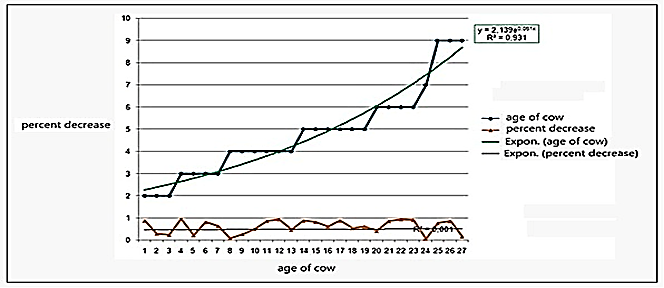
Graphical analysis of the reduction in Total Plate Count (TPC) across 26 samples (see Figure 5), revealed distinct patterns. The blue line in the graph represents the age distribution of vaccinated and ozonated cows, showing an increasing trend with an R² value of 0.931, indicating that the trend model closely represents the actual age distribution of the cows. The orange line represents the percentage reduction in bacterial counts in milk, with an R2 value of 0.01. This suggesting that although vaccination and ozonation contribute to bacterial reduction, the relationship between cow age and the percentage decrease in bacterial counts was weak and not statistically significant. Nevertheless, the graph indicates an overall decline in bacterial colony count among the 26 vaccinated cattle samples, with a general decreasing trend observed as the age increased from 2 to 9 years.
The graph illustrates an inverse relationship between bacterial colony counts and cow age. As bacterial colony count decreases, following an exponential trend line, the cows tend to be younger. This inverse relationship can be explained by physiological, immunological, and anatomical differences across age groups. Younger cows typically in their first or second lactation, possess a more intact mammary epithelial barrier, a narrower teat canal, and higher neutrophil phagocytic efficiency, all of which enhance their resistance to bacterial invasion and promote faster microbial clearance from milk. In contrast, older cows experience cumulative mammary tissue damage, teat canal relaxation, and subclinical inflammation resulting
from repeated lactations, which compromise udder defense mechanisms and increase microbial persistence55,56). However, in herds receiving intensive vaccination and medication—such as those in the Subang case study, age-related immune differences may be modulated. Vaccination can transiently enhance systemic immunity in younger animals, while repeated exposure to antibiotic or anti-inflammatory drugs in older cows may alter microbial ecology and select for more resilient bacterial subpopulations. Consequently, the effectiveness ozonation may vary across age group, with younger cows exhibiting a greater proportional reduction in Total Plate Count (TPC) after treatment due to their higher baseline immune responsiveness and a lower prevalence of chronic intramammary infections.
Finding by Vlasova52) supports this observation, demonstrating that in younger cows, generally exhibit a higher rate of bacterial reduction in milk following antibiotic treatment compared to older cows. This difference may be attributed to age-related variations in immune function and responses to antimicrobial therapy. Additionally, adult cows tend to harbor a higher total bacterial load in their digestive tract than younger cows15). Beyond age, other factors such as overall health status, hygiene, and diet also influence bacterial presence. Greater diversity in feed intake has been associated with increased bacterial loads in the digestive tract15). Although younger cattle may have a less mature immune system, they often show a more pronounced response to antibiotics, resulting in a greater reduction in bacterial counts52).
Ozonation has been shown to improve the microbiological quality of fresh milk while largerly preserving its nutritional properties. Harjanti et al.54) demonstrated that bacterial count decreasing with increasing ozone exposure time due to progressive oxidative damage to essential cellular components. Ozone (O₃), a strong oxidizing agent, initially targets the bacterial cell wall by oxidizing unsaturated fatty acids and disrupting membrane integrity, leading to loss of selective permeability and leakage of intracellular contents. Ozone also inactivates key metabolic pathways by oxidizing amino acids and sulfhydryl groups (-SH) groups in proteins and enzymes, and it damages nucleic acids (DNA/RNA), thereby inhibiting transcription and replication. Furthermore, ozone forms transient oxidation complexes and releases molecular oxygen upon contact with the phospholipids and lipoproteins in bacterial membranes. In spore-forming bacteria, ozone penetrates the spore coat and oxidatively degrades the core and cortex structures, inhibiting metabolic activity and germination. This multifaceted mechanism enables rapid bacterial inactivation, achieving reductions of up to 96.14% (approximately 1.42 log CFU/mL) after 9 minutes of ozonation at 3 ppm56). Specifically, bacterial reductions of 0.45, 0.95, and 1.42 log CFU/mL were observed after 3, 6, and 9 minutes of ozonation, respectively, with a strong correlation between ozone exposure time and bacterial reduction (r = 0.92; R² = 0.99; p < 0.0153). Because ozone decomposes naturally into oxygen without leaving harmful residues, this process is considered environmentally safe53). The observed reductions in microbial load can be explained by the well-established oxidative mechanisms of ozone action on bacterial cells.
The total bacterial count in ozonated cow’s milk must comply with the quality standards outlined in SNI 3141.1:2011 for fresh milk. According to these standards, fresh milk should contain a minimum fat content of 3.0%, and a protein content of 2.8%, and microbial contamination not exceeding 1x10⁶ CFU/mL, Staphylococcus aureus not exceeding 1x10² CFU/mL, Enterobacteriaceae 1x10³ CFU/mL. The results of this study (see Table 1) show that a single 15 minutes ozonation treatment significantly increased the proportion of milk samples meeting SNI standards from 3.8% (one sample) to 26.9% (seven samples). This finding is consistent with the study by Harjanti et al.54), which concluded that ozone treatment at a concentration of 3 ppm for 6 minutes effectively improves the microbiological quality of fresh milk while maintaining its nutritional value55). This improvement highlights the potential of ozonation as a residue-free post-harvest intervention for enhancing raw milk safety in smallholder dairy systems. Ozone has also been shown to be effective in reducing the number of microbes in cow's milk in three regions in West Java, Indonesia. The study showed that ozonation treatment inactivated microorganisms by 94.50%. E. coli and Staphylococcus aureus, two pathogenic bacteria, were inactivated by 97.19% and 95.97%, respectively 58).
4. Conclusion
Based on the assessment of bacterial contamination in milk samples collected from Subang, particularly using the Total Plate Count (TPC) method, and by comparing the results after ozonation treatment with the quality standards for fresh cow's milk as specified in SNI 3141.1:2011, the following conclusions can be drawn:
The ozonation process proved to be an effective method for improving the microbiological quality of cow’s milk by controlling microbial contamination. The effectiveness of ozonation was influenced by field-related factors, including cow age and baseline microbial variability, with older cows showing a lower percentage reduction in bacterial counts. This trend may be attributed to differences in immune responsiveness, as younger cows generally possess a more active immune system, whereas older cows tend to have a more established microbiome and consume a wider variety of feed, contributing to greater microbiological diversity.
These findings suggest that ozonation is a promising complementary technology rather than a standalone solution. Further studies are required to optimize ozonation parameters at commercial scale, evaluate interactions between ozone and veterinary drug residues, and integrate microbial profiling to enhance food safety assurance in dairy supply chains. Further research and quantitative evaluations are necessary to assess the effectiveness and efficiency of the ozonation process at a commercial or industrial scale and to optimize treatment parameters.
Acknowledgements
The author would like to thank The Department Food Security and Livestock of West Java Province for their assistance during field collection.
Nomenclature
| Symbol | Description (Unit) |
|---|---|
| d | Dilution corresponding to the first dilution retained |
| n1 | Number of plates retain in the first dilution |
| n2 | Number of plates retain in the second dilution |
| N | Number of sample colonies (colonies/ml) |
| ∑C | Sum of all colonies counted on the two dishes retained from two successive dilutions |
Supplementary materials
| Kolmogorov-Smirnova | Shapiro-Wilk | |||||
|---|---|---|---|---|---|---|
| Statistic | df | Sig. | Statistic | df | Sig. | |
| Original | .446 | 23 | .000 | .439 | 23 | .000 |
| Treatment | .230 | 23 | .003 | .830 | 23 | .001 |
a.Lilliefors Significance Correction
| Total N | 26 |
|---|---|
| Test Statistic | 276.000 |
| Standard Error | 32.877 |
| Standardized Test Statistic | 4.198 |
| Asymptotic Sig.(2-sided test) | .000 |
| Null Hypothesis | Test | Sig. | Decision | |
|---|---|---|---|---|
| 1 | The median of differences between Original and Treatment equals 0. | Related-Samples Wilcoxon Signed Rank Test | .000 | Reject the null hypothesis. |
Asymptotic significances are displayed. The significance level is .050
Supplementary 3: Ethical Clearence Approval
References
- A. Kuipers, W.J. Koops, and H. Wemmenhove, “Antibiotic use in dairy herds in the netherlands from 2005 to 2012,” J. Dairy Sci., 99 (2) 1632–1648 (2016). doi:https://doi.org/10.3168/jds.2014-8428. [DOI]
- P.D. Constable, K.W. Hinchcliff, S.H. Done, and W. Grünberg, “Veterinary medicine: a textbook of the diseases of cattle, horses, sheep, pigs and goats,” Elsevier Health Sciences, 2016.
- D. Tomanić, M. Samardžija, and Z. Kovačević, “Alternatives to antimicrobial treatment in bovine mastitis therapy: a review,” Antibiotics, 12 (4) 683 (2023). https://doi.org/10.3390/antibiotics12040683. [DOI]
- R. Floris, I. Recio, B. Berkhout, and S. Visser, “Antibacterial and antiviral effects of milk proteins and derivatives thereof,” Curr. Pharm. Des., 9 (16) 1257–1275 (2003). doi:10.2174/1381612033454810.
- I. Hotea, M. Dragomirescu, A. Berbecea, and I. Radulov, “The role of nutrition in enhancing sustainability in sheep production,” (2023). doi:10.5772/intechopen.113938.
- E.I. Stoltz, and D.J. Hankinson, “Antibiotics and lactic acid starter cultures,” Appl. Microbiol., 1 (1) 24–29 (1953).
- S. Nurmala, and D.O. Gunawan, “Pengetahuan penggunaan obat antibiotik pada masyarakat yang tinggal di kelurahan babakan madang,” J Ilm Farm, 10 (1) 22–31 (2020). doi:10.33751/jf.v10i1.1728.
- N.F. Amalia, D. Mahdiyah, and N. Noval, “Antibacterial Activity of Bungur Bark Extract (Lagerstroemia speciosa (L.) Pers) Againts Staphylococcus aureus ATCC 29213 By Diffusion and Dillution Methods.,” in: Int. Conf. Heal. Sci., 2021: pp. 470–479.
- M.F.R. Shuvo, F.F. Haque, and K.M.A. Kabir, “Modeling the impact of combined effect of vaccination, testing, and treatment on epidemic dynamics,” Evergr. Jt. J. Nov. Carbon Resour. Sci. Green Asia Strateg., 11 (03) 1498–1507 (2024). doi:10.5109/7236807.
- M.A. Cavalcante, B.R. de C. Leite Júnior, A.A.L. Tribst, and M. Cristianini, “Improvement of the raw milk microbiological quality by ozone treatment.,” Int. Food Res. J., 20 (4) (2013).
- G. Sydykova, S. Umbetova, Z. Baimakhanova, G. Abieva, and G. Kurmanbayev, “Modern applications of ozone technology,” 10 (4) 2308–2316 (2023). doi: ttps://doi.org/10.5109/7160908.
- R.B. Afonso, R.H.R. Moreira, and P.L.R. de Almeida, “Can ozone be used as antimicrobial in the dairy industry? a systematic review,” J. Dairy Sci., 105 (2) 1051–1057 (2022). doi:10.3168/jds.2021-20900.
- T.E. Susilorini, S. Maylinda, P. Surjowardojo, and S. Suyadi, “Importance of body condition score for milk production traits in peranakan etawah goats.,” (2014).
- N. Montayeva, S. Montayev, and A. Montayeva, “Bioactive mineral feed additive for poultry: therapeutic and preventive effects on haematological parameters in chickens,” 11 (02) 984–992 (2024). doi:10.3390/ani12131623.
- P.C.N. Mantrawan, I.N.K. Besung, I.G.K. Suarjana, and N.K. Suwiti, “Total bakteri pada berbagai umur dan lokasi peternakan sapi bali di nusa penida,” Bul. Vet. Udayana, 10 (2) 122–126 (2018). doi:10.24843/bulvet.2018.v10.i02.p03.
- Kementerian Pertanian, “Annual Report 2022,” 2022.
- A.D.W.I. Setyawan, “Review: the diversity of local cattle in indonesia and the efforts to develop superior indigenous cattle breeds,” 17 (1) 275–295 (2016). doi:10.13057/biodiv/d170139.
- F.F. Rahmah, F. Rahly, and Y. Yusriani, “Development planning ranch area based on the potential of feeding ruminants in aceh , indonesia,” 05002 1–13 (2021). doi: https://doi.org/10.1051/e3sconf/202130605002. [DOI]
- P. Biswal, “ASSESSMENT of immunity, stress and production performance of bovines after foot and mouth disease vaccination”, Deemed University. ICAR-Indian Veterinary Research Institute. Izatnagar - 243 122 (U.P.), India (2023).
- E.A. Fuentes, J.A. Achy, D.F. da Silva, A.C.G. Graboschii, J. de O. Bernardo, J.G. Joaquim, A.B. Fraga, and P.B. Escodro, “Ozone use in the treatment of subclinical mastitis in dairy cows,” J. Dairy Res., 90 (4) 382–386 (2023). doi: https://doi.org/10.1017/S0022029923000808. [DOI]
- I. Jarto, J.A. Lucey, and K.E. Smith, “Impact of processing temperature on production of milk protein permeate during microfiltration of skim or whole milk,” Int. J. Dairy Technol., 71 (4) 844–848 (2018). doi: https://doi.org/10.1111/1471-0307.12542. [DOI]
- F. Trimboli, M. Ragusa, C. Piras, V. Lopreiato, and D. Britti, “Outcomes from experimental testing of nonsteroidal anti-inflammatory drug (nsaid) administration during the transition period of dairy cows,” Animals, 10 (10) 1832 (2020). doi: https://doi.org/10.3390/ani10101832. [DOI]
- S.K. Njoroge, “Effect of dairy farming practices on intake of antibiotic residues in milk consumed in kiambu county, kenya,” (2020).
- E. De Jong, “Enhancing antimicrobial stewardship on dairy farms with a focus on selective treatment of clinical mastitis,” (2024). https://doi.org/10.11575/PRISM/42812. [DOI]
- N. Verma, N. Agarwal, and L. Misra, “Review of some diseases of dairy animals and treatment by ethno-veterinary medicines,” Adv. Med. Plants Res. Https//Doi. Org/11, 9–32 (2023).
- R. Paramasivam, D.R. Gopal, R. Dhandapani, R. Subbarayalu, M.P. Elangovan, B. Prabhu, V. Veerappan, A. Nandheeswaran, S. Paramasivam, and S. Muthupandian, “Is amr in dairy products a threat to human health? an updated review on the origin, prevention, treatment, and economic impacts of subclinical mastitis,” Infect. Drug Resist., 155–178 (2023). doi:10.2147/IDR.S384776.
- M. Babur, “Usage areas of ozone in animal health as an alternative treatment method: usage ozone in animal health,” Rats, 2 (1) 33–39 (2024). https://doi.org/10.5281/zenodo.12601232. [DOI]
- C. Sharma, N. Rokana, M. Chandra, B.P. Singh, R.D. Gulhane, J.P.S. Gill, P. Ray, A.K. Puniya, and H. Panwar, “Antimicrobial resistance: its surveillance, impact, and alternative management strategies in dairy animals,” Front. Vet. Sci., 4 237 (2018). doi:10.3389/fvets.2017.00237.
- M.C. Beltrán, R.L. Althaus, A. Molina, M.I. Berruga, and M.P. Molina, “Analytical strategy for the detection of antibiotic residues in sheep and goat’s milk,” Spanish J. Agric. Res., 13 (1) e0501–e0501 (2015). https://doi.org/10.5424/sjar/2015131-6522. [DOI]
- S. Pyörälä, “Treatment of mastitis during lactation,” Ir. Vet. J., 62 1–5 (2009).
- B.D. Tampubolon, B. Basuki, P. Anggraeni, W.C. Anggundari, A.B. Mulyono, E.H. Purwanto, A. Nurhakim, D.R. Wahono, B. Prasetya, and A. Manab, “Trend of High Microbial Contamination in Livestock Milk in Indonesia and Distribution Mapping,” in: E3S Web Conf., EDP Sciences, 2024: p. 2003. doi:10.1051/e3sconf/202452702003.
- M. Virto, G. Santamarina-García, G. Amores, and I. Hernández, “Antibiotics in dairy production: where is the problem?” Dairy, 3 (3) 541–564 (2022). doi: https://doi.org/10.3390/dairy3030039. [DOI]
- R. Kupczyński, M. Bednarski, M. Sokołowski, W. Kowalkowski, and K. Pacyga, “Comparison of antibiotic use and the frequency of diseases depending on the size of herd and the type of cattle breeding,” Animals, 14 (13) 1889 (2024). doi: https://doi.org/10.3390/ani14131889. [DOI]
- R. Botondi, M. Lembo, C. Carboni, and V. Eramo, “The use of ozone technology: an eco–friendly method for the sanitization of the dairy supply chain,” Foods, 12 (5) 987 (2023). doi: https://doi.org/10.3390/foods12050987. [DOI]
- O. Sonia, and L. Fernandez, “Ozone therapy as a novel complementary therapeutic approach in refractory idiopathic granulomatous mastitis,” (July) 1–8 (2023). doi:10.3389/fmed.2023.1174372.
- L.V. de Faria, T.P. Lisboa, N. da S. Campos, G.F. Alves, M.A.C. Matos, R.C. Matos, and R.A.A. Munoz, “Electrochemical methods for the determination of antibiotic residues in milk: a critical review,” Anal. Chim. Acta, 1173 (xxxx) (2021). doi:10.1016/j.aca.2021.338569.
- H. De Beer, A. Jacoby, and K. Jansen, “Microbial quality of milk , produced by small scale farmers in a peri-urban area in south africa,” (February 2014) (2010).
- D. Sert, and E. Mercan, “Assessment of powder flow, functional and microbiological characteristics of ozone-treated skim milk powder,” Int. Dairy J., 121 (2021). doi:10.1016/j.idairyj.2021.105121.
- L.V. Costa, C. Gebara, O. De F, N.E. Freitas, A. Nascimento, C.S. Prado, I.A. Nunes, F. Oliveira, S. Duarte, M.E. Lage, F.R. De Alencar, B. Aparecida, S. Machado, K. Val, and S. Hodel, “Antibiotic residues in raw cow ’ s milk: a systematic review of the last decade,” 1–14 (2024). doi:10.17605/OSF.IO/3ZMJC.
- A. Fadli, “Total plate count, most probable number index, and coliform bacteria of fresh cow milk in jember traditional market,” 1 (1) 7–13 (2024).
- A.C. Khanashyam, M.A. Shanker, A. Kothakota, N.K. Mahanti, and R. Pandiselvam, “Ozone applications in milk and meat industry,” Ozone Sci. Eng., 44 (1) 50–65 (2022). doi:10.1080/01919512.2021.1947776.
- E. Prayitno, R. Hartanto, and D.W. Harjanti, “Physicochemical and microbiological appearance of sapera goat’s milk on frozen storage,” J. Sain Peternak. Indones., 16 (4) 308–314 (2021). doi: https://doi.org/10.31186/jspi.id.16.4.308-314. [DOI]
- M.A. Khadre, A.E. Yousef, and J.‐. Kim, “Microbiological aspects of ozone applications in food: a review,” J. Food Sci., 66 1242–1252 (2001). doi:10.1111/j.1365-2621.2001.tb15196.x.
- E. da P.E. Sitoe, L.R.D. Faroni, E.A.F. Fontes, E.R. de Alencar, P.R. Cecon, M.V. de Assis Silva, R. Pandiselvam, and F.C. Pacheco, “Effect of application of ozone at low-pressure on the technological properties, phenolic compounds, and antioxidant capacity of common beans during storage,” LWT, 212 116964 (2024). doi: https://doi.org/10.1016/j.lwt.2024.116964. [DOI]
- E.S. Rohaeni, N. Ilham, R.A. Saptati, H. Sulistyawati, and P. Rahayu, “Developing a sustainable beef cattle business model for smallholder farms in south kalimantan ’ s drylands developing a sustainable beef cattle business model for smallholder farms in south kalimantan’s drylands,” (February) (2024). doi:10.18280/ijsdp.190207.
- E. Sulistyowati, M.E. Malinda, W. Afrianti, D. Suherman, E. Soetrisno, S. Suharyanto, I. Badarina, and T. Akbarillah, “Sensory profile, total plate count and production cost of yogurt made from dairy goat milk added with ananas comosus and cucumis melo fruits,” AGRITROPICA J. Agric. Sci., 7 (1) 34–38 (2024). https://doi.org/10.31186/j.agritropica.7.1.34-38. [DOI]
- H. Pudjaatmaka, D. Fardiaz, and T. Agus, “KAMUS KIMIA,” Ministry of Education and Culture, Jakarta, 1993.
- A. Maria, O. Id, and E. Romaszko, “Study protocol: the role of milk matrix lipids in programming the immunoreactivity of proteins derived from lactic acid bacteria,” 1–17 (2024). doi:10.1371/journal.pone.0301477.
- S. Chun, Y. Chih, H. Lin, I.A. Aljuffali, and J. You, “Current pathogenic escherichia coli foodborne outbreak cases and therapy development,” Arch. Microbiol., 199 (6) 811–825 (2017). doi:10.1007/s00203-017-1393-y.
- Y.F. Rosmi, A. Jati, A. Wasesa, D. Majid, and M.N. Jauhari, “Implementation of assistive hydraulic exoskeleton technology for children with cerebral palsy,” 11 (03) 2305–2316 (2024). doi:10.5109/7236873.
- B.D. Tampubolon, P. Anggraeni , W.C. Anggundari , A.B. Mulyono, E.H. Purwanto, Novitasari, D.R. Wahono, B. Prasetya, A. Manab, and L.E. Radiati, “High distribution of antibiotic residues in dairy milk and used testing methods in Indonesia – review,” J. Environ. Sci. Health B., 1-11 (2026). doi:10.1080/03601234.2026.2640802.
- A.N. Vlasova, and L.J. Saif, “Bovine immunology: implications for dairy cattle,” 12 (June) 1–18 (2021). doi:10.3389/fimmu.2021.643206.
- J.A. Souza-Corrêa, M.A. Ridenti, C. Oliveira, S.R. Araújo, and J. Amorim, “Decomposition of lignin from sugar cane bagasse during ozonation process monitored by optical and mass spectrometries,” J. Phys. Chem. B, 117 (11) 3110–3119 (2013). doi:10.1021/jp3121879.
- D.W. Hajanti, and D.G. Kusumaningrum, “The Effect of Ozone Exposure Duration on the Microbiological Quality and Nutritional Content of Ettawa Crossbred Goat Milk,” J. Apl. Teknol. Pangan, 10 (1) 1–5 (2021). doi: https://doi.org/10.17728/jatp.7252 1. [DOI]
- H. Hogeveen, K. Huijps, and T.J.G.M. Lam, “Economic aspects of mastitis: new developments.,” N. Z. Vet. J., 59 (1) 16–23 (2011). doi:10.1080/00480169.2011.547165.
- W. Suriyasathaporn, Y.H. Schukken, M. Nielen, and A. Brand, “Low somatic cell count : a risk factor for subsequent clinical mastitis in a dairy herd,” 1248–1255 (2000). Doi: https://doi.org/10.3168/jds.S0022-0302(00)74991-5. [DOI]
- G. Lutviandhitarani, D.W. Harjanti, and F. Wahyono, “Green antibiotic daun sirih (piper betle l.) sebagai pengganti antibiotik komersial untuk penanganan mastitis,” J. Agripet, 15 (1) 28–32 (2015).
- B.D. Tampubolon, A.T. Setyoko, D.A. Bangun, R.B.F. Gultom, W.C. Anggundari, P. Anggraeni, N. Kusnandar, B. Prasetya, D.A. Susanto, D.R. Wahono, A. Manab, and L.E. Radiati, “Effect of Ozonation on Microbiological Quality, Nutritional Value, and Shelf Life of Fresh Cow’s Milk,” International Journal of Design and Nature and Ecodynamics, 20 (5) 1093-1102 (2025). doi: https://doi.org/10.18280/ijdne.200514. [DOI]