
Abstract
This study aims to measure the effects of Piper nigrum soaking temperature, density, and sacking on its stiffness using our tailor-made Piper nigrum stiffness instrument. The soaking water temperature is classified as low (room water temperature), moderate (60 °C), and high temperature (90 °C). The Piper nigrum density is grouped into low (90 gr/2 l), moderate (90 gr/1.5 l), and high density (90 gr/1 l). The Piper nigrum is divided into sacking and non-sacking. The experiment is conducted in three batches. Hence, the total samples are 54 (3 x 3 x 2 x 3). The first batch (18 samples) is divided into three temperature groups, three density groups, and two sacking groups. The second and third samples of temperature groups are treated further with moderate or high temperatures, respectively, for five minutes. The first batch is lifted from the soaking tubs for natural drying. These processes are repeated for the second and third batches. The stiffness measurements, from 11352.56 N/m to 20356.32 N/m, were obtained. The results tested using three-way Anova with a 5 % (0.05) significance level (95 % confidence level) showed that there were significant interactions among Piper nigrum soaking temperature, density, and sacking on its stiffness.
Keywords: density, Piper nigrum pericarp stiffness, Piper nigrum stiffness instrument, sacking, soaking temperature
Outline
1. Introduction
Energy is vital to increasing the quality of Piper nigrum. All processes in producing Piper nigrum products need energy1). These roles are valid for both traditional and modern processing systems that use many controllers inside2). The soaking process in this paper is one example of energy saving when producing Piper nigrum products.
Piper nigrum, the king of spices3), is very useful for traditional Indonesian medicine to cure various ailments 4), such as an antioxidant and anti-inflammatory5,6). There are some kinds of Piper nigrum, but the most famous are the black Piper nigrum (black gold)7) and the white Piper nigrum. The main feature that differentiates white and black Piper nigrum is the existence of their pericarp, which influences their piperine content8). Unlike the black Piper nigrum9), the white Piper nigrum10) has no pericarp. The pericarp is considered a significant determinant of colour intensity, texture and yield of Piper nigrum11). Its pericarp is intentionally thrown away, usually by soaking it. Hence, the efficiency of producing white Piper nigrum is lower than that of black Piper nigrum12), typically 25-28 % compared to 33-37 %13). At the same quantity, the piperine percentage for white Piper nigrum in Lampung, Indonesia, is typically higher than that of black Piper nigrum14).
The removal of the Piper nigrum pericarp can be done with chemical, physical, or biological methods15). The majority (99.9%) of pepper plantations in Indonesia are smallholder plantations16), so the famous method, especially in Indonesia, is using a soaking process. The retting method is defined as the fibre extraction that involves decomposition by the microbiological method of the cementing material or dissolution by chemical method in which the fibre bundles are loosened from the adhering tissues and extracted by washing17). This process generally takes a time that is too long, 10-14 days18). Therefore, the chemical, physical, and biological methods are combined to accelerate the soaking process. For example, the soaking process is combined with boiling19). Alternatively, adding some organisms, such as bacteria, especially Bacillus subtilis20).
The soaking process is usually carried out in rivers21). This habit is risky both for the workers, the Piper nigrum itself, and the river. The workers might be swept away by a sudden flood, especially in big rivers. Rivers are usually dirty and polluted, and unneeded materials in the river water may contaminate the Piper nigrum. On the other hand, the decomposed material from the Piper nigrum can pollute the river water, particularly in the aspects of turbidity, pH, dissolved oxygen, and chemical oxygen demand22), and reduce the colour quality23). Durian waste husks can be used as an adsorbent to improve soaking water during the retting process of piper nigrum24). This technique, however, is not suitable for soaking in rivers.
In order to avoid soaking in rivers, The Development of Integrated Farming System in Upland Areas (UPLAND) Project has developed some soaking tubs in Purbalingga Regency, Central Java Province, Indonesia 1). So far, unfortunately, there are no records showing that the utilization of soaking tubs can improve the Piper nigrum quality measured from the hardness aspect. The golden goal for the soaking process is to reduce the hardness of the Piper nigrum pericarp. Therefore, the Piper nigrum pericarp can be peeled off easily to make the white Piper nigrum.
There are several factors that influence the hardness of Piper nigrum pericarps, including temperature, density (concentration), soaking time, sacking, additional acid material, bacteria, and mechanical flow. This study aims to obtain the effects of Piper nigrum soaking temperature, density, and sacking on its hardness. However, the authors prefer to use stiffness for this study for some reasons, which will be explained later. The dependent variable was measured using our tailor-made pepper stiffness instrument. Hardness refers to the resistance of a material to deformation or penetration25). Especially on the sacking aspect, this study can answer the research question of whether soaking tubs are beneficial or not in reducing the Piper nigrum pericarp.
There are some famous methods to measure material hardness, such as Vickers, Brinell, Rockwell, Knoop, and Berkovich26). These methods are usually used for non-organic materials such as metal and plastic, some of which are made in portable form27-29). The hardness tester is also used for organic materials such as fruits30). The hardness tester for fruits can be measured based on a texture analyzer31) and tactile method32,33). So far as the authors know, however, there is no method dedicated to measuring the hardness of Piper nigrum pericarp, especially after the soaking process. So, for this study, the authors also developed a Piper nigrum pericarp hardness instrument first.
The common hardness testers are based on the force on a certain area. So, even though there are many hardness unities, they can be converted into Newton/m2. Our tailor-made Piper nigrum hardness instrument works based on the displacement that reacts to the force that works on that object (Piper nigrum in this case). This instrument is dedicated to this purpose to the common hardness testers, but their unity is different. Our instrument has a unity Newton/m. Hence, as many of our tailor-made instruments are in control34,35), measurement36,37), and software38), the Piper nigrum stiffness instrument also has a special purpose. To avoid misunderstanding hardness in Newton/m2, the authors use the word stiffness, the ratio of load to deflection Newton/m39).
2. Methodology
2.1. Data Gathering
2.1.1. Experiment Process
Some preparations (Figure 1) are made before conducting the main activity in this study, namely the Piper nigrum pericarp stiffness as a function of temperature, density, and sacking. Generally, stiffness and compression characteristics are extremely important parameters for size reduction operations40). In this study, it is an important parameter for producing white Piper nigrum. The preparation includes raw material procurement, soaking, washing, heating (boiling), and draining.
We have to prepare the raw material, namely the Piper nigrum. Mature and ripe pepper berries are used for white pepper production due to the stiffness of the peppercorn and thinner outer skin41). For this sake, the Piper nigrum was picked directly from the Piper nigrum field in Purbalingga. This method was also used to reduce the possibility of Piper nigrum damage due to the transportation process via a freight forwarding agent. Before the soaking process, the branches, leaves, and dirt of Piper nigrum should be thrown away first. This activity should be carried out because white pepper is of better quality if the stalk is removed first42). The pericarp, stalks, and leaves of Piper nigrum are usually treated as waste materials43,44).
The utilization of mechanical tools has the potential to damage the Piper nigrum berries45). Hence, the Piper nigrum farmers tend to use soaking techniques rather than

mechanical tools. The soaking was conducted for six days.
After soaking, the Piper nigrum was washed slightly. This action was to make sure that the Piper nigrum was clean.
Some Piper nigrum were heating. The heating was classified into two groups, 60 °C and 100 °C. Water was heated at 60 °C or 100 °C. Then, the Piper nigrum was poured into the heated water for 5 minutes.
All Piper nigrum should be drained first. So, there was no flowing or dripping water from the Piper nigrum tube. In this phase, the Piper nigrum pericarp stiffness was ready to be measured.
2.1.2. Measurement Process
In this study, Piper nigrum stiffness cannot be measured using a common stiffness tester, but a special one is needed (Figure 2) for some reasons. 1) There is a variation in the ripe fruit stiffness of Piper nigrum46). So, the measurement stiffness of Piper nigrum can not be represented by a single berry. The Piper nigrum pericarp would also like to be measured in the collection of fruit after they experience the soaking process.2) The stiffness measurement is also dependent on the face sheet47), which, in this study, is not as flat as the common objects.
All Piper nigrum that has been drained has become almost dry. The almost dry Piper nigrum then was weighed first. Its weight should be made uniformly at 90 gr and a distance of 10 cm. Then, it was entered into the Piper nigrum tube. Shake the tube slightly so the Piper nigrum berries are in their proper positions. Place the piston surface into the Piper nigrum surface in the Piper nigrum tube. Measure the distance of the piston canopy using a laser distance meter (LDM, a handheld device that uses a laser beam to measure the distance between the Piper nigrum surface and the piston canopy) to obtain the initial measurement.
Lift the piston. Lock the piston canopy so it cannot move up and down. Place the load into the piston canopy centre. Drop the piston with its load into the Piper nigrum surface in the Piper nigrum tube. Remeasure the distance of the piston canopy using the LDM to obtain the final measurement.
Subtract the first distance measurement with the second distance measurement. The distance difference (length) is proportional to the compression experienced by the Piper
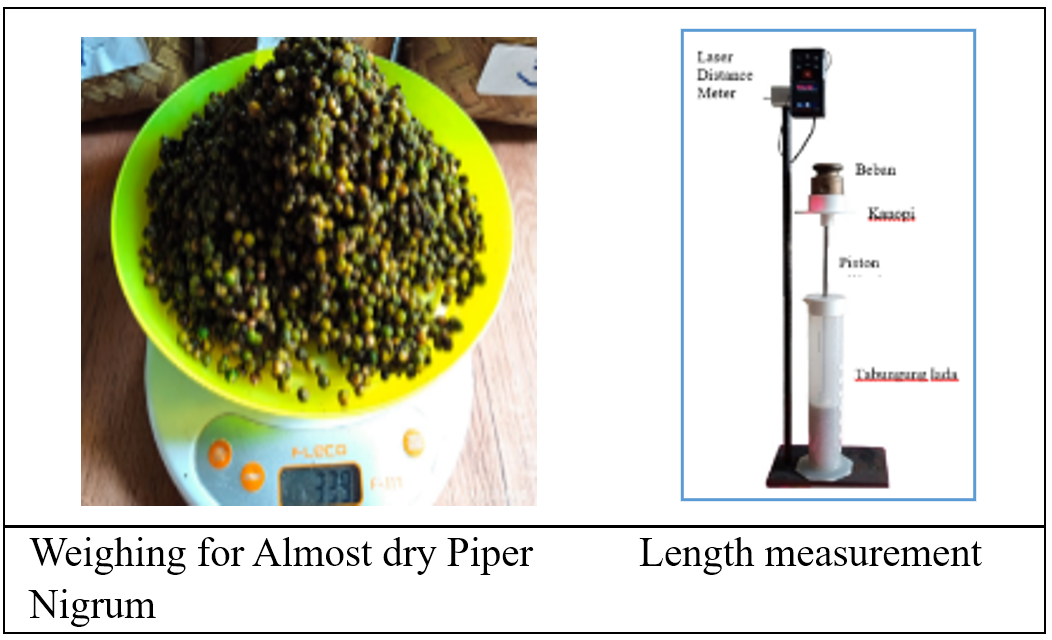
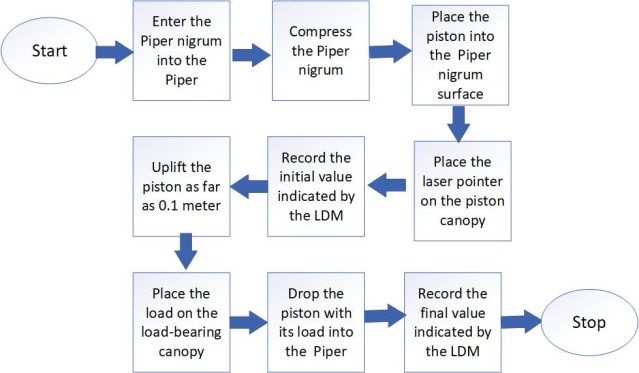
nigrum in the Piper nigrum tube. The flowchart of all these processes is presented in Figure 3.
The design of the stiffness instrument for this study is available on the patent of this paper48). Hence, there is no further discussion in this paper.
The stiffness instrument in this study is a new one. Therefore, it cannot be calibrated directly using its standard. What should be conducted is by calibrating its factors. Two dominant variables that influence the stiffness of the instrument were mass and distance. These units can be calibrated at a formal calibration laboratory. The calibration result shows that a 1000 g mass was calibrated to 1020.47, with an error of 2.047%. The accuracy of LDM was 1.5 mm for the range of 40 m, or the LDM accuracy was 0.00375 %. It can be seen that the mass error is much higher than the distance error. Hence, the accuracy of this stiffness instrument is around 2%.
2.2. Data Analysis
2.2.1. Stiffness conversion
The deformation modulus expresses the stiffness of the material in N/m42). In this study, however, the stiffness is stated as N/m49) following the international system for units, where if the force uses Newton (N), then the distance uses a meter (m).
The distances were then converted into stiffness by dividing the force by the distance. Hence, stiffness is inversely proportional to the displacement measurement.
2.2.2. Anova
Anova (analysis of variance) is a statistical technique for analyzing mean differences50). The Anova used in this study is a three-way Anova with a 5 % significance level (95 % confidence level) and many parameters.
The total sum of squares is
The treatment sum of squares is
The error sum of squares is equal to the total sum of squares minus the treatment sum of squares51) Hence it is represented as:
The temperature sum of squares is
The density sum of squares is
The sacking sum of squares is
The temperature and density interaction sum of squares is
The temperature and sacking interaction sum of squares is
The density and sacking interaction sum of squares is
The temperature, density and sacking interaction sum of squares is
The internal sum of squares is
The total number of degrees of freedom
The temperature number of degrees of freedom
The density number of degrees of freedom
The sacking number of degrees of freedom
The temperature vs density number of degrees of freedom
The temperature vs sacking number of degrees of freedom
The density vs sacking number of degrees of freedom
The temperature vs density vs sacking number of degrees of freedom
The internal number of degrees of freedom
There are three kinds of mean squares, namely the main effect, interaction, and internal mean squares. The main effect means square consists of temperature (, density (, and sacking (mean squares. The interaction means squares comprise the interaction between temperature and density (, temperature and sacking (, density and sacking (, and among temperature, density, and sacking (. Another main square, called the total mean square is no longer used for further calculation. Hence, it is not presented in the following formulas.
2.2.3. Hypothesis Testing
Hypothesis testing is obtained by comparing the experiment F () values with statistic (theoretical, ) F (Fisher-Snedecor). In this study, there are seven null hypotheses (Hypothesis 1 – Hypothesis 7). The seven hypotheses are:
Water temperature has no significant effect on the stiffness of Piper nigrum pericarp.
Tub density has no significant effect on the stiffness of Piper nigrum pericarp.
Pepper sacking has no significant effect on the stiffness of Piper nigrum pericarp.
There is no significant interaction between water temperature and tub density that affects the stiffness of Piper nigrum pericarp.
There is no significant interaction between water temperature and Piper nigrum sacking that affects the stiffness of Piper nigrum pericarp.
There is no significant interaction between tub density and Piper nigrum sacking that affects the stiffness of Piper nigrum pericarp.
There is no significant interaction among water temperature, tub density, and Piper nigrum sacking that affects the stiffness of Piper nigrum pericarp.
There are two kinds of Fe values, namely the main effect and interaction F values. The main effect Fe value consists of the mean square comparisons between the temperature and internal (, density and internal (, and sacking and internal (. The interaction Fe comprises the mean square comparisons between temperature and density interaction and internal (, temperature and sacking interaction and internal (, density and sacking interaction and internal ( and temperature, density, and sacking interaction and internal (.
The magnitude of is obtained from the F table that is usually available in many inferential statistic books. Two things make the magnitude of usually different. These are the row effect and column effect on the F table. The row effect depended on the DF of the main effect and interaction effect. The column effect is caused only by the internal DF.
Each of the hypotheses will be accepted based on the following formulas:
If the correct is not obtained on the F table, then a linear interpolation is carried out from the two nearest values. For example, there is no DF= 36 for the column of the F table (Table 1).
Table 1: Interpolation for DB= 36 on the column of the F table
| Experiment Result (ER) | 250 | 251 | 250.6 | ER | 19.46 | 19.47 | 19.467 | ER | 5.74 | 5.71 | 5.728 |
Table 2: The stiffness measurement results
| Temperature (t) | Density (d) | Sacking (s1) | Not Sacking (s2) | ||||
|---|---|---|---|---|---|---|---|
| Xn or Xtdsb | Xn or Xtdsb | ||||||
| Low (t1) (30 °C) | d1 | X1111 | X1112 | X1113 | X1121 | X1122 | X1123 |
| 19677.78 | 15136.75 | 17888.89 | 13118.52 | 13416.67 | 12560.28 | ||
| d2 | X1211 | X1212 | X1213 | X1221 | X1222 | X1223 | |
| 13118.52 | 13416.67 | 15954.95 | 13416.67 | 16866.67 | 15136.75 | ||
| d3 | X1311 | X1312 | X1313 | X1321 | X1322 | X1323 | |
| 15954.95 | 17362.75 | 17362.75 | 14758.33 | 12833.33 | 16866.67 | ||
| d1 | X2111 | X2112 | X2113 | X2121 | X2122 | X2123 | |
| 20356.32 | 11352.56 | 17362.75 | 13728.68 | 15535.09 | 13118.52 | ||
| Moderate (t2) | d2 | X2211 | X2212 | X2213 | X2221 | X2222 | X2223 |
| (60 °C) | 16398.15 | 16398.15 | 17888.89 | 12560.28 | 14758.33 | 11806.67 | |
| d3 | X2311 | X2312 | X2313 | X2321 | X2322 | X2323 | |
| 12047.62 | 11575.16 | 12833.33 | 12833.33 | 13118.52 | 14055.56 | ||
| d1 | X3111 | X3112 | X3113 | X3121 | X3122 | X3123 | |
| 15136.75 | 15954.95 | 20356.32 | 15954.95 | 13728.68 | 14398.37 | ||
| High (t3) | d2 | X3211 | X3212 | X3213 | X3221 | X3222 | X3223 |
| (100 °C) | 12047.62 | 17362.75 | 17362.75 | 16866.67 | 13728.68 | 13728.68 | |
| d3 | X3311 | X3312 | X3313 | X3321 | X3322 | X3323 | |
| 14398.37 | 17362.75 | 15869.18 | 13728.68 | 13728.68 | 14055.56 | ||
So far, we have presented the methodology for data gathering (experiment process and measurement process) and data analysis. Then, the data obtained from the experiment process and measurement process are further analyzed and discussed in the result and discussion section. Seven answers will be obtained because there are also seven research questions presented in the hypothesis form. The seven answers to the hypothesis, however, are summarized in one sentence in the conclusion.
3. Result and discussion
3.1. Result
Based on the methodology explained before, stiffness measurement results were obtained and presented in Table 2. Totally there were 54 (3 x 3 x 2 x 3) samples, which were classified by three kinds of temperature (low, moderate, and high), three kinds of density (low, moderate, and high), two kinds of sackings (sacking and not sacking), and three batches (batch 1, batch 2, and batch 3). Hence, the Xn (sample) can be written in general form as Xtdsb or in detail from X1111 to X3323.
The raw data in Table 2 was analyzed in squared form, as presented in Table 3. Every row and column in this table were summed using either the column-to-row or row-to-column methods. In this case, both methods gave the same result.
Table 2 was also summed horizontally or vertically (Table 4). The low, moderate, or high temperature was presented as X1dsb, X2dsb, and X3dsb, respectively, where each Xn has 18 samples. The low, moderate, or high density was presented as Xt1sb, Xt2sb, and Xt3dsb, respectively, where each Xn has 18 samples. The sacking or not sacking was presented as Xtd1b and Xtd2b, respectively, where each Xn has 27 samples. The interaction between temperature and density was presented as X11sb, X12sb, X13sb, X21sb, X22sb, X23sb, X31sb, X32sb, and X33sb, respectively, where each Xn has 6 samples. The interaction between temperature and sacking was presented as X1d1b, X1d2b, X2d1b, X2d2b, X3d1b, and X3d2b, respectively, where each Xn has nine samples. The interaction between density and sacking was presented as Xt11b, Xt12b, Xt21b, Xt22b, Xt31b, and Xt32b, respectively, where each Xn has nine samples. The interaction among temperature, density, and sacking was presented as X111b, X112b, X121b, X122sb, X131b, X132b, X211b, X212b, X221b, X222sb, X231b, X232b, X311b, X312b, X321b, X322sb, X331b, and X332b, respectively where each Xn has three (triplicated) samples. The magnitude of these samples is saved in Table 4.
Some results were obtained (Table 5) by applying formulas presented in the methodology to Table 4. Six hypotheses presented in Table 5 were accepted from seven hypotheses, and two hypotheses were rejected. Hence, there was a significant interaction between water temperature, tub density, and Piper nigrum sacking that affected the stiffness of Piper nigrum pericarp.
Table 3: The stiffness measurement results
| Temperature (t) | Density (d) | Sacking (s1) | Not Sacking (s2) | Grand Total | ||||||||||||||
|---|---|---|---|---|---|---|---|---|---|---|---|---|---|---|---|---|---|---|
| tds1b | Xn | tds2b | Xn | |||||||||||||||
| Low (t1) (30 °C) | d1 | 3 | X1111 | X1112 | X1113 | 3 | X1121 | X1122 | X1123 | |||||||||
| 387214938.27 | 229121265.25 | 320012345.68 | 172095528.12 | 180006944.44 | 157760726.32 | |||||||||||||
| d2 | 3 | X1211 | X1212 | X1213 | 3 | X1221 | X1222 | X1223 | ||||||||||
| 172095528.12 | 180006944.44 | 254560587.61 | 180006944.44 | 284484444.44 | 229121265.25 | |||||||||||||
| d3 | 3 | X1311 | X1312 | X1313 | 3 | X1321 | X1322 | X1323 | ||||||||||
| 254560587.61 | 301464917.34 | 301464917.34 | 217808402.78 | 164694444.44 | 284484444.44 | |||||||||||||
| 9 | 13871054.01 | 710593127.03 | 876037850.63 | 400502031.67 | 9 | 569910875.34 | 629185833.33 | 671366436.02 | 870463144.6 | 270965176.3 | ||||||||
| Moderate (t2) (60 °C) | d1 | 3 | X2111 | X2112 | X2113 | 3 | X2121 | X2122 | X2123 | |||||||||
| 414379838.82 | 128880711.70 | 301464917.34 | 188476714.14 | 241338950.45 | 172095528.12 | |||||||||||||
| d2 | 3 | X2211 | X2212 | X2213 | 3 | X2221 | X2222 | X2223 | ||||||||||
| 268899262.69 | 268899262.69 | 320012345.68 | 157760726.32 | 217808402.78 | 139397377.78 | |||||||||||||
| d3 | 3 | X2311 | X2312 | X2313 | 3 | X2321 | X2322 | X2323 | ||||||||||
| 145145124.72 | 133984407.71 | 164694444.44 | 164694444.44 | 172095528.12 | 197558641.98 | |||||||||||||
| 9 | 828424226.22 | 531764382.10 | 786171707.46 | 2146360315.78 | 9 | 510931884.91 | 631242881.34 | 509051547.87 | 1651226314.12 | 3797586629.91 | ||||||||
| High (t3) (100 °C) | d1 | 3 | X3111 | X3112 | X3113 | 3 | X3121 | X3122 | X3123 | |||||||||
| 229121265.25 | 254560587.61 | 414379838.82 | 254560587.61 | 188476714.14 | 207313173.38 | |||||||||||||
| d2 | 3 | X3211 | X3212 | X3213 | 3 | X3221 | X3222 | X3223 | ||||||||||
| 145145124.72 | 301464917.34 | 301464917.34 | 284484444.44 | 188476714.14 | 188476714.14 | |||||||||||||
| d3 | 3 | X3311 | X3312 | X3313 | 3 | X3321 | X3322 | X3323 | ||||||||||
| 207313173.38 | 301464917.34 | 251830735.09 | 188476714.14 | 188476714.14 | 197558641.98 | |||||||||||||
| 9 | 581579563.34 | 857490422.29 | 967675491.24 | 2406745476.88 | 9 | 727521746.20 | 565430142.42 | 593348529.49 | 1886300418.11 | 4293045894.99 | ||||||||
| Grand Total | 27 | 139136.09 | 2223874843.57 | 2099847931.42 | 6953607824.33 | 27 | 126966.12 | 1808364506.45 | 1825858857.10 | 5407989876.93 | 12361597701.26 | |||||||
Table 5 had seven main results, which answered the seven hypotheses presented before. The discussion below is based on these results.
3.2. Discussion
The temperature did not affect the stiffness decrement of the Piper nigrum pericarp (the second row of Table 4). At a glance, this result was strange. Due to degradation temperature52), the temperature can soften the Piper nigrum pericarp. So, why are both results different? After six days of soaking process, the Piper nigrum pericarp was soft. Besides, the Piper nigrum pericarp is very thin, around 1 mm. Hence, as soon as the Piper nigrum pericarp is soft, heating or boiling for 5 minutes will not soften the Piper nigrum. This result is because the Piper nigrum pericarp has been removed, and what is left is dominated by the hard pepper core, which is why there was no significant difference in heating the soaking water for 5 minutes.
It can be seen (the third row of Table 4) that the density did not affect the stiffness decrement of the Piper nigrum pericarp. Due to water absorption53) of materials, It is already known that stiffness decreases with the increase in moisture content54). This statement is the reason why Piper nigrum farmers conduct a soaking process to soften the Piper nigrum pericarp. Based on this finding, the lower the density, the softer the Piper nigrum pericarp. However, the density comparison among 90 gr/1 l, 90 gr/1.5 1, and 90 gr/21 are almost similar.
The sacking did not significantly decrease the stiffness of the Piper nigrum pericarp (the fourth row of Table 4). The reason is that the soaking and washing processes had caused some of the Piper nigrum pericarp to peel off before its stiffness was measured.
There was no interaction between temperature and density that affected the stiffness decrement of Piper nigrum pericarp (the fifth row of Table 4). This is due to the measurement results, which show that temperature or density had no significant effect as an independent variable.
There was no interaction between temperature and sacking in affecting the stiffness decrement of the Piper nigrum pericarp (the sixth row of Table 4). This statement is due to the measurement results, which show that temperature had no significant effect on the Piper nigrum pericarp.
There was no interaction between density and sacking in affecting the stiffness decrement of the Piper nigrum pericarp (the seventh row of Table 4). This statement is due to the measurement results, which show that density had no significant effect on the Piper nigrum pericarp.
There was a significant interaction among temperature, density, and sacking in affecting the stiffness decrement of Piper nigrum pericarp (the eighth row of Table 4).
Table 4: The stiffness measurement results
| Temperature (t) | Density (d) | Sacking (s1) | Not Sacking (s2) | Grand Total | ||||||||
|---|---|---|---|---|---|---|---|---|---|---|---|---|
| tds1b | Xn | Tds 2b | Xn | |||||||||
Low (t1) (30 °C) | d1 | 3 | X1111 | X1112 | X1113 | 278782.85 | 3 | X1121 | X1122 | X1123 | 153223.0788 | 125559.7684 |
| 19677.78 | 15136.75 | 17888.89 | 52703.42 | 13118.52 | 13416.67 | 12560.28 | 39095.47 | 91798.8877 | ||||
| d2 | 3 | X1211 | X1212 | X1213 | 268817.83 | 3 | X1221 | X1222 | X1223 | 139948.4346 | 128869.4002 | |
| 13118.52 | 13416.67 | 15954.95 | 42490.14 | 13416.67 | 16866.67 | 15136.75 | 45420.09 | 87910.2256 | ||||
| d3 | 3 | X1311 | X1312 | X1313 | 260745.52 | 3 | X1321 | X1322 | X1323 | 134766.8556 | 125978.6606 | |
| 15954.95 | 17362.75 | 17362.75 | 50680.45 | 14758.33 | 12833.33 | 16866.67 | 44458.33 | 95138.7785 | ||||
| 9 | 48751.25 | 45916.16 | 51206.59 | 145874.0041 | 9 | 41293.52 | 43116.67 | 44563.70 | 128973.8877 | 274847.8918 | ||
Moderate (t2) (60 °C) | d1 | 3 | X2111 | X2112 | X2113 | 3 | X2121 | X2122 | X2123 | |||
| 20356.32 | 11352.56 | 17362.75 | 49071.63 | 13728.68 | 15535.09 | 13118.52 | 42382.29 | 91453.9194 | ||||
| d2 | 3 | X2211 | X2212 | X2213 | 3 | X2221 | X2222 | X2223 | ||||
| 16398.15 | 16398.15 | 17888.89 | 50685.19 | 12560.28 | 14758.33 | 11806.67 | 39125.28 | 89810.4689 | ||||
| d3 | 3 | X2311 | X2312 | X2313 | 3 | X2321 | X2322 | X2323 | ||||
| 12047.62 | 11575.16 | 12833.33 | 36456.12 | 12833.33 | 13118.52 | 14055.56 | 40007.41 | 76463.5232 | ||||
| 9 | 48802.09 | 39325.88 | 48084.97 | 136212.9320 | 9 | 39122.30 | 43411.94 | 38980.74 | 121514.9795 | 257727.9115 | ||
High (t3) (100°C) | d1 | 3 | X3111 | X3112 | X3113 | 3 | X3121 | X3122 | X3123 | |||
| 15136.75 | 15954.95 | 20356.32 | 51448.03 | 15954.95 | 13728.68 | 14398.37 | 44082.01 | 95530.0400 | ||||
| d2 | 3 | X3211 | X3212 | X3213 | 3 | X3221 | X3222 | X3223 | ||||
| 12047.62 | 17362.75 | 17362.75 | 46773.11 | 16866.67 | 13728.68 | 13728.68 | 44324.03 | 91097.1403 | ||||
| d3 | 3 | X3311 | X3312 | X3313 | 3 | X3321 | X3322 | X3323 | 54 | |||
| 14398.37 | 17362.75 | 15869.18 | 47630.29 | 13728.68 | 13728.68 | 14055.56 | 41512.92 | 89143.2146 | ||||
| 9 | 41582.75 | 50680.45 | 53588.24 | 145851.4329 | 9 | 46550.30 | 41186.05 | 42182.61 | 129918.9620 | 275770.3949 | ||
| Grand Total | 27 | 139136.09 | 135922.48 | 152879.80 | 427938.37 | 27 | 126966.12 | 127714.65 | 125727.05 | 380407.83 | 808346.1982 | |
Table 5: The summary of hypotheses results with p < 0.05
| Source | DF | The sums of squares (SS) | The mean squares (MS) | < or > | Hypothesis | ||
|---|---|---|---|---|---|---|---|
| Temperature (t) | 2 | 11471776.72 | 5735888.36 | 2.085 | < | 19.47 | Accepted |
| Density (d) | 2 | 9070538.95 | 4535269.48 | 1.648 | < | 19.47 | Accepted |
| Sacking (s) | 1 | 41836152.09 | 41836152.09 | 15.205 | < | 250.6 | Accepted |
| Temperature & density (td) | 4 | 21392926.27 | 5348231.57 | 1.944 | < | 5.73 | Accepted |
| Temperature & sacking (ts) | 2 | 135368.51 | 67684.25 | 0.025 | < | 19.47 | Accepted |
| Density & sacking (ds) | 2 | 11788076.58 | 5894038.29 | 2.142 | < | 19.47 | Accepted |
| Temperature, density, & sacking (tds) | 4 | 66414163.09 | 16603540.77 | 6.034 | > | 5.73 | Rejected |
| Internal (i) | 36 | 99052104.48 | 2751447.35 | ||||
| Total (tot) | 53 | 261161106.70 | 4927568.05 |
The effect of sacking was so strong that there was an interaction affecting the stiffness decrement of Piper nigrum pericarp.
Interaction is a situation where the effect of one independent variable on the dependent variable depends on the level of another independent variable55). In this case, the impact between two independent variables (temperature and density, temperature and density, density and sacking) was not strong enough to affect the stiffness of Piper nigrum. After the three independent variables interacted together, their impact was significant. This statement is in line with the fact that temperature, density, and density affect each other.
At a glance, almost all the above results were counterintuitive. By observing the Piper nigrum pericarps after they were soaked for six days, it was clear that many parts of the Piper nigrum pericarps peeled off. Therefore, what was measured was not solely the pericarp hardness, but rather the combination of the pericarp and seeds.
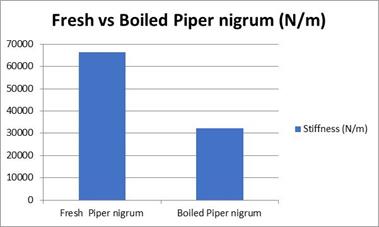
To prove the assumption of the effect of the Piper nigrum pericarps peeled off on the stiffness measurement result, a simpler experiment was conducted. The simplification method was chosen because it is not always easy to obtain good Piper nigrum samples, especially during the Piper nigrum season. Two bundles of Piper nigrum berries were tested. The one bundle comprised of fresh Piper nigrum berries. The other bundle were fresh Piper nigrum berries that were boiled for five minutes. Then the hardness of both Piper nigrum bundles was tested.
Figure 4 shows that the hardness of the boiled Piper nigrum bundle was lower than that of the one that was not boiled at all. This result is in agreement with the theory and serves as evidence that strengthens the above assumption, namely, the prolonged soaking has changed the stiffness of Piper pericarp due to the impact of the seed emergence.
Another experiment was conducted. There were three groups of Piper nigrum bundles. Each group represented a sample of low, moderate, and high density. The samples
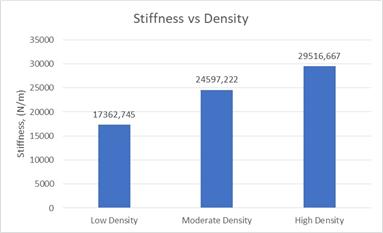
were soaked for three days.
Figure 5 shows that the higher the density, the lower the stiffness of the Piper nigrum pericarps. This result aligns with the expected outcome.
The additional experiments yielded different results compared to the main experiment. This fact was due to many parts of the Piper nigrum pericarp being peeled off in the main experiment, whereas in the additional experiments, the Piper nigrum pericarp remained intact. In normal conditions, the interaction between two independent variables (temperature and density, temperature and sacking, and density and sacking) and among three independent variables (temperature, density, and sacking) would affect the stiffness decrement of Piper nigrum pericarp. The reality, as observed in the main experiment, did not support this claim. The more the emergence of seeds - that much harder than pericarps – the higher the measurements of the stiffness.
4. Conclusion
Based on the above discussion, two conclusions can be drawn as follows:
If the soaking has not peeled off the pericarp bundles, then the independent variables affected the stiffness measurement of Piper nigrum pericarp bundles in a regular manner, such as the higher the water temperature, the lower the stiffness measurement of Piper nigrum pericarp bundles.
In case the soaking of Piper nigrum bundles has caused some parts of the Piper nigrum pericarp to peel, the stiffness measurement of Piper nigrum pericarp bundles might give unexpected results. A lower water temperature, for example, might show lower stiffness measurements of the Piper nigrum pericarp bundles, because the measurements of pericarp bundles were unexpectedly replaced with the measurements of the pericarps and their seeds
Acknowledgements
The authors wish to express their gratitude to the Ministry of Agriculture of the Republic of Indonesia for its support through research funding, as outlined in contract number B254/TU.020/B.3/04/2024 (Simulator Pengendali Perendaman Lada) associated with the UPLAND Project. This initiative, supported by the Islamic Development Bank (IsDB) and the International Fund for Agricultural Development (IFAD), aims to enhance the agricultural productivity, incomes, livelihoods, and resilience of smallholder farmers in the targeted regions. Additionally, the authors would like to acknowledge the Research Center for Photonics and the Deputy for Research and Innovation Infrastructure (DIRI) within the National Research and Innovation Agency (BRIN) of Indonesia for their valuable contributions
References
- D. Rustandi, Irmansyah, S. Wijonarko, M. Kurniati and T. Maftukhah, "The role of thermal and electrical energies to increase the pepper quality: A review," in IOP Conf. Series: Earth and Environmental Science 1344, Bali, 2024.
- D. Rustandi, Irmansyah, M. Kurniati, S. Wijonarko, S. W. Hidayat, T. Maftukhah and Mahmudi, "A control system for pepper submersion tub actuators," in Journal of Physiscs: Conference Serries, 2973 012009, doi:10.1088/1742-6596/2973/1/012009, Belitung, 2025.
- G. Wu, C. Zhang, X. Li, Z. Niu, X. Jiang, J. Zhang, L. You, J. Li, Y. Liu, Y. Liu, H. Wu and W. Hu, "Purification and characterization of a novel peroxidase from pepper (Piper nigrum L.)," LWT - Food Sci. Technol.,, vol. 214, pp. 1-10, doi:10.1016/j.lwt.2024.117149, 2024.
- S. A. Purnamasari and D. Setyaningsih, "The drying temperature impact on curcumin - piperine dissolution and its kinetic release: Application of a spray dryer on the preparation of solid dispersion-based microparticle containing curcuma longa and Piper nigrum extracts," J. Res. Pharm.,, vol. 27, no. 4, p. 1329–1337 (2023). doi:10.29228/jrp.420..
- J. P. M. OliveiraI, G. O. EvertonI and V. E. M. Filho, "Green synthesis and biotechnological profile of silver nanoparticles using Piper nigrum L. essential oil," Ciência e Nat., vol. v, no. 46, pp. 1–19, doi:10.5902/2179460X74388, 2024.
- M. Khajeh, M. Ghaffari-Moghaddam, A. B. J. Piri, H. Senol and D. Saloglu, "Using microwave-assisted extraction with advanced artificial intelligence models for predicting tannins in black pepper (Piper nigrum L.)," J. Appl. Res. Med. Aromat. Plant, vol. 44, p. 1–8 (2025). doi:10.1016/j.jarmap.2024.100594, 2025.
- R. Varghese and J. G. Ray, "Ecology of endomycorrhizal association in black pepper (Piper nigrum L.), South India," J. Appl. Res. Med. Aromat. Plants, vol. 45, pp. 1–20, doi:10.1016/j.jarmap.2024.100617., 2025.
- E. Sampepana, A. Rinaldi, T. Nurwidayati and S. H. Saputra, "Moisture content, piperine and essential oils of pepper produced by SME Samboja, SME Bontang and those circulated in Samarinda market," JRTI, vol. 42, pp. 275–283, doi:10.26578/jrti.v1, 2020.
- BSN, SNI 01- 0005-1995 Lada Hitam, Jakarta: BSN, 1995.
- BSN, SNI 0004:2013 Lada Putih, Jakarta:: BSN, 2013.
- S. M. Somashekar, K. K. Subraya, S. K. Vijayan and S. B. Pillai, "Pericarp as a new berry trait to define dry recovery and quality in black pepper (Piper nigrum L.)," Sci. Hortic. (Amsterdam), vol. 281, pp. 1–7, doi:10.1016/j.scienta.2021. 1099, 2021.
- J. T. Sulhatun, "Pemanfaatan lada hitam sebagai bahan baku pembuatan oleoresin dengan metode ekstraksi," J. Teknol. Kim. Unimal, vol. 22, p. 16–30, 2013.
- N. S. Aziz, N. S. S. Seng, N. S. M. Razali, S. J. Lim and W. A. W. Mustapha, "A review on conventional and biotechnological approaches in white pepper production," Sci Food Agric,, vol. 99, no. 6, pp. 2665–2676, doi:10.1002/jsfa.9481, 2019.
- R. W. Arief, D. R. Mustikawati and R. Asnawi, "Karakteristik mutu lada hitam dan lada putih dari beberapa kabupaten sentra lada di Lampung," in Seminar Nasional dalam Rangka Dies Natalis ke-44 UNS Tahun 2020 Strategi Ketahanan Pangan Masa New Normal Covid-19, pp. 111–116, 2022.
- Y. Fu, S. C. X. Wang, L. Wang, Z. Wang, Y. Cheng, Y. Liu, L. Zhang, S. Liu, J. Kang and C. Li, "Insights into the correlation between microbial community succession and pericarp degradation during pepper (Piper nigrum L.) peeling process via retting," Foods, vol. 12, pp. 1–14, doi:10.3390/foods13111615, 2024.
- E. Karmawati, I. K. Ardana, Siswanto and D. Soetopo, "Factors effecting pepper production and quality in several production center," in IOP Conference Series: Earth and Environmental Science, 1–10, doi:10.1088/1755-1315/418/1/ 012051, 2020.
- P. N. M. A. Azman, R. Shamsudin, H. C. Man and M. E. Ya’acob, "Effects of flowing water on soaking water quality during the retting process of pepper berries (Piper Nigrum L.)," Adv. Agric. Food Res. J.,, vol. 3, no.1, p. 1–10.doi:10.36877/aafrj.a, 2022.
- Kamila, R. Kusmiadi and N. S. Aini, "Impact aisessment of immersion time delaying and threshing on quality of Muntok white pepper," J. Bioind., vol. 01, no. 02, p. 213–228, 2019.
- Hernani, T. Hidayat and E. Sukasih, "Processing of white pepper through the combination of soaking and boiling time towards the quality," Int. J. Technol., vol. 14, no. 5, pp. 1147–1156, doi:10.14716/ijtech.v14i5.4169, 2023.
- V. Vinod, A. Kumar and T. J. Zachariah, "Isolation, characterization and identification of pericarp-degrading bacteria for the production of off-odour-free white pepper from fresh berries of Piper nigrum L.," J. Appl. Microbiol., vol. 116, pp. 890--902, doi:10.1111/jam.12431, 2014.
- R. Kusmiadi, S. N. Aini and Nurkholis, "Analysis of mature and physiological aspects of soaking method physical and chemical white pepper (Muntok White Pepper)," Agrosainstek, vol. 1, no. 1, p. 39–48, 2017.
- P. N. M. A. Azman, R. Shamsudin, H. C. Man and M. E. Ya’acob, "Kinetics of quality changes in soaking water during the retting process of pepper berries (Piper nigrum L.)," Processes, vol. 8, pp. 1–11, doi:10.3390/pr8101255, 2020.
- Y. Huang, X. Wang, Y. Lyu, Y. Li, R. He and H. Chen, "Metabolomics analysis reveals the non-enzymatic browning mechanism of green peppers (Piper nigrum L.) during the hot-air drying process," Food Chem., vol. 464, pp. 1–14, doi:10.1016/j.foodchem, 2025.
- M. H. Hamzah, A. S. Amran, A. F. A. Hamzah, M. Z. M. Nor, R. Shamsudin, H. C. Man and W. A. W. Razali, "Durian waste husks as an adsorbent in improving soaking water during the retting process of Piper nigrum L. (Pepper Berries)," Separations, vol. 10, no. 96, pp. 1–15, doi:10.3390/separations10020096, 2023.
- S. Desai, V. S. Sharanagat and P. K. Nema, "Dielectric Roasting Induced Physical, Mechanical, and Grinding Characteristics of Black Pepper (Piper nigrum)," J. Food Process. Preserv., vol. 1, pp. 1–12, doi:10.1155/2023/9052417, 2023.
- S. Gutt, G. Gutt, T.-L. Severin, S. Mironeasa, M. Poroch-Seritan and F.-C. Alexuc, "Equipment for material testing and advanced characterization," in Intelligent Manufacturing & Automation: Power Of Knowledge And Creativity, 697–698, 2011.
- S. Gutt, G. Gutt, T.-L. Severin, M. Poroch-Seritan, S. Mironeasa and M. A. Oroian, "Portable hardness tester," in Proceedings of the 22nd International DAAAM Symposium, B. Katalinic, Ed., Vienna: DAAAM International, 0699–0700, 2011.
- G. Gutt, S. Gutt, M. Poroch-Seritan, T.-L. Severin and S.-G. Stroke, "Contribution regarding the achievement of portable hardness tester and it’s applications," Metal, vol. 20, no. 5, p. 1–17, 2011.
- A. Vaško, J. Sovík and M. Krynke, "Determination of accuracy and reliability of portable hardness testers," Qual. Prod. Improv., vol. 1, no. 1, pp. 289–295, doi:10.2478/9783110680591-039, 2019.
- F. R. Harker, R. L. Amos, G. Echeverría and F. A. Gunson, "Influence of texture on taste: Insights gained during studies of hardness, juiciness, and sweetness of apple fruit," J. Food Sci., vol. 71, no. 2, p. S77–S82, 2006.
- S. K. R. Shreelavaniya, "Effect of moisture content on physical properties of black pepper," Int.J.Curr.Microbiol.App.Sci,, vol. 6, no. 10, pp. 4873–4879, doi:10.20546/ijcmas. 2017.610.456, 2017.
- W. S. Q. L. C. L. J. L. S. Li, "Assessing fruit hardness in robot hands using electric gripper actuators with tactile sensors," Sensors Actuators A. Phys., vol. 365, pp. 1–10, doi:10.1016/j.sna.2023.114843, 2024.
- Z. Zhang, J. Zhou, Z. Yan, K. Wang, J. Mao and Z. Jiang, "Hardness recognition of fruits and vegetables based on tactile array information of manipulator," Comput. Electron. Agric., vol. 181, pp. 1–10, doi:10.1016/j.compag.2020.105959, 2021.
- J. A. Prakosa, P. Purwowibowo, E. Kurniawan, S. Wijonarko, T. Maftukhah, D. Rustandi, E. B. Pratiwi and R. Rahmanto, "Experimental design of fast terminal sliding mode control for valve regulation under water load uncertainty for precision irrigation," Actuators, vol. 12, no. 155, pp. 1-13, 10.3390/act12040155, 2023.
- E. Kurniawan, J. A. Prakosa, H. Wang, S. Wijonarko, T. Maftukhah, P. Purwowibowo, H. Septanto, E. B. Pratiwi and D. Rustandi, "Design of fractional order odd-harmonics repetitive controller for discrete-time linear systems with experimental validations," Sensors, vol. 22, pp. 1-17, 2022.
- B. H. Sirenden, P. Mursanto and S. Wijonarko, "Galois field transformation effect onspace-time-volume velocimetry methodfor water surface velocity video analysis," Multimedia Tools and Applications, pp. 1-22, 10.1007/s11042-022-13627-z, 2022.
- S. Wijonarko and T. Maftukhah, "Instrumentation system for water balance measurements on Serkuk subbasin, Kubu watershed, Belitung," in AIP Conference Proceedings, Yogyakarta, 2016.
- T. Maftukhah, S. Wijonarko, Purwowibowo, D. Rustandi, Mahmudi, S. W. Hidayat, J. A. Prakosa, E. Kartarajasa and I. M. Siburian, "A method to present the uniqueness for uniform program applied in irrigation telecontrol," Evergreen, vol. 10, no. 03, pp. 1708-1716, 2023.
- A. Kumar, A. K. Chanda and S. Angra, "Numerical modelling of a composite sandwich structure having non metallic honeycomb core," Evergreen, vol. 8, no. 4 doi.org/10.5109/4742119,pp. 759-767, 2021.
- C. T. Murthy and S. Bhattacharya, "Moisture dependant physical and uniaxial compression properties of black pepper," J. Food Engineeting, vol. 37, p. 193–205, 1998.
- P. N. M. A. Azman, R. Shamsudin, H. C. Man and M. E. Ya’acob, "Some physical properties and mass modelling of pepper berries (Piper nigrum L.), variety Kuching, at different maturity levels,”," Processes, vol. 8, pp. 1–15, 10.3390/pr8101314, 2020.
- S. Usmiati and N. Nurdjannah, "Pengaruh lama perendaman dan cara pengeringan terhadap mutu lada putih," J. Tek. Ind. Pert., vol. 16, no. 3, p. 91–98, 2007.
- L. Yu, X. Hu, R. Xu, Y. Ba, X. Chen, X. Wang, B. Cao and X. Wu, "Amide alkaloids characterization and neuroprotective properties of Piper nigrum L.: A comparative study with fruits, pericarp, stalks and leaves," Food Chem., vol. 368, pp. 1–8, doi:10.1016/j.foodchem.2021. 130832, 2022.
- A. N. S. A. Khorairi, N.-S. Sofian-Seng, R. Othaman, N. S. M. Razal and K. F. Kasim, "Assessment of natural cellulosic powder from pepper pericarp waste (Piper nigrum L.) after alkalization and bleaching treatment: Effect of alkali concentration and treatment cycle," Sains Malaysiana, vol. 51, no. 4, pp. 1061–1074, doi:10.17576/jsm-2022-5104-09, 2022.
- T. Hidayat, Risfaheri and N. Nurdjannah, "Pengaruh perlakuan buah lada sebelum pengupasan dan kecepatan putaran piringan terhadap kinerja alat pengupas lada yang dimodifikasi," Buletin Penelitian Tanaman Rempah dan Obat, pp. 19–28, 2002.
- K. Valenta, H. D. Bhramdat, G. V. Calhoun, D. J. Daegling and O. Nevo, "Variation in ripe fruit hardness: a mechanical constraint?," Oikos, vol. 2022, no. 2, p. 10.1111/ oik.08074.
- A. Kumar, A. K. Chanda and S. Angra, "Optimization of Stiffness Properties of Composite Sandwich," Evergreen, vol. 08, no. 02, pp. 310-317, 2021.
- S. Wijonarko, D. Rustandi, T. Maftukhah, Purwowibowo, A. Setiono, D. Hanto, H. Pratomo, S. W. Hidayat and Mahmudi, "Metode jatuhan dan alat ukur kekerasan kulit lada sehabis perendaman". Indonesia Patent Patent P00202410229, 2024.
- N. Z. A. Bakar and M. H. Padzillah, "Comparison between computational fluid dynamics and fluid-structure interaction models of an automotive mixed flow turbocharger turbine," Evergreen, vol. 11, no. 02, pp. 1457-1470, 2024.
- Ganta, M. Gezahagn and M. Patel, "Evaluation of mechanical and thermal properties of alkali-treated sisal, bamboo, and hybrid fiber-reinforced polymer composites," Evergreen, vol. 11, no. 3, pp. 1784-1797, 2024.
- W. Navidi, Statistics for Engineers and Scientists, New York:: McGraw-Hill Education, 2020.
- V. Ordonez, H. Baykara, A. Riofrio, M. Cornejo and R. Rodríguez, "Preparation and characterization of ecuadorian bamboo fiber-low-density polyethylene (LDPE) biocomposites," Evergreen, vol. 10, no. 01, pp. 43-54, 2023.
- H. Sosiati, Hidayatullah and S. Hamdan, "Effect of woven e-glass and bamboo stacking sequences on the properties of laminated composites using polyester matrix filled with eggshell microparticles," Evergreen, pp. 693-700, 2024.
- D. Ariawan, W. P. Raharjo, K. Diharjo, W. W. Raharjo and B. Kusharjanta, "Influence of water immersion on flexural and impact strength of microcrystalline cellulose- added unsaturated polyester-matriced composites strengthened by untreated, fumigated and alkalized cantala fibers," Evergreen, vol. 11, no. 03, pp. 2164-2174, 2024.
- M. G. Ganta and P. Mahaboob, "Evaluation of mechanical and thermal properties of alkali treated sisal, bamboo, and hybrid fiber-reinforced polymer composites," Evergreen, vol. 11, no. 03, pp. 1784-1797, 2024.