
Abstract
Magnesium based composites have emerged as potential material in biomedical applications owing to its biocompatibility and strength. Present work fabricates the Magnesium-Aluminium with insitu reinforced zirconium diboride composites (Mg-Al/ZrB2). Synthesis was conducted in the presence of Argon gas through electric resistance furnace using stir casting route. XRD analysis was performed to see the presence of elements which confirmed the presence of Mg, Al and ZrB2peaks. Further Optical microscopy study was conducted to analysis the behaviour of microstructural features of alloy and composites. It was observed that inclusions of insitu formed ZrB2 results in significant reduction in average grain size. Further, SEM was employed to see the presence of particle, particles distribution, their shape and size. SEM reveals uniform distribution of ZrB2 particles with hexagonal morphology. However, some agglomeration is also evident which is due to nano particles size of reinforced particles. Also, some porosity is also visible in composite which is further confirmed through density and porosity investigation. Further the Vickers hardness test and ultimate tensile test was performed to analysis the mechanical behaviour of alloy and composites. Results clearly demonstrate increase in Vickers hardness value by ~ 67% and tensile strength ~ 30 % of composite when compared with Mg-Al alloy.
Keywords: Characterization, Fabrication, Insitu composite, mechanical properties, Mg-Al alloy
Outline
1. Introduction
Magnesium (Mg) and its alloys have garnered significant interest in therecent past owing to their excellent properties for a variety of applications, particularly in the biomedical field. Magnesium's low density (1.74 g/cm³), high specific strength, and natural biodegradability make it an attractive material for applications such as orthopedic implants1). More importantly, Mg's biocompatibility and ability to degrade in biological environments eliminate the requirement for a second surgery to remove the implant, reducing patient risk and medical costs2).However, pure Magnesium suffers from several drawbacks, including lowmechanical strength and rapidcorrosion rates, which restrictsits use inload-bearing applications, magnesium alloys have been developed, with the incorporation of alloying elements such as aluminium (Al) to enhance mechanical strength, corrosion resistance, and overall performance3). Mg-Al alloys, such as AZ series alloys (e.g., AZ31, AZ91), are among the most widely researched magnesium alloys. Aluminium serves to increasethe hardness and tensile strength of magnesium alloys while reducing grain size through precipitation hardening. Despite these improvements, Mg-Al alloys still exhibit insufficient mechanical strength and corrosion resistance for long-term biomedical applications, particularly in harsh physiological environments4).
As a result,there has beena growing focus on developing Mg-Al-based composites that incorporate ceramic reinforcements to further enhance their mechanical properties and corrosion behavior5). Composites offer the advantage of combining the desirable properties of a metal matrix with the high hardness and strength of ceramic reinforcements6,7). Among various ceramic reinforcements, zirconium diboride (ZrB2) has emerged as a promising candidate due to its excellent hardness, high melting point, and chemical stability8,9). ZrB2's high biocompatibility also aligns with the stringent requirements for biomedical applications, making it an ideal reinforcement for Mg-Al-based composites10).
The synthesis of Mg-Al based composites has become essential for improving the mechanical characteristics and corrosion resistance of magnesium alloys for biomedical applications11). The use of ZrB2 as an in-situ reinforcement creates a strong interfacial bonding between the matrix and the reinforcement particles, which increases the load transfer and results in better performance under tensile loading10). Studies have demonstrated that in-situ formed reinforcements have superior bonding and mechanical properties compared to ex-situ reinforcements, w1here ceramic particles are mechanically mixed with the metal matrix12,13).
Among the various fabrication methods, the stir casting route has been chosen for the synthesis of Mg-Al/ ZrB2composites due to its simplicity, cost-effectiveness, and ability to produce uniform dispersions of reinforcement particles14,15). Stir casting involves an introduction of a reactive element or compound into the molten magnesium alloy to form the reinforcement in-situ, avoiding the issues of poor interfacial bonding and agglomeration that often occur with ex-situ techniques16). Furthermore, the use of an argon gas atmosphere during the casting process helps to minimize oxidation, ensuring the quality and purity of the final composite material. Stir casting is a scalable technique, making it suitable for industrial production, which is critical for developing biomaterials for commercial biomedical applications17,18).
In this context, the current research aims to synthesize in-situ composites using stir casting and to characterize the microstructure and mechanical behavior of the composites. The study focuses on investigating the influence of in-situ formed ZrB2particles on the grain structure, hardness, and tensile strength of Mg-Al alloys, with the goal of developing a composite material that meets the mechanical and biocompatibility requirements for biomedical implants. By enhancing the mechanical properties of Mg-Al alloys, the study seeks to overcome the limitation of conventional magnesium alloys and contribute to the development of next-generation biodegradable implants for enhanced load-bearing applications.
2. Materials and Methodology
To fabricate the alloy and composites, commerciallyavailable pure Mg (purity ≥ 99.89 %), Al (purity ≥ 99.9 %), and inorganic salts of Potassium Fluoro-zirconate (K2ZrF6) and Potassium tetrafluoroborate (KBF4) were procured from India mart. To fabricate the alloy, Mg and Al were taken in the ratio of 95 and 5 weight percent respectively. Initially, the furnace temperature was set at 680°C, and the required amount of Mg and Al in the form of small ingots were kept in graphite crucible having capacity of 5 liter. The heating rate was set 4°C/minute, and holding time was set for 45 minutes. The continuous supply of Argon gas was maintained to create inert atmosphere. After holding for 45 minutes at 680°C the molten alloy was poured into preheated (at 200°C for 2 hour) cast iron Mold having size of 50mm× 50 mm × 170 mm. For the fabrication of composites, initially the furnace temperature was set at 780°C, and required amount of Al ingots was kept in graphite crucible was placed in furnace. Once the temperature reached at 780°C, the preheated (at 120°C for 1 hour to remove the moisture presents) inorganic salts of K2ZrF6 and KBF4 wrapped in Al foil was charged into furnace. To form insitu ZrB2, intermittent stirring (10 minutes stirring followed by 3 minutes holding) using mechanical stirrer having stainless steel blade was performed for 39 minutes at 200 rotations per minute (rpm). Once the reaction was completed the temperature was lowered at 680°C, and small ingots of preheated (at 100°C for 1 hour) Mg was incorporated into melts and was hold till the Mg was in molten condition. After the melting of Mg, once again the 10 minutes stirring was performed at 200 rpm for homogenization. Finally, the casted samples were poured in preheated mould and allowed to cool at atmospheric temperature. The three composites were fabricated having ZrB2 weight percentage (wt. %) 1, 3, and 5 respectively. During the whole fabrication process of composites, the continuous supply of Ar gas was maintained. The following likely reaction may have taken place to form the insitu ZrB2 particles in the melts.In the reactions, Aluminum reacts with the boron obtained from the decomposition of KBF4 to form AlB2 which is an intermediate boride.In the presence of Al, K2ZrF6 decomposes and forms Al3Zr. Now both AlB2 and Al3Zr are intermediate forms that combines together to form ZrB2 (an in situ formation) within the Al matrix and releasing excess Al back to the melt. The reaction takes place on the basis of negative Gibbs free energy concept. The decomposition of KBF4 and K2ZrF6is occurred due to the presence of Al, which is a strong reducing agent. At last, thermodynamically stable compounds are formed in which total enthalpy decreases and net entropy increases19).
3. Characterization and Testing
Desktop XRD of Malvern Pananalytical technique was employed to find the peaks present in the alloy and composites. XRD study was performed for 2θ values of 10°-90° with scan rate of 10° per minute. Because, at an angle of less than 10°, it has been observed from the literature that the peaks obtained are weak and has a probability of overlapping with noise or amorphous phase. Whereas, at an angle greater than 90°, the noise increases that leads to significant drop in the intensity. Optilux optical microscopy of Lietz was used to analyze the optical microstructure of alloy and composites. The square cross section of sample (20 mm × 20 mm × 10 mm) was prepared from as cast sample. Set of emery papers was used for grinding the surface followed by cloth polishing of
specimen. Once the sample was free from scratch, the acetic Picralwas used as etchant to find out the grain boundaries. Further, JEOL Bench top scanning electron microscopy (SEM) was utilized to see the particles size, shape and distribution of particles in the matrix. Experimental density was determined using Archimedes principal and porosity was calculated using ratio of difference of theoretical density to experimental density over theoretical density.
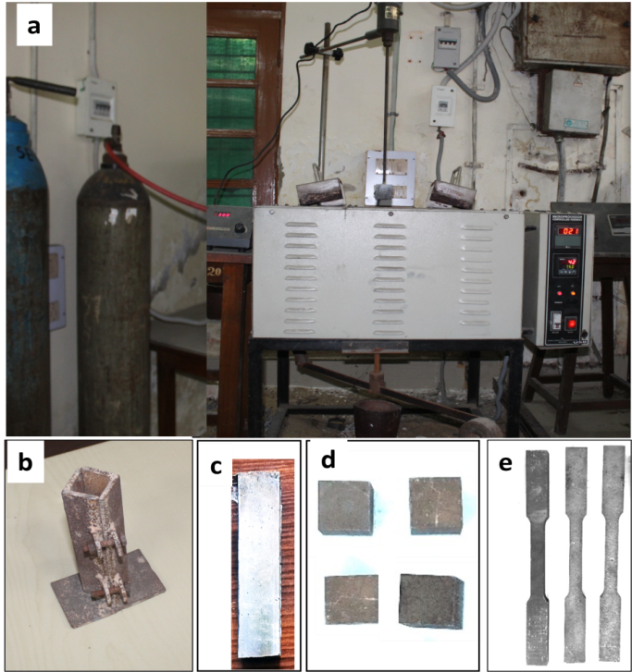
To study the impact of reinforced particles on mechanical properties, the hardness and tensile test was performed using Vickers hardness and ultimate tensile strength set up according to ASTM standard E384 and E8 respectively. Figure 1 shows the stir casting set up; Mold made of cast iron along with prepared samples for various study.
4. Results and Discussion
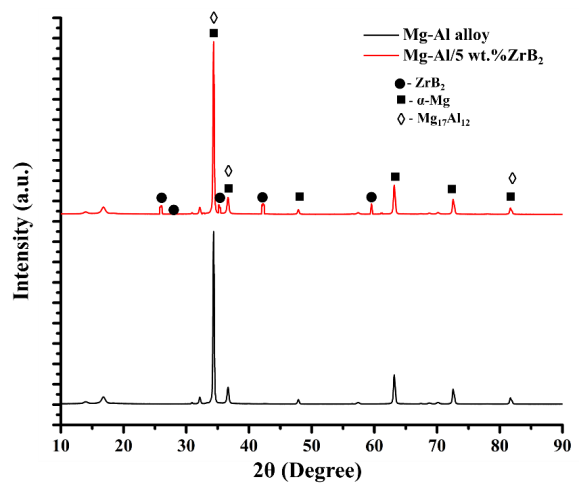
Figure 2 presents the X ray diffractometer (XRD) image of Mg-Al alloy and Mg-Al/5wt.% ZrB2 composites. It can see from the image that in the case of alloy, the peaks of Mg and alloy of Mg i.e. Mg17Al12is present while for composites along with peaks of Mg and MG17Al12, presence of ZrB2 can be seen, which confirms the presence of reinforced particles in matrix.
Figure 3 shows the optical microstructure (OM) of Mg-Al alloy and Mg-Al/5 wt.% ZrB2 composite. Figure 3 (a) shows the OM of Mg-Al alloy. The white region shows the α- Mg (magnesium-rich phase), while the darker region presents the Mg17Al12 phase. Figure 3 (b) shows the OM of Mg-Al/5 wt.% ZrB2. A finer grain structure can be seen in the case of composites. This reduction in grain size is due to the insertion of reinforced particles, which act as a secondary phase leading to the region of generation of
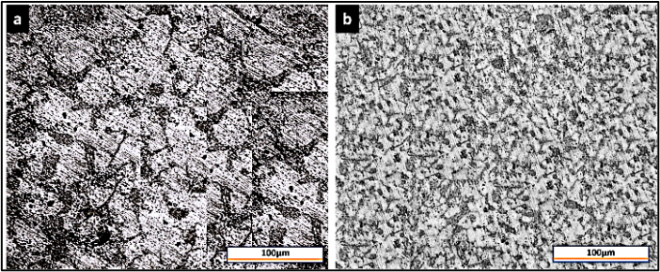
nucleation sites, which further hinders grain growth. Further, mismatch in the thermal coefficient of hard ZrB2 particles with Mg-Al causes a restriction in grain growth, thus finer grain structure19-21). The average grain size was determined in accordance with ASTM E112 standard. At least five random fields were analyzed per sample to ensure statistical accuracy and given in Figure 522). In the linear intercept method, a set of straight, evenly spaced lines is superimposed over a micro structural image. These lines intersect grain boundaries, and each intersection point is counted. The basic idea is that the more the intersections the smaller the grain size. The average grain size is then calculated by dividing the total length of all test lines by the number of intercepts. This gives an estimate of the mean linear intercept length, which represents the average grain diameter. This can be observed that for Mg-Al alloy the average grain size is in the range of 27µm while decreases with addition of ZrB2 and is observed to be lowest with reinforcement of 5 wt.% of ZrB2 having order of 8µm.
Figure 4 presents the SEM image of Mg-Al/5wt.% ZrB2 composites. This can be observed from the Figure 4(a) that particles are uniformly distributed with slight agglomerations which may be because of very fine size of the particles. Further Figure 4(b) shows the SEM image of particles at higher magnification which clearly demonstrate the shape and size of reinforced particles i.e. hexagonal shape23-25). Also, the average particles size was
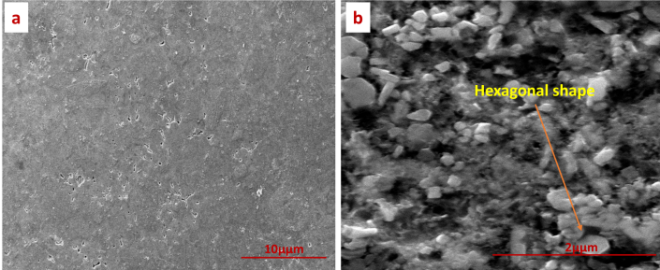

determined using Image J software from SEM micrograph and found to be 0.1µm.
Figure 5 shows the physical properties (i.e. experimental densities and % porosity) and average grain size of the alloy and composites (Figure 4). It can be observed from Figure 4. That the mixing of ZrB2 and Al is fairly homogenous however, at some sites the ZrB2 agglomeration is noted which is probably attributed to the uneven cooling and shrinkage of boundaries due to solidification. The observed decrease in experimental density, despite the use of high-density reinforcement particles can be attributed to the presence of micro-porosity and possible particle agglomeration during solidification26). These defects reduce the overall compactness of the matrix, leading to a lower measured density compared to the theoretical value27). This observed porosity may be attributed to more stirring speed and trapping of atmospheric gases at the time of pouring 28). In addition to, phenomena such as grain boundary pinning (due to local grain coarsening), etching, and settlement of ZrB2 particle due to not rapidly cooling are some of the probable reasons of density difference.
Figure 6 presents the mechanical (hardness and tensile strength) of Mg-Al alloy and its composites. This can be seen that with addition of ZrB2, there is significant improvement in hardness with respect to Mg-Al alloy and maximum for Mg-Al/ 5 wt. % ZrB2 composites. This is due to high hardness properties of reinforced particles which results in an increase in bulk hardness. Further, reinforced
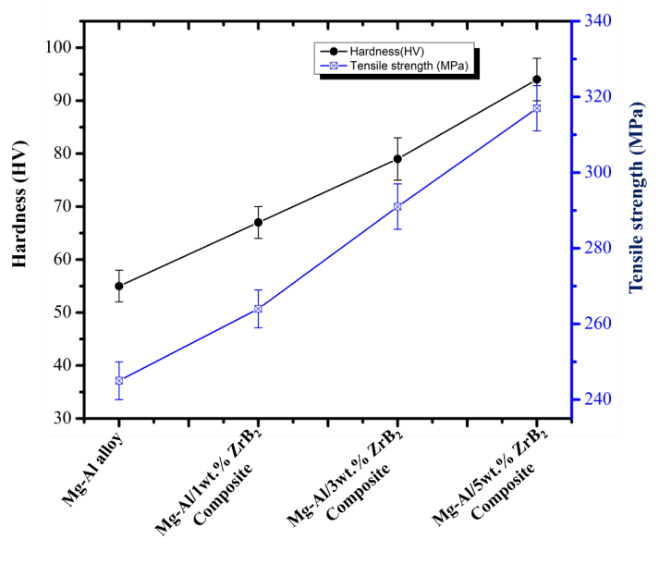
ZrB2 particles and Mg-Al alloy exhibits mismatch in thermal coefficient of expansion which results in increase in dislocation density thus causing restriction to plastic deformation further leading to rise in hardness10,29,30).
Tensile behaviour of Mg-Al alloy and its composites was investigated at atmospheric temperature as given in Figure 6. This can be observed that with reinforcement of ZrB2 particles, there is a significant rise in tensile strength of matrix of Mg-Al alloy and is maximum for Mg-Al/5 wt.% ZrB2. The increase in tensile strength results from the refinement of matrix grains caused by the introduction of ZrB2 particles, as explained in the previous section. This grain refinement leads to improved tensile strength, which can be explained by the Hall-Petch relationship in which the particles of ZrB2 serve as heterogeneous nucleation sites that result in refined grain structure in the Al metal matrix. During tensile loading, dislocations are generated, and the second-phase particles obstruct their movement due to decrease in grain size and increase in total grain boundaries area, thereby contributing to the strengthening effect31-34). Additionally, the mismatch in the thermal expansion coefficients between the matrix and particles further raises the dislocation density, enhancing the strength35).
5. Conclusions
The Mg-Al alloy and Mg-Al/ZrB2 in situ composites were successfully synthesized using the stir casting technique, with ZrB2 reinforcement varying from 0 to 5 wt.%. Key observations include:
The in-situ formation of ZrB2 particles significantly refined the grain structure, achieving up to ~70% grain refinement with 5 wt.% ZrB2 addition.
Homogeneous dispersion of ZrB2 particles in the matrix was achieved, contributing to enhanced mechanical properties.
Vickers hardness increased notably from 55 HV to 92 HV at 5 wt.% ZrB2.
Tensile strength improved by ~30% for the Mg-Al/5 wt.% ZrB2 composite compared to the base Mg-Al alloy.
With superior hardness and tensile strength, the newly developed Mg-Al/5 wt.% ZrB2 composite holds promising potential for biomedical applications, particularly in load-bearing implants and devices where strength and biocompatibility are crucial.
References
- S. V. S. Prasad, S. B. Prasad, K. Verma, R. K. Mishra, V. Kumar, and S. Singh, “The role and significance of Magnesium in modern day research-A review,” J. Magnesium Alloys, 10(1), 1–61 (2022). https://doi.org/10.1016/j.jma.2021.05.012. [DOI]
- V. Tsakiris, C. Tardei, and F. M. Clicinschi, “Biodegradable Mg alloys for orthopedic implants – A review,” J. Magnesium Alloys, 9(6), 1884–1905 (2021). https://doi.org/10.1016/j.jma.2021.06.024. [DOI]
- K. Munir, J. Lin, C. Wen, P. F. A. Wright, and Y. Li, “Mechanical, corrosion, and biocompatibility properties of Mg-Zr-Sr-Sc alloys for biodegradable implant applications,” Acta Biomater., 102, 493–507 (2020). https://doi.org/10.1016/j.actbio.2019.12.001. [DOI]
- Z. Yang, J. Li, J. Zhang, G. Lorimer, and J. Robson, “Review on research and development of magnesium alloys,” Acta Metall. Sin. (Engl. Lett.), 21, 313–328 (2008). https://doi.org/10.1016/S1006-7191(08)60054-X. [DOI]
- J. Y. Ren, G. C. Ji, H. R. Guo, Y. M. Zhou, X. Tan, W. F. Zheng, Q. Xing, J. Y. Zhang, J. R. Sun, H. Y. Yang, F. Qiu* and Q. C. Jiang, “Nano-enhanced phase reinforced magnesium matrix composites: A review of the Matrix, Reinforcement, Interface Design, Properties and Potential Applications,” Materials, 17(10), 2454 (2024). https://doi.org/10.3390/ma17102454. [DOI]
- R. Maurya, V. Kumar, S. Gautam, S. Bharti, and S. Mallika, “Investigation of microstructural and mechanical characteristics of Al-ZrO2 composites fabricated by stir casting,” Interactions, 245, 301 (2024). https://doi.org/10.1007/s10751-024-02163-x. [DOI]
- L. Ranakoti, P. Bhandari, M. K. Gupta, K. Kumar, S. Bhatia, S. Kosaraju, and Jarnail Singh, “Ceramic matrix composite reinforced with glass and walnut shell filler: Influence of mesh size on its mechanical properties,” Mater. Today Proc., (2023). https://doi.org/10.1016/j.matpr.2023.08.106. [DOI]
- V. Kumar, A. Singh, Ankit, and Gaurav Gautam, “A comprehensive review of processing techniques, reinforcement effects, and performance characteristics in copper-based metal matrix composites,” Interactions, 245, 357 (2024). https://doi.org/10.1007/s10751-024-02200-9. [DOI]
- A. L. Chamberlain, W. G. Fahrenholtz, G. E. Hilmas, and D. T. Ellerby, “High-strength zirconium diboride-based ceramics,” J. Am. Ceram. Soc., 87, 1170–1172 (2004).
- V. Kumar, A. Mishra, S. Mohan, and A. Mohan, “Fabrication of stir cast ZA/ZrB2 reinforced in-situ composites,” Mater. Res. Express, 6(12) (2019). https://doi.org/10.1088/2053-1591/ab53f2. [DOI]
- A. Verma and S. Ogata, “Magnesium based alloys for reinforcing biopolymer composites and coatings: A critical overview on biomedical materials,” Adv. Ind. Eng. Polym. Res., 6(4), 341–355 (2023). https://doi.org/10.1016/j.aiepr.2023.01.002. [DOI]
- J. D. R. Selvam and I. Dinaharan, “In situ formation of ZrB2 particulates and their influence on microstructure and tensile behavior of AA7075 aluminum matrix composites,” Eng. Sci. Technol. Int. J., 20(1), 187–196 (2017). https://doi.org/10.1016/j.jestch.2016.09.006. [DOI]
- S. Tripathi, A. Bhadauria, A. Tiwari, and A. K. Tiwari, “Effect of carbonaceous reinforcements on mechanical properties of ZrB2-SiC composites via nanoindentation study,” Diamond Relat. Mater., 140, 110537 (2023). https://doi.org/10.1016/j.diamond.2023.110537. [DOI]
- V. Kumar, L. Ranakoti, G. Gautam, A. Negi, T. Singh,“Erosive wear and topographical study of zinc-aluminum based composite reinforced with in-situ formed ZrB2 particles,” Results Eng., 22, 102346 (2024). https://doi.org/10.1016/j.rineng.2024.102346. [DOI]
- E. Suneesh, and M. Sivapragash, “Comprehensive studies on processing and characterization of hybrid magnesium composites,” Mater. Manuf. Process,33(12), 1324-1345(2018).https://doi.org/10.1080/10426914.2018.1453155 [DOI]
- M. A. M. D. L. Sanchez, J. Duarte, B. J. Santos, L.E. C. Garcia, J. M. Ruiz-Roman, and F. J. Elorza, “Stir Casting Routes for Processing Metal Matrix Syntactic Foams: A Scoping Review,” Processes, 10(3), 478 (2022). https://doi.org/10.3390/pr10030478. [DOI]
- P. K. Gurmaita, R. Pongen, and S. K. Gurmaita, “A7075 alloy reinforced metal matrix composites fabricated through stircasting route: a review,” Int. J. Cast Met. Res., 37(3), 208-255(2024).https://doi.org/10.1080/13640461.2024.2355634 [DOI]
- J. Grilo, V. H. Carneiro, J. C. Teixeira, H. Puga, “Manufacturing methodology on casting-based aluminium matrix composites: systematic review,” Metals, 11(3), 436(2021).https://doi.org/10.3390/met11030436 [DOI]
- P. Pesode, S. Barve, S. V. Wankhede, and A. Ahmad, Sustainable materials and technologies for biomedical applications. Adv. Mater. Sci. Eng., 2023(1), 6682892(2023). https://doi.org/10.1155/2023/6682892 [DOI]
- D. Padalia, U. Kumar, P. Bhandari, J. Dalal, L. Ranakoti, and T. Singh, “Tuning the structural, optical, and dielectric properties of europium-doped barium titanate ceramics,” J. Mater. Sci.: Mater. Electron., 35 (2024). https://doi.org/10.1007/s10854-024-12984-9. [DOI]
- D. Chandra and N. Chauhan, “Effect of Ceramic Coating on Mechanical Properties of AZ31 Magnesium Alloy,” Evergreen, 11, 1732–1739 (2024). https://doi.org/10.5109/7236825. [DOI]
- ASTM, “Standard test methods for determining average grain size,” ASTM E112, 4–20 (1996).
- V. Kumar, G. Gautam, A. Singh, V Singh, S Mohan, and A. Mohan, “Tribological behaviour of ZA/ZrB2 in situ composites using response surface methodology and artificial neural network,” Surf. Topogr.: Metrol. Prop., 10(4), 045001 (2022). https://doi.org/10.1088/2051-672X/ac9426. [DOI]
- K. Kirman, H. A. Suhartono, O. Ivano, and Y. Irawadi,“Enhancing aluminum alloys with nanoparticle reinforcement,” Evergreen, 11, 2720–2727 (2024). https://doi.org/10.5109/7236911. [DOI]
- H. Cao, C. Wang, Q. Shan, J. Che, Z. Luo, L. Wang, and M. Huang, “Kinetic analysis of pore formation in die-cast metals and influence of absolute pressure on porosity,” Vacuum, 168, 108828 (2019). https://doi.org/10.1016/j.vacuum.2019.108828. [DOI]
- H. Kumar, V. Kumar, D. Kumar, S. Singh, “Wear Behavior of Friction Stir Processed Copper-Cerium Oxide Surface Composites,” Evergreen, 10, 78–84 (2023). https://doi.org/10.5109/6781043. [DOI]
- V. Kumar, G. Gautam, Ankit, A. Mohan, and S. Mohan, “Correlating surface topography of relaxed layer of ZA/ZrB2in situ composites to wear and friction,” Surf. Topogr.: Metrol. Prop., 11(2) (2023). https://doi.org/10.1088/2051-672X/acc881. [DOI]
- L. Ranakoti, A. Negi, B. Gangil, P. Bhandari, R. Singh, S. Sharma, S. Dwivedi, P. Bains, E. Makki, &M. Abbas,“Physicomechanical, microstructural morphological, and thermal characterizations of jute and coconut husk–based natural fibers reinforced hempcrete hurd composites for building and construction applications,” Biomass Convers. Biorefin., 1–12 (2024). https://doi.org/10.1007/s13399-024-05682-3. [DOI]
- W. Ma, B. Zhenyu, S. Chufeng, A. Yulong, and Z. Xiaoqin, “Influence of porosity distribution and toughening effect on the tribological properties of Al2O3-Y2O3 coatings with different Y2O3 contents,” Ceram. Int., 51(6), 7809-7824 (2024). https://doi.org/10.1016/j.ceramint.2024.12.218. [DOI]
- Y. J. Ge, R. F. Guo, and P. Shen, “Wettability and interfacial reactions in Al–Mg–Si/SiC and Al–Mg–Si/SiO2 systems,” Mater. Charact., 219, 114599 (2024). https://doi.org/10.1016/j.matchar.2024.114599. [DOI]
- R. Lumley, A. Morton, I. Polmear“Nanoengineering of metallic materials,” Woodhead Publishing, 219–250 (2006). https://doi.org/10.1533/9781845691189.219. [DOI]
- V. Kumar, G. Gautam, A. Mohan and S. Mohan, “Tribology of Insitu Zn-Al/ZrB2 Composites in Reciprocating Motion,” Int. Metalcast, 17, 182–194 (2023). https://doi.org/10.1007/s40962-022-00764-2. [DOI]
- A. Kumar, R. Rana, R. Purohit, M. Baghel, A. Namdev, and R. Kumar, “nvestigation of Tensile behaviour, Seizure Conditions and Frictional Characteristics of Al-Zn-Cu-Mg Alloy based Composites,” Silicon, 15(18), 7903-7915 (2023). https://doi.org/10.1007/s12633-023-02627-9. [DOI]
- C. L. Li, Q. S. Mei, J. Y. Li, F. Chen, Y. Ma, and X. M. Mei, “Hall-Petch relations and strengthening of Al-ZnO composites in view of grain size relative to interparticle spacing,” Scr. Mater., 153, 27–30 (2018). https://doi.org/10.1016/j.scriptamat.2018.04.042. [DOI]
- O. Matvienko, O. Daneyko, T. Kovalevskaya, A. Khrustalyov, I. Zhukov, and A. Vorozhtsov, “Investigation of Stresses Induced Due to the Mismatch of the Coefficients of Thermal Expansion of the Matrix and the Strengthening Particle in Aluminum-Based Composites.,” Metals, 11(2), 279 (2021). https://doi.org/10.3390/met11020279. [DOI]