
Abstract
The weighting of criteria in multi-criteria decision-making (MCDM) is essential because it reflects the level of importance or priority of each criterion considered in decision-making. This paper aims to propose an innovative objective weighting method called the Data Assessment Model (DAM) to increase the validity and reliability of objective weighting in multi-criteria decision-making. The DAM method enables the weighting of criteria to be determined based on empirical data, rather than solely on a subjective assessment made by one or several decision-makers. The Pearson correlation analysis was conducted to measure the linear relationship between the ranking vectors of alternatives generated by different combinations of objective weighting methods and MCDM techniques, including SAW, MOORA, TOPSIS, and SMART. In this context, each correlation value represents the similarity between alternative rankings produced using different weighting schemes within the same MCDM method. The results show that, in combination with SAW, the MEREC and DAM methods achieved a perfect correlation value of 1, followed by CRITIC with 0.909 and Entropy with 0.825. For TOPSIS, DAM demonstrated the highest correlation value of 0.902, followed by MEREC with 0.881, while Entropy and CRITIC showed lower values of 0.811 and 0.825. In the MOORA method, DAM again reached the maximum value of 1, followed by MEREC with 0.993 and CRITIC with 0.95, whereas Entropy remained lower at 0.825. Meanwhile, for SMART, CRITIC produced the highest correlation value of 0.979, followed by DAM with 0.965, MEREC with 0.95, and Entropy with 0.888. These results indicate that the DAM and MEREC weighting methods tend to produce ranking patterns that are more consistent with other methods, while the Entropy method shows relatively greater variation. From these results, it can be concluded that the DAM Weighting method has the strongest correlation with the tested data, while the Entropy method shows a relatively lower correlation compared to the other methods.
Keywords: DAM Weighting, Decision-Making, Determining, MCDM, Pearson Correlation
Outline
1. Introduction
Decision support systems (DSS) are a crucial tool in facilitating decision-making, particularly in complex situations involving numerous variables1,2). DSS is capable of integrating data, analysis models, and information processing techniques to provide more accurate and objective recommendations. By utilizing DSS, decision-makers can identify the best solutions more efficiently, reduce the risk of errors, and improve the quality of decisions3–5). Multi-criteria decision making (MCDM) is a method used to make decisions by considering various interrelated criteria. In situations where existing options or alternatives are not evaluated based on a single factor6–9), MCDM helps identify the best solution by integrating assessments against multiple aspects or criteria simultaneously. Each criterion can have a different weight or level of importance, and MCDM provides a framework for evaluating alternatives in a holistic manner.10–12).
The weighting of criteria in MCDM holds significant importance because it reflects the level of importance or priority assigned to each criterion considered in the decision-making process13–15). The correct weights allow the system to capture the nuances of the difference in the importance of each criterion in achieving the decision objectives. If weights are not set correctly or do not accurately reflect true priorities, the results of decisions can become less accurate or less relevant to real needs. Determining the proper criteria weighting improves the quality of decisions by ensuring that the more critical criteria receive greater attention in the evaluation process, thereby making the resulting solution more suitable for the context and objectives of the decision-making. Traditional weighting methods in MCDM are often considered to have limitations because they are less flexible or too subjective16–18). Some conventional methods rely on subjective input from decision-makers to determine the weight of criteria, which can lead to outcomes influenced by personal bias. The primary drawback of traditional weighting methods is their inability to dynamically adjust weights in response to changes in context or the specific needs of decision-makers19–21). As a result, the resulting decision may be less relevant if the specified weight does not fully reflect the actual situation or the purpose of the decision-making.
Data Assessment Model Weighting (DAM Weighting) is a new approach that offers an alternative solution to overcome the limitations of conventional weighting methods in MCDM. In contrast to techniques such as the Analytical Hierarchy Process (AHP), Criteria Importance Through Inter-Criteria Correlation (CRITIC), or Entropy, which tend to be less flexible or rely too heavily on subjectivity and statistical data, DAM Weighting emphasizes more adaptive assessments. The model dynamically evaluates the data by considering how each criterion contributes to the overall goal of the decision. DAM Weighting does not rely on fixed weights, but allows for weight adjustments based on the relevance of the criteria in specific contexts and changes in the data. This approach is more responsive to variations in data as well as subjective preferences from decision-makers22–24). This helps to reduce bias and improve accuracy in decision-making. In addition, DAM Weighting offers greater flexibility in handling changes within a complex decision environment, making it a more effective alternative to traditional weighting methods.
DAM Weighting has several key features that make it unique and differentiate it from traditional weighting methods in MCDM. One of the key advantages of DAM Weighting is its ability to combine objective data, such as criterion values from datasets, with the subjective preferences of decision-makers. This allows the model to be more flexible in adjusting weights based on specific situations, overcoming the limitations of methods that focus on only one aspect. DAM Weighting reduces the subjectivity assessment that often occurs in MCDM, where weights are determined based solely on personal preference. By integrating objective data-driven assessments, DAM Weighting provides a better balance between subjectivity and objectivity.
The primary purpose of DAM Weighting is to increase objectivity in determining the weighting of criteria in the decision-making process. This method is designed to reduce the influence of subjectivity that often dominates traditional weighting methods or manual preference-based methods. By integrating the objective data generated from the criterion analysis, DAM Weighting allows the weighting of criteria to be determined based on empirical data, rather than just subjective judgments from decision makers. When the weights of criteria can be dynamically adjusted based on the relevance and actual results of the data analysis, the decision-making process becomes more objective, reflecting the significant differences between the criteria in the context of the decision. DAM Weighting helps focus on the most relevant data for the decision-making situation, avoiding the involvement of factors that may be unrelated or less important.
1.1. Related Work
The related work section provides an overview of the existing criteria weighting method and will be a reference in this study.
Research from Kumar (2021) The entropy weighting method is a technique used to objectively determine the weighting of criteria in MCDM. This method utilizes the concept of information entropy from information theory to measure the degree of uncertainty or variation in criterion data. The main disadvantage of the entropy method is that it assumes that the criteria with higher variation are more informative and essential. However, in cases where all alternatives have almost the same value on a criterion (slight variation), the criterion will gain low weight, although it may be essential in certain contexts25).
Research from Wang (2021) Criteria Importance Through Intercriteria Correlation (CRITIC) is an objective method to determine the weight of criteria in MCDM. This method considers two main elements in deciding weights, namely the variability of values between alternatives for each criterion and the correlation between criteria. The CRITIC method has the disadvantage of requiring a number of more complex calculations, including calculating standard deviations and correlation coefficients. This process can be complicated, especially when the number of criteria and alternatives analysis is massive, requiring more time and effort to undertake26).
Research from Van Dua (2024) Method Based on Criteria Elimination Effects (MEREC) is an MCDM method that provides a structured approach to decision-making that prioritizes the impact of criteria on the effectiveness of alternatives. With a focus on the elimination effect, this method allows for a deeper understanding of the role of criteria in the evaluation process, ultimately leading to better and more informed decisions. The disadvantage of this method is that it tends to prioritize criteria that have a significant erasure effect. This can cause other criteria that are actually important but have less impact when removed to be ignored, thus affecting the balance in decision-making19).
The main difference from previous studies that became literature in this study lies in the approach in determining the weight of the criteria. The Entropy method focuses on measuring information uncertainty, where criteria with a more uniform distribution of data are given lower weight because they are considered less informative. MEREC assesses weights based on the impact of the elimination of criteria on overall effectiveness, thus emphasizing the importance of criteria based on the effect of loss. CRITIC, on the other hand, combines variability and correlation between criteria to determine weight, with criteria that have high variability and low correlation given greater weight. Meanwhile, DAM Weighting introduces a new approach that assesses the weight of criteria more comprehensively, by taking into account objective factors and sensitivity between criteria in a more flexible context, thus providing more accurate and adaptive results to changes in parameters in decision-making.
1.2. Motivation for Conducting Research
The primary motivation in conducting this study is to overcome the limitations of the current criterion weighting method in the context of multi-criteria decision-making. Many traditional methods rely on the subjectivity of decision-making or lack flexibility in handling data that is complex and dynamic27,28). This can lead to biased or inaccurate results in providing recommendations. By developing the DAM Weighting approach, this study aims to present a weighting method that is more objective, adaptive, and able to reflect data values more accurately. This new approach is expected to make a significant contribution to improving the quality and efficiency of decision support systems, especially in situations that require in-depth data analysis to generate optimal decisions.
In the context of multi-criteria decision-making (MCDM), the choice between objective and subjective weighting methods has a substantial impact on the robustness and interpretability of the analysis results. Objective weighting methods, such as Entropy, CRITIC, and MEREC, determine the importance level of criteria based on quantitative data characteristics, thereby offering a high level of reproducibility and reducing the potential for human bias. However, this approach often pays less attention to contextual or strategic aspects and risks producing unstable outputs when the data is noisy or has disproportionate scales. Conversely, subjective weighting methods, such as AHP, SWING, and Delphi, rely on expert judgment to reflect the decision context and leverage experience-based knowledge, thereby enhancing the relevance and acceptance of the results. However, reliance on human perception makes this method vulnerable to bias, inconsistency, and limitations in reproducibility, especially in group decision-making situations. To overcome these limitations, recent studies have proposed a hybrid approach that combines data-based objective weighting methods with subjective expert evaluations, aiming to achieve a balance between methodological rigor and contextual validity.
In MCDM, determining the weights of criteria is a crucial stage that determines the quality and credibility of the ranking results. Various approaches have been developed to produce accurate weights, ranging from objective weighting methods based on statistical characteristics of data to subjective methods that rely on expert judgment. The fundamental differences between these two approaches often create a dilemma for researchers and practitioners, as each has advantages and limitations related to stability, bias, and context relevance. Therefore, comprehensively understanding how these two approaches work, including their potential integration, becomes important for creating a more robust, transparent, and accountable MCDM process.
A fundamental weakness of traditional criteria weighting methods in MCDM is that many approaches still rely on the subjectivity of decision-makers, for example through direct assessments or individual preferences, making the resulting weights vulnerable to bias and inconsistency. This situation causes the quality of recommendations produced by decision support systems to often be inaccurate, especially when applied to problems that require high precision. Furthermore, existing methods tend to be static and are therefore less capable of adapting to dynamic and complex data. These limitations create a need for a new approach that not only reduces the level of subjectivity but also has the flexibility to accommodate the diverse characteristics of data. DAM Weighting emerges as a solution to address this challenge by emphasizing objectivity in the calculation of weights, so that each criterion is assessed based on its actual contribution to the data, rather than merely on subjective preferences. This approach is expected to enhance the representation of criterion values in the decision-making process and provide more consistent and valid ranking results.
Thus, the motivation of this research is not merely to offer a new method, but also to make a significant contribution to improving the quality of decision support systems. DAM Weighting is designed to be more adaptive to data changes and capable of providing more accurate weighting according to the context of the problem. It is expected that this can expand the application of MCDM across various fields, ranging from management and business to technology, with results that are more reliable and relevant to real-world needs.
1.3. The Contributions of the Study
This research makes a significant contribution to the development of a more objective, adaptive, and accurate criteria weighting method. This new approach presents a weighting model that not only reduces subjectivity in decision-making, but is also able to effectively utilize data to produce criteria weights that reflect the complexity and relevance of each aspect of the decision-making process. With the ability to integrate different types of data and address information imbalances between criteria, DAM Weighting provides a more flexible solution than traditional methods.
The theoretical contribution of this research lies in strengthening the methodological foundation in the field of multi-criteria MCDM. By introducing DAM Weighting, this study provides a new alternative to weighting methods that have primarily relied on entropy, CRITIC, or subjective preference-based approaches. DAM Weighting emphasizes objectivity through the utilization of more representative data distribution patterns, making the resulting weights more adaptive to data variations and dynamics. This has implications for improving the reliability of analysis results and expanding the conceptual framework in MCDM research by offering a new perspective on how data can be optimally used in the weighting process.
From a practical standpoint, this research provides a tangible contribution to enhancing the effectiveness of decision support systems across various fields. The DAM Weighting approach enables organizations to perform multi-criteria evaluations with more consistent results and minimal bias, especially in cases involving large and complex datasets. With its ability to adapt to data dynamics, this method can be integrated into modern analytical platforms, including those based on artificial intelligence and big data analytics. Therefore, this research not only addresses current needs but also lays a relevant methodological foundation to support future data-driven and intelligent technology-based decision-making.
2. Materials and Method
Methodology is a systematic approach used to plan, organize, and carry out research or decision-making processes29–31). The methodology aims to provide a clear and logical foundation in the problem-solving process, resulting in decisions that are accurate, reliable, and in accordance with the research needs or situation at hand. The selection of the correct methodology is essential,

because the methodology used will affect the quality and validity of the final results obtained.
2.1. DAM Weighting Framework
The DAM Weighting framework is a framework that integrates several stages to objectively determine the weighting of criteria in the MCDM. This framework is designed to ensure that the weighting of criteria is carried out systematically based on the available data, so that it can
produce more accurate and relevant decisions. The DAM Weighting framework is shown in Figure 1.
The stages in DAM Weighting begin with Data Collection, which is the process of collecting relevant information related to the alternatives to be evaluated and the criteria used in decision-making. After the data is collected, the next step is the Alternative Assessment Data, where the assessment of each alternative is carried out based on predetermined criteria. This data is then organized in a Decision Matrix, which maps the alternatives in rows and the criteria in the columns, with each cell reflecting the value of the alternative performance against a specific criterion. Furthermore, this matrix needs to go through the Decision Matrix Normalization stage to equalize the value scale so that each criterion can be fairly compared. From the normalization results, a Preference Value was calculated which shows the level of superiority of each alternative by considering the weight of the criteria. Finally, the Criteria Weighting Value is determined using a data-driven model, which gives greater weight to the criteria that have a more significant influence on decision-making, ensuring an objective and data-driven process.
2.2. DAM Weighting
DAM Weighting is a new approach in determining the weighting of criteria in multi-criteria decision-making. This method is designed to optimize objective assessment by utilizing data obtained from various sources, so that it can provide more accurate and relevant weight to the criteria used. Using data-driven principles, DAM Weighting dynamically analysis the distribution and contribution of each criterion based on the available data. This method is beneficial in situations where the weight of the criteria cannot be determined subjectively or based solely on intuitive judgment, but instead needs to be supported by quantitative evidence from existing data. DAM Weighting also emphasizes the importance of flexibility in adjusting the weight of criteria according to changes in data or the dynamics of the decision environment. One of its main advantages is its ability to overcome subjectivity bias by minimizing the influence of human judgments that may be inconsistent. In addition, this approach is suitable for use in decision support systems that require more responsive and adaptive weighting to high data complexity, improving the accuracy and credibility of the final decision.
The first stage in DAM Weighting is to compile a decision matrix. This matrix contains the assessment data of each alternative based on various relevant criteria. The rows in the matrix represent the alternatives being evaluated, while the columns contain values for each of the criteria that have been measured. This decision matrix is the basis for conducting further analysis in the weighting and decision-making process32–34). The decision matrix is structured using the following equation.
The second stage in DAM Weighting is to normalize. The normalization process aims to equalize the scale of data between criteria that may differ. This normalization is essential so that comparisons between alternatives based on different criteria can be carried out in a fairer and more balanced manner35,36). The normalization of the decision matrix is calculated using the following equation.
The third stage of the DAM Weighting process involves calculating the preference values derived from the normalized decision matrix. In this stage, the preference value of each alternative is determined based on the contribution of each criterion to the final decision. These values are obtained by integrating the results of the normalization process with the applied weighting factors37–39), thereby indicating the degree of superiority of each alternative over the others.
The fourth stage in DAM Weighting is determined using a data assessment model based on existing data. This weight is calculated for each criterion based on how much it affects the final result in the decision-making process40–42). The DAM Weighting method calculates these weights objectively, using data analysis based on variability and contribution of criteria in the decision matrix. With the weight of the criteria that have been obtained, each criterion is given the appropriate significance to measure the final value of each alternative in the evaluation process43,44). The weight of the criteria is calculated using the following equation.
The stages in DAM Weighting help produce more objective and accurate data-driven decisions in a multi-criteria decision-making process.
Table 1: Salesperson Performance Appraisal Data
| Name | Criteria | |||||
|---|---|---|---|---|---|---|
| K1 | K2 | K3 | K4 | K5 | K6 | |
| Salesperson 1 | 90 | 1 | 9 | 6 | 80 | 4 |
| Salesperson 2 | 88 | 2 | 8 | 8 | 78 | 5 |
| Salesperson 3 | 78 | 3 | 6 | 8 | 84 | 4 |
| Salesperson 4 | 70 | 1 | 7 | 9 | 79 | 3 |
| Salesperson 5 | 85 | 2 | 8 | 4 | 80 | 4 |
| Salesperson 6 | 80 | 3 | 5 | 7 | 88 | 3 |
| Salesperson 7 | 88 | 2 | 6 | 9 | 90 | 3 |
| Salesperson 8 | 92 | 3 | 7 | 4 | 81 | 4 |
| Salesperson 9 | 89 | 2 | 5 | 8 | 75 | 3 |
| Salesperson 10 | 92 | 3 | 7 | 7 | 83 | 4 |
| Salesperson 11 | 93 | 2 | 8 | 5 | 85 | 4 |
| Salesperson 12 | 86 | 3 | 7 | 8 | 80 | 5 |
3. Result and Discussion
The DAM Weighting method presents the application of
the methodology that has been developed and a comprehensive analysis of the weights of the resulting criteria. The results of each stage of the DAM Weighting process will be evaluated, including the decision matrix, normalization, calculation of preference values, and determination of criteria weighting. This application is particularly beneficial in complex environments with many criteria, where the determination of the proper weighting of criteria is essential for optimal results.
3.1. Case Study
The best salesperson selection case study aims to identify and assess sales performance based on a number of relevant criteria, such as sales achievement, negotiation skills, product understanding, communication skills, creativity in marketing and confidence. In this study, a multi-criteria decision-making approach is used to give weight to each criterion and objectively determine the most superior sales. The salesperson performance appraisal data is shown in table 1.
The source of assessment data for the case study of selecting the best salesperson in table 1 was obtained through a questionnaire to the Head of the Marketing Division based on the criteria that have been set. Each panel member provides a rating for each criterion, and those values are used as preliminary data. The criteria used in selecting the best salesperson are sales target achievement (K1), negotiation skills (K2), product understanding (K3), communication skills (K4), creativity in marketing (K5), and confidence (K6).
3.2. Implementation of the DAM Weighting
The implementation of DAM weighting in multi-criteria decision-making introduces an innovative approach to assessing criterion weighting based on the quality and relevance of available data. This method emphasizes the importance of evaluating data objectively, taking into account the accuracy, consistency, and significance of the data used in the decision-making process. With the DAM approach, the weight of the criteria is not only determined statically, but adjusted based on the quality of the data, allowing for more valid and precise decisions. This provides greater flexibility in dealing with varied data, ensuring more accurate and reliable decision results.
The first stage in DAM Weighting is to compile a decision matrix. The decision matrix is arranged using equation (1).
The second stage in DAM Weighting is to normalize, the normalization of the decision matrix is calculated using equation (2).
Table 2: The Calculation of all Matrix Normalization Values
| Name | Criteria | |||||
|---|---|---|---|---|---|---|
| K1 | K2 | K3 | K4 | K5 | K6 | |
| Salesperson 1 | 0.087 | 0.037 | 0.108 | 0.072 | 0.081 | 0.087 |
| Salesperson 2 | 0.085 | 0.074 | 0.096 | 0.096 | 0.079 | 0.109 |
| Salesperson 3 | 0.076 | 0.111 | 0.072 | 0.096 | 0.085 | 0.087 |
| Salesperson 4 | 0.068 | 0.037 | 0.084 | 0.108 | 0.080 | 0.065 |
| Salesperson 5 | 0.082 | 0.074 | 0.096 | 0.048 | 0.081 | 0.087 |
| Salesperson 6 | 0.078 | 0.111 | 0.060 | 0.084 | 0.090 | 0.065 |
| Salesperson 7 | 0.085 | 0.074 | 0.072 | 0.108 | 0.092 | 0.065 |
| Salesperson 8 | 0.089 | 0.111 | 0.084 | 0.048 | 0.082 | 0.087 |
| Salesperson 9 | 0.086 | 0.074 | 0.060 | 0.096 | 0.076 | 0.065 |
| Salesperson 10 | 0.089 | 0.111 | 0.084 | 0.084 | 0.084 | 0.087 |
| Salesperson 11 | 0.090 | 0.074 | 0.096 | 0.060 | 0.086 | 0.087 |
| Salesperson 12 | 0.083 | 0.111 | 0.084 | 0.096 | 0.081 | 0.109 |
Table 3: The Calculation of all Criteria Preference Values
| Criteria | |||||
|---|---|---|---|---|---|
| K1 | K2 | K3 | K4 | K5 | K6 |
| 3.0855 | 3.8106 | 3.4332 | 3.6130 | 2.9653 | 3.4682 |
Table 4: The Calculation of all Criteria Weight Values
| Criteria | |||||
|---|---|---|---|---|---|
| K1 | K2 | K3 | K4 | K5 | K6 |
| 0.1514 | 0.1871 | 0.1685 | 0.1773 | 0.1455 | 0.1702 |
Table 2 is the result of the calculation of all matrix normalization values.
The third stage in DAM Weighting is to calculate the preference value obtained from the normalized decision matrix using equation (3).
Table 3 is the result of the calculation of all criteria preference values.
The fourth stage in DAM Weighting calculates the weights for each criterion using equation (4).
Table 4 is the result of the calculation of all criterion weight values.
The criterion weighting results of the DAM Weighting method distribute the weights fairly evenly among the six criteria, with less noticeable differences between the values.
3.3. Comparison of Criteria Weights
Determining the weight of the criteria is a crucial stage in multi-criteria decision-making because the weight determines how much influence each criterion has on the final result of the decision. Various methods have been developed to determine weights objectively, including the entropy, MEREC, CRITIC, and DAM Weighting methods. Each method has a unique approach to evaluating and weighting criteria based on specific data or characteristics. Comparisons between these methods are essential to assess the extent to which each approach gives valid weight and is relevant to the context of decision-making. Table 5 is the result of the comparison of the weight of the criteria.
The weighting methods of entropy, CRITIC, MEREC, and DAM Weighting have different approaches in assessing
Table 5: The result of the comparison of the weight of the criteria
| Entropy | CRITIC | MEREC | DAM Weighting | |
|---|---|---|---|---|
| K1 | 0.0240 | 0.1367 | 0.1312 | 0.1514 |
| K2 | 0.4527 | 0.1803 | 0.1878 | 0.1871 |
| K3 | 0.1211 | 0.1622 | 0.1781 | 0.1685 |
| K4 | 0.2630 | 0.2200 | 0.1941 | 0.1773 |
| K5 | 0.0100 | 0.1469 | 0.1396 | 0.1455 |
| K6 | 0.1292 | 0.1539 | 0.1719 | 0.1702 |
the significance of the criteria. The entropy method tends to give more extreme weight, with K2 (Negotiation Skills) getting the most weight and K5 (Communication Skills) the least. In contrast, the CRITIC, MEREC, and DAM Weighting methods show a more balanced distribution of weights among all criteria, without placing excessive emphasis on one particular criterion.
3.4. Discussion
The combination of weighting methods such as Entropy, CRITIC, MEREC, and DAM Weighting in the Simple Additive Weighting (SAW), Multi–Objective Optimization on The Basis of Ratio Analysis (MOORA), and Simple Multi–Attribute Rating Technique (SMART) and Multi-Objective Optimization by Ratio Analysis (MOORA) affects the way each MCDM produces alternative rankings. Entropy focuses on measuring uncertainty in data to give higher weight to the criteria with the most significant variability, while CRITIC combines correlations between criteria and information significance to determine more informative weight. MEREC places more emphasis on reducing mean errors, weights based on the contribution of criteria to the reduction of assessment errors, and DAM introduces balanced evaluations based on data objectivity. When applied in SAW, MOORA, and SMART, this weighting method results in rankings that vary depending on how they capture information from the criteria and how sensitive the calculation is to a given weight, allowing for flexibility in multi-criteria decision-making. Figure 2 is the result of a comparison of the ranking of the best salesperson selection.
Figure 2 shows the ranking results of salesperson alternatives using four different MCDM methods, namely SMART, MOORA, TOPSIS, and SAW, with four objective weighting schemes: Entropy, CRITIC, MEREC, and DAM. The results in Figure 2(a) with the SAW method show the most consistent trend across weighting methods. The differences between weighting schemes appear smaller compared to the other methods. DAM-SAW generally places ranks almost identical to MEREC-SAW, while Entropy-SAW tends to slightly deviate for some alternatives, particularly salesperson 1 and 11. The results of Figure 2(b) using the TOPSIS method show notable differences in several alternatives, for example in salespersons 6 and 11, where Entropy-TOPSIS and CRITIC-TOPSIS provide results that differ significantly compared to DAM-TOPSIS and MEREC-TOPSIS. DAM-TOPSIS appears to be able to balance the ranking distribution, making it more stable across various alternatives.
The results of Figure 2(c) using the MOORA method show a similar pattern, with higher consistency across weighting methods. Salesperson 12 consistently ranks first in all approaches. DAM-MOORA and MEREC-MOORA provide more uniform results, while Entropy-MOORA tends to produce larger fluctuations. The results of Figure 2(a) using the SMART method show a fairly significant variation in rankings for several alternatives, for example, for salesperson 11 where Entropy-SMART places them at the lowest rank (12), while other weighting methods rank relatively higher. DAM-SMART demonstrates more stable ranking consistency compared to the other three methods, especially in the middle group. Overall, it can be concluded that the use of DAM as a weighting method provides more stable and consistent results across the four MCDM methods, while Entropy shows greater variation in ranking.
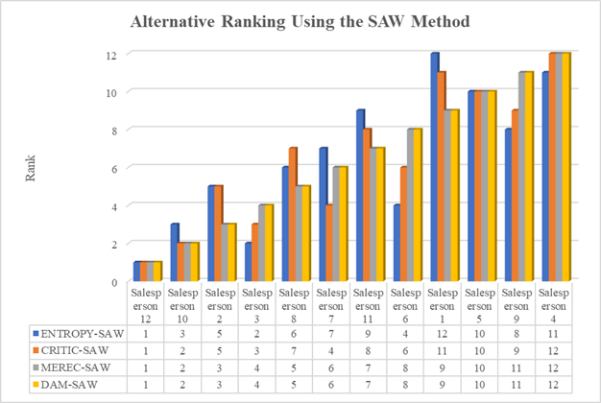
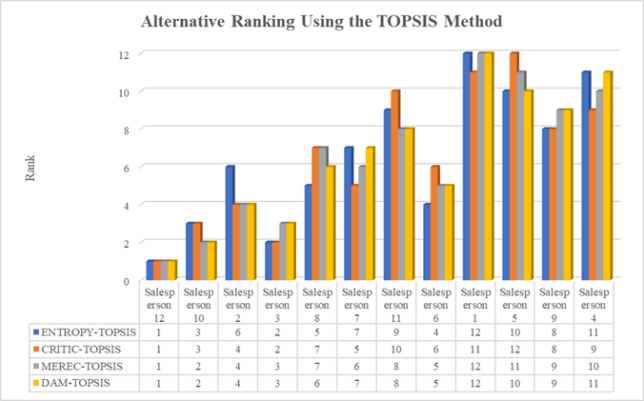
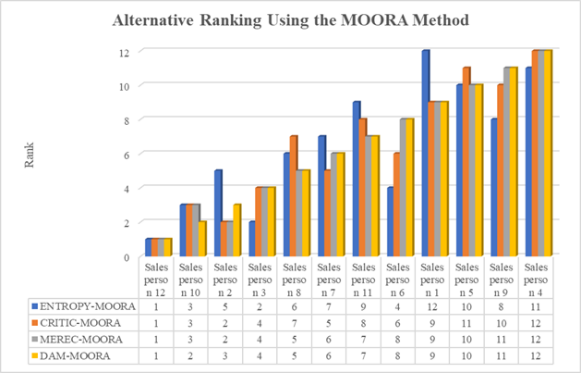

This indicates that DAM is able to minimize weighting bias and maintain balanced alternative ranking results across various decision-making methods.
The results of alternative ranking using Entropy, CRITIC, MEREC, and DAM weighting methods show different results based on the objectivity assessment approach of each method, namely SAW, TOPSIS, MOORA, and SMART. The results of this ranking provide in-depth insight into the sensitivity of decisions to the weighting methods used, with the resulting ranking differences reflecting the strength of each approach in capturing information from the criteria evaluated.
Pearson's correlation value measurement in ranking is used to evaluate the extent to which two sets of alternative rankings have a linear relationship. By calculating Pearson's correlation, we can find out if there is a significant similarity or difference between the rankings generated from two different methods or models. Pearson correlation helps identify the consistency or sensitivity of results to variations in evaluation methods, making it easier to analysis the validity of the approaches used in determining alternative rankings. Figure 3 is the result of the Pearson correlation value of the existing weighting method.

The correlation results between the weighting methods and
the ranking methods are generally in the high category, with most values above 0.8. In combination with SAW, the MEREC and DAM methods achieved a perfect correlation of 1, followed by CRITIC at 0.909 and Entropy at 0.825. For TOPSIS, DAM showed the highest performance at 0.902, followed by MEREC at 0.881, while Entropy and CRITIC had lower values of 0.811 and 0.825. In MOORA, DAM again reached the maximum value of 1, followed by MEREC at 0.993 and CRITIC at 0.95, whereas Entropy remained lower at 0.825. Meanwhile, in SMART, CRITIC produced the highest correlation at 0.979, followed by DAM at 0.965, MEREC at 0.95, and Entropy at 0.888. Overall, the DAM and MEREC methods show very high consistency across various ranking methods, whereas Entropy tends to have the lowest correlation, indicating a
more significant difference in weight patterns compared to the other methods.
4. Conclusion
The main goal of DAM Weighting is to create a new approach in increasing objectivity in determining the weighting of criteria in the decision-making process. The DAM Weighting method allows the weighting of criteria to be determined based on empirical data, not just subjective judgments from decision makers. When the weight of the criteria can be dynamically adjusted based on the relevance and actual results of the data analysis, the decision-making process becomes more objective, reflecting significant differences between the criteria in the context of the decision. The results of the Pearson correlation comparison of the DAM weighting method showed the highest correlation value of 0.96675, followed by the MEREC method with a value of 0.956. The CRITIC method has a correlation value of 0.91575, while the Entropy method shows the lowest correlation value of 0.83725. The results of the comparison of correlation values of the DAM Weighting method have the strongest correlation relationship with the tested data compared to other methods.
The main advantage of the DAM weighting method lies in its ability to produce criterion weights that are more representative of real-world conditions, while simultaneously enhancing the validity of analysis results compared to other objective methods. This opens up opportunities for broader application in various fields, both academic and practical, making the DAM method an essential reference for the development of decision support systems in the future. In addition, this study also opens up opportunities for further growth through several directions for future work, namely, testing the DAM weighting method with more complex and large-scale data to examine its consistency and scalability in various decision-making contexts. It is necessary to explore the application of DAM in specific fields such as supply chain management, risk assessment, and organizational performance evaluation to demonstrate the flexibility and generalizability of this method.
Acknowledgements
This research was funded by Universitas Teknokrat Indonesia, Hibah Publikasi Terindeks Scopus (HiPuTS) grant number 022/UTI/LPPMI/E.1.1/VIII/2024.
References
- L. Siciliani, V. Taccardi, P. Basile, M. Di Ciano, and P. Lops, “AI-based decision support system for public procurement,” Inf. Syst., 119 (1) 1–16 (2023). doi:10.1016/j.is.2023.102284.
- F.M. Toma, “A hybrid neuro-experimental decision support system to classify overconfidence and performance in a simulated bubble using a passive bci,” Expert Syst. Appl., 212 (1) 11–22 (2023). doi:10.1016/j.eswa.2022.118722.
- H. Sulistiani, S. Setiawansyah, P. Palupiningsih, F. Hamidy, P.L. Sari, and Y. Khairunnisa, “Employee Performance Evaluation Using Multi-Attribute Utility Theory (MAUT) with PIPRECIA-S Weighting: A Case Study in Education Institution,” in: 2023 Int. Conf. Informatics, Multimedia, Cyber Informations Syst., 2023: pp. 369–373. doi:10.1109/ICIMCIS60089.2023.10349017.
- H. Sulistiani, S. Setiawansyah, A.F.O. Pasaribu, P. Palupiningsih, K. Anwar, and V.H. Saputra, “New topsis: modification of the topsis method for objective determination of weighting,” Int. J. Intell. Eng. Syst., 17 (5) 991–1003 (2024). doi:10.22266/ijies2024.1031.74.
- D.D. Trung, “Application of edas, marcos, topsis, moora and piv methods for multi-criteria decision making in milling process,” Strojnícky Časopis - J. Mech. Eng., 71 (2) 69–84 (2021). doi:10.2478/scjme-2021-0019.
- S. Biswas, A. Sanyal, D. Božanić, A. Puška, and D. Marinković, “Critical success factors for 5g technology adaptation in supply chains,” Sustainability, 15 (6) 5539 (2023). doi:10.3390/su15065539.
- S.K. Sahoo, and S.S. Goswami, “A comprehensive review of multiple criteria decision-making (mcdm) methods: advancements, applications, and future directions,” Decis. Mak. Adv., 1 (1) 25–48 (2023). doi:10.31181/dma1120237.
- T. Sharma, and A. Sarin, “Multi-criteria decision making for solar site selection in punjab, india: an evaluation of site suitability using hybrid mcdm techniques towards the goal of sustainable energy development,” Results Eng., 27 (1) 106–125 (2025). doi:https://doi.org/10.1016/j.rineng.2025.106288. [DOI]
- V.T.N. Uyen, N. Ersoy, D.D. Trung, and N.T.P. Giang, “Applying mcdm to evaluate benchmark scores in the logistics sector for the period 2021–2023: application to universities in vietnam,” J. Infrastructure, Policy Dev., 8 (11) 8942 (2024). doi:10.24294/jipd.v8i11.8942.
- M.C. Joe Anand, K. Kalaiarasi, N. Martin, B. Ranjitha, S.S. Priyadharshini, and M. Tiwari, “Fuzzy C-Means Clustering with MAIRCA -MCDM Method in Classifying Feasible Logistic Suppliers of Electrical Products,” in: 2023 First Int. Conf. Cyber Phys. Syst. Power Electron. Electr. Veh., IEEE, 2023: pp. 1–7. doi:10.1109/ICPEEV58650.2023.10391835.
- G.M. Magableh, “An integrated model for rice supplier selection strategies and a comparative analysis of fuzzy multicriteria decision-making approaches based on the fuzzy entropy weight method for evaluating rice suppliers,” PLoS One, 19 (4) e0301930 (2024). doi:10.1371/journal.pone.0301930.
- S. Dash, S. Chakravarty, N.C. Giri, and R. Khargotra, “Evaluating sustainable wind energy sources with multiple criteria decision-making (mcdm) techniques,” Comput. Electr. Eng., 123 (1) 110–123 (2025). doi:https://doi.org/10.1016/j.compeleceng.2025.110285. [DOI]
- A. Ulutaş, F. Balo, and A. Topal, “Identifying the most efficient natural fibre for common commercial building insulation materials with an integrated psi, merec, lopcow and mcrat model,” Polymers (Basel)., 15 (6) 1500 (2023). doi:10.3390/polym15061500.
- A.M. Barasin, A.Y. Alqahtani, and A.A. Makki, “Performance evaluation of retail warehouses: a combined mcdm approach using g-bwm and ratmi,” Logistics, 8 (1) 10 (2024). doi:10.3390/logistics8010010.
- B. Ayan, S. Abacıoğlu, and M.P. Basilio, “A comprehensive review of the novel weighting methods for multi-criteria decision-making,” Information, 14 (5) 285 (2023). doi:10.3390/info14050285.
- L. Zhang, Q. Cheng, and S. Qu, “Evaluation of railway transportation performance based on critic-relative entropy method in china,” J. Adv. Transp., 23 (1) 1–11 (2023). doi:10.1155/2023/5257482.
- D. Boix-Cots, F. Pardo-Bosch, and P. Pujadas, “A systematic review on multi-criteria group decision-making methods based on weights: analysis and classification scheme,” Inf. Fusion, 9 (6) 16–36 (2023). doi:10.1016/j.inffus.2023.03.004.
- D. Tešić, M. Radovanović, D. Božanić, D. Pamucar, A. Milić, and A. Puška, “Modification of the dibr and mabac methods by applying rough numbers and its application in making decisions,” Information, 13 (8) 353 (2022). doi:10.3390/info13080353.
- T. Van Dua, D. Van Duc, N.C. Bao, and D.D. Trung, “Integration of objective weighting methods for criteria and mcdm methods: application in material selection,” EUREKA Phys. Eng., (2) 131–148 (2024). doi:10.21303/2461-4262.2024.003171.
- A.R. Paramanik, S. Sarkar, and B. Sarkar, “OSWMI: an objective-subjective weighted method for minimizing inconsistency in multi-criteria decision making,” Comput. Ind. Eng., 16 (9) 108–126 (2022). doi:https://doi.org/10.1016/j.cie.2022.108138. [DOI]
- D.D. Trung, B. Dudić, D. Van Duc, N. Hoai Son, and A. Mittelman, “Building a ranking system for lecturers based on student evaluations in teaching a specific course: a case study at a university in vietnam,” Int. J. Cogn. Res. Sci. Eng. Educ., 12 (2) 335–350 (2024). doi:10.23947/2334-8496-2024-12-2-335-350.
- A.R. Mishra, M. Alrasheedi, J. Lakshmi, and P. Rani, “Multi-criteria decision analysis model using the q-rung orthopair fuzzy similarity measures and the copras method for electric vehicle charging station site selection,” Granul. Comput., 9 (1) 23 (2024). doi:10.1007/s41066-023-00447-1.
- S. Dhruva, R. Krishankumar, E.K. Zavadskas, K.S. Ravichandran, and A.H. Gandomi, “Selection of suitable cloud vendors for health centre: a personalized decision framework with fermatean fuzzy set, lopcow, and cocoso,” Informatica, 35 (1) 65–98 (2024). doi:10.15388/23-INFOR537.
- D.D. Trung, “Development of data normalization methods for multi-criteria decision making: applying for marcos method,” Manuf. Rev., 9 22 (2022). doi:10.1051/mfreview/2022019.
- R. Kumar, S. Singh, P.S. Bilga, Jatin, J. Singh, S. Singh, M.-L. Scutaru, and C.I. Pruncu, “Revealing the benefits of entropy weights method for multi-objective optimization in machining operations: a critical review,” J. Mater. Res. Technol., 10 1471–1492 (2021). doi:10.1016/j.jmrt.2020.12.114.
- X. Wang, Z. Zhou, L. Sun, G. Xie, and Q. Lou, “Research on the evaluation index system of ‘new energy cloud’ operation mode based on critic weighting method and ahp method,” IOP Conf. Ser. Earth Environ. Sci., 831 (1) 12–17 (2021). doi:10.1088/1755-1315/831/1/012017.
- M.N. Dwi Satria, E.R. Susanto, Setiawansyah, S. Maryana, and P. Palupiningsih, “Modification of grey relational analysis for dynamic criteria weighting in decision-making systems,” IIUM Eng. J., 26 (2) 187–203 (2025). doi:10.31436/iiumej.v26i2.3494.
- D.A. Megawaty, D. Damayanti, S. Sumanto, S. Setiawansyah, Y.P. Putra, and C.R.S. Hati, “Comparative Analysis of Student Organization Chair Candidate Selection Using a Combination of ROC-MAUT and ROC-SMART,” in: 2024 Int. Conf. Adv. Inf. Sci. Dev., 2024: pp. 98–103. doi:10.1109/ICAISD63055.2024.10894887.
- N.M. Mahfuz, M. Yusoff, and Z. Idrus, “Clustering heterogeneous categorical data using enhanced mini batch k-means with entropy distance measure,” Int. J. Electr. Comput. Eng., 13 (1) 1048 (2023). doi:10.11591/ijece.v13i1.pp1048-1059.
- M. Akram, S. Naz, F. Feng, and A. Shafiq, “Assessment of hydropower plants in pakistan: muirhead mean-based 2-tuple linguistic t-spherical fuzzy model combining swara with copras,” Arab. J. Sci. Eng., 48 (5) 5859–5888 (2023). doi:10.1007/s13369-022-07081-0.
- E. Pranita, J.P. Sembiring, A. Jayadi, N.U. Putri, A. Jaenul, and A.M. Fathurahman, “Melinjo Chip Dryer Monitoring System Using Fuzzy Logic Method,” in: 2023 Int. Conf. Networking, Electr. Eng. Comput. Sci. Technol., IEEE, 2023: pp. 98–102. doi:10.1109/IConNECT56593.2023.10327339.
- C.-C. Liu, C.-H. Yu, and K.-S. Chen, “Using statistical test method to establish a decision model of performance evaluation matrix,” Appl. Sci., 13 (8) 51–59 (2023). doi:10.3390/app13085139.
- P. William, O.J. Oyebode, A. Sharma, N. Garg, A. Shrivastava, and A. Rao, “Integrated decision support system for flood disaster management with sustainable implementation,” IOP Conf. Ser. Earth Environ. Sci., 1285 (1) 12–18 (2024). doi:10.1088/1755-1315/1285/1/012015.
- J. Więckowski, B. Kizielewicz, B. Paradowski, A. Shekhovtsov, and W. Sałabun, “Application of multi-criteria decision analysis to identify global and local importance weights of decision criteria,” Int. J. Inf. Technol. Decis. Mak., 22 (06) 1867–1892 (2023). doi:10.1142/S0219622022500948.
- S. Bošković, L. Švadlenka, M. Dobrodolac, S. Jovčić, and M. Zanne, “An extended aroman method for cargo bike delivery concept selection,” Decis. Mak. Adv., 1 (1) 1–9 (2023). doi:10.31181/v120231.
- A. Sani, S. Aisyah, M. Rachmawati, D. P, and N. Wiliani, “Analysis of Decision Support Systems for Candidate Selection Scholarship Recipients Using TOPSIS Method,” in: Proc. 2nd Int. Conf. Law, Soc. Sci. Econ. Educ., EAI, 2022: pp. 19–26. doi:10.4108/eai.16-4-2022.2320136.
- J. Tang, and F. Meng, “New method for interval-valued hesitant fuzzy decision making based on preference relations,” Soft Comput., 24 (17) 13381–13399 (2020). doi:10.1007/s00500-020-04756-4.
- M.S. Saidin, L.S. Lee, S.M. Marjugi, M.Z. Ahmad, and H.-V. Seow, “Fuzzy method based on the removal effects of criteria (merec) for determining objective weights in multi-criteria decision-making problems,” Mathematics, 11 (6) 1544 (2023). doi:10.3390/math11061544.
- Y.L. Li, Y.P. Tsang, C.-H. Wu, and C.K.M. Lee, “A multi-agent digital twin–enabled decision support system for sustainable and resilient supplier management,” Comput. Ind. Eng., 18 (7) 109–118 (2024). doi:10.1016/j.cie.2023.109838.
- I. Badi, G. Demir, M.B. Bouraima, and A.K. Maraka, “Vendor managed inventory in practice: efficient scheduling and delivery optimization,” Spectr. Decis. Mak. Appl., 2 (1) 157–165 (2024). doi:10.31181/sdmap21202515.
- F. Psarommatis, and D. Kiritsis, “A hybrid decision support system for automating decision making in the event of defects in the era of zero defect manufacturing,” J. Ind. Inf. Integr., 26 100263 (2022). doi:10.1016/j.jii.2021.100263.
- V. Zamani, H. Taghaddos, and Y. Gholipour, “Simulation-based decision support system for earthmoving operations using computer vision,” Eng. Appl. Artif. Intell., 12 (4) 106–124 (2023). doi:10.1016/j.engappai.2023.106564.
- M.P. Libório, R. Karagiannis, A.M.A. Diniz, P.I. Ekel, D.A.G. Vieira, and L.C. Ribeiro, “The use of information entropy and expert opinion in maximizing the discriminating power of composite indicators,” Entropy, 26 (2) 143 (2024). doi:10.3390/e26020143.
- D. Kang, R. Jaisankar, V. Murugesan, K. Suvitha, S. Narayanamoorthy, A.H. Omar, N.I. Arshad, and A. Ahmadian, “A novel mcdm approach to selecting a biodegradable dynamic plastic product: a probabilistic hesitant fuzzy set-based copras method,” J. Environ. Manage., 340 (1) 117–127 (2023). doi:10.1016/j.jenvman.2023.117967.