
Abstract
Psychosocial safety climate (PSC) shapes worker well-being, yet no review has focused on construction workers in developing countries, where informal, resource-constrained conditions differ from the Western settings dominating PSC research. This study presents the first systematic review of how PSC relates to worker well-being in this context. Following PRISMA 2020, three databases (Scopus, PubMed, ScienceDirect) were searched from 2010 to 2025 using PICO; from 102 records, three studies using validated PSC instruments were included. PSC was positively associated with job satisfaction and safety performance; mental-health evidence was only indirect, and physical health untested. All three studies came from China, exposing a critical evidence gap across other developing regions. Positioning PSC as a dimension of social sustainability that links lower stress and absenteeism to productivity, the review calls for context-specific, longitudinal, and multi-country studies and for leadership-training and peer-support policies.
Keywords: Construction workers, Developing countries, Psychosocial safety climate, Safety performance, SLR
Outline
1. Introduction
Construction remains one of the most hazardous industries worldwide, accounting for about 30% of all fatal occupational injuries and at least 108,000 worker deaths on site each year; in developing countries, the risk of fatal accidents may be three to six times greater than elsewhere1). Although physical risk has long dominated construction safety research, psychological health is now recognized as an equally pressing concern2). Marchand3) found that mental health risk varies systematically across occupations and industries, while Macdonald4) identified high job demands and workload as key drivers of stress and fatigue. Importantly, Naji et al.5) showed that psychosocial hazards mediate the relationship between safety culture and safety performance, indicating that psychological factors lie at the center of occupational safety rather than at its margins.
Even where strict safety regulations exist, the psychosocial causes of accidents are frequently overlooked. Sousa et al.6) noted that construction risk management has traditionally concentrated on visible physical hazards, and Dollard et al.2) established work stress as a distinct theoretical domain requiring dedicated organizational attention. The conceptual foundations run deeper. Karasek and Theorell7) linked the balance between job demands and decision latitude to worker strain, and Dollard8) positioned psychosocial conditions as a leading indicator of workplace psychological health. Later work refined this view, with Loh et al.9) showing that leadership shapes the strength of an organization’s psychosocial climate over time, Fila et al.10) connecting stressful work to voluntary turnover, and Dollard and Gordon11) demonstrating that participatory interventions can reduce work stress. Empirical work has likewise tied elevated job stress to compromised safety: Leung et al.12) found that job stressors among construction workers were associated with poorer safety behavior and a higher likelihood of accidents, while Boschman et al.13) identified weak social support and role conflict as psychosocial features associated with poorer mental health among construction workers. Occupational stressors translate directly into unsafe outcomes: among oil and gas workers in Kuwait, job stressors undermined safety compliance and participation, with mental health and fatigue acting as mediators14), and a survey of Malaysian construction professionals identified workload, role, and interpersonal demands as the leading stressors in the sector15). Together, this evidence makes a clear case that construction firms must embed psychosocial considerations within accident-prevention strategies, a need reinforced by Langdon and Sawang16), who traced the drivers of depression, anxiety, and stress in construction workers; Loh et al.17), who documented practical PSC interventions; and Lyu et al.18), who validated a context-specific safety climate scale.
Construction activity tends to expand alongside economic development in developing countries, where investment in the sector is positively associated with national income growth19). Moavenzadeh20) characterized construction as a foundational engine of economic development and employment in developing countries. This expansion, however, has brought serious safety and health challenges that are increasingly documented in developing-country settings. In Bangladesh, Roy et al.21) reported a high prevalence of depression, anxiety, and stress among construction workers and underscored how little mental health research exists for these populations. In Indonesia, Hansen et al.22) identified five context-specific mental health factor groups spanning workplace conditions, work pressure, role, gender inequality, and psychosocial factors, while a study of Malaysian construction workers, Mohd Suadi Nata et al.23) linked irregular hours, income instability, and inadequate rest to elevated occupational stress, with particular exposure among migrant labourers. This burden recurs across the region: in China, a survey of 912 construction workers tied depression, anxiety, and stress to insomnia, alcohol dependence, and work-family conflict24); foreign construction workers in Singapore showed elevated distress linked to long hours and poor living conditions25); and a site study in North Karnataka, India, found depression, anxiety, or stress in roughly half the workforce26). Physical health is similarly affected: among 1,200 construction workers in Nigeria, Ekpenyong and Inyang27) found that high psychological demands and mental workload raised the odds of work-related musculoskeletal disorders, illustrating how psychosocial and physical strain intertwine. Among road construction workers in Nigeria, Egwuonwu et al. reported a 12-month musculoskeletal-disorder prevalence of 66%, with the lower back most frequently affected28), and a survey of 666 Pakistani construction workers similarly found a high prevalence of work-related musculoskeletal disorders alongside identifiable occupational and personal risk factors29). Occupational factors compound this: among Nigerian construction labourers, low task control, lack of breaks, and load weight explained 53% of the variance in neck pain and predicted neck disability and sick leave30), and a building-site study in Colombo, Sri Lanka, linked these disorders to limited local ergonomics capacity31). In Ghana, Frimpong et al.31) documented the compromised health status of young construction workers in the Global South, reinforcing how physically demanding, low-resource settings burden worker well-being. Job satisfaction follows comparable patterns, with Rohmah and Widanarko32) reporting that Indonesian precast-concrete workers who perceived strong social support were considerably more likely to report high job satisfaction. Against this backdrop, a body of work links the work environment to safety outcomes in construction. Hallowell and Gambatese33) showed that construction carries substantial and often under-mitigated safety risk, while Jung et al.34) found that adverse work environments and occupational stress degrade individual safety behavior. Bronkhorst35) demonstrated that job demands and safety climate jointly shape safety behavior, and Bodner et al.36) linked the psychosocial work environment to the health and well-being of construction and utility workers. This pattern extends to developing-country settings: among construction workers in mainland China, Guo et al.37) found that psychological symptoms such as stress, depression, and anxiety interacted with safety-climate perceptions to shape risk-taking, safety compliance, and safety participation.
In response to these risks, the psychosocial safety climate (PSC) construct has become a central organizing framework. Dollard and Bakker38) defined PSC as the organizational policies, practices, and procedures that protect worker psychological health, and showed it to be a precursor of conducive work environments, fewer psychological health problems, and higher engagement. Idris et al.39) established PSC’s conceptual distinctiveness from general safety climate, while Schwatka et al.40), reviewing the construction literature, clarified that conventional safety climate emphasizes physical-hazard prevention. The construct has since been extended in several directions. Dollard et al.41) linked PSC to psychological strain across multiple worksites, Law et al.42) connected it to workplace bullying and engagement, Afsharian et al.43) introduced the notion of climate strength, and Idris et al.44) showed longitudinally that PSC buffers emotional demands, burnout, and depression in a Malaysian sample. Garrick et al.45) further demonstrated PSC’s role in moderating daily recovery from job demands. Foundational safety-climate scholarship clarified how the climate itself is constituted: Cox46) reframed safety culture as a useful but contested organizing idea, Clarke47) showed that workers’ perceptions of organizational safety drive the development of a safety culture, and Williamson et al.48) developed an early measure tying safety perceptions and attitudes to the climate construct. Rahlin et al.49) extended these insights to small and medium enterprises, which dominate developing-country construction.
Despite this expanding evidence base, PSC research has concentrated overwhelmingly in developed economies, and few studies examine its association with worker outcomes in developing countries. Recent cross-national work by Loh et al.50) tested PSC-12 measurement invariance across four nations and found the construct to be largely universal, albeit with some national variation, which raises the question of how PSC behaves where formal structures are weaker. In a developing-country setting, Abu Bakar et al.51) validated a Malay-language PSC-12 among Malaysian healthcare workers and confirmed its four-factor structure and reliability. Using cognitive interviews in Germany and Sweden, Berthelsen et al.52) confirmed the cross-cultural validity of the PSC questionnaire when it was transferred from its original Australian context to European settings, while noting that valid responses depend on workers' familiarity with organizational policies and procedures. Evidence from developing economies remains thin and scattered across sectors: Pahuja et al.53) found among Indian service-sector employees that workplace spirituality predicted PSC, and Dera et al.54), studying Libyan construction workers, showed that PSC was positively associated with safety behavior and work engagement. In the Vietnamese construction sector, Nguyen et al.55) used PLS-SEM with 238 construction professionals to show that PSC dimensions reduced mental ill health, with management commitment and management priority exerting the strongest effects. Both Idris et al.44) and Dollard and McTernan56) emphasize that PSC operates through immediate work-environment factors, which may differ sharply under resource constraints. Earlier reviews approached PSC from adjacent angles: Amoadu et al.57) scoped its influence on occupational health and safety broadly, and Derdowski and Mathisen58) reviewed psychosocial factors across high-risk industries. Neither focused on construction workers in developing countries, where SME dominance, informal employment, and limited safety resources reshape how PSC functions; Kheni et al.59) documented among Ghanaian construction SMEs that few adopt proactive health-and-safety practices because of size-related resource constraints. This review addresses that gap by synthesizing evidence on PSC and worker outcomes in developing-country construction, examining its associations with mental health, physical health, job satisfaction, and safety performance, and adding a sustainability-oriented perspective that links PSC to long-term workforce well-being.
Accordingly, this study addresses the following research question: what is the association between PSC implementation and mental well-being, physical health, job satisfaction, and safety performance among construction workers in developing countries? In answering it, the review makes three contributions. Contextually, it synthesizes evidence specific to developing-country construction settings characterized by SME dominance and informal work practices. Theoretically, it offers insight for adapting established PSC frameworks to resource-constrained environments. Practically, it provides recommendations for policymakers and practitioners seeking to improve worker well-being in the sector.
2. Methods
2.1. Protocol and Registration
The present systematic review adhered to the Preferred Reporting Items for Systematic Reviews and Meta-Analyses (PRISMA) 2020 framework60). The study protocol was registered in OSF Registries and is publicly accessible at https://osf.io/z685a/registrations. The completed PRISMA 2020 checklist is provided as Supplementary Material (Appendix A).
2.2. Search Strategy
This study employed a systematic literature review following PRISMA 2020 guidelines to identify, evaluate, and analyze relevant research on PSC implementation in the construction industry60). The framework uses PICO (see section 2.3) to help determine the keywords for the literature search.
2.2.1. Databases and Search Dates
The search was conducted across three electronic databases. Each database was searched independently, with the search dates and record counts summarised in Table 1.
2.2.2. Search Strings
Database-specific search strings were developed to optimize retrieval based on each platform's syntax requirements. The search strategy employed Boolean operators (AND, OR) to systematically combine key concepts: psychosocial safety-related terms (e.g., "psychosocial safety climate," "psychosocial risk," "psychosocial work environment") were combined using OR to capture synonymous concepts, while AND was used to intersect these with construction industry-related terms (e.g., "construction workers," "building industry," "construction sector"). Phrase searching using quotation
Table 1: Databases, Dates, and Results
| Database | Search Date | Results |
|---|---|---|
| Scopus | September 9, 2024 | 50 |
| PubMed | September 15, 2024 | 14 |
| ScienceDirect | September 20, 2024 | 22 |
| Manual Search | September 24, 2024 | 16 |
| Total | 102 |
marks (" ") ensured precise matching of multi-word terms, and parentheses were applied to control operator precedence. The complete search strings, Boolean logic structure, and database-specific adaptations are provided in Appendix B (Supplementary Material S1).
2.2.3. Deduplication Process
Following the initial search, all identified records were imported into Rayyan QCRI, a web-based systematic review tool61). The deduplication process (Appendix C) was conducted in two stages to ensure accuracy and minimize errors:
•Automated detection: Rayyan’s built-in algorithm identified potential duplicates based on title similarity (>90%), author matching, DOI matching, and publication year.
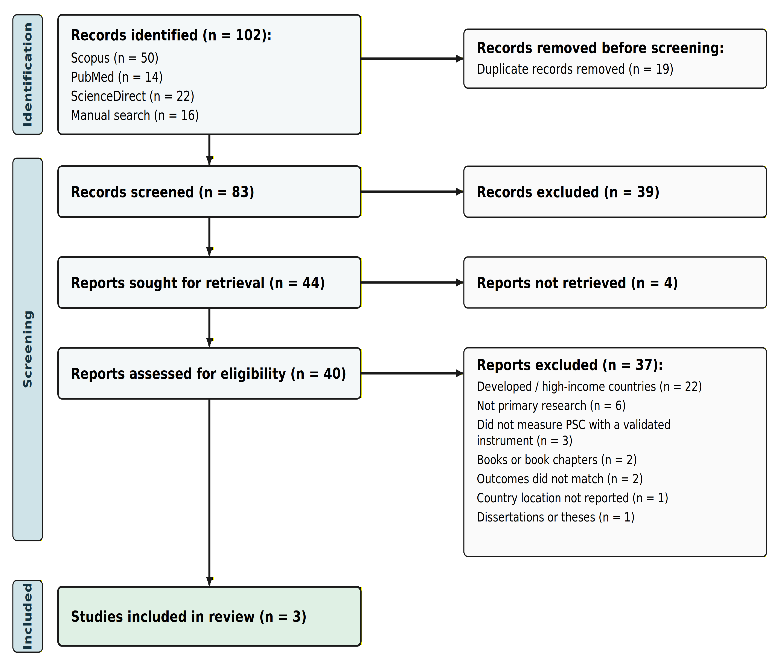
•Manual verification: All flagged duplicates were reviewed by the first author (IWT) to confirm their status, prevent false-positive removals, and retain the most complete record (e.g., the version with full metadata or open access). A total of 19 duplicate records were identified and removed, leaving 83 unique records for title and abstract screening (see PRISMA 2020 flow diagram in Figure 1 for full details).
2.3. Selection criteria
This study employed inclusion and exclusion criteria structured according to the PICO framework (Population, Intervention, Comparator, and Outcome), consistent with the eligibility-criteria framework reported in PRISMA 202060). The PICO components were defined as follows: P (Population): Construction workers in developing countries; I (Intervention): Implementation or assessment of psychosocial safety climate in the construction work environment; C (Comparison): No specific comparator required, as this review examines the association between PSC and worker outcomes rather than comparing interventions; O (Outcomes): Mental health/psychological well-being, physical health, job satisfaction, and/or safety performance. This framework is suitable for the present
Table 2: World Bank Income Classification Summary (2024)
| Income Group | GNI per Capita (USD) | Classification | Examples |
|---|---|---|---|
| Low | ≤ 1,135 | Developing | Ethiopia, Tanzania |
| Lower-middle | 1,136 – 4,495 | Developing | India, Indonesia, Nigeria |
| Upper-middle | 4,496 – 13,935 | Developing | China, Brazil, Malaysia |
| High | > 13,935 | Developed | USA, UK, Australia |
Source: adapted from The World Bank (2024)62), used under CC BY 4.0
review as it examines the effects of an organizational intervention (PSC) on health-related outcomes among a defined worker population. These inclusion criteria were designed to reduce bias in article selection.
2.3.1. Operational Definition of Developing Countries
Developing countries were operationally defined as economies with Gross National Income (GNI) per capita ≤ $13,935 using the World Bank Country Classification by Income Level (2024)62) . This includes low-income (≤ $1,135), lower-middle-income ($1,136–$4,495), and upper-middle-income ($4,496–$13,935) economies, while high-income economies (> $13,935) were excluded as developed, as presented in Table 2.
2.3.2. Publication Timeframe Rationale
The publication period was restricted to 2010–2025 for theoretical and methodological reasons. The psychosocial safety climate (PSC) construct was formally introduced by Dollard and Bakker in 201038), and the PSC-12 measurement instrument was developed by Hall et al.63) in the same year, which has since become the standard tool for assessing organizational-level psychosocial safety climate. Publications prior to 2010 could not have examined PSC as a distinct construct, as the theoretical framework and validated measurement tools did not exist. Therefore, limiting the search to 2010–2025 ensures conceptual alignment with the PSC literature and prevents the inclusion of studies examining related but distinct constructs.
2.3.3. Inclusion Criteria
Articles were eligible for inclusion upon satisfying the subsequent conditions: 1. Examined psychosocial safety climate (PSC) as defined by Dollard and Bakker38) or used validated PSC measurement instruments 2. Focused on construction workers or the construction industry 3. Conducted in developing countries 4. Open access 5. Published in English between 2010 and 2025 6. Peer-reviewed articles or conference papers (due to the emerging nature of PSC research in construction).
2.3.4. Open-Access Justification
The restriction to open-access publications was applied as a pragmatic scoping constraint to enhance the accessibility and reproducibility of this review64). This decision was made to enable researchers without institutional subscription access—particularly those in developing countries where institutional access may be limited—to verify, replicate, and build upon the findings. While this criterion may limit the comprehensiveness of included studies, it aligns with principles of open science. It ensures that all cited evidence is freely accessible to the global research community. This limitation is explicitly acknowledged in Section 4 (Limitations), and future reviews with broader institutional access are encouraged to validate these findings using subscription-based literature.
2.3.5. Exclusion Criteria
Studies were excluded if they: 1. Did not examine PSC as a specific construct (e.g., studies examining only general psychosocial risk factors without PSC measurement) 2. Studies were conducted in developed/high-income countries 3. Published in languages other than English 4. Focused on populations other than construction workers 5. Were book chapters, editorials, commentaries, or grey literature 6. Published before 2010 (prior to formal PSC construct development).
2.4. Screening
The selection of studies adhered to the PRISMA 2020 guidelines and consisted of three sequential stages60).
a)Stage 1: Identification
Literature searches were conducted across three electronic databases (Scopus, PubMed, ScienceDirect) and manual sources, yielding 86 records, supplemented by manual searching of reference lists (n = 16), resulting in a total of 102 records. Following deduplication using Rayyan QCRI (see Section 2.2.3), 19 duplicate records were removed, leaving 83 unique records for screening.
b)Stage 2: Title and Abstract Screening
Two reviewers independently conducted the screening of titles and abstracts (IWT and AM) using Rayyan QCRI systematic review software with blind mode enabled to minimize bias. Each reviewer assessed all 83 records against the predetermined eligibility criteria (Section 2.3). Inter-rater agreement was calculated using Cohen’s kappa coefficient, yielding κ = 0.95 (almost perfect agreement)65). Disagreements were addressed via deliberation between both reviewers until consensus was reached; no conflicts required adjudication by a third reviewer. After the initial screening of titles and abstracts, 39 articles were removed due to failure to satisfy the inclusion eligibility requirements, leaving 44 records. Of these, 4 records could not be retrieved (full text unavailable), leaving 40 eligible for full-text assessment.
c)Stage 3: Full-Text Screening
Full-text evaluation was carried out by the same two reviewers working independently (IWT and AM). Each article was assessed against all inclusion and exclusion criteria. The 40 full-text articles were evaluated, and 37 were excluded for the following reasons: Studies conducted in developed/high-income countries (n = 22); Review articles, not primary research (n = 6); Did not include country location (n = 1); Books or book chapters (n = 2); Dissertations or theses (n = 1); Did not examine relevant outcomes (mental health, physical health, job satisfaction, or safety performance) (n = 2); Did not measure PSC using validated instruments (n = 3).
Notably, three studies reached the final stage of full-text assessment. However, they were ultimately excluded as they did not specifically measure psychosocial safety climate (PSC) as an organizational-level construct using validated PSC instruments (PSC-12 or PSC-4). Lu et al.66) examined psychosocial safety behavior at the individual level rather than PSC; Kusmasari et al.67) investigated the interrelationship of bodily and psychosocial aspects in relation to cervical pain symptoms without assessing PSC; and Gajbhiye et al.68) focused on the frequency of occupational musculoskeletal conditions without incorporating PSC measurement. Although these studies addressed psychosocial aspects of construction worker health, none met the inclusion criterion requiring PSC as defined and measured in the existing literature38).
d)Final Inclusion
Upon completion of the independent full-text evaluation, both reviewers (IWT and AM) achieved complete consensus (100% agreement) on the eligibility of studies for final inclusion. Three publications fulfilled all predetermined selection criteria and were retained for the concluding qualitative synthesis: Xie et al.69), Liu et al.70), and Xie et al.71). No third-party arbitration was necessary during this final selection phase, as both reviewers independently reached identical conclusions regarding study eligibility. The comprehensive study selection procedure is depicted in Figure 1 (PRISMA 2020 flow diagram). The limited number of included studies reflects the emerging state of PSC research specifically within the construction sector in developing countries, rather than methodological constraints of this review.
2.5. Data Extraction
The extraction of data was performed by two reviewers working independently (IWT and AM) employing a pre-designed data collection template developed a priori. The extraction form captured the following information from each included study: (1) study identification (author, year, title, journal); (2) study design and methodology; (3) setting and geographic location; (4) participant characteristics (sample size, demographics, construction sector); (5) PSC measurement instrument and psychometric properties; (6) outcome variables and measurement tools; (7) statistical methods employed; (8) key quantitative findings including effect sizes, path coefficients, or correlation coefficients; and (9) confounding variables and adjustment strategies. Each reviewer independently extracted data from all included studies. For studies reporting multiple outcome variables
or analytical models, all relevant findings about PSC and its associations with worker outcomes were extracted. When studies reported both bivariate correlations and multivariate analyses, preference was given to adjusted effect estimates from multivariate models.
2.6. Quality Assessment
The methodological rigor of the selected studies was evaluated employing the Joanna Briggs Institute (JBI) Critical Appraisal Tool for Analytical Cross-Sectional Studies72). This tool was selected because all included studies employed cross-sectional designs. The JBI checklist comprises eight criteria evaluating key methodological domains: sample definition, participant and setting description, exposure measurement validity, outcome measurement standardization, confounding factor identification and management, and statistical analysis appropriateness. Each criterion was rated as “Yes” (Y), “No” (N), “Unclear” (U), or “Not Applicable” (NA). Quality rating thresholds were determined a priori by the review team: High quality (≥75% or ≥6/8 criteria met), Moderate quality (50–74% or 4–5/8 criteria met), and Low quality (<50% or ≤3/8 criteria met).
3. Results
The systematic search across three databases (Scopus, PubMed, and ScienceDirect) and manual searching yielded 102 records. After removing 19 duplicates, 83 records were screened by title and abstract, of which 39 were excluded and 4 were inaccessible. The remaining 40 full-text articles were assessed for eligibility, and 37 were excluded against the predefined criteria (Section 2.3), leaving three studies for qualitative synthesis (Figure 1).
3.1. Study Characteristics
Finally, three articles satisfied the eligibility requirements and were incorporated into the present systematic review (Table 3). All studies employed cross-sectional survey designs and were conducted in China, representing various regions including Guangzhou, Shenzhen, Nanjing, Xuzhou, Xi'an, Chongqing, and Wuhan. The combined sample comprised 1,615 construction workers (range: 489–626 per study), predominantly male (about 85–93% across studies, roughly 89% overall). All three studies used the PSC-12 scale developed by Hall et al.63). Two of them employed structural equation modeling, while the comparative study used independent t-tests and one-way ANOVA.
Table 3: Characteristics of Included Studies
| Characteristic | Xie et al.69) | Liu et al.70) | Xie et al.71) |
|---|---|---|---|
| Country | China | China | China |
| Setting | Guangzhou (50 construction projects) | 5 cities: Nanjing, Xuzhou, Xi’an, Chongqing, Wuhan | Shenzhen (10 megaprojects) and Guangzhou (143 non-megaprojects) |
| Study Design | Cross-sectional survey | Cross-sectional survey | Cross-sectional survey |
| Sample Size | n = 489 | n = 500 | n = 626 personnel (124 from 10 megaprojects + 502 from 143 non-megaprojects) |
| Gender (Male %) | 85.10% | 88.8% | 91–93% |
| Age Distribution | 21–30 yrs (29.2%); 31–40 yrs (28.2%); 41–50 yrs (27.6%) | ≤20 (2%); 21–30 (38.8%); 31–40 (33.6%); 41–50 (16.6%); ≥50 (9%) | 26–35 yrs (37.5%); 35–50 yrs (29%) |
| PSC Instrument | PSC-1263) | PSC-1263) | PSC-1263) |
| Outcome Variables | Job satisfaction; Intent to stay | Safety task behavior; Safety contextual behavior; Safety motivation; Emotional exhaustion. | PSC level comparison (megaprojects vs ordinary projects) |
| Statistical Analysis | SEM, CFA | SEM, CFA, Moderation analysis | Independent t-test, one-way ANOVA, LSD post hoc |
| Theoretical Framework | COR Theory; SOR Model | JD-R Theory | Organizational climate perspective |
| Key Findings | PSC → job satisfaction (β = 0.659, p < 0.001); job satisfaction → intent to stay (β = 0.645, p < 0.001); PSC → intent to stay (direct β = 0.289, p < 0.001); job satisfaction partially mediates PSC–intent to stay (indirect β = 0.425, p < 0.001) | Both supervisor and coworker safety support directly predicted safety task and contextual behavior, with supervisor support stronger (β = 0.250 and 0.289, p < 0.05) than coworker support (β = 0.185 and 0.136, p < 0.05); coworker support more strongly predicted emotional exhaustion (β = -0.471) than supervisor support (β = -0.119); PSC moderated the pathways mediated by safety motivation and emotional exhaustion (p < 0.05) | PSC was significantly higher in megaprojects than ordinary projects across all four dimensions (p < 0.001); management commitment was the highest-scoring dimension; overall PSC-12 Cronbach’s α = 0.938 |
Note: PSC = Psychosocial Safety Climate; SEM = Structural Equation Modeling; CFA = Confirmatory Factor Analysis; COR = Conservation of Resources; SOR = Stimulus-Organism-Response; JD-R = Job Demands-Resources; β = standardized path coefficient; → = path direction
Table 4: Quality Appraisal Utilizing the JBI Appraisal Criteria for Analytical Cross-Sectional Studies
| JBI Criteria | Xie et al.69) | Liu et al.70) | Xie et al.71) |
|---|---|---|---|
| 1. Were the criteria for inclusion in the sample clearly defined? | Y | Y | Y |
| 2. Were the study subjects and the setting described in detail? | Y | Y | Y |
| 3. Was the exposure measured in a valid and reliable way? | Y | Y | Y |
| 4. Were objective, standard criteria used for measurement of the condition? | Y | Y | Y |
| 5. Were confounding factors identified? | Y | Y | U |
| 6. Were strategies to deal with confounding factors stated? | Y | Y | U |
| 7. Were the outcomes measured in a valid and reliable way? | Y | Y | Y |
| 8. Was appropriate statistical analysis used? | Y | Y | Y |
| Total Score (/8) | 8 | 8 | 6 |
| Quality Rating | High | High | High |
Note: Y = Yes; N = No; U = Unclear. Quality rating thresholds were determined a priori: High quality (≥75% or ≥6/8 criteria met), Moderate quality (50–74% or 4–5/8 criteria met), and Low quality (<50% or ≤3/8 criteria met). Appraisal items adapted from the JBI Critical Appraisal Checklist for Analytical Cross-Sectional Studies72).
3.2. Quality Assessment Results
Methodological rigor of the three selected studies was evaluated employing the JBI Critical Appraisal Tool designed for Analytical Cross-Sectional Studies72), and the results are presented in Table 4. Overall, all three studies were rated as high quality, meeting at least 75% of the appraisal criteria (scores ranging from 6/8 to 8/8). Xie et al.69) and Liu et al.70) each achieved a perfect score (8/8), demonstrating robust methodological rigor across all assessed domains, whereas Xie et al.71) scored 6/8, with two criteria rated as "Unclear" for identifying confounding factors and strategies to address them. All included studies distinctly outlined selection criteria, comprehensively detailed study respondents along with study environments, used valid and reliable instruments to measure PSC exposure (PSC-12 scale), applied standardized outcome measures, and employed appropriate statistical analyses (primarily Structural Equation Modeling). The primary methodological limitation across studies was the cross-sectional nature of the studies, which limits the ability to establish causality concerning the association between PSC and worker outcomes. Additionally, Xie et al.71) did not explicitly report confounding variables or adjustment strategies, which may have introduced bias into the findings.
4. Discussion
4.1. Cross-study synthesis of PSC associations
The reviewed evidence reveals a consistent pattern in which PSC is positively associated with desirable worker outcomes across different theoretical frameworks. Despite variation in outcome variables and analytical approaches, every reviewed study linked PSC to favourable worker outcomes, whether through direct associations, moderated pathways, or higher PSC levels in better-resourced settings. This convergence offers preliminary support for the relevance of the PSC construct in developing-country construction sectors, while also exposing important evidence gaps. Figure 2 maps the included studies against the four outcome dimensions, and Table 5 summarizes their analytical contribution.
As the evidence map shows, the included studies cluster around safety performance and job satisfaction, while mental well-being is supported only indirectly and physical health remains entirely unexamined69–71). This uneven coverage echoes the broader PSC literature, in which behavioural and attitudinal outcomes have drawn far more attention than health endpoints38). The three studies are not interchangeable, however. Each offers a distinct analytical angle: mediation through job satisfaction69), moderated pathways that link safety support to safety behaviour70), and a comparison of PSC levels across project scales71). Their value to this synthesis therefore lies less in any single outcome than in the complementary mechanisms they expose. Table 5 sets out these contributions, stating for each study the specific way it advances the review's argument rather than restating its descriptive findings.
Xie et al.69) found that PSC had a significant positive effect on job satisfaction and on intent to stay, and that job satisfaction partially mediated the PSC to intent-to-stay relationship. Drawing on Conservation of Resources (COR) theory and the Stimulus-Organism-Response (SOR) model, the authors positioned PSC as an organizational resource tied to positive psychological states and retention. This mediation is noteworthy, since PSC may not retain construction workers directly but rather operate through positive work experiences, a mechanism consistent with Dollard and Bailey’s73) account of PSC in demanding work contexts.

Table 5: Significance and contribution of the included studies.
| Study (country) | Design & sample | Outcome examined | Lens | Key finding | Contribution and significance to this review |
|---|---|---|---|---|---|
| Xie et al.69) (China) | Cross-sectional; SEM; 489 construction workers, Guangzhou | Job satisfaction; intent to stay | COR; SOR | PSC had a significant positive effect on job satisfaction and intent to stay; job satisfaction partially mediated the PSC to intent-to-stay effect. | Shows PSC supports retention indirectly, through workers’ subjective experience rather than direct mandate; anchors the review’s argument that PSC acts via experiential channels where formal structures are weak. |
| Liu et al.70) (China) | Cross-sectional; moderated mediation; 500 construction workers | Safety task/contextual behavior; safety motivation; emotional exhaustion | JD-R | Both supervisor and coworker safety support directly predicted safety behavior; safety motivation was predicted mainly by supervisor support and emotional exhaustion by coworker support; PSC moderated both mediated pathways. | Shows support translates into safety behavior through psychological states rather than directly, and PSC strengthens these mediated routes; key basis for the review’s experiential-mechanism argument. |
| Xie et al.71) (China) | Cross-sectional, comparative; 626 construction personnel (10 megaprojects, 143 non-megaprojects), Shenzhen and Guangzhou | PSC level across project types | Organizational climate perspective | PSC was significantly higher in megaprojects than non-megaprojects across all four dimensions, with management commitment the highest-scoring dimension. | Links organizational scale and resources to PSC level; informs the review’s point that better-resourced settings can sustain higher PSC. |
Liu et al.70) examined how organizational safety support relates to construction workers’ safety behavior. Both supervisor and coworker safety support directly predicted safety task and contextual behavior, but they operated through different psychological routes: safety motivation was predicted mainly by supervisor support, whereas emotional exhaustion was more strongly predicted by coworker support, and PSC moderated both mediated pathways. These findings extend the Job Demands-Resources (JD-R) framework by showing that PSC shapes how job resources translate into safety behavior through workers’ motivational and affective states, echoing evidence that PSC buffers the effect of job demands on psychological distress74).
Comparative evidence indicates that better-resourced settings can sustain higher PSC. In a study of 626 construction personnel drawn from 10 megaprojects and 143 non-megaprojects in China, PSC was significantly higher in megaprojects than in non-megaprojects across all four dimensions, with management commitment scoring highest71). This suggests that organizational scale and resources accompany higher PSC, offering contextual insight into the conditions that facilitate psychosocial safety.
Evidence for mental well-being is indirect. Liu et al.70) found that PSC moderates the coworker-support to emotional-exhaustion pathway, implying a protective association, yet no included study directly assessed depression or anxiety. None measured physical health. Outside the construction and PSC literature, primary studies link psychosocial exposure to musculoskeletal disorders, including Bailey et al.75) on the role of PSC and psychosocial factors in the aetiology of musculoskeletal symptoms, and Kusmasari et al.67), who reported an interaction between physical and psychosocial exposure and neck pain among construction workers in a developing country. A substantial musculoskeletal burden has likewise been tied to combined physical and psychosocial demands among construction workers in Kuwait76). Evidence that physical and psychosocial safety climates interact dynamically rather than operate independently77) reinforces why the physical-health dimension warrants direct attention in this setting. This pathway has not yet been examined in the PSC and construction-worker context in developing countries, so both dimensions remain without direct evidence from the reviewed studies.
4.2. Why PSC mechanisms may differ in developing country contexts
The structural characteristics of construction sectors in many developing economies, including the prevalence of small-to-medium enterprises and informal employment20), may shape how PSC operates in practice, since few construction SMEs adopt proactive health-and-safety practices owing to size-related resource constraints59), may shape how PSC operates in practice. Dollard and Bakker38) conceptualize PSC as driven by senior-management policies and formal procedures. The reviewed findings, however, suggest that psychological and relational processes may matter as much as formal structures in these settings.
Three observations support this. First, Liu et al.’s70) finding that safety support shapes behavior through workers’ safety motivation and emotional exhaustion, with PSC moderating these routes, indicates that PSC operates through psychological and relational processes rather than direct structural control. Construction-specific evidence supports this relational reading: in the construction sector, PSC predicted safety behaviour and employee engagement, with safety leadership shaping the strength of the effect54); among petrochemical workers, job-stress dimensions, especially low job satisfaction and weak social support, were tied to a poorer safety climate and more accidents78); and among foreign construction workers, social support was the link that carried safety-management practices through to safe behaviour79). Construction-specific evidence reinforces this: PSC shapes safety behaviour partly by reducing safety-related stress80) and through ego depletion and self-efficacy81); subjective well-being channels work stress into safe behaviour82); and enacted managerial support translates climate into lower emotional exhaustion and higher engagement day to day83). Second, Xie et al.’s69) finding that job satisfaction partially mediates PSC’s effect on retention implies that PSC works through workers’ subjective experience rather than through direct mandates. Third, the higher PSC observed in megaprojects than in non-megaprojects across all four dimensions71) indicates that visible organizational investment, rather than formal rules alone, accompanies stronger psychosocial safety. Taken together, these patterns suggest that PSC in resource-constrained settings may function primarily through relational and experiential channels.
This reading aligns with Dollard and McTernan’s56) multilevel theory, in which PSC associations depend on immediate work-environment factors, and with Sousa et al.’s6) observation that construction safety has traditionally targeted visible physical hazards, which may help explain why psychosocial factors remain underaddressed in developing-country regulatory frameworks.
4.3. PSC and sustainable construction
The association between PSC and worker outcomes carries implications for sustainable construction, a link underscored by Akhtar et al.84), whose system-dynamics analysis of construction projects identified worker health and well-being among the core factors of social sustainability.
From a social-sustainability perspective, PSC is linked to workforce stability through lower turnover intentions, as Xie et al.69) showed for intent to stay and Geisler et al.85) documented for engagement and organizational commitment, and through stronger safety behavior, reported by Liu et al.70) and by Bronkhorst and Vermeeren86) for the link between safety climate and health performance. Convergent evidence from other sectors strengthens this pathway: among nurses, PSC predicted safety performance through job satisfaction and emotional exhaustion87); among Chinese construction project managers, high job demands drove burnout that eroded engagement and raised turnover intention88); and a cross-level study found PSC raising work engagement and lowering burnout through organization-based self-esteem89). This mirrors evidence beyond construction: job satisfaction mediated the safety-climate to turnover-intention link among mine workers90); company responses to near-miss reports shaped the safety climate and workers’ turnover intentions91); and a strong safety climate raised life satisfaction through job stress and job satisfaction92). A stable, healthy workforce is a critical human-capital asset for the sector’s long-term development. From an environmental-sustainability perspective, workers under lower psychological strain may make fewer errors that cause rework, material waste, and delays. Construction-specific evidence supports the underlying health burden: among 1,200 Nigerian construction workers, psychological demands and mental workload raised the odds of musculoskeletal disorders27); high WMSD prevalence has likewise been documented among building workers in Ethiopia93) and South China94), where work fatigue, stress, and weak social support featured among the risk factors. From an economic-sustainability perspective, the stronger safety behavior associated with high PSC70) may yield more resilient construction systems through fewer accidents, stoppages, and associated costs. These linkages position PSC not merely as an occupational-health measure but as an integral element of green-construction strategies that join worker well-being with environmental and economic goals.
4.4. Theoretical implications
The findings support contextual adaptation rather than direct extension of the PSC model38). This is consistent with evidence that PSC acts as a macro-level resource buffering the effect of job demands on psychological health95), and that organizational climate moderates PSC’s influence on outcomes96). The core mechanisms appear valid here, given the consistent positive associations. Yet the moderation results of Liu et al.70) and the mediation results of Xie et al.69) indicate that PSC works largely through psychological and relational processes, namely the way support and job satisfaction shape workers’ motivational and affective states, rather than through formal policy alone. PSC theory therefore appears to need adaptation that gives weight to these experiential mechanisms where formal structures are limited, in line with Bakker and Demerouti’s97) call for contextual understanding of workplace well-being. Whether this pattern holds across other developing regions remains an open empirical question. Figure 3 presents the proposed conceptual framework synthesizing these relationships.
4.5. Practical and policy implications
Three concrete implications follow for construction in developing countries. First, PSC interventions should build on existing routines. Integrating brief psychosocial-safety discussions into daily toolbox talks and training site supervisors as PSC facilitators are low-cost entry points, consistent with Schwatka et al.’s98) evidence on leadership training and safety practice and with evidence linking PSC to managerial quality99). Validated short PSC instruments make feasible measurement possible in new settings, supporting locally adapted assessment100). Recent work in Malaysia further shows that organizational training moderates PSC’s effect on worker outcomes101), reinforcing leadership and supervisor development as a central implementation pathway.
Second, policymakers should consider building psychosocial-risk assessment into construction safety audits. This is supported by established frameworks for assessing psychosocial work environments102) and by evidence that poor psychosocial conditions raise sick leave and absenteeism103), with significant costs for firms and the sector. Simplified checklists adapted to local conditions, as Dollard and Bailey73) suggest for turbulent contexts, can enable compliance among small enterprises without heavy administrative burden, addressing the regulatory gap that characterizes many developing-country frameworks6).
Third, because coworker support is closely tied to workers’ emotional exhaustion70), industry associations should explore peer-support networks that offer informal channels for psychosocial concerns. Such networks may be especially useful in hierarchical workplace cultures where formal reporting is underused. International collaboration can build PSC research capacity, although local adaptation remains essential.
4.6. Limitations
Several limitations constrain the conclusions that can be drawn. First, the open-access restriction may have excluded relevant subscription-based studies, potentially affecting the comprehensiveness of the review. This pragmatic decision prioritized accessibility for researchers in developing countries with limited institutional access, but future reviews with broader access should validate these findings.
Second, and most critically, the small number of included studies (n = 3) limits the strength and generalizability of

the evidence. With only three studies examining different outcome variables, definitive conclusions about PSC’s role cannot be drawn; rather, the findings should be interpreted as preliminary indicators of a promising but underexplored area. The consistency of positive associations provides directional support but does not constitute robust evidence.
Third, all reviewed studies employed cross-sectional designs, precluding causal inferences. The associations reported should not be interpreted as establishing that PSC causes improved outcomes.
Fourth, the concentration of all studies in China limits generalizability to other developing regions. Chinese construction operates at a scale and within regulatory and cultural contexts that differ substantially from those in Southeast Asia, South Asia, Africa, or Latin America. These findings should therefore be interpreted as context-specific evidence requiring validation across diverse settings.
Fifth, evidence for the mental well-being dimension was indirect (emotional exhaustion as an outcome in a moderation model), and no study directly measured PSC–physical health associations. Two of the four research question dimensions thus lack direct evidence from the included studies.
5. Conclusion
This review provides preliminary evidence that PSC is positively associated with job satisfaction and safety performance among construction personnel in the Chinese context. PSC is linked to job satisfaction, which in turn mediates the PSC to retention relationship69). It also moderates how interpersonal support translates into safety behavior and emotional exhaustion70). Comparative evidence further shows that PSC is higher in better-resourced megaprojects than in non-megaprojects71). Evidence for mental well-being was only indirect, and no study examined the PSC to physical health association.
This review makes a distinct contribution as the first systematic synthesis of PSC associations in developing-country construction. The findings suggest that PSC theory requires contextual adaptation, giving weight to relational and experiential mechanisms rather than formal structures alone, to function in resource-constrained settings. For practitioners and policymakers, the evidence supports low-cost, leadership-centered, and relationship-based implementation strategies suited to sectors dominated by small enterprises. By linking PSC to lower turnover, stronger safety behavior, and workforce stability, this study positions psychosocial safety climate as an integral dimension of social sustainability in green construction, contributing to resilient and sustainable infrastructure development in developing countries.
5.1. Outlook and recommendations
The scarcity of eligible studies, all confined to a single country, is a critical gap given the scale of occupational health challenges across developing-country construction. Building on this, several directions merit priority.
For research, future work should extend PSC investigation to underrepresented developing regions beyond China, particularly Southeast Asia, South Asia, Africa, and Latin America, where SME dominance and informal employment may reshape how PSC operates. Longitudinal and intervention designs are needed to move beyond the cross-sectional evidence currently available and to establish temporal ordering and causal relationships. The PSC to mental health and PSC to physical health pathways, which this review found to be indirect or absent, should be examined directly among construction workers, including the link between psychosocial exposure and musculoskeletal disorders. Methodologically, future reviews would benefit from including non-open-access and non-English studies to widen the evidence base.
For practice and policy, organizations should embed brief psychosocial-safety discussions into existing routines such as toolbox talks, and develop supervisors as PSC facilitators through low-cost training. Policymakers should consider incorporating psychosocial-risk assessment into construction safety audits, using simplified checklists adapted to local conditions so that small enterprises can comply without heavy administrative burden. Industry associations can support peer networks that provide informal channels for psychosocial concerns, which may be especially useful where formal reporting is underused.
For measurement and reporting, the field would benefit from validated local-language versions of the PSC-12 instrument and from consistent reporting of effect sizes, so that future evidence can be pooled and compared across developing-country settings.
APPENDIX A: PRISMA 2020 Checklist for Systematic Reviews
| Section and Topic | # | Checklist Item | Location Where Item Is Reported |
|---|---|---|---|
| TITLE | |||
| Title | 1 | Identify the report as a systematic review. | Title page |
| ABSTRACT | |||
| Abstract | 2 | Provide a structured summary including, as applicable: background; objectives; data sources; study eligibility criteria, participants, and interventions; study appraisal and synthesis methods; results; limitations; conclusions and implications of key findings; systematic review registration number. | Abstract |
| INTRODUCTION | |||
| Rationale | 3 | Describe the rationale for the review in the context of existing knowledge. | Section 1 (Introduction), paragraphs 1–5 |
| Objectives | 4 | Provide an explicit statement of the objective(s) or question(s) the review addresses. | Section 1 (Introduction), final paragraphs |
| METHODS | |||
| Eligibility criteria | 5 | Specify the inclusion and exclusion criteria for the review and how studies were grouped for the syntheses. | Section 2.3 (Selection Criteria); Sections 2.3.3 and 2.3.5 |
| Information sources | 6 | Specify all databases, registers, websites, organisations, reference lists and other sources searched or consulted to identify studies. Specify the date when each source was last searched or consulted. | Section 2.2.1 (Databases and Search Dates); Table 1; Appendix A |
| Search strategy | 7 | Present the full search strategies for all databases, registers and websites, including any filters and limits used. | Section 2.2.2 (Search Strings); Appendix A (Supplementary Material S1) |
| Selection process | 8 | Specify the methods used to decide whether a study met the inclusion criteria of the review, including how many reviewers screened each record and each report retrieved, whether they worked independently, and if applicable, details of automation tools used in the process. | Section 2.4 (Screening): Stages 1–3; Rayyan QCRI; two independent reviewers (IWT, AM); Cohen’s κ = 0.95 |
| Data collection process | 9 | Specify the methods used to collect data from reports, including how many reviewers collected data from each report, whether they worked independently, any processes for obtaining or confirming data from study investigators, and if applicable, details of automation tools used in the process. | Section 2.5 (Data Extraction): two independent reviewers (IWT, AM); standardized extraction form; disagreement resolution process |
| Data items | 10a | List and define all outcomes for which data were sought. Specify whether all results that were compatible with each outcome domain in each study were sought (e.g. for all measures, time points, analyses), and if not, the methods used to decide which results to collect. | Section 2.5 (Data Extraction): items (5)–(8); preference for adjusted effect estimates from multivariate models |
| 10b | List and define all other variables for which data were sought (e.g. participant and intervention characteristics, funding sources). Describe any assumptions made about any missing or unclear information. | Section 2.5 (Data Extraction): items (1)–(4) and (9) | |
| Study risk of bias assessment | 11 | Specify the methods used to assess risk of bias in the included studies, including details of the tool(s) used, how many reviewers assessed each study and whether they worked independently, and if applicable, details of automation tools used in the process. | Section 2.6 (Quality Assessment): JBI Critical Appraisal Checklist; two independent reviewers (IWT, AM) |
| Effect measures | 12 | Specify for each outcome the effect measure(s) (e.g. risk ratio, mean difference) used in the synthesis or presentation of results. | Table 3: standardized path coefficients (β) and p-values for the two SEM studies; mean differences, t-values and p-values for the comparative study |
| Synthesis methods | 13a | Describe the processes used to decide which studies were eligible for each synthesis (e.g. tabulating the study intervention characteristics and comparing against the planned groups for each synthesis). | Section 2.4 (Screening): Stage 3 (Full-Text Screening); three-stage eligibility assessment |
| 13b | Describe any methods required to prepare the data for presentation or synthesis, such as handling of missing summary statistics, or data conversions. | ||
| 13c | Describe any methods used to tabulate or visually display results of individual studies and syntheses. | Section 3.1 (Table 3: study characteristics and key findings); Section 3.2 (Table 4: JBI quality assessment) | |
| 13d | Describe any methods used to synthesize results and provide a rationale for the choice(s). If meta-analysis was performed, describe the model(s), method(s) to identify the presence and extent of statistical heterogeneity, and software package(s) used. | Section 3: narrative synthesis adopted due to methodological and outcome heterogeneity across studies (n = 3) | |
| 13e | Describe any methods used to explore possible causes of heterogeneity among study results (e.g. subgroup analysis, meta-regression). | Not applicable | |
| 13f | Describe any sensitivity analyses conducted to assess robustness of the synthesized results. | Not applicable | |
| Reporting bias assessment | 14 | Describe any methods used to assess risk of bias due to missing results in a synthesis (arising from reporting biases). | Section 4 (Limitations paragraph): open-access restriction acknowledged |
| Certainty assessment | 15 | Describe any methods used to assess certainty (or confidence) in the body of evidence for an outcome. | Section 3.2 (Quality Assessment Results); Section 4 (Discussion): quality ratings integrated into interpretation |
| RESULTS | |||
| Study selection | 16a | Describe the results of the search and selection process, from the number of records identified in the search to the number of studies included in the review, ideally using a flow diagram. | Section 3 (Results), opening paragraph; Figure 1 (PRISMA 2020 flow diagram) |
| 16b | Cite studies that might appear to meet the inclusion criteria, but which were excluded, and explain why they were excluded. | Section 2.4 (Screening), Stage 3: Lu et al. (2023), Kusmasari et al. (2024), and Gajbhiye et al. (2023) excluded with reasons | |
| Study characteristics | 17 | Cite each included study and present its characteristics. | Section 3.1 (Study Characteristics); Table 3 |
| Risk of bias in studies | 18 | Present assessments of risk of bias for each included study. | Section 3.2 (Quality Assessment Results); Table 4 |
| Results of individual studies | 19 | For all outcomes, present, for each study: (a) summary statistics for each group (where appropriate) and (b) an effect estimate and its precision (e.g. confidence/credible interval), ideally using structured tables or plots. | β coefficients and p-values for the two SEM studies; mean differences and t-values for the comparative study |
| Results of syntheses | 20a | For each synthesis, briefly summarise the characteristics and risk of bias among contributing studies. | Section 3.2 (Quality Assessment Results): all studies rated high quality (6/8 to 8/8) |
| 20b | Present results of all statistical syntheses conducted. If meta-analysis was done, present for each the summary estimate and its precision (e.g. confidence/credible interval) and measures of statistical heterogeneity. If comparing groups, describe the direction of the effect. | Section 3, Results narrative: narrative synthesis with direction of effects described per study | |
| 20c | Present results of all investigations of possible causes of heterogeneity among study results. | Not applicable | |
| 20d | Present results of all sensitivity analyses conducted to assess the robustness of the synthesized results. | Not applicable | |
| Reporting biases | 21 | Present assessments of risk of bias due to missing results (arising from reporting biases) for each synthesis assessed. | Section 4 (Limitations paragraph): open-access restriction and limited number of studies acknowledged |
| Certainty of evidence | 22 | Present assessments of certainty (or confidence) in the body of evidence for each outcome assessed. | Section 4 (Discussion): cross-sectional designs noted as limiting causal inference; quality ratings considered in interpretation |
| DISCUSSION | |||
| Discussion | 23a | Provide a general interpretation of the results in the context of other evidence. | Sections 4.1 (Association between PSC and worker well-being) and 4.2 (Contextual factors) |
| 23b | Discuss any limitations of the evidence included in the review. | Section 4, Limitations paragraph: cross-sectional designs, geographical concentration, limited sample | |
| 23c | Discuss any limitations of the review processes used. | Section 4, Limitations paragraph: open-access restriction, small number of included studies | |
| 23d | Discuss implications of the results for practice, policy, and future research. | Sections 4.4 (Theoretical and practical implications) and 4.5 (Recommendations for future research and practice) | |
| OTHER INFORMATION | |||
| Registration and protocol | 24a | Provide registration information for the review, including register name and registration number, or state that the review was not registered. | Section 2.1 (Protocol and Registration): The review protocol was registered in OSF Registries and is available at https://osf.io/z685a/registrations. |
| 24b | Indicate where the review protocol can be accessed, or state that a protocol was not prepared. | Section 2.1 (Protocol and Registration): The review protocol can be accessed at https://osf.io/z685a/registrations. | |
| 24c | Describe and explain any amendments to information provided at registration or in the protocol. | Not applicable (no amendments made to the registered protocol) | |
| Support | 25 | Describe sources of financial or non-financial support for the review, and the role of the funders or sponsors in the review. | Acknowledgements section |
| Competing interests | 26 | Declare any competing interests of review authors. | Not required by the journal manuscript template; declared separately during submission if applicable. |
| Availability of data, code, and other materials | 27 | Report which of the following are publicly available and where they can be found: template data collection forms; data extracted from included studies; data used for all analyses; analytic code; any other materials used in the review. | Relevant data and materials are reported within the manuscript and Appendix B. |
Note: Items marked "Not applicable" indicate checklist items that are not relevant to narrative syntheses without meta-analysis. N/A = Not applicable.
APPENDIX B: Complete Database Search Strategy
| A.1 Scopus (Searched: September 09, 2024) | |
|---|---|
| Search Field | Title, Abstract, Keywords (TITLE-ABS-KEY) |
| Search String | TITLE-ABS-KEY(("psychosocial safety climate" OR "psychosocial safety" OR "psychosocial risk" OR "psychosocial work environment" OR "psychosocial intervention") AND ("construction industry" OR "construction sector" OR "construction workers" OR "construction employees" OR "building industry" OR "building sector" OR "building workers")) |
| Filters Applied | Document Type: Article (ar), Conference Paper (cp) Language: English Publication Year: 2010-2025 Access Type: Open Access |
| Results | 50 records |
| A.2 PubMed (Searched: September 15, 2024) | |
| Search Field | Title/Abstract |
| Search String | ((psychosocial safety climate[Title/Abstract] OR psychosocial safety[Title/Abstract] OR psychosocial risk[Title/Abstract] OR psychosocial work environment[Title/Abstract]) AND (construction industry[Title/Abstract] OR construction sector[Title/Abstract] OR construction workers[Title/Abstract] OR construction employees[Title/Abstract] OR building industry[Title/Abstract] OR building sector[Title/Abstract] OR building workers[Title/Abstract])) |
| Filters Applied | Text Availability: Free full text Publication Date: 2010/01/01 to 2025/12/31 Language: English Article Type: Journal Article, Clinical Trial, Randomized Controlled Trial |
| Results | 14 records |
| A.3 ScienceDirect (Searched: September 20, 2024) | |
| Note | Due to ScienceDirect's limitation of maximum 8 Boolean connectors per field, the search was conducted in two separate queries and results were combined. |
| Search Query 1 | "psychosocial safety climate" AND (construction OR building) AND (worker OR workers OR employee OR employees) |
| Search Query 2 | ("psychosocial risk" OR "psychosocial work environment") AND (construction OR building) AND (worker OR workers) |
| Filters Applied | Years: 2010-2025 Article Type: Research articles, Review articles, Conference abstracts Access Type: Open access Subject Areas: Engineering, Social Sciences, Psychology |
| Combined Results | 22 records |
| A.4 Manual/Hand Search (September 24, 2024) | |
| Description | Manual searching was conducted to supplement the electronic database search. |
| Methods | a. Reference list searching: Backward citation tracking of included studies b. Google Scholar: First 5 pages of results using query: "psychosocial safety climate" AND "construction workers" AND "developing countries" c. Key author search: Publications by researchers known for PSC research in construction (e.g., Dollard, Bailey, etc.) |
| Results | 16 additional records identified |
APPENDIX C: Deduplication Protocol
| B.1 Tools Used | ||
|---|---|---|
| Primary Tool | Rayyan QCRI (https://rayyan.ai) | |
| B.2 Deduplication Procedure | ||
| Step | Action | Description |
| 1 | Import | All records from databases exported as RIS/BibTeX files and imported into Rayyan |
| 2 | Automatic Detection | Rayyan's algorithm identified potential duplicates based on: title similarity (>90%), author matching, DOI matching, publication year |
| 3 | Manual Review | First author (IWT) reviewed all flagged duplicates to confirm/reject |
| 4 | Resolution | Confirmed duplicates were merged, retaining the most complete record |
| 5 | Documentation | All decisions documented in Rayyan with reasons |
| B.3 Results | ||
| Total records imported | 102 | |
| Duplicates identified | 19 | |
| Duplicates removed | 19 | |
| Unique records for screening | 83 | |
References
- International Labour Organization, “Construction: a hazardous work,” Int. Labour Organ., (2015). https://www.ilo.org/resource/construction-hazardous-work (accessed June 5, 2026).
- M. Dollard, C. Dormann, and M.A. Idris, “Psychosocial Safety Climate A New Work Stress Theory: A New Work Stress Theory,” 2019. doi:10.1007/978-3-030-20319-1.
- A. Marchand, “Mental health in canada: are there any risky occupations and industries?,” Int. J. Law Psychiatry, 30 (4–5) 272–283 (2007).
- W. MacDonald, “The impact of job demands and workload on stress and fatigue,” Aust. Psychol., 38 (2) 102–117 (2003). doi:10.1080/00050060310001707107.
- G.M.A. Naji, A.S.N. Isha, M.E. Mohyaldinn, S. Leka, M.S. Saleem, S.M.N.B.S.A. Rahman, and M. Alzoraiki, “Impact of safety culture on safety performance; mediating role of psychosocial hazard: an integrated modelling approach,” Int. J. …, (2021). https://scholar.google.com/scholar?hl=id&as_sdt=0%2C5&q=Impact+of+safety+culture+on+safety+performance%3B+mediating+role+of+psychosocial+hazard%3A+An+integrated+modelling+approach&btnG=.
- V. Sousa, N.M. Almeida, and L.A. Dias, “Risk-based management of occupational safety and health in the construction industry – part 1: background knowledge,” Saf. Sci., 66 75–86 (2014). doi:10.1016/J.SSCI.2014.02.008.
- R. Karasek, and T. Theorell, “Healthy Work: Stress, Productivity, and the Reconstruction Of Working Life,” New York, 1992.
- M.F. Dollard, “Psychosocial safety climate: A lead indicator of workplace psychological health and engagement and a precursor to intervention success,” in: Improv. Organ. Interv. Stress Well-Being, Routledge, 2012: pp. 77–101.
- M.Y. Loh, M.F. Dollard, S.S. McLinton, and M.R. Tuckey, “How psychosocial safety climate (psc) gets stronger over time: a first look at leadership and climate strength.,” J. Occup. Health Psychol., 26 (6) 522 (2021).
- M.J. Fila, E. Eatough, and R. Griffeth, “Stressful Work And Voluntary Turnover,” in: A.M. Rossi, J.A.. Meurs, P.L. Perrewé (Eds.), Stress Qual. Work. Life Interpers. Occup. Stress, Information Age Publishing, Charlotte, NC, 2016: pp. 147–164. doi:10.1108/978-1-68123-341-320251013.
- M.F. Dollard, and J.A. Gordon, “Evaluation of a participatory risk management work stress intervention.,” Educational Publishing Foundation, 2014.
- M.-Y. Leung, Q. Liang, and P. Olomolaiye, “Impact of job stressors and stress on the safety behavior and accidents of construction workers,” J. Manag. Eng., 32 4015019 (2015). doi:10.1061/(ASCE)ME.1943-5479.0000373.
- J.S. Boschman, H.F. van der Molen, J.K. Sluiter, and M.H.W. Frings-Dresen, “Psychosocial work environment and mental health among construction workers,” Appl. Ergon., 44 (5) 748–755 (2013). doi:10.1016/j.apergo.2013.01.004.
- A.S. Alroomi, and S. Mohamed, “Occupational stressors and safety behaviour among oil and gas workers in kuwait: the mediating role of mental health and fatigue.,” Int. J. Environ. Res. Public Health, 18 (21) (2021). doi:10.3390/ijerph182111700.
- N.S. Fauzan, “Risk factors associated with occupational stress among malaysian construction professionals risk factors associated with occupational stress among malaysian,” 27 (2) (2023).
- R.R. Langdon, and S. Sawang, “Construction workers’ well-being: what leads to depression, anxiety, and stress?,” J. Constr. Eng. Manag., 144 (2) 4017100 (2018).
- M.Y. Loh, M.F. Dollard, S.S. McLinton, and P. Brough, “Translating psychosocial safety climate (psc) into real-world practice: two psc intervention case studies,” J. Occup. Health, 66 (1) uiae051 (2024).
- X. Lyu, B. Zhao, T. Yang, and L. Zhao, “The development and validation of the chinese safety climate scale using the item-response theory approach,” Front. Psychol., 14 1119928 (2023).
- J. Lopes, L. Ruddock, and F.L. Ribeiro, “Investment in construction and economic growth in developing countries,” (1973) (n.d.).
- F. Moavenzadeh, “Construction industry in developing countries,” World Dev., 6 (1) 97–116 (1978). doi:10.1016/0305-750X(78)90027-X.
- N. Roy, K.D. Paul, S.S. Tamanna, A.K. Paul, M.M. Almerab, and M.A. Mamun, “Prevalence and risk factors of depression, anxiety, and stress among the bangladeshi construction workers: a cross-sectional study.,” PLoS One, 19 (8) e0307895 (2024). doi:10.1371/journal.pone.0307895.
- S. Hansen, F. Fassa, and N.S. Pastika, “Analysis of context-specific mental health factors of construction workers in indonesia,” 14 (2) 213–221 (2025). doi:10.20473/ijosh.v14i2.2025.213-221.Received.
- D.H. Mohd Suadi Nata, A. Kamarolzaman, P.A.S. Mohamad Jamil, and N. Mohammad Yusof, “Level of occupational stress and quality of life among construction workers in malaysia,” Sci. Rep., 16 (2026). doi:10.1038/s41598-026-37979-w.
- Z. Ling, Y. Xu, M. Tao, B. Zhang, M. Zhang, Z. Zhang, X. DA, X. Liu, and L. Huang, “Construction workers’ depression, anxiety, stress, and risk factors in china: a cross-sectional study.,” J. Glob. Health, 15 4167 (2025). doi:10.7189/jogh.15.04167.
- K. Palaniappan, R. Natarajan, and C. Ghosh, “Prevalence and risk factors for depression, anxiety and stress among foreign construction workers in singapore – a cross-sectional study,” Int. J. Constr. Manag., 23 1–9 (2022). doi:10.1080/15623599.2022.2070343.
- J.L. Iti, R. Sonavane, and K. V Gude, “A cross sectional study to assess the depression , anxiety , and stress among the construction workers of gadag , north karnataka,” (2024).
- C. Ekpenyong, and U. Inyang, “Associations between worker characteristics, workplace factors, and work-related musculoskeletal disorders: a cross-sectional study of male construction workers in nigeria,” Int. J. Occup. Saf. Ergon., 20 447–462 (2014). doi:10.1080/10803548.2014.11077057.
- A. Egwuonwu, C.P. Mbaoma, and A. Abdullahi, “Prevalence and associated risk factors of work-related musculoskeletal disorders among road construction workers in a nigerian community,” Ergon. SA, 28 25 (2016). doi:10.4314/esa.v28i1.4.
- M. Kashif, A. Albalwi, A. Raqib, M. Farooq, R. Ullah, M. Sakoor, and Z. Kamran, “Work-related musculoskeletal disorders among pakistani construction workers: prevalence, characteristics, and associated risk factors.,” Work, 72 (1) 119–126 (2022). doi:10.3233/WOR-205009.
- C.N. Igwesi-Chidobe, E. Effiong, J.O. Umunnah, and B.C. Ozumba, “Occupational biopsychosocial factors associated with neck pain intensity, neck-disability, and sick leave: a cross-sectional study of construction labourers in an african population.,” PLoS One, 19 (4) e0295352 (2024). doi:10.1371/journal.pone.0295352.
- S. Frimpong, A. Bemah Antwi, R. Yosia Sunindijo, C. Changxin Wang, G. Ampratwum, A. Dansoh, E. Seiwaa Boateng, J. Antwi Hagan, and P. Annor Mensah, “Health status of young construction workers in the global south: the case of ghana,” Saf. Sci., 148 105673 (2022). doi:10.1016/j.ssci.2022.105673.
- R.L. Rohmah, and B. Widanarko, “The impact of social support on job satisfaction among precast concrete workers in indonesia : a cross-sectional study,” 1–7 (2025).
- M.R. Hallowell, and J.A. Gambatese, “Construction safety risk mitigation,” J. Constr. Eng. Manag., 135 (12) 1316–1323 (2009). doi:10.1061/(ASCE)CO.1943-7862.0000107.
- M. Jung, S. Lim, and S. Chi, “Impact of work environment and occupational stress on safety behavior of individual construction workers,” … J. Environ. Res. Public …, (2020). https://www.mdpi.com/885318.
- B. Bronkhorst, “Behaving safely under pressure: the effects of job demands, resources, and safety climate on employee physical and psychosocial safety behavior,” J. Safety Res., 55 63–72 (2015).
- T. Bodner, M. Kraner, B. Bradford, L. Hammer, and D. Truxillo, “Safety, health, and well-being of municipal utility and construction workers,” J. Occup. Environ. Med., 56 (7) 771–778 (2014). doi:10.1097/JOM.0000000000000178.
- N. Guo, Y. Liu, S. Yu, B. Xia, and W. Cong, “Behavioral sciences examining the role of psychological symptoms and safety climate in shaping safety behaviors among construction workers,” (2025).
- M.F. Dollard, and A.B. Bakker, “Psychosocial safety climate as a precursor to conducive work environments, psychological health problems, and employee engagement,” J. Occup. Organ. Psychol., 83 (3) 579–599 (2010). doi:10.1348/096317909X470690.
- M.A. Idris, M.F. Dollard, J. Coward, and C. Dormann, “Psychosocial safety climate: conceptual distinctiveness and effect on job demands and worker psychological health,” Saf. Sci., 50 (1) 19–28 (2012). https://www.sciencedirect.com/science/article/pii/S0925753511001421?casa_token=3Pso3AYKN7AAAAAA:8YzjIC8uuPxivM54Xc7bGVLbfzjj1iW5xbcwJb8cAsWkYyB82GfGkFNuQbn5TZH9k8DK1Q4pbiJ3.
- N. V Schwatka, S. Hecker, and L.M. Goldenhar, “Defining and measuring safety climate: a review of the construction industry literature,” Ann. Occup. Hyg., 60 (5) 537–550 (2016).
- M.F. Dollard, T. Opie, S. Lenthall, J. Wakerman, S. Knight, S. Dunn, G. Rickard, and M. MacLeod, “Psychosocial safety climate as an antecedent of work characteristics and psychological strain: a multilevel model,” Work Stress, 26 (4) 385–404 (2012).
- R. Law, M.F. Dollard, M.R. Tuckey, and C. Dormann, “Psychosocial safety climate as a lead indicator of workplace bullying and harassment, job resources, psychological health and employee engagement,” Accid. Anal. Prev., 43 (5) 1782–1793 (2011).
- A. Afsharian, A. Zadow, M.F. Dollard, C. Dormann, and T. Ziaian, “Should psychosocial safety climate theory be extended to include climate strength?,” J. Occup. Health Psychol., 23 (4) 496 (2018).
- M.A. Idris, M.F. Dollard, and Yulita, “Psychosocial safety climate, emotional demands, burnout, and depression: a longitudinal multilevel study in the malaysian private sector,” J. Occup. Health Psychol., 19 (3) 291–302 (2014). doi:10.1037/A0036599.
- A. Garrick, A.S. Mak, S. Cathcart, P.C. Winwood, A.B. Bakker, and K. Lushington, “Psychosocial safety climate moderating the effects of daily job demands and recovery on fatigue and work engagement,” J. Occup. Organ. Psychol., 87 (4) 694–714 (2014).
- S. Cox, “Safety culture: philosopher’s stone or man of straw?,” Work Stress, 12 (3) 189–201 (1998). doi:10.1080/02678379808256861.
- S. Clarke, “Perceptions of organizational safety: implications for the development of safety culture,” J. Organ. Behav., 20 (2) 185–198 (1999). doi:10.1002/(SICI)1099-1379(199903)20:2<185::AID-JOB892>3.0.CO;2-C. [DOI]
- A.M. Williamson, A.-M. Feyer, D. Cairns, and D. Biancotti, “The development of a measure of safety climate: the role of safety perceptions and attitudes,” Saf. Sci., 25 (1–3) 15–27 (1997).
- N.A. Rahlin, Z. Awang, M.Z.A. Rahim, and A.S. Bahkia, “The impact of employee safety climate on safety behavior in small & medium enterprises: an empirical study,” Humanit Soc Sci Rev, 8 (3) 163–177 (2020).
- M.Y. Loh, M.C.C. Lee, M. Dollard, D. Gardner, K. Kikunaga, T. Tondokoro, A. Nakata, M.A. Idris, T. Bentley, A. Afsharian, D. Tappin, and D. Forsyth, “The generality of psychosocial safety climate theory-a fundamental element for global worker well-being: evidence from four nations.,” Stress Heal. J. Int. Soc. Investig. Stress, 41 (4) e70070 (2025). doi:10.1002/smi.70070.
- N. Abu Bakar, A. Bulgiba, and M. Isahak, “Validity and reliability of the malay version of the psc-12 scale among healthcare workers in malaysia,” PLoS One, 20 (2) e0317744 (2025). https://doi.org/10.1371/journal.pone.0317744. [DOI]
- H. Berthelsen, M. Ertel, M. Geisler, and T. Muhonen, “Validating the psychosocial safety climate questionnaire - integration of findings from cognitive interviews in germany and sweden,” Scand. J. Work Organ. Psychol., 4 (1) 1–12 (2019). doi:10.16993/sjwop.85.
- D.S. Pahuja, P. Garg, and B. Punia, “Workplace spirituality and psychosocial safety climate: moderating role of gratitude,” J. Hum. Values, 31 (2024). doi:10.1177/09716858241287480.
- A.K. Dera, M.W. Adedokun, and K. Iyiola, “The psychosocial safety climate’s influence on safety behavior and employee engagement: does safety leadership really count?,” Behav. Sci., 15 (2) 179 (2025). doi:10.3390/bs15020179.
- M. Van Nguyen, H.D. Khanh, P.T. Chien, and L.D. Thuc, “Investigating the impacts of psychological safety climate on mental ill health in the vietnamese construction industry,” Eng. Constr. Archit. Manag., 33 (2025). doi:10.1108/ECAM-11-2024-1576.
- M.F. Dollard, and W. McTernan, “Psychosocial safety climate: a multilevel theory of work stress in the health and community service sector,” Epidemiol. Psychiatr. Sci., 20 (4) 287–293 (2011). doi:10.1017/S2045796011000588.
- M. Amoadu, E.W. Ansah, and J.O. Sarfo, “Influence of psychosocial safety climate on occupational health and safety: a scoping review,” BMC Public Health, 23 (1) 1344 (2023). https://scholar.google.com/scholar?hl=id&as_sdt=0%2C5&q=Influence+of+psychosocial+safety+climate+on+occupational+health+and+safety%3A+A+scoping+review&btnG=.
- L.A. Derdowski, and G.E. Mathisen, “Psychosocial factors and safety in high-risk industries: a systematic literature review,” Saf. Sci., 157 (January 2022) 105948 (2023). doi:10.1016/j.ssci.2022.105948.
- N. Kheni, A. Dainty, and A. Gibb, “Health and safety management in developing countries: a study of construction smes in ghana,” Constr. Manag. Econ., 26 1159–1169 (2008). doi:10.1080/01446190802459916.
- M.J. Page, J.E. Mckenzie, P.M. Bossuyt, I. Boutron, C. Hoffmann, C.D. Mulrow, L. Shamseer, J.M. Tetzlaff, E.A. Akl, S.E. Brennan, R. Chou, J. Glanville, J.M. Grimshaw, A. Hróbjartsson, M.M. Lalu, T. Li, E.W. Loder, E. Mayo-wilson, S. Mcdonald, L.A. Mcguinness, L.A. Stewart, J. Thomas, A.C. Tricco, V.A. Welch, P. Whiting, and D. Moher, “The prisma 2020 statement : an updated guideline for reporting systematic reviews systematic reviews and meta-analyses,” (2021). doi:10.1136/bmj.n71.
- M. Ouzzani, H. Hammady, Z. Fedorowicz, and A. Elmagarmid, “Rayyan-a web and mobile app for systematic reviews.,” Syst. Rev., 5 (1) 210 (2016). doi:10.1186/s13643-016-0384-4.
- The World Bank, “World bank country and lending groups,” (2024). https://datahelpdesk.worldbank.org/knowledgebase/articles/906519-world-bank-country-and-lending-groups (accessed January 29, 2026).
- G.B. Hall, M.F. Dollard, and J. Coward, “Psychosocial safety climate: development of the psc-12.,” Int. J. Stress Manag., 17 (4) 353 (2010). doi:10.1037/a0021320.
- H. Piwowar, J. Priem, V. Larivière, J.P. Alperin, L. Matthias, B. Norlander, A. Farley, J. West, and S. Haustein, “The state of oa: a large-scale analysis of the prevalence and impact of open access articles.,” PeerJ, 6 e4375 (2018). doi:10.7717/peerj.4375.
- J.R. Landis, and G.G. Koch, “The measurement of observer agreement for categorical data.,” Biometrics, 33 (1) 159–174 (1977).
- C. Lu, D. Yu, Q. Luo, and C. Xu, “A study of the effects of job stress on the psychosocial safety behavior of construction workers: the mediating role of psychological resilience,” Buildings, 13 (8) (2023). doi:10.3390/buildings13081930.
- W. Kusmasari, A.P. Sutarto, N.S. Dewi, Yassierli, T. Yudhistira, K. Muslim, K.H. Sanjaya, A. Haqiyah, and W.D. Lestari, “Exploring the interaction between physical, psychosocial, and neck pain symptoms in construction workers.,” J. Occup. Health, 66 (1) (2024). doi:10.1093/joccuh/uiae010.
- M.T. Gajbhiye, S. Das, C. Das, and D. Banerjee, “Pervasiveness of work-related musculoskeletal disorders on indian construction workers,” Int. J. Exp. Res. Rev., 31 203–221 (2023). doi:10.52756/ijerr.2023.v31spl.019.
- L. Xie, Z. Luo, and B. Xia, “Influence of psychosocial safety climate on construction workers’ intent to stay, taking job satisfaction as the intermediary,” Eng. Constr. Archit. Manag., (2022). doi:10.1108/ECAM-12-2021-1082.
- W. Liu, Q. Meng, Z. Li, H.Y. Chong, K. Li, and H. Tang, “Linking organizational safety support and construction workers’ safety behavior: the roles of safety motivation, emotional exhaustion and psychosocial safety climate,” Eng. Constr. Archit. Manag., (2024). doi:10.1108/ECAM-02-2024-0182.
- L. Xie, G. Lin, C. Hon, B. Xia, and M. Skitmore, “Comparing the psychosocial safety climate between megaprojects and non-megaprojects: evidence from china,” Appl. Sci., 10 (24) 8809 (2020).
- S. Moola, C. Tufanaru, E. Aromataris, K. Sears, R. Sfetc, M. Currie, K. Lisy, R. Qureshi, P. Mattis, and P.-F. Mu, “Chapter 7: Systematic Reviews of Etiology and Risk,” in: 2020. doi:10.46658/JBIMES-20-08.
- M.F. Dollard, and T. Bailey, “Building psychosocial safety climate in turbulent times: the case of covid-19,” J. Appl. Psychol., 106 (7) 951–964 (2021). doi:10.1037/APL0000939.
- A. Inoue, H. Eguchi, Y. Kachi, and A. Tsutsumi, “Moderating effect of psychosocial safety climate on the association of job demands and job resources with psychological distress among japanese employees: a cross-sectional study,” Saf. Health Work, 16 (2) 213–219 (2025). doi:10.1016/j.shaw.2025.02.001.
- T.S. Bailey, M.F. Dollard, S.S. McLinton, and P.A.M. Richards, “Psychosocial safety climate, psychosocial and physical factors in the aetiology of musculoskeletal disorder symptoms and workplace injury compensation claims,” Work Stress, 29 (2) 190–211 (2015). doi:10.1080/02678373.2015.1031855.
- M.I. Al-Khiami, S.M. Lindhard, and S. Wandahl, “Prevalence of work-related musculoskeletal disorders and associated sociocultural reporting behaviors in kuwait’s construction industry.,” Work, 81 (3) 2937–2951 (2025). doi:10.1177/10519815251325780.
- S.S. McLinton, A. Afsharian, M.F. Dollard, and M.R. Tuckey, “The dynamic interplay of physical and psychosocial safety climates in frontline healthcare,” Stress Heal., 35 (5) 650–664 (2019).
- A.H. Khoshakhlagh, S. Yazdanirad, Y. Hatamnejad, E. Khatooni, S. Kabir, and A. Tajpoor, “The relations of job stress dimensions to safety climate and accidents occurrence among the workers,” Heliyon, 7 (9) e08082 (2021). doi:10.1016/j.heliyon.2021.e08082.
- B. Alfayez, “The social support : a missing link between safety management practices and safety behaviour of foreign construction workers in saudi arabia,” 990–1012 (2021). doi:10.4236/ojbm.2021.93053.
- W. Zhao, and S. Li, “How does psychosocial safety climate affect safety behavior in the construction industry? a cross-level analysis,” Front. Public Heal., 12 1473449 (2024). doi:10.3389/fpubh.2024.1473449.
- G. Ye, Q. Xiang, L. Yang, J. Yang, N. Xia, Y. Liu, and T. He, “Safety stressors and construction workers’ safety performance: the mediating role of ego depletion and self-efficacy,” Front. Psychol., Volume 12-2021 (2022). doi:10.3389/fpsyg.2021.818955.
- Q. Liu, L. Zhang, and Y. Li, “Pathway to enhancing safety behavior of construction workers through subjective well-being.,” Front. Public Heal., 13 1652268 (2025). doi:10.3389/fpubh.2025.1652268.
- Yulita, M.F. Dollard, and M.A. Idris, “Climate congruence: how espoused psychosocial safety climate and enacted managerial support affect emotional exhaustion and work engagement,” Saf. Sci., 96 132–142 (2017). doi:10.1016/j.ssci.2017.03.023.
- J. Akhtar, K. Iqbal, A. Khan, M.B. Tahir, F. Ullah, and A. Waheed, “Decoding social sustainability in construction projects : analysis of project dynamics and impact,” (Ci) 1–33 (2024).
- M. Geisler, H. Berthelsen, and T. Muhonen, “Retaining social workers: the role of quality of work and psychosocial safety climate for work engagement, job satisfaction, and organizational commitment,” Hum. Serv. Organ. Manag. Leadersh. Gov., 43 (1) 1–15 (2019). doi:10.1080/23303131.2019.1569574.
- B. Bronkhorst, and B. Vermeeren, “Safety climate, worker health and organizational health performance: testing a physical, psychosocial and combined pathway,” Int. J. Work. Heal. Manag., 9 (3) 270–289 (2016). doi:10.1108/IJWHM-12-2015-0081.
- F. Abdi, M. Jahangiri, M. Kamalinia, R. Cousins, and H. Mokarami, “Developing a model for predicting safety performance of nurses based on psychosocial safety climate and role of job demands and resources, job satisfaction, and emotional exhaustion as mediators,” BMC Psychol., 11 (1) 187 (2023). doi:10.1186/s40359-023-01223-1.
- F. Yang, X. Li, Y. Zhu, Y. Li, and C. Wu, “Job burnout of construction project managers in china: a cross-sectional analysis,” Int. J. Proj. Manag., 35 1272–1287 (2017). doi:10.1016/j.ijproman.2017.06.005.
- T. Yuan, H. Ren, X. Yin, L. Liang, J. Fei, X. Liu, C. Zheng, H. Wang, J. Gao, S. Mei, and H. Li, “How does psychosocial safety climate cross-level influence work engagement and job burnout: the roles of organization-based self-esteem and psychological detachment,” BMC Nurs., 23 (1) 389 (2024). doi:10.1186/s12912-024-01935-8.
- A.O. Balogun, S.A. Andel, and T.D. Smith, “‘Digging deeper’ into the relationship between safety climate and turnover intention among stone, sand and gravel mine workers: job satisfaction as a mediator,” Int. J. Environ. Res. Public Health, 17 (6) (2020). doi:10.3390/ijerph17061925.
- A. Yamamoto, T. Nagata, K. Odagami, N.P. Adi, M. Nagata, and K. Mori, “Relationship between companies’ responses to near-miss reports and turnover intentions of workers: a nationwide cross-sectional study,” Saf. Health Work, 15 (2) 187–191 (2024). doi:10.1016/j.shaw.2024.01.004.
- A.H. Özkan, and O. Başol, “From safety climate to life satisfaction: the mediating role of job stress and job satisfaction,” Saf. Health Work, 16 (3) 349–354 (2025). doi:10.1016/j.shaw.2025.04.006.
- M. Kinfe, S. Wami, and D. Yenealem, “Prevalence and associated risk factors of work related musculoskeletal disorders among building construction workers in shire endaslassiae town, northern ethiopia,” Sci. Rep., 16 (2026). doi:10.1038/s41598-025-34261-3.
- Y.-C. Lee, X. Hong, and S.S. Man, “Prevalence and associated factors of work-related musculoskeletal disorders symptoms among construction workers: a cross-sectional study in south china,” Int. J. Environ. Res. Public Health, 20 4653 (2023). doi:10.3390/ijerph20054653.
- G.B. Hall, M.F. Dollard, A.H. Winefield, C. Dormann, and A.B. Bakker, “Psychosocial safety climate buffers effects of job demands on depression and positive organizational behaviors.,” Anxiety. Stress. Coping, 26 (4) 355–377 (2013). doi:10.1080/10615806.2012.700477.
- A.J. bin J. Lintanga, and B. Rathakrishnan, “The impact of psychosocial safety climate on public sector job satisfaction: the moderating role of organizational climate,” BMC Psychol., 12 (1) (2024). doi:10.1186/s40359-023-01513-8.
- A.B. Bakker, and E. Demerouti, “Job demands-resources theory: taking stock and looking forward,” J. Occup. Health Psychol., 22 (3) 273–285 (2017). doi:10.1037/OCP0000056.
- N. V. Schwatka, L.M. Goldenhar, and S.K. Johnson, “Change in frontline supervisors’ safety leadership practices after participating in a leadership training program: does company size matter?,” J. Safety Res., 74 199–205 (2020). doi:10.1016/J.JSR.2020.06.012.
- C. Biron, A. Parent-Lamarche, H. Ivers, and G. Baril-Gingras, “Do as you say: the effects of psychosocial safety climate on managerial quality in an organizational health intervention,” Int. J. Work. Heal. Manag., 11 (4) 228–244 (2018). doi:10.1108/IJWHM-01-2018-0009.
- A. Inoue, H. Eguchi, Y. Kachi, M.F. Dollard, and A. Tsutsumi, “Reliability and validity of the japanese version of the four-item psychosocial safety climate scale (psc-4j).,” Am. J. Ind. Med., 68 (5) 439–449 (2025). doi:10.1002/ajim.23715.
- A.D.L. ZamirKhan, M.R.B. Rubel, and D.M.H. Kee, “Exploring the effect of psychosocial safety climate on employee outcomes: the moderating roles of workload and organizational training,” J. Adv. Manag. Res., 22 (3) 493–514 (2024). doi:10.1108/JAMR-04-2023-0096.
- P. Smith, “The psychosocial work environment: what is it, why is it important, how is it measured?,” Toronto, Ontario, Canada, 2025. https://www.ohcow.on.ca/wp-content/uploads/2025/05/Psychosocial_Exposures_Smith_Mayday_Mayday.pdf (accessed May 27, 2025).
- S. Amiri, and S. Behnezhad, “Association between job strain and sick leave: a systematic review and meta-analysis of prospective cohort studies,” Public Health, 185 235–242 (2020). doi:10.1016/J.PUHE.2020.05.023.