
Abstract
Assessment of structural condition is essential for ensuring concrete integrity. Phased Array Ultrasonic Testing (PAUT) offers notable advantages for concrete inspection, including electronic beam steering and dynamic focusing; however, its application is challenged by signal attenuation, material heterogeneity, and limited defect resolution. This paper provides a comprehensive overview of PAUT's principles and applications in concrete structures, supported by experimental results and case studies. The study evaluates current limitations and highlights the novelty of advanced signal processing and machine learning integration to enhance defect detectability and improve data interpretation in heterogeneous concrete structures.
Keywords: concrete, machine learning, Phased Array Ultrasonic Testing, signal processing
Outline
1. Introduction
Concrete is the primary construction material in civil engineering due to its durability, strength, and cost-effectiveness. When combined with steel reinforcement, it offers excellent mechanical and structural performance over its service life. However, concrete material is prone to defects such as voids, cracks, and delamination, which may weaken the structural durability of buildings and infrastructure1,2). These defects can be particularly problematic in harsh conditions. For example, the rusting of reinforcing bars in concrete can weaken structures3,4), the load-carrying capacity5), and affect the earthquake resistance6). In marine environments, chloride ions can migrate through concrete and cause corrosion7). In pre-stressed concrete, corrosion is often found in ducts with voids caused by trapped air pockets, grout bleeding8), or improper grouting9–11) . Cracks in concrete can also occur due to various reasons such as external force, rebar corrosion, freeze-thaw cycles, moisture changes, and self-shrinkage. The detection and characterization of these defects are crucial for ensuring safety and longevity. However, determining defects in concrete, particularly those that are internal, is a difficult task.
To resolve these problems, Ultrasonic Testing (UT) can be used to detect defects in concrete. UT is a non-destructive test that uses high-frequency sound waves through the concrete and measures how they travel through the material. Defects such as voids, cracks, and delamination areas can be detected by analyzing the reflected sound waves. UT offers many advantages, including accuracy and precision, flexibility, and versatility. It can also be used to test in a wide range of areas, making it an essential method for verifying the integrity and safety of concrete structures. Moreover, UT can be used to monitor the condition of reinforcing bars and detect early signs of corrosion, allowing for maintenance and repairs. The UT method can increase the concrete structure’s durability, prevent the risk of failure, and improve overall safety. It employs high-frequency sound waves to identify flaws or defects. These sound waves, usually ranging from 0.5 to 15 MHz, are generated by a transducer and travel through the material being tested. When these waves encounter a boundary between different materials or a flaw such as a crack or void, part of the wave energy is reflected to the transducer. By analyzing the time of wave propagation and the amplitude, UT offers valuable insights into the material’s integrity.
Recent advancements in UT methods have significantly enhanced non-destructive evaluation (NDE) techniques for concrete structures, enabling precise detection of internal defects, measurement of thickness, and monitoring of structural integrity. Maack et al.12,13) provided a comprehensive dataset using low-frequency ultrasonic pulse-echo techniques for concrete specimens, highlighting high precision and repeatability. Xu and Jin13) combined UT with artificial neural networks to measure reinforcement corrosion and found that moisture significantly impacts ultrasonic velocity. Corrosion in reinforced concrete can also detect by using ultrasonic-guided waves14,15), and this method showed the effectiveness in identifying top-bar defects and facilitating early maintenance. Another study investigated ultra-high-performance fiber-reinforced concrete (UHPFRC) using an in-situ nonlinear ultrasonic technique, which demonstrated high sensitivity to early-stage damage, while ultrasonic fatigue testing showed the durability of concrete under cyclic loading15). Additionally, Terzioglu et al.16) assessed various NDE techniques for detecting defects of grout in post-tensioned girders and stated that while Ground Penetrating Radar (GPR) identified tendon profiles, Impact Echo (IE) and Ultrasonic Pulse Echo (UPE) were more effective in locating grout defects. These advancements highlight the critical role of ultrasonic testing in ensuring the longevity and safety of concrete infrastructures. Furthermore, Wael Zatarl17) conducted a study using UPE to evaluate defects in reinforced concrete decks. The study emphasized that these methods could assess the location and the depth of void defects, providing valuable quantitative data for calibrating UPE device images. Nevertheless, such methods have insufficient accuracy in quantitatively measuring internal defects in concrete structures.
PAUT offers several advantages compared to traditional UT methods18), making it the best option in many applications, particularly for the NDE of concrete structures. The following section reviews the fundamental theory of PAUT, compares its performance with other NDE techniques, and summarizes its applications and optimization strategies for concrete inspection. In general, the electronic control of beam steering and focusing enables flexible inspection, improves the detection capability for internal defects, and allows effective scanning even in structures with limited access or complex geometries.
Higher frequencies theoretically enhance the sensitivity and resolution of PAUT imaging, but attenuation must be considered. Frequencies in the MHz range are typically used for inspecting metals, where wave propagation is less affected. However, for concrete structures, which are more attenuated than metals, a lower-frequency array transducer is essential for effective PAUT imaging. To further enhance the results and obtain better images from PAUT, signal wavelet processing techniques can be utilized. Signal wavelet processing decomposes ultrasonic signals into various frequency components and enables further analysis and processing to improve image quality. This technique allows for noise reduction, enhanced resolution, and improved defect detectability.
Recent developments in Artificial Intelligence (AI) have significantly enhanced the accuracy and efficiency of data interpretation. Toke19) and Deepal20) demonstrated that an Artificial Neural Network (ANN) can enhance the quality prediction and material evaluation. Similarly, Pinku21) and Sethi22) presented the potential of applying deep learning and machine learning to improve the prediction and perform pattern recognition.
1.1. Existing review articles and motivation for the present review
Several review articles have examined NDE, Structural Health Monitoring (SHM), UT, and AI applications for infrastructure assessment23–26). Previous reviews have provided a systematic review of advanced sensor technologies used in Non-Destructive Test (NDT) and SHM, covering UT, GPR, infrared thermography, acoustic emission, and AI-assisted monitoring systems 27). Their review offers a broad perspective on sensing technologies and infrastructure monitoring strategies. Furthermore, deep-learning applications in ultrasonic NDE have been reviewed, highlighting developments in automated defect detection, classification, and signal interpretation28) More recently, machine learning applications in PAUT have been discussed, emphasizing the use of intelligent algorithms for defect characterization and automated analysis29).
As summarized in Table 1, previous review articles have primarily focused on broad NDE technologies, general UT methods, or AI-assisted inspection frameworks. Although these studies have significantly advanced the understanding of infrastructure assessment, relatively limited attention has been given to the application of PAUT for concrete structures. Furthermore, the integration of PAUT with signal processing techniques such as wavelet-based analysis, image reconstruction, and AI
Table 1: Comparison of existing review articles and the present review
| Review article | NDE methods | PAUT | Concrete focus | Signal processing | AI |
|---|---|---|---|---|---|
| Mainly focus on NDT techniques30) | ✓ | ✗ | ✓ | ✗ | ✗ |
| Broad review of sensor technology and SHM27) | ✓ | Limited | ✓ | General discussion | ✓ |
| Focus on deep learning28) | Ultrasonic NDE | Limited | ✗ | Limited | ✓ |
| Focus on machine learning for PAUT29) | PAUT | ✓ | Partial | Limited | ✓ |
| Present review | ✓ | ✓ | ✓ | ✓ | ✓ |
classifiers remains insufficiently addressed in the existing review literature.
Therefore, this review aims to provide a comprehensive overview of PAUT for concrete integrity assessment, with particular emphasis on signal processing techniques, imaging enhancement methods, and AI-assisted interpretation approaches. By integrating these topics within a single review, this study seeks to identify current challenges, summarize recent advances, and highlight future research directions for improving defect detection and characterization in concrete structures.
2. Fundamentals of PAUT
2.1. Comparison of other NDE methods
Various NDE techniques have been developed to assess the internal condition of concrete structures, including GPR, IE, UT and PAUT. These methods differ in their physical principles, defect detection capabilities, penetration characteristics, and suitability for complex concrete structures.
GPR utilizes electromagnetic waves to identify changes in dielectric associated with internal defects. Due to its rapid scanning capability and ability to cover large inspection areas, GPR has been widely used for the evaluation of bridge decks, tunnels, and post-tensioned concrete structures31,32). Previous studies have shown that GPR can effectively detect water filled voids, chloride-induced corrosion, and grouting deficiencies in prestressing ducts31,33). In addition, GPR has demonstrated the ability to distinguish between well-grouted and voided ducts and to differentiate air-filled and water-filled voids based on their reflection characteristics34). However, the performance of GPR is strongly influenced by moisture content, reinforcement density, antenna frequency, and data acquisition configuration33,35). Furthermore, GPR surveys can be affected by scan spacing, and field conditions, including signal interference and positioning limitations36). Consequently, although GPR is highly effective for rapid screening and large-area condition assessment, its capability for detailed defect characterization remains limited in heavily reinforced concrete structures.
IE is an acoustic-based technique that evaluates the frequency response of stress waves generated by a mechanical impact. The method has been extensively applied to detect voids, delamination, thickness variations, and defects associated with concrete37–41). Previous investigations have demonstrated that IE can estimate defect location and depth with reasonable accuracy and provide valuable information for structural condition assessment and maintenance planning38,39). Nevertheless, the performance of IE is influenced by defect geometry, orientation, and material characteristics. Defect with surfaces perpendicular to the testing surface may be difficult to detect, and error in depth estimation can occur in complex structural configurations37).
Conventional UT has long been employed for the evaluation of concrete structures because its sensitivity to changes in acoustic properties42–44). Techniques such as Ultrasonic Pulse Velocity (UPV), Ultrasonic Pulse Echo (UPE), and ultrasonic tomography have been used to assess concrete quality, estimate material properties, and detect defects including cracks, voids, honeycombing, and delamination44–46). UT methods can also be applied to evaluate grout condition in post-tensioned ducts and assess tendon integrity16). By analyzing wave velocity, attenuation, travel time, and reflection characteristics, UT provides valuable information regarding internal structural conditions. However, the heterogeneous nature of concrete introduces significant attenuation and scattering, which can complicate signal interpretation. Moreover, conventional UT typically employs single-element transducers, requiring multiple measurements and mechanical repositioning to inspect large areas. Consequently, the resulting information is often localized, limiting defect visualization and reducing inspection efficiency. To overcome these limitations, PAUT offers superior inspection efficiency47,48), improving defect inspection, and greater flexibility in complex structural geometries18,47). Table 2 summarizes the characteristics, advantages, and limitations of principal NDE methods used for concrete evaluation.
Table 2: Comparison of NDE methods for concrete assessment
| Method | Principle | Advantages | Limitations | Typical defects detected |
|---|---|---|---|---|
| GPR | Electromagnetic wave reflection | Rapid scanning, large-area coverage | Sensitive to reinforcement density, moisture variation, and antenna resolution | Voids, corrosion, grout deficiencies |
| IE | Stress-wave frequency analysis | Effective for depth estimation and defect assessment | Limited imaging capability and defect characterization | Voids, delamination, thickness variations |
| Conventional UT | Analysis of ultrasonic wave propagation and reflection | Sensitive to internal defects, material condition information | Limited coverage and visualization | Cracks, voids, honeycombing, delamination, grout defects |
| PAUT | Electronically steered, focused ultrasonic array | High-resolution imaging, improved coverage, accurate localization | Higher equipment cost and data-processing complexity | Voids, cracks, grout deficiencies |
2.2. Basic theory of PAUT
PAUT is a sophisticated non-destructive testing technique, increasingly applied to evaluating the integrity of concrete structures. Unlike traditional methods, PAUT uses multiple ultrasonic elements and delayed electronic signals (Figure 1) to generate a signal and direct, focus, and steer it electronically. By applying time delays to the signals emitted by each transducer element, the ultrasonic beam can be electronically steered to various angles49). This approach directs the inspection beam without physically moving the probe. It also uses time delays to focus the ultrasonic beam at specific depths within the material. This improves the detection and sizing of defects by concentrating on the signal energy at a particular point. The phased array system can electronically scan the beam across the test object. This rapid scanning capability increases inspection speed and coverage compared to conventional single-element ultrasonic testing. This capability allows for detailed concrete scanning, offering enhanced detection of flaws such as cracks, voids, delamination, and corrosion without invasive measures.
PAUT's flexibility in adapting to different concrete conditions and its ability to provide accurate, real-time imaging make it invaluable in ensuring structural integrity assessments, making guidelines for conducting repairs, and extending the lifespan of concrete infrastructure. PAUT of concrete commonly uses a frequency range of 50 to 200 kHz, influenced by variables such as aggregate composition and pore pattern, which impact the ultrasonic wave scattering and energy loss. However, low-frequency ultrasound testing presents various practical and technical challenges, including the need for probes with a larger diameter compared to those used in conventional ultrasound testing. Consequently, the longitudinal wave sound beam becomes nearly non-directional. Additionally, significant shear and surface waves occur, interfering with the PAUT results. Ultrasonic waves propagate more efficiently in uniform materials, whereas in air they are largely reflected. This principle is essential for detecting micro-cracks within the material. Analyzing changes in acoustic characteristic parameters during ultrasonic wave propagation can detect internal defects in materials, such as pulse wave velocity, time of flight, attenuation, and amplitude. (1) Pulse wave velocity: the speed of ultrasonic waves in a material depends on the propagation medium, with denser materials allowing for faster wave propagation. (2) Time of flight: it refers to the duration for an ultrasonic wave to pass through the material and bounce back to the transducer after encountering a defect or boundary. If the wave encounters a boundary (like the back wall of the material) or a defect (such as a crack or void), it will reflect toward the transducer. (3) Attenuation: the phenomenon of gradual loss of energy as an ultrasonic wave propagates through a material, which affects the amplitude of the received signal. Ultrasonic waves with higher frequencies attenuate more rapidly than those with lower frequencies. This is because higher-frequency waves are more capable of scattering and absorption. (4) Amplitude: a measure of the strength of the ultrasonic wave that is reflected to the transducer from a defect or boundary within the material. A higher amplitude indicates a stronger reflection, while a lower amplitude indicates a weaker reflection.
2.3. Application of PAUT
The application of ultrasonic methods for non-destructive testing in civil engineering significantly differs from their use in metal testing. In concrete, the heterogeneous composition contributes to significant sound reduction caused by absorption and scattering. Conventional ultrasonic testing methods, especially those utilizing higher frequencies, often fail to detect internal defects such as cracks and delamination effectively. Consequently, ultrasound frequencies lower than 200 kHz, corresponding to wavelengths over 2 cm, are typically required. Yoshikazu Ohara et al50) discussed the development of a low-frequency (LF) phased array transducer designed for NDT of concrete structures. The research showed the

effectiveness of the LF phased array transducer for imaging internal defects in concrete structures. However, while LF enhances detectability, it results in lower spatial resolution, which may limit the accurate characterization of small defects. To further address wave distortion and signal loss, several studies47,51,52) integrated advanced imaging into low-frequency ultrasonic imaging, such as Total Focusing Method (TFM), Diffusion Attenuation Compensation Method (DACM), and Solid Directivity Correction Method (SDCM). These methods improved the signal-to-noise ratio (SNR) and significantly enhanced defect detection accuracy and resolution, especially for defects at large deflection angles or distances. However, the effectiveness of these techniques depends on material properties, which may vary significantly between concrete specimens.
O. Paris, C. Poidevin, J.M. Rambach, and G. Nahas47,53) investigated the application of PAUT for inspecting concrete structures, particularly in nuclear power plants. The research utilized the potential of PAUT and Synthetic Aperture Focusing Technique (SAFT) and succeeded in improving inspection accuracy by enhancing SNR and resolution. Jialun Zhang, Lin Liu, and Lixin Li54) explored the application of PAUT for identifying internal defects in concrete structures. PAUT allows for dynamic adjustment of the sound beam's focus and angle, enabling detailed imaging and precise detection of internal defects in concrete structures. Its advantages include continuous scanning capability, clear imaging, and the ability to identify various types of defects. PAUT was also used for detecting interfacial debonding in Concrete-Filled Steel Tube (CFST) structures, with a specific focus on its application to the Shenzhen SEG building. The findings indicated that the method proves successful in determining the debonding area and measuring its size.
2.4. Optimization of PAUT
To optimize PAUT in concrete, it is essential to overcome the unique challenges caused by the material's heterogeneous and attenuated nature. Frequency is a critical factor in PAUT due to its balancing the trade-offs between penetration depth, resolution, material attenuation, and the specific characteristics of the defects and material being inspected. Lower frequencies penetrate deeper into the material but have lower resolution. They are useful for inspecting thicker sections of concrete. Higher frequencies provide better resolution but have less penetration depth, making them suitable for detecting smaller defects near the surface. Higher frequencies can sometimes result in lower SNR due to scattering effects and reduced signal quality in concrete. Optimizing the frequency helps maintain a good SNR, which is crucial for accurate defect detection and characterization. Proper surface preparation is also crucial, ensuring the concrete surface is smooth and adequately coupled with a suitable gel to enhance signal transmission. Moreover, utilizes advanced signal processing techniques, such as filtering and averaging, to reduce noise and improve the signal-to-noise ratio. To reduce Gaussian noise, which is characterized by random, normally distributed amplitude fluctuations and other random noise in the signal, an Adaptive Least Mean Square (ALMS) filter was suggested55). By combining a low-pass filter (LPF), a high-pass filter (HPF), and a band-pass filter (BPF), the ALMS filter reduces noise while preserving defect-related signal characteristics. Further signal processing approaches, such as the wavelet transform, are presented in the next section.
Machine learning and deep learning have significant potential to optimize PAUT by enhancing data interpretation, improving defect detection accuracy, and automating analysis processes. Conventional PAUT methods rely heavily on manual interpretation of complex signal data, making the process time-consuming and susceptible to human error. Machine learning models24), such as support vector machine and random forest classifiers, can be trained on feature extraction of PAUT signals to identify patterns associated with different defect types and anomalies. Deep learning approaches, particularly Deep Convolutional Neural Networks (DCNN), further advance this capability by automatically extracting features from processed PAUT signals, enabling more accurate defect localization and classification55). Additionally, integrating machine learning and deep learning can reduce the reliance on traditional signal processing techniques, improving the speed and efficiency of defect detection in concrete and other materials56,57).
Focusing is also important in PAUT because it directly affects beam energy concentration, SNR, and spatial resolution, all of which are essential for accurate defect
Table 3: Summary of studies on PAUT optimization
| Optimization strategy | Reported improvement |
|---|---|
| Wave transmission sequence (full matrix capture, plane waves, Hadamard)59) | Hadamard improved SNR by 9 dB compared to full matrix capture, plane waves |
| Focal law optimization60) | Increased the acoustic energy and significantly improved the focusing performance |
| Optimized sensor position and defect depth61) | The echo amplitude increased significantly |
| Coded excitation (Golay)58) | SNR increased from 11.1 dB to 16.4 dB |
| Adaptive filtering + DCNN 55) | Mean square error reduced to 0,0938, and classification accuracy reached 97% |
classification and imaging. Therefore, proper adjustment of steering angles and focus point based on the inspection geometry and expected defect locations enhances echo amplitude and improves detection contrast. Viktor Feller58) discussed innovations in using a phased array with dry contact probes for testing concrete components. The study focused on using low-frequency ultrasonic phased arrays with shear wave probes to control the sound field's directivity during measurements. The results showed the effectiveness of point source synthesis in optimizing probe array designs, particularly in suppressing side lobes and enhancing signal concentration. The research also highlighted the utilization of coded transmission signals, such as Golay coding, to enhance the signal-to-noise ratio, which resulted in better performance than traditional rectangular pulses. Table 3 summarizes several studies investigating different approaches to PAUT optimization.
3. Defect detection based on signal
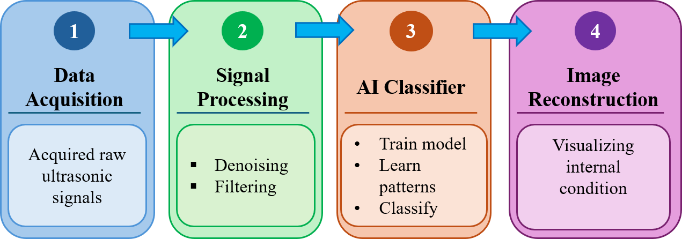
Ultrasonic signals obtained from concrete structures are inherently non-stationary and contain information in both the time and frequency domains. Figure 2 illustrates the general framework of ultrasonic signals-based defect detection. Raw ultrasonic signals are first acquired and then processed through denoising and filtering techniques to improve signal quality. Then analyzed by an Artificial Intelligence (AI) method for defect classification. Finally, image reconstruction techniques are applied to visualize the internal condition of the structure and localize potential defects.
3.1. Signal filtering
Signal filtering is an important process in signal processing that involves removing unwanted components or noise from a signal to enhance its quality and extract useful information62) [29,30]. In the context of ultrasonic testing and other non-destructive evaluation methods, signal filtering is indispensable for improving the clarity and accuracy of the detected signals. Figure 3 presents a schematic illustration of the effect of signal filtering on ultrasonic signals. In the raw signal, defect-related reflections are partially masked by noise and unwanted signals. After filtering, noise is suppressed, and the defect-scattering response becomes more distinguishable, resulting in improved signal interpretation and defect detectability.
For instance, researchers employed Chebyshev's filtering63) to enhance the SNR of defect-scattering signals. By selecting filter parameters, the researchers were able to remove unwanted noise components while preserving the integrity of the defect signals, thereby improving the accuracy of the defect detection process. M. Moles, L. Wesley, and T. Sinclair63) discussed advancements in accurately sizing defects using ultrasonic phased array technology combined with digital signal processing techniques. Traditional ultrasonic sizing methods,

including simple amplitude-based techniques and Time-Of-Flight Diffraction (TOFD), have limitations in accuracy due to factors like pulse length and operator interpretation. This study proposed an innovative approach using Weiner filtering and autoregressive spectral extrapolation to improve ultrasonic signals' time resolution and accuracy. Furthermore, Weifeng Yang64) introduced a novel denoising method with a detailed study of electrical noise in PAUT. The study provided a detailed evaluation of electrical noise in PAUT systems and presented an effective denoising method that enhances the accuracy and reliability of ultrasonic testing, especially in materials with high acoustic energy loss like composites.
Among the available filtering approaches, low-pass, band-pass, adaptive, and wavelet-based filtering techniques are the most employed in ultrasonic NDE. Each method offers distinct advantages depending on the signal characteristics, noise, and inspection objectives.
3.1.1. Low-pass filtering
Low-pass filtering allows low-frequency components of a signal to pass while attenuating high-frequency noise. In ultrasonic concrete inspection, high-frequency noise may originate from electronic interference, coupling variations, and wave scattering caused by aggregates and material heterogeneity65). Therefore, low-pass filters are commonly employed to improve signal quality, enhance the signal-to-noise ratio (SNR), and facilitate the identification of dominant reflections associated with internal defects66,67). Studies have shown that filtering techniques can significantly improve the visibility of defect echoes and the quality of ultrasonic images in concrete structures. However, excessive low-pass filtering may suppress high-frequency information associated with small defects, leading to reduced spatial resolution and decreased sensitivity to fine discontinuities.
3.1.2. Band-pass filtering
Band-pass filtering allows signals within a specified frequency range to pass while attenuating both low-frequency and high-frequency noise components. In ultrasonic concrete inspection, band-pass filters are commonly employed to isolate the frequency content associated with ultrasonic wave propagation and defect reflections while suppressing electronic noise, low-frequency drift, and scattering-related disturbances68). By retaining only the frequency band of interest, band-pass filtering can improve the signal-to-noise ratio (SNR), enhance defect visibility, and improve the quality of ultrasonic images. Recent studies on ultrasonic concrete imaging have demonstrated that band-pass filtering effectively improves the detectability of internal defects and can provide superior image quality when combined with a reconstruction algorithm such as SAFT69,70). However, improper selection of the passband may result in the loss of useful defect information or insufficient noise suppression. Therefore, the filter parameter should be carefully selected according to the transducer frequency and inspection requirements71,72).
3.1.3. Adaptive filtering
Adaptive filtering is a signal-processing technique that automatically adjusts its filter parameters according to the characteristics of the input signal and surrounding noise environment. Unlike fixed low-pass or band-pass filters, adaptive filters continuously update their response to suppress noise while preserving useful ultrasonic information73). This capability is particularly valuable in concrete inspection, where ultrasonic signals are strongly affected by material heterogeneity, aggregate scattering, coupling variations, and environmental interference. Early research reported that adaptive beamforming and adaptive array processing can effectively suppress noise, enhance defect echoes, and improve imaging resolution in ultrasonic array inspection, thereby increasing the reliability of defect detection and characterization74). More recently, adaptive signal processing has been integrated into phased array testing imaging algorithms. An adaptive amplitude-phase fusion framework that combines adaptive phase-entropy weighting and phase-amplitude interaction was proposed75). Their results demonstrated enhanced SNR, improved defect boundary, and a more accurate image of internal defects in precast concrete.
3.1.4. Wavelet denoising
Another filter that is also widely used is wavelet denoising. This filtering offers several advantages over traditional filtering methods, especially for certain types of signals and applications. Wavelet-based denoising provides a time-frequency representation of the signal76,77), allowing for adaptive filtering that can target specific features or noise patterns within the signal76,78). This is especially beneficial for non-stationary signals, where the frequency content changes over time. Wavelet transforms decompose a signal into components based on shifted and scaled versions of a mother wavelet function79,80).
Previous studies have demonstrated that wavelet denoising effectively improves SNR, enhances the clarity of defect-related reflections, and facilitates more accurate characterization of cracks and other internal defects in concrete77,81,82). Furthermore, Wavelet Packet Transform (WPT) methods have been successfully applied to reconstruct useful frequency-band information approaches such as Convolutional Neural Network (CNN), have achieved high accuracy in automated concrete defect recognition and classification78).
In ultrasonic imaging and signal enhancement, two main wavelet transform types are commonly used: (1) Continuous Wavelet Transform (CWT). Provides a highly redundant representation of the signal with continuous scaling and shifting. It is useful for detailed analysis of signal characteristics at various scales and locations; (2) Discrete Wavelet Transform (DWT). Offers more efficient representation by using discrete scaling and shifting steps, often implemented through multi-resolution analysis (MRA), suitable for filtering and denoising applications.
CWT has been applied to the analysis of frequency-dependent velocities in concrete83). In this study, multiple wavelet families constructed the time-frequency distributions of ultrasonic pulses, and the analysis evaluated velocity variations with frequency for both transverse and longitudinal waves. The experimental dataset consisted of 14 concrete specimens with five different mix designs, demonstrating the capability of CWT to decompose and analyze waves propagating in heterogeneous materials. The results indicated that CWT is particularly effective for overcoming challenges related to attenuation and material heterogeneity, providing a clearer understanding of the concrete microstructure and its damage condition. In contrast, DWT is more commonly used for signal denoising and feature enhancement84). Takashi Nagamatsu85) studied the use of Parasitic Discrete Wavelet Transform (P-DWT) for early detection of anomalies in the rotating machinery of the fast-breeder reactor Monju. In this study, the diagnostic system integrated P-DWT and designed customized mother wavelets to closely resemble real anomaly signals. This parasitic filtering enabled the enhancement of the weak diagnostic component while suppressing noise, therefore improving detection sensitivity in environments with challenging signal conditions.
As shown in Table 4, conventional filtering techniques such as low-pass and band-pass filters are computationally efficient and effective for removing specific frequency components. However, their fixed frequency-domain operation limits their ability to process non-stationary ultrasonic signals in concrete inspection.
Adaptive filtering offers greater flexibility but requires additional computational resources and parameter optimization. Among the reviewed techniques, wavelet denoising techniques have proven to be powerful tools for signal enhancement, particularly in the field of ultrasonic testing and non-destructive evaluation. Wavelet analysis enables the extraction of subtle signal features that are often masked by noise. Furthermore, the integration of wavelet filtering with advanced digital signal processing techniques, as demonstrated in several recent studies, continues to improve the detection sensitivity of UT.
3.2. AI-based defect classification
AI has emerged as a powerful tool for interpreting ultrasonic ins for interpreting ultrasonic inspection data and improving defect characterization in concrete structures. Conventional ultrasonic analysis often relies on manual interpretation of signal amplitudes, wave arrival time, and reconstructed images, which can be time-consuming and highly dependent on operator expertise. The integration of AI techniques enables automated analysis of complex ultrasonic data, improving inspection efficiency, consistency, and reliability. Recent studies have highlighted the importance of machine learning and deep learning for ultrasonic NDE, particularly for defect detection, characterization, and imaging application86–88).
Machine learning algorithms are typically applied after signal pre-processing. Statistical features, frequency-domain parameters, wavelet coefficients, and image descriptors can be extracted from ultrasonic signals and subsequently used as inputs for classification models. Common machine learning methods include Support Vector Machine (SVM), Random Forest (RF), Decision Tree (DT), k-Nearest Neighbors (k-NN), and Artificial Neural Network (ANN). These algorithms have demonstrated the ability to classify cracks, voids, delamination, and other internal defects57,87,89–94). Furthermore, Cacciola M. et al.94) proposed an extension of the Takagi-Sugeno fuzzy inference system [TS-FIS] framework based on prototypical fuzzy similarity (PFS) for defect detection in concrete.
Among conventional machine learning approaches, ANN have received considerable attention because of their capability to model complex nonlinear patterns in ultrasonic signals. Their ability to learn from experimental data enables the identification of subtle signal variations
Table 4: Summary of signal filtering methods
| Filtering technique | Principle | Advantages | Limitations |
|---|---|---|---|
| Low-pass filter | Retains low-frequency components | Simple implementation | May remove high-frequency information associated with small defects |
| Band-pass filter | Preserves a selected frequency band | Improves SNR | Required careful selection of cutoff frequencies |
| Adaptive filter | Dynamically adjusts filter parameters | Effective in non-stationary environments | Higher computational complexity and dependence on parameter selection |
| Wavelet denoising | Decomposes signal into multiple scales and removes noise | Excellent time-frequency localization | Performance depends on wavelet selection, decomposition level |
that may not be evident through traditional analytical methods. Previous studies have demonstrated that ANN-based approaches can improve prediction accuracy and enhance the interpretation of ultrasonic inspection results93,95,96). Moreover, Lee S. and Popovics J.S.95) applied Physics-Informed Neural Networks (PINNs) to facilitate accurate material property characterization and defect identification.
Recent advances in deep learning have further enhanced ultrasonic defect detection and characterization. Convolutional Neural Network (CNN) can automatically learn discriminative features directly from ultrasonic signals or reconstructed images without requiring extensive manual feature engineering. Deep learning methods have been applied to various NDE, including signal preprocessing, defect detection, defect characterization, and automated image interpretation97–99).
In PAUT, AI techniques have become increasingly important because of the complexity of data. Recent studies have reported successful applications of machine learning for PAUT image enhancement, defect detection, defect characterization, and automated interpretation86,87,100,101). Machine learning-assisted PAUT has demonstrated the potential to improve defect localization and enhance inspection consistency.
3.3. Imaging methods
The imaging method for wavelet signals involves using wavelet transform techniques to analyze and visualize signals in a way that captures both time and frequency information. The integration of wavelet signal analysis with advanced imaging algorithms has significantly enhanced the capability of NDE to visualize and interpret internal structure conditions. Figure 4 presents a schematic illustration of the ultrasonic image reconstruction process. Multiple A-scan signals acquired from different transducer positions are combined using reconstruction algorithms to generate a two-dimensional image of the inspected region. The reconstructed image provides spatial information regarding the location and geometry of internal reflectors, enabling improved visualization and characterization of defects.
The TFM102,103) was used as a high-resolution ultrasonic

imaging method for detecting damage in concrete structures. The study overcame the concrete natural characteristics, such as severe signal scattering due to diverse internal acoustic interfaces and attenuation by coarse aggregates. The authors proposed an optimization method combining TFM with advanced signal processing algorithms to enhance detection resolution and SNR. The combined application of TFM, time reversal (TR), and phase coherence imaging (PCI) algorithms, along with digital filtering, significantly improves the resolution and accuracy of ultrasonic imaging in concrete structures.
Another widely used reconstruction approach is SAFT. SAFT is an image reconstruction method that improves ultrasonic image quality by synthetically increasing the effective aperture of the transducer through the coherent summation of signals acquired from multiple scan positions. These discontinuities make SAFT particularly suitable for locating cracks, voids, and delamination in concrete structures104,105). The application of the wavelet transform and SAFT for detecting and sizing flaws in ultrasonic images has been investigated106). By integrating wavelet transform for noise reduction and SAFT for enhanced imaging, the authors proposed a method that significantly improved the accuracy and reliability of flaw detection and characterization. Compared with conventional pulse-echo imaging, SAFT provides clearer images and improved defect localization while maintaining relatively low computational requirements
In addition to SAFT, inverse-scattering-based imaging methods have been developed to provide more detailed characterization of internal defects. One of the techniques is the Kirchhoff Linearized Inverse Scattering Method (K-LISM), which reconstructs the geometry and location of internal reflectors by utilizing scattered ultrasonic wavefields. Because K-LSIM accounts for wave-scattering mechanisms, it can provide more detailed representations of defect boundaries and material interfaces than conventional reconstruction methods. The combined application of the K-LISM and P-DWT has been investigated for the early detection and visualization of reinforcing-bar (rebar) corrosion in concrete structures 107). By integrating K-LISM and P-DWT, the researchers achieved high-resolution imaging of the steel-concrete interface, enabling the identification of corrosion before it becomes visible.
As demonstrated in recent studies, such integrated imaging frameworks improve both accuracy and visual interpretability108), leading to an intelligent diagnostic system of automated defect recognition and material health evaluation. In general, the imaging methods discussed above show varying performance in terms of resolution, computational requirements, and suitability for concrete inspection. The TFM provides high-resolution imaging and is effective for detecting small defects, but it requires high computational resources and can be affected by strong scattering in heterogeneous materials. The SAFT improves image clarity with lower computational cost, although its resolution may be lower than that of TFM. Meanwhile, K-LSIM enables detailed reconstruction of defect geometry and reflector locations through inverse-scattering analysis, making it highly suitable for defect characterization in heterogeneous materials. Therefore, selecting an appropriate imaging method depends on the inspection objective and the complexity of wave propagation in concrete.
4. Challenges and recommendations
PAUT has become a widely recognized technique in NDT for various materials, notably metals. However, its application in concrete presents unique challenges that interfere with its effectiveness and widespread utilization. Concrete is a composite material with varying densities and compositions, including aggregates, cement paste, and voids. This heterogeneity scatters ultrasonic waves, making it difficult to obtain clear and accurate images. Concrete significantly attenuates ultrasonic waves, especially at higher frequencies. This attenuation reduces the signal strength and penetration depth, limiting the ability to detect deep defects. Furthermore, the complex wave patterns and potential for multiple reflections demand advanced signal processing and analysis techniques to accurately identify and characterize defects.
In the future, advancements in PAUT technology and methodologies offer promising solutions to overcome these challenges. Signal processing techniques, including wavelet-based analysis and filtering methods, can reduce noise and separate important information related to defect signals from scattered wave components. Imaging methods, such as advanced reconstruction algorithms, help improve image resolution and depth penetration. Future research should focus on developing computationally efficient reconstruction algorithms that can provide high-resolution imaging while enabling practical field implementation. Furthermore, the integration of advanced computational models and machine learning algorithms can assist in better interpreting complex data109–111), thereby enhancing the accuracy and reliability of PAUT in concrete. However, future studies are needed to establish large-scale benchmark datasets, improve model generalization suitable for infrastructure application.
5. Conclusions
1)PAUT represents a significant advancement in the NDE of concrete structures. By utilizing multiple ultrasonic elements and electronic time delays, PAUT enables high-resolution imaging for the detection and characterization of internal defects such as voids, cracks, corrosion, and delamination.
2)The application of PAUT in concrete confronts notable challenges due to the material’s heterogeneity, which causes wave attenuation and scattering. Future research should focus on optimizing the array and probe configuration to improve beam focusing and penetration depth. In addition, the development of adaptive signal processing algorithms and denoising techniques is promising to improve image resolution and depth penetration. Emphasis on real-time analysis, automated defect assessment, large-scale field validation, and robust machine learning integration will be essential to improve the reliability of defect detection.
3)The future of PAUT in concrete testing is promising, offering real-time defect imaging and improved inspection efficiency, while also enabling effective testing in difficult-to-access regions and structures with complex or asymmetrical geometries. As research progresses, PAUT is expected to become a valuable tool for modern concrete evaluation.
References
- P. Kumar Sahu, “Defects in concrete in building construction,” Journal of Advances in Geotechnical Engineering, 5 (2) (n.d.). doi:10.5281/zenodo.7193395.
- C. Massay, M. Cornejo, and H. Baykara, “Predicting compressive strength and density of ecuadorian natural mordenite-based geopolymer using machine learning algorithms,” Evergreen Joint Journal of Novel Carbon Resource Sciences & Green Asia Strategy, 11 (4) 3183–3203 (2024). doi:10.5109/7326955.
- T. Ahmed, E. Burley, S. Rigden, and A.I. Abu-Tair, “The effect of alkali reactivity on the mechanical properties of concrete,” Constr. Build. Mater., 17 123–144 (2003).
- A. Poursaee, “Corrosion of steel in concrete structures,” in: Corrosion of Steel in Concrete Structures, Elsevier Inc., 2016: pp. 19–33. doi:10.1016/B978-1-78242-381-2.00002-X.
- A. Bossio, F. Fabbrocino, G.P. Lignola, T. Monetta, F. Fabbrocino, F. Bellucci, G. Manfredi, and A. Prota, “Effects of Corrosion on Reinforced Concrete Structures,” in: XIV International Forum World Heritage and Degradation Smart Design, Planning and Technologies, 2016. https://www.researchgate.net/publication/301685463.
- M. Li, D. Shen, Q. Yang, X. Cao, C. Huang, Z. Cui, and Y. Qi, “Effect of reinforcement corrosion on the seismic performance of reinforced concrete shear walls,” Constr. Build. Mater., 377 (2023). doi:10.1016/j.conbuildmat.2023.130977.
- A.S. Al-Ameeri, M. Imran Rafiq, and O. Tsioulou, “Influence of carbonation on the resistance of concrete structures to chloride penetration and corrosion,” in: MATEC Web of Conferences, EDP Sciences, 2019. doi:10.1051/matecconf/201928908001.
- A.J. Schokker, and H.R. Hamilton, “Estimating post-tensioning grout bleed resistance using a pressure-filter test,” PCI Journal, 47 (2) 32–39 (2002).
- Im Seok Been, and Hurlebaus Stefan, “NDT method to indentify voids in external post-tensionded tendons,” KSCE Journal of Civil Engineering, 16 388–397 (2012). doi:10.1007/s12205-012-1295-0.
- D. Ferretti, F. Pagliari, and B. Belletti, “Bond of post-tensioning strands in case of grouting defects,” Constr. Build. Mater., 426 (2024). doi:10.1016/j.conbuildmat.2024.136133.
- S. Kamalakannan, R. Thirunavukkarasu, R.G. Pillai, and M. Santhanam, “Factors affecting the performance characteristics of cementitious grouts for post-tensioning applications,” Constr. Build. Mater., 180 681–691 (2018). doi:10.1016/j.conbuildmat.2018.05.236.
- S. Maack, S. Küttenbaum, B. Bühling, K. Borchardt-Giers, N. Aßmann, and E. Niederleithinger, “Low frequency ultrasonic pulse-echo datasets for object detection and thickness measurement in concrete specimens as testing tasks in civil engineering,” Data Brief, 48 (2023). doi:10.1016/j.dib.2023.109233.
- Y. Xu, and R. Jin, “Measurement of reinforcement corrosion in concrete adopting ultrasonic tests and artificial neural network,” Constr. Build. Mater., 177 125–133 (2018). doi:10.1016/j.conbuildmat.2018.05.124.
- Y. Wang, A. Mukherjee, and A. Castel, “Ultrasonic guided waves for monitoring incipient corrosion in reinforced concrete with top-bar defect,” Cem. Concr. Compos., 141 (2023). doi:10.1016/j.cemconcomp.2023.105116.
- T. Yin, C.T. Ng, L. Chen, and A. Kotousov, “In-situ nonlinear ultrasonic technique for monitoring damage in ultra-high performance fibre reinforced concrete (uhpfrc) during direct tensile test,” Measurement (Lond)., 222 (2023). doi:10.1016/j.measurement.2023.113587.
- T. Terzioglu, M.M. Karthik, S. Hurlebaus, M.B.D. Hueste, S. Maack, J. Woestmann, H. Wiggenhauser, M. Krause, P.K. Miller, and L.D. Olson, “Nondestructive evaluation of grout defects in internal tendons of post-tensioned girders,” NDT and E International, 99 23–35 (2018). doi:10.1016/j.ndteint.2018.05.013.
- W. Zatar, H. Nghiem, G. Chen, and F. Xiao, “Ultrasonic pulse echo signals for detection and advanced assessment of reinforced concrete anomalies,” (2024). doi:10.20944/preprints202403.1428.v1.
- H. Taheri, and A.A. Hassen, “Nondestructive ultrasonic inspection of composite materials: a comparative advantage of phased array ultrasonic,” Applied Sciences (Switzerland), 9 (8) (2019). doi:10.3390/app9081628.
- L.K. Toke, D.M. Mate, L.N. Patil, D.S. Patil, and A.M. Zope, “Optimizing aluminium alloy surface quality with ann-driven burnishing: machining parameters and durability study,” Evergreen Joint Journal of Novel Carbon Resource Sciences & Green Asia Strategy, 11 927–937 (2024).
- Deepal Agrawal, Nitish K. Gupta, and Yogesh Shrivastava, “Synthesis of catalyst for aqueous polymerization: perform artificial neural network for the prediction of maximum yield of polymer,” Evergreen Joint Journal of Novel Carbon Resource Sciences & Green Asia Strategy, 12 (3) 1520–1530 (2025). doi:10.5109/7388846.
- P. Ranjan, S. Yadav, H. Gupta, and A. Bage, “Design and development of machine learning assisted cylindrical dielectric resonator antenna,” Evergreen Joint Journal of Novel Carbon Resource Sciences & Green Asia Strategy, 10 308–316 (2023).
- A.K. Sethi, A.K. Sharma, S. Chandra, and A. Rawat, “The photovoltaic (pv) module performance analysis using artificial neural network (ann),” Evergreen Joint Journal of Novel Carbon Resource Sciences & Green Asia Strategy, 11 1273–1278 (2024).
- Z. Li, J. Yoon, R. Zhang, F. Rajabipour, W. V. Srubar, I. Dabo, and A. Radlińska, “Machine learning in concrete science: applications, challenges, and best practices,” NPJ Comput. Mater., 8 (1) (2022). doi:10.1038/s41524-022-00810-x.
- B. I, K. Barashok, Y. Choi, Y. Choi, M. Aslam, and J. Lee, “Machine learning techniques in ultrasonics-based defect detection and material characterization: a comprehensive review,” Advances in Mechanical Engineering, 17 (6) (2025). doi:10.1177/16878132251347390.
- H. Taheri, Bocanegra Maria Gonzalez, and Taheri Mohammad, “Artificial intelligence, machine learning and smart technologies for nondestructive evaluation,” 22 (11) (2022). doi:10.3390/s22114055.
- S. Ji, “Non-destructive evaluation (nde) methods used for condition assessment of concrete structures,” Applied and Computational Engineering, 23 (1) 45–51 (2023). doi:10.54254/2755-2721/23/20230609.
- S. Hassani, and U. Dackermann, “A systematic review of advanced sensor technologies for non-destructive testing and structural health monitoring,” Sensors, 23 (4) (2023). doi:10.3390/s23042204.
- S. Cantero-Chinchilla, P.D. Wilcox, and A.J. Croxford, “Deep learning in automated ultrasonic nde -- developments, axioms and opportunities,” NDT and E International, 131 (2022). doi:10.1016/j.ndteint.2022.102703.
- Y. Na, Y. He, B. Deng, X. Lu, H. Wang, L. Wang, and Y. Cao, “Advances of machine learning in phased array ultrasonic non-destructive testing: a review,” AI (Switzerland), 6 (6) (2025). doi:10.3390/ai6060124.
- B. Tefera, and A. Tarekegn, “Non-destructive testing techniques for condition assessment of concrete structures: a review,” American Journal of Civil Engineering, 13 (1) 10–31 (2025). doi:10.11648/j.ajce.20251301.12.
- Z.W. Coleman, and A.K. Schindler, “Investigation of ground-penetrating radar defect detection capabilities, influence of moisture content, and optimal data collection orientation in condition assessments of concrete bridge decks,” J. Appl. Geophy., 202 (2022). doi:10.1016/j.jappgeo.2022.104655.
- O.O. Falowo, V. Oluwasegunfunmi, A.O. Babatunde, and O.W. Kunle, “Ground penetrating radar for monitoring damage in reinforced concrete bridges: a reliable tool for structural health assessment,” Computational Engineering and Physical Modeling, 7 (3) 108–123 (2024). doi:10.22115/cepm.2024.488656.1343.
- R. Hussein, B. Etete, H. Mahdi, and H. Al-Shukri, “Detection and delineation of cracks and voids in concrete structures using the ground penetrating radar technique,” J. Appl. Geophy., 226 (2024). doi:10.1016/j.jappgeo.2024.105379.
- S. Liu, C. Weng, P. Jiao, F. Wang, L. Fu, X. Meng, and L. Lei, “GPR signal analysis of post-tensioned prestressed concrete girder defects,” Journal of Geophysics and Engineering, 10 (3) (2013). doi:10.1088/1742-2132/10/3/034005.
- M.P. Owerko, and Ł. Ortyl, “GPR Identification of Prestressing Tendons in Areas with High Density of Ordinary Reinforcement,” in: 13th International Multidisciplinary Scientific GeoConference SGEM 2013, 2013.
- S. Lai, Y. Yue, X. Meng, and H. Liu, “Void Detection behind Shield Tunnel Segments Using Ground Penetrating Radar: A Laboratory Experiment,” in: J. Phys. Conf. Ser., Institute of Physics, 2023. doi:10.1088/1742-6596/2651/1/012044.
- Y.X. Yang, W.H. Chai, D.C. Liu, W. De Zhang, J.C. Lu, and Z.K. Yang, “An impact-echo experimental approach for detecting concrete structural faults,” Advances in Civil Engineering, 2021 (2021). doi:10.1155/2021/8141015.
- J.K. Zhang, W. Yan, and D.M. Cui, “Concrete condition assessment using impact-echo method and extreme learning machines,” Sensors (Switzerland), 16 (4) (2016). doi:10.3390/s16040447.
- M.T.A. Chaudhary, “Effectiveness of impact echo testing in detecting flaws in prestressed concrete slabs,” Constr. Build. Mater., 47 753–759 (2013). doi:10.1016/j.conbuildmat.2013.05.021.
- Y. Tinkey, and L.D. Olson, “Impact-Echo Scanning for Grout Void Detection in Post-tensioned Bridge Ducts-Findings from a Research Project and a Case History,” in: ASCE Structures Congress, California, 2007.
- Z.W. Coleman, and A.K. Schindler, “Investigation of ground-penetrating radar, impact echo, and infrared thermography methods to detect defects in concrete bridge decks,” Transp. Res. Rec., 2679 (1) 169–182 (2025). doi:10.1177/03611981221101027.
- G. Concu, and N. Trulli, “Concrete defects sizing by means of ultrasonic velocity maps,” Buildings, 8 (12) (2018). doi:10.3390/buildings8120176.
- W.A. Zatar, H.D. Nguyen, and H.M. Nghiem, “Ultrasonic pitch and catch technique for non-destructive testing of reinforced concrete slabs,” Journal of Infrastructure Preservation and Resilience, 1 (1) (2020). doi:10.1186/s43065-020-00012-z.
- Z. Li, L. Zheng, C. Chen, Z. Long, and Y. Wang, “Ultrasonic detection method for grouted defects in grouted splice sleeve connector based on wavelet pack energy,” Sensors (Switzerland), 19 (7) (2019). doi:10.3390/s19071642.
- W. Zatar, G. Chen, H. Nghiem, and F. Xiao, “Ultrasonic pulse-echo signals for quantitative assessment of reinforced concrete anomalies,” Applied Sciences (Switzerland), 14 (11) (2024). doi:10.3390/app14114860.
- I. Mazzatura, J.R. Casas, S. Caprili, and W. Salvatore, “Reliability of UT for the grouting inspection in PT bridges: A case study,” in: Bridge Maintenance, Safety, Management, Digitalization and Sustainability - Proceedings of the 12th International Conference on Bridge Maintenance, Safety and Management, IABMAS 2024, CRC Press/Balkema, 2024: pp. 2585–2593. doi:10.1201/9781003483755-308.
- O. Paris, C. Poidevin, J.M. Rambach, and G. Nahas, “Study of phased array techniques for concrete inspection,” International Journal of Microstructure and Materials Properties, 1 (3–4) 274–281 (2006). doi:10.1504/ijmmp.2006.011643.
- F. Mielentz, “Phased arrays for ultrasonic investigations in concrete components,” J. Nondestr. Eval., 27 (1–3) 23–33 (2008). doi:10.1007/s10921-008-0032-6.
- “Introduction to Phased Array Ultrasonic Technology Applications,” Olympus, United States of America, 2017.
- Y. Ohara, K. Kikuchi, T. Tsuji, and T. Mihara, “Development of low‐frequency phased array for imaging defects in concrete structures,” Sensors, 21 (21) (2021). doi:10.3390/s21217012.
- J. Yang, G. Fan, Y. Xiang, H. Zhang, W. Zhu, H. Zhang, and Z. Li, “Low-frequency ultrasonic array imaging for detecting concrete structural defects in blind zones,” Constr. Build. Mater., 425 (2024). doi:10.1016/j.conbuildmat.2024.135948.
- A. Ozawa, H. Izumi, K. Nakahata, K. Ohira, and K. Ogawa, “Low frequency ultrasonic array imaging using signal post-processing for concrete material,” in: AIP Conf. Proc., American Institute of Physics Inc., 2017. doi:10.1063/1.4974634.
- J. Zhang, L. Liu, and L. Li, “Research on internal defect detection of concrete structure based on ultrasonic phased array technology,” JOURNAL OF SIMULATION, 8 (4) (2020).
- Liu Hai, Chen Zhijie, Liu Yijie, Chen Yangyang, Du Yanliang, and Zhou Fulin, “Interfacial debonding detection for cfst structures using an paut: application to the shenzen seg building,” Mech. Syst. Signal Process., 192 (2023). doi:10.1016/j.ymssp.2023.110214.
- J. JC, and L. S, “ Phased array ultrasonic test signal enhancement and classification using empirical wavelet transform and deep convolution neural network,” Concurrent Engineering, 30 (3) 229–236 (2022). doi:10.1177/1063293X211073714.
- S. El Hawwat, J. Kumar Shah, and H. Wang, “Machine learning supported ultrasonic testing for characterization of cracks in polyethylene pipes,” Measurement (Lond)., 240 (2025). doi:10.1016/j.measurement.2024.115609.
- P. jo Chun, I. Ujike, K. Mishima, M. Kusumoto, and S. Okazaki, “Random forest-based evaluation technique for internal damage in reinforced concrete featuring multiple nondestructive testing results,” Constr. Build. Mater., 253 (2020). doi:10.1016/j.conbuildmat.2020.119238.
- V. Feller, F. Mielentz, T. Klewe, M. Krause, R. Orglmeister, and M. Pflugradt, “Ultrasonic Phased Array for Investigations of Concrete Components,” in: International Symposium Non-Destructive Testing in Civil Engineering, Berlin, 2015. www.ndt.net/?id=18291.
- F. Dupont-Marillia, M. Jahazi, S. Lafreniere, and P. Belanger, “Design and optimisation of a phased array transducer for ultrasonic inspection of large forged steel ingots,” NDT and E International, 103 119–129 (2019). doi:10.1016/j.ndteint.2019.02.007.
- Z.-B. Luo, F.-L. Li, H.-Q. Cao, S.-J. Jin, and L. Lin, “Focal Law Optimization and Acoustic Field Simulation of PAUT on CFRP Radii,” in: Proceedings of FENDT 2018, 2018.
- M. Achbal, A. Khamlichi, and F. El Khannoussi, “Optimizing the focal laws of ultrasonic arrays for non-destructive evaluation of composite panels with delamination,” in: MATEC Web of Conferences, EDP Sciences, 2018. doi:10.1051/matecconf/201819100001.
- Pramod Kumar, Manvendra Verma, Pramod Kumar, Pokhraj Sahu, and Shailendra Kumar Yadav, “Qualitative and quantitative analyses of hazardous compounds from ntpc rihand, india,” Evergreen Joint Journal of Novel Carbon Resource Sciences & Green Asia Strategy, 12 (3) 1402–1417 (2025). doi:10.5109/7388837.
- M. Moles, O. Ndt, C.; L. Wesley, and T. Sinclair, “Developments in ultrasonic inspection ii accurate defect sizing using phased array and signal processing,” JRC-NDE 2009, (2010). http://www.ndt.net/?id=8881.
- W. Yang, Q. Wang, Y. Hou, C. Yu, X. Shi, Y. Hu, and Y. Ke, “Analysis and denoising of electric noise in phased array ultrasonic testing system,” NDT and E International, 146 (2024). doi:10.1016/j.ndteint.2024.103164.
- Y. Lu, H. Ma, and Z. Li, “Ultrasonic monitoring of the early-age hydration of mineral admixtures incorporated concrete using cement-based piezoelectric composite sensors,” J. Intell. Mater. Syst. Struct., 26 (3) 280–291 (2015). doi:10.1177/1045389X14525488.
- M. Almalki, “Application of non-destructive geophysical methods for testing concrete structures,” J. King Saud Univ. Sci., 35 (8) (2023). doi:10.1016/j.jksus.2023.102916.
- M.A. Therib, I.H. Al-Kharsan, and A.F. Al-Baghdadi, “Design a suitable optimized low pass FIR filter for ultrasonic signal,” in: IOP Conf. Ser. Mater. Sci. Eng., IOP Publishing Ltd, 2020. doi:10.1088/1757-899X/928/2/022149.
- E. Jägle, R. Tuladhar, E. Niederleithinger, N. Epple, C. Andrea, S. Trujillo, C. Gehlen, and J.J. Timothy, “Evaluation of ultrasonic signals collected from laboratory concrete specimens: preprocessing and analysis with coda wave interferometry,” MethodsX, 16 103811 (2026). doi:10.5281/zenodo.
- M. Li, and G. Hayward, “Optimal matched filter design for ultrasonic NDE of coarse grain materials,” in: AIP Conf. Proc., American Institute of Physics Inc., 2016. doi:10.1063/1.4940457.
- L. Rong, Y. Chen, J. Hu, Y. Liu, and H. Li, “Ultrasonic synthetic aperture imaging for inner defect of concrete based on delay-multiple-and-sum,” Traitement Du Signal, 41 (2) 653–668 (2024). doi:10.18280/ts.410209.
- H. Morishige, and Tanaka S., “Non-Destructive Inspect ion of Structures Using Ultrasonic,” in: SICE Annual Conference, Sapporo, 2004.
- S. Tayfur, “Assessing the influences of noise suppression filters on ultrasonic concrete images generated by an innovative cmu-saft algorithm,” Arab. J. Sci. Eng., 50 (3) 1601–1614 (2025). doi:10.1007/s13369-024-09024-3.
- B. Yenealem, M. Genetu, and E. Mamushet, “Applications of adaptive filtering techniques for noise cancellation systems to the ultrasonic non-destructive evaluation (nde),” Journal of Electrical and Electronic Engineering, 13 (4) 168–183 (2025). doi:10.11648/j.jeee.20251304.13.
- M. Li, and G. Hayward, “Ultrasound nondestructive evaluation (nde) imaging with transducer arrays and adaptive processing,” Sensors, 12 (1) 42–54 (2012). doi:10.3390/s120100042.
- Z. Sun, L. Yang, M. Liu, Y. Ma, and D. Li, “Adaptive amplitude-phase fusion based ultrasonic imaging for internal defect detection in precast concrete components,” Mech. Syst. Signal Process., 240 (2025). doi:10.1016/j.ymssp.2025.113377.
- K.A. Tiwari, R. Raisutis, and V. Samaitis, “Hybrid signal processing technique to improve the defect estimation in ultrasonic non-destructive testing of composite structures,” Sensors (Switzerland), 17 (12) (2017). doi:10.3390/s17122858.
- Z. Nie, K. Wang, and M. Zhao, “Application of wavelet and eemd joint denoising in nonlinear ultrasonic testing of concrete,” Advances in Materials Science and Engineering, 2018 (2018). doi:10.1155/2018/7872036.
- J. Zhao, T. Hu, and Q. Zhang, “A wavelet packet transform and convolutional neural network method based ultrasonic detection signals recognition of concrete,” Sensors, 22 (10) (2022). doi:10.3390/s22103863.
- “Signal-to-noise ratio improvement based on the discrete wavelet transform in ultrasonic defectoscopy,” 44 (4) 61–66 (2004). http://ctn.cvut.cz/ap/.
- A. Abbate, J. Koay, J. Frankel, S.C. Schroeder, and P. Das, “Signal detection and noise suppression using a wavelet transform signal processor: application to ultrasonic flaw detection,” IEEE Trans. Ultrason. Ferroelectr. Freq. Control, 44 (1) (1997).
- I.G.P.S. Wijaya, and N.N. Kencanawati, “Denoising acoustic emission signal using wavelet transforms for determining the micro crack location inside of concrete,” International Journal of Technology, 5 (3) 259–268 (2014). doi:10.14716/ijtech.v5i3.613.
- D. Ai, D. Zhang, and H. Zhu, “A damage localization approach for concrete structure using discrete wavelet transform of electromechanical admittance of bonded pzt transducers,” Mech. Syst. Signal Process., 218 (2024). doi:10.1016/j.ymssp.2024.111531.
- C.L. Nogueira, “Wavelet-based analysis of ultrasonic longitudinal and transverse pulses in cement-based materials,” Cem. Concr. Res., 41 (11) 1185–1195 (2011). doi:10.1016/j.cemconres.2011.07.008.
- M. Dahmani, A. Arbaoui, and B. Rebai, “Wavelet signal analysis for the detection of sand excess defects in hardened concrete,” Research on Engineering Structures and Materials, 11 (5) 2507–2519 (2025). doi:10.17515/resm2025-735ma0309rs.
- T. Nagamatsu, Y. Jou, A. Gofuku, T. Fujino, and Z. Zhang, “Diagnostic agent using parasitic discrete wavelet transform for the hybrid diagnostic agent system for the fast-breeder reactor ‘monju,’” E-Journal of Advanced Maintenance, 6 71–85 (2014).
- O. Siljama, T. Koskinen, O. Jessen-Juhler, and I. Virkkunen, “Automated flaw detection in multi-channel phased array ultrasonic data using machine learning,” J. Nondestr. Eval., 40 (3) (2021). doi:10.1007/s10921-021-00796-4.
- T. Latête, B. Gauthier, and P. Belanger, “Towards using convolutional neural network to locate, identify and size defects in phased array ultrasonic testing,” Ultrasonics, 115 (2021). doi:10.1016/j.ultras.2021.106436.
- Y. Wang, L. Wang, W. Ye, F. Zhang, Y. Pan, and Y. Li, “Concrete defect localization based on multilevel convolutional neural networks,” Materials, 17 (15) (2024). doi:10.3390/ma17153685.
- J. Yang, D. Ai, and D. Zhang, “Damage classification approach for concrete structure using support vector machine learning of decomposed electromechanical admittance signature via discrete wavelet transform,” Buildings, 15 (15) (2025). doi:10.3390/buildings15152616.
- C.L. Fan, and Y.J. Chung, “Supervised machine learning–based detection of concrete efflorescence,” Symmetry (Basel)., 14 (11) (2022). doi:10.3390/sym14112384.
- Y. Ravichandran, D. Liao, and C.T. Kurakula, “Data-Driven Assessment of Concrete Slab Integrity via Impact-Echo Signals and Neural Networks,” in: 2025. http://arxiv.org/abs/2511.21080.
- F. Dethof, and S. Keßler, “Incorporating a-priori knowledge into convolutional neural networks for impact echo frequency estimation,” J. Nondestr. Eval., 45 (1) (2026). doi:10.1007/s10921-025-01312-8.
- T. Hu, J. Zhao, R. Zheng, P. Wang, X. Li, and Q. Zhang, “Ultrasonic based concrete defects identification via wavelet packet transform and ga-bp neural network,” PeerJ Comput. Sci., 7 1–20 (2021). doi:10.7717/peerj-cs.635.
- M. Cacciola, G. Angiulli, P. Burrascano, F. Laganà, and M. Versaci, “A prototypical fuzzy similarity-based classification framework for ultrasonic defect detection in concrete,” Eng, 7 (2) (2026). doi:10.3390/eng7020088.
- S. Lee, and J.S. Popovics, “Ultrasonic defect detection in a concrete slab assisted by physics-informed neural networks,” NDT and E International, 151 (2025). doi:10.1016/j.ndteint.2024.103311.
- D. Di Giacinto, V. Musone, and E. Ruocco, “Voids indentification by isogeometric boundary element and neural network algorithms,” Int. J. Mech. Sci., 231 (2022). doi:10.1016/j.ijmecsci.2022.107538.
- Y.J. Cha, W. Choi, and O. Büyüköztürk, “Deep learning-based crack damage detection using convolutional neural networks,” Computer-Aided Civil and Infrastructure Engineering, 32 (5) 361–378 (2017). doi:10.1111/mice.12263.
- S. Dorafshan, R.J. Thomas, and M. Maguire, “Comparison of deep convolutional neural networks and edge detectors for image-based crack detection in concrete,” Constr. Build. Mater., 186 1031–1045 (2018). doi:10.1016/j.conbuildmat.2018.08.011.
- C.V. Dung, and L.D. Anh, “Autonomous concrete crack detection using deep fully convolutional neural network,” Autom. Constr., 99 52–58 (2019). doi:10.1016/j.autcon.2018.11.028.
- H. Hervé-Côte, F. Dupont-Marillia, and P. Bélanger, “Automatic flaw detection in sectoral scans using machine learning,” Ultrasonics, 141 (2024). doi:10.1016/j.ultras.2024.107316.
- W. Sun, S. Hou, G. Wu, Z. Wu, W. Xiong, and J. Zhang, “Phased array ultrasonic and deep learning based internal defect detection in underwater concrete bridge structures,” Case Studies in Construction Materials, 23 (2025). doi:10.1016/j.cscm.2025.e04946.
- L. Ge, Q. Li, Z. Wang, Q. Li, C. Lu, D. Dong, and H. Wang, “High-resolution ultrasonic imaging technology for the damage of concrete structures based on total focusing method,” Computers and Electrical Engineering, 105 (2023). doi:10.1016/j.compeleceng.2022.108526.
- H. Kwon, C. Joh, and W.J. Chin, “Pulse peak delay-total focusing method for ultrasonic tomography on concrete structure,” Applied Sciences (Switzerland), 11 (4) 1–12 (2021). doi:10.3390/app11041741.
- H. Kwon, C. Joh, and W.J. Chin, “3D internal visualization of concrete structure using multifaceted data for ultrasonic array pulse-echo tomography,” Sensors, 21 (19) (2021). doi:10.3390/s21196681.
- J.H. Tong, C.L. Chiu, and C.Y. Wang, “Improved synthetic aperture focusing technique by hilbert-huang transform for imaging defects inside a concrete structure,” IEEE Trans. Ultrason. Ferroelectr. Freq. Control, 57 (11) 2512–2521 (2010). doi:10.1109/TUFFC.2010.1717.
- R.-J. Liout, K.-C. Kao, C.-Y. Yeh, and M.-S. Chen, “Flaw detection and sizing of ultrasonic images using wavelet transform and saft,” Proceedings 0f 2004 International Symposium on Intelligent Signal Processing and Communication Systems, (2004). doi:10.1109/SPACS.2004.1439025.
- Tsunoda T., and Suzuki K., “Early detection of reinforcing-bar corrosion with Linearized Inverse Scattering Method,” in: Maintenance, Safety, Risk, Management and Life-Cycle Performance of Bridges : Proceedings of the Ninth International Conference on Bridge Maintenance, Safety and Management (IABMAS 2018), CRC Press, 2018.
- P. Jaidka, P. Upadhyay, A. Kumar, A. kumar, and S. Prakash Yadav, “Transforming coconut farming with deep learning disease detection,” Evergreen Joint Journal of Novel Carbon Resource Sciences & Green Asia Strategy, 11 3233–3242 (2024).
- A. Arunika, J.F. Fatriansyah, and V.A. Ramadheena, “Detection of asphalt pavement segregation using machine learning linear and quadratic discriminant analyses,” Evergreen Joint Journal of Novel Carbon Resource Sciences & Green Asia Strategy, 9 (1) 213–218 (2022). doi:10.5109/4774236.
- S. Akhai, “Navigating the potential applications and challenges of intelligent and sustainable manufacturing for a greener future,” Evergreen Joint Journal of Novel Carbon Resource Sciences & Green Asia Strategy, 10 (4) 2237–2243 (2023). doi:10.5109/7160899.
- P. Saraswat, and R. Agrawal, “Artificial intelligence as key enabler for sustainable maintenance in the manufacturing industry: scope & challenges,” Evergreen Joint Journal of Novel Carbon Resource Sciences & Green Asia Strategy, 10 (4) 2490–2497 (2023). doi:10.5109/7162012.