
Abstract
This study examines how Green Leadership drives Sustainable Business Performance through the joint mediation of green organizational identity (GOI) and green human resource management policies (GHP), grounded in the resource-based view. Three gaps motivate this research: the undertheorized joint mediation mechanisms, the unmodeled symbiotic reinforcement loop between the GOI and GHP, and the inferential limitations of conventional bootstrapping. A Monte Carlo simulation-based PLS-SEM framework (K = 10,000 iterations) was applied to data from 218 managers across diverse Vietnamese industries. The results confirmed a significant direct effect of Green Leadership on Business Performance (beta = 0.208, 95% MC-CI [0.107, 0.315]), with the total indirect effect through both mediators substantially larger (beta = 0.436; VAF = 67.7%). A strong symbiotic GOI-to-GHP path was confirmed (beta = 0.490, 95% MC-CI [0.392, 0.581]), positioning collective green identity and green human capital as co-evolving VRIN resources that jointly drive sustainable competitive advantages.
Keywords: business performance, green human resource management policies, green leadership, green organizational identity, Monte Carlo simulation, structural equation modeling
Outline
1. Introduction
The modern global business environment is marked by a pressing need for environmental sustainability, necessitating that firms incorporate green initiatives into their fundamental operations and strategic frameworks. This paradigm shift has elevated "green management" to a central position in academic and practical discussions, highlighting its essential role in addressing complex ecological issues while promoting economic development and sustainable organizational longevity1). Concerns regarding climate change, resource depletion, and environmental degradation have heightened global awareness of environmental issues, resulting in the implementation of more rigorous regulations by governments and escalating demands from diverse stakeholders, including consumers, employees, and NGOs2). To navigate this changing environment, organizations must move beyond conventional profit maximization and adopt corporate sustainability, which entails formulating "green" strategies to generate enduring value for a diverse array of stakeholders, including customers and employees. This includes assessments of economic feasibility, social justice and environmental conservation. In this changing environment, human resources are widely regarded as vital assets and fundamental drivers of organizational sustainability3).
Leadership stands at the center of this green transformation. Green Leadership — defined as a style that prioritizes ecological sustainability, champions employee environmental innovation, fosters inclusive green dialogue, and embeds environmental values into organizational decision-making — has been identified as the pivotal driver of an organization's environmental orientation4,5). Nevertheless, the exact mechanism by which Green Leadership transmits its effect through the organizational system to produce tangible sustainable performance outcomes remains unclear. Two critical intermediate mechanisms have emerged from the literature as particularly promising — Green Organizational Identity and Green HRM Policies — but their joint dynamics and combined mediation of the leadership-performance nexus have not been rigorously examined.
Prior research has predominantly examined either Green Organizational Identity or Green HRM Policies as isolated mediators between green leadership and performance outcomes6,7). Studies that include both constructs tend to model them as independent parallel paths without theorizing their mutual influence. This fragmentation produces an underspecified model that omits a theoretically important and practically significant feedback mechanism: the degree to which a strong collective green identity preconditions the effectiveness of green HR practices.
The Resource-Based View asserts that intangible cultural resources and formal organizational structures mutually develop and strengthen each other8). In the context of green management, this suggests that a robust Green Organizational Identity — the collective internalization of environmental principles — should serve as a cultural foundation that enhances the implementation and efficacy of Green HRM Policies. Employees who strongly align with their organization's environmental objectives are more inclined to actively participate in GHRM activities rather than see them as mere compliance requirements9). This directional symbiotic pathway from GOI to GHP has not been formally theorized or empirically tested within an integrated mediation model.
The present study addresses these three gaps through three interrelated research objectives. Initially, it formulates and evaluates a comprehensive theoretical model in which Green Organizational Identity and Green HRM Policies collectively mediate the association between Green Leadership and Business Performance, including a directional path from GOI to GHP that represents the symbiotic identity-practice loop. Second, it employs Monte Carlo simulation as the primary inferential engine, generating 10,000 simulated indirect-effect estimates to construct stable, asymmetric 95% confidence intervals for all direct, indirect, and total effects of the variables. Third, it grounds the model in the Resource-Based View, extending its application to explicitly encompass the co-evolution of cultural identity resources (GOI) and human capital resources (green human capital developed through GHRM) as jointly constituting a VRIN-based competitive advantage in green management.
This study makes three hierarchically ordered contributions to the literature. (1) Primary theoretical contribution: This study develops the first integrated model positioning GOI and GHP as co-evolving, mutually reinforcing VRIN mediators connected by a directional identity-to-practice reinforcement path (GOI → GHP), extending RBV beyond its conventional treatment of human capital as independently constituted. For e-commerce (TMDT) scholars, green brand identity (GOI equivalent on platforms such as Tiki, Sendo, TikTok Shop Vietnam) and sustainable HR practices in logistics (GHP equivalent) co-evolve as jointly constituted assets. (2) Primary methodological contribution: Monte Carlo simulation-based mediation inference was introduced to green management research and implemented in Python 3.11, enabling full replication. (3) Contextual contribution: Evidence from a Vietnamese multi-industry sample, including 34 e-commerce organizations (15.6%).
The remainder of this paper is organized as follows. Section 2 provides an extensive literature review and formulates the study hypotheses. Section 3 delineates the study approach, including a thorough explanation of the Monte Carlo simulation process. Section 4 presents the empirical results. Section 5 discusses the contributions, limitations, and avenues for further study. Finally, the conclusions are presented.
2. Literature review
The contemporary business landscape is profoundly affected by urgent environmental concerns, requiring companies to integrate sustainability into their core objectives and strategies. This paradigm shift has positioned "green management" prominently in both scholarly and practical discourse, notably concerning the influence of leadership and human resource strategies on fostering sustainable business performance10). This literature review analyzes the intricate relationships among green leadership, green organizational identity, green human resource management (GHRM) policies, and sustainable company performance based on the Resource-Based View.
2.1. The Resource-Based View
The Resource-Based View (RBV) theory offers a foundational framework for understanding how firms achieve and sustain competitive advantages. RBV posits that a firm's superior performance arises from its unique, valuable, rare, inimitable, and non-substitutable (VRIN) internal resources and capabilities. Within the framework of green management, the RBV underscores that human capital, encompassing employees' skills, capacities, and motivations, is an essential internal resource that can foster a sustainable competitive advantage11).
Human resources are considered "socially savvy and competent assets" that are difficult for rivals to replicate, and hence play a vital role in achieving a prolonged competitive advantage. Green Human Resource Management solutions, including green recruiting, training, performance management, and pay, seek to enhance human capital by augmenting workers' environmental awareness, knowledge, skills, and commitment6,12). These methods foster the cultivation of a "greener workforce" adept at advancing environmentally sustainable initiatives and realizing corporate ecological objectives.
Moreover, the Resource-Based View posits that a firm's distinctive internal resources, such as exceptionally skilled and motivated personnel, can effectively mitigate organizational deficiencies and environmental problems, thus preserving a competitive edge13). This viewpoint aligns with the notion that GHRM policies and the resulting green employee behaviors (such as green work engagement, green knowledge sharing, and green innovation) enhance a firm's overall performance and its capacity to address environmental challenges. The ability-motivation-opportunity (AMO) hypothesis, frequently combined with the resource-based view (RBV), clarifies how green human resource management methods cultivate these employee characteristics, resulting in favorable environmental consequences14). RBV and AMO theories collectively offer a comprehensive framework for understanding how firms can strategically leverage their human resources to achieve sustainable economic performance in an environmentally conscious environment.
2.2. Research Hypotheses Development
Research demonstrates that a robust Green Organizational Identity motivates workers to participate in the organization's sustainability goals, cultivating a conviction in the organization's support and recognition of their distinct environmental endeavors. This conviction fosters the creation of additional environmental concepts and solutions within innovation initiatives, resulting in progress in environmental protection and enhancing overall green innovation15). These strategies foster a mutually beneficial environment for environmental conservation and commercial innovation.
Drawing on Social Identity Theory16), green leaders signal the organization's environmental identity through visible behavioral commitment; employees internalize this identity as self-defining when they perceive personal-organizational green value congruence, which is particularly salient in e-commerce, where brand sustainability narratives are publicly visible (e.g., Shopee Green Shop certification, Lazada carbon-neutral delivery pledges). Drawing on Social Learning Theory17), employees acquire green behaviors by observing managers who model sustainable practices; when leaders visibly adopt paperless workflows and eco-friendly procurement, employees gradually internalize these as defining features of collective identity. Together, SIT and SLT explain how Green Leadership constructs the collective identity substrate from which the GOI emerges.
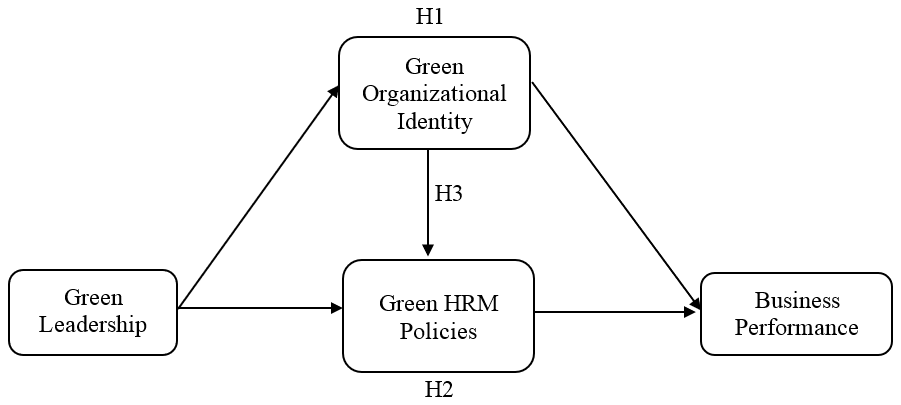
H1: Green Organizational Identity mediates the relationship between Green Leadership and Sustainable Business Performance.
GHRM practices are essential for enhancing organizational performance by strategically directing managerial focus through methods such as personnel selection, training, performance assessment, and incentives18). These activities are essential for providing the components necessary to develop corporate sustainability. Research underscores the significance and potential of GHRM in achieving company sustainability.
Organizations that adopt GHRM methods cultivate an environment aligned with individual values and developmental phases, promoting pro-environmental behaviors that enhance sustainable growth19). Employees who witness their company’s sincere dedication to environmental conservation feel intrinsically inspired to engage in eco-friendly practices to secure a sustainable future20,21). Research indicates that GHRM is directly associated with favorable environmental results and encourages pro-environmental behavior among employees. This directly enhances sustainable business performance by reducing environmental impact and increasing resource efficiency. Thus, we posit that
H2: Green HRM Policies mediate the relationship between Green Leadership and Sustainable Business Performance.
Green organizational identity (GOI) refers to the collective understanding and affiliation of workers with an organization's environmental goals22). When workers' views fit with the leader's vision, it enhances their feeling of belonging and synchronizes employee and company goals23). This may be achieved by enhancing green inclusive leadership techniques, thereby fostering workers' green organizational identity and positive changes in their environmentally aware behavior24). The constructive actions and choices of leaders are essential in mirroring and shaping an organization's cultural values, and the establishment of a sustainable and environmentally aware corporate culture may be attributed to the practices of green inclusive leadership25).
When employees recognize that their firm authentically endorses environmental conservation through its HR policies, their green identity is strengthened, resulting in increased dedication and involvement in environmentally friendly actions9). This symbiotic link indicates that GHRM policies not only mirror but also actively cultivate and reinforce an organization's green identity among its personnel19). Consequently, we posit the following:
H3: Green Organizational Identity positively impacts Green HRM Policies.
The research model is presented in Figure 1.
3. Research method
This study utilized a quantitative research approach to examine the influence of Green Leadership (GLE) on Business Performance (BPE), considering the mediating effects of Green Organizational Identity (GOI) and Green Human Resource Management (GHRM) Policies. This section outlines the measurement scales, sampling strategy, data collection methods, and participants’ descriptive statistics.
GLE was assessed using five items adapted from Rasyid and Stepanus26), defining green inclusive leadership as prioritizing ecological vision, inclusivity, and active support for employees' environmental initiatives. GOI was measured using four items from Chang and Chen22), capturing employees' shared identification with the organization's environmental objectives. GHP was assessed using five items from Zafar et al.27), encompassing green recruitment, training, performance appraisal, reward systems, and participatory green initiatives. BPE was measured using four items from Cheng et al.28), capturing sustainable competitive advantage through the integration of economic and environmental objectives.
The data collection procedure encompasses multiple phases. A thorough questionnaire will be created by integrating the enhanced measurement scales. The questionnaire items, originally composed in English, will be translated into the local language using a parallel translation methodology, which incorporates multiple translators and back-translation to guarantee linguistic and conceptual equivalence.
A total of 218 managers were recruited through purposive sampling for this study. Organizations were identified through three channels: (1) Vietnam's Ministry of Natural Resources and Environment green enterprise certification registry, (2) ESG-reporting firms listed on the Ho Chi Minh City Stock Exchange, and (3) professional networks affiliated with the Vietnam Business Council for Sustainable Development. Among them, 34 organizations (15.6%) were from the e-commerce and digital commerce sectors. Managers were contacted via institutional emails and LinkedIn outreach. Questionnaires distributed: 287; returned: 231 (response rate: 80.5%); and retained: 218 (completion rate: 94.4%). Self-selection bias was mitigated by sampling across multiple industries, firm sizes, and cohorts adopting green initiatives. Table 1 presents the demographic characteristics of the sample.
The distribution of the sample among business sizes indicates an emphasis on small and medium-sized enterprises (SMEs), which are vital to economic development. The prevalence of manufacturing companies corresponds to the significant environmental consequences of this sector and its growing emphasis on sustainable management methods. The differing years of implemented
Table 1: Demographic Statistics of Respondents (N=218)
| Category | n | % | |
|---|---|---|---|
| Firm Size | 20-99 employees | 87 | 39.9% |
| 100-299 employees | 131 | 60.1% | |
| Industry | Manufacturing | 112 | 51.4% |
| Service | 65 | 29.8% | |
| IT | 21 | 9.6% | |
| Media | 20 | 9.2% | |
| Year of Applied Green Initiatives | Before 2020 | 45 | 20.6% |
| 2020 - 2022 | 78 | 35.8% | |
| 2022 - Present | 95 | 43.6% |
green initiatives yield a broad spectrum of expertise in executing sustainability plans, providing deeper insights into the development and influence of green leadership and HRM policies over time.
Conventional PLS bootstrapping constructs confidence intervals by resampling observed data. While this corrects the symmetry error of Sobel-type tests, it carries critical limitations that are particularly consequential under three conditions present in this study: (1) small-to-moderate sample size (N = 218 < 300), where resampling variability amplifies CI instability; (2) a complex model with three distinct indirect paths, including a serial chain (GLE→GOI→GHP→BPE), where the product of three path coefficients produces a more severely non-normal distribution; and (3) moderate path coefficients (0.157–0.490), where CI precision most critically affects hypothesis testing. MacKinnon, et al.29), Preacher and Selig30) demonstrate that Monte Carlo CIs achieve near-optimal Type I error control under exactly these conditions. For e-commerce mediation research — which commonly involves sequential technology adoption paths with moderate N and effect sizes — the Monte Carlo simulation is the preferred inferential tool. Monte Carlo resolves all three issues by drawing from the analytical distribution of path estimates, yielding stable, asymmetric CIs that do not depend on resampling variability.
The simulation Procedure (K = 10,000 iterations) includes five steps:
Step 1 — Estimation. Path coefficients (β̂ᵢ) and standard errors (SEᵢ) for all structural paths were estimated using PLS-SEM in SmartPLS 4.0.
Step 2 — Sampling. For each iteration k, random draws were taken: .
Step 3 — Computation. Indirect effects were computed as the products of the drawn coefficients per path (e.g., α₁⁽ᵏ⁾ × β₁⁽ᵏ⁾ for H1).
Step 4 — Distribution. The 10,000 simulated values formed an empirical sampling distribution for each of the indirect effects.
Step 5 — Inference. The 95% MC-CI was extracted as the [2.5th, 97.5th] percentile. An effect is significant when the CI excludes zero. K = 10,000 was selected after convergence testing confirmed CI stability (< 0.001 variation) from K = 5,000.
4. Research result
The four-stage analytical approach was comprehensive. In the first phase, we carefully examined the measurement model to ensure its reliability (outer loadings > 0.70), validity (convergent validity > 0.50), and discriminant validity (HTMT < 0.85). Stage 2: Structural model assessment, evaluating R², Q², f², and VIF for all the endogenous constructs and paths. Stage 3: Hypothesis testing via Monte Carlo simulation (K = 10,000) to generate MC-CIs for all direct, indirect, and total effects. Stage 4: Mediation type classification using the VAF and MC-CI criteria31). All PLS-SEM analyses were conducted using SmartPLS 4.0. Monte Carlo simulation was implemented in a dedicated computational routine external to SmartPLS, using path coefficient estimates and standard errors exported from the software.
All PLS-SEM analyses were conducted in SmartPLS 4.0.932). The Monte Carlo simulation was implemented in Python 3.11 with NumPy 1.26.0 for random number generation33), strictly following MacKinnon, et al.29), Preacher and Selig30) : for each of K = 10,000 iterations, independent random draws were taken from N(β̂ᵢ, SEᵢ²) for each path coefficient; indirect effects were computed as products of drawn coefficients; and 95% MC-CIs were extracted as the [2.5th, 97.5th] percentiles of the empirical distribution. The path coefficients and standard errors were exported from SmartPLS 4.0.9. The full simulation script (~80 lines) is available as Supplementary File S1 from the corresponding author upon request, in accordance with open-science principles. For e-commerce researchers: the script requires only Python with NumPy/SciPy, runs in <3 seconds, and adapts directly to any PLS-SEM output from SmartPLS, WarpPLS, or PLSc.
4.1. Measurement model
The recommended threshold for green leadership, organizational identity, green HRM policies, and business performance was 0.70, while the outer loadings for these variables ranged from 0.704 to 0.940, as shown in Table 2. The loads ranged from 0.774 to 0.827 for the GLE. The GOI loadings varied between 0.701 and 0.870. The GHP loadings varied from 0.724 to 0.873. For BPE, the loadings varied between 0.718 and 0.814. The consistently elevated loadings demonstrate that the observed items are dependable indicators of the intended latent structures. The dependability of the internal consistency of all structures was remarkable. The GLE, GOI, GHP, and BPE had Cronbach's alphas of 0.939, 0.938, 0.878, and 0.924, respectively. The corresponding CR values for GLE, GOI, GHP, and BPE were 0.940, 0.919, 0.911, and 0.925, respectively, indicating good reliability. Our measuring tools have good internal consistency and reliability, as the results are above the required level of 0.70.
All conceptions achieved sufficient convergent validity (Table 2). On average, GLE had an AVE of 0.633; GOI, 0.656; GHP, 0.674; and BPE, 0.756. These numbers show that the constructions converge on their metrics to a suitable degree; none are less than 0.50.
To show sufficient discriminant validity, HTMT values should be less than 0.90 or, more conservatively, 0.8534) (see Table 3 for the HTMT values for each pair of constructs). All HTMT values were lower than the conservative threshold of 0.85, proving that each construct was distinct from the others. The HTMT values were as follows: 0.730 for GLE and GOI; 0.662 for GLE and GHP; and 0.722 for GLE and BPE. Table 3 presents the Fornell-Larcker criterion. The square root of the AVE for each construct (GLE: 0.796, GOI: 0.810, GHP: 0.821, BPE: 0.870) exceeds all corresponding inter-construct correlations in its row and column, confirming discriminant validity by this complementary criterion35). The results collectively confirm that discriminant validity was established in this study.
Table 2: Convergent Validity and Reliability
| Construct | Factor Loading (min-max) | CA | CR | AVE |
|---|---|---|---|---|
| GLE | 0.774 - 0.827 | 0.939 | 0.940 | 0.633 |
| GOI | 0.701 - 0.870 | 0.938 | 0.919 | 0.656 |
| GHP | 0.724 - 0.873 | 0.878 | 0.911 | 0.674 |
| BPE | 0.718 - 0.814 | 0.924 | 0.925 | 0.756 |
Table 3: Discriminant validity
| Heterotrait-Monotrait Ratio (HTMT) | Fornell-Larcker criterion | |||||||
|---|---|---|---|---|---|---|---|---|
| Construct | GLE | GOI | GHP | BPE | GLE | GOI | GHP | BPE |
| GLE | - | 0.796* | ||||||
| GOI | 0.730 | - | 0.573 | 0.810* | ||||
| GHP | 0.662 | 0.638 | - | 0.491 | 0.507 | 0.821* | ||
| BPE | 0.722 | 0.701 | 0.701 | - | 0.531 | 0.549 | 0.543 | 0.870* |
Note: *square root of AVE on diagonal
Table 4: R² and Q² Values
| Path | β | SE | f² | VIF | R² | Q² |
|---|---|---|---|---|---|---|
| GLE → GOI | 0.612 | 0.058 | 0.043 | 1.197 | 0.374 | 0.044 |
| GLE → GHP | 0.580 | 0.063 | 0.087 | 1.112 | 0.337 | 0.028 |
| GLE → BPE (direct) | 0.208 | 0.054 | 0.024 | 1.245 | 0.473 | 0.114 |
| GOI → BPE | 0.296 | 0.072 | 0.025 | 1.000 | ||
| GHP → BPE | 0.271 | 0.069 | 0.016 | 1.000 |
Note: β = standardized path coefficient; SE = Standard Error; f² = effect size; VIF = Variance Inflation Factor.
4.2. Structural model
Table 4 presents the R2 values for the endogenous constructs as follows: Green Organizational Identity exhibited an R2 of 0.374, signifying that Green Leadership accounted for 37.4% of the variance in GOI, thereby demonstrating considerable explanatory strength. Green HRM Policies exhibited an R2 of 0.337, indicating that Green Leadership explained 33.7% of the variance in Green HRM Policies, thereby demonstrating significant explanatory power. With an R2 value of 0.473, Green Leadership, Green Organizational Identity, and Green HRM Policies combined to explain 47.3% of the variation in Business Performance, demonstrating their strong explanatory ability. According to the R2 values, the proposed model satisfactorily explained the variation in the dependent and mediating variables.
The Q2 values for all endogenous constructs were positive: Green Organizational Identity recorded a Q2 of 0.044, Green HRM Policies exhibited a Q2 of 0.028, and Business Performance showed a Q2 of 0.114. All Q2 values exceeded zero, indicating that the model demonstrated adequate predictive relevance for Green Organizational Identity, Green HRM Policies, and Business Performance. The f2 values suggest that the individual contributions of each exogenous variable to the endogenous variables are typically minimal; however, their collective impact on Business Performance, as indicated by the R2 value, is significant. The maximum inner VIF value observed in our model, as indicated in Table 4, was 1.245, which was significantly below the typical threshold of 3. This suggests that multicollinearity was not an issue in this study, as the independent variables did not significantly overlap in their predictive capabilities.
Table 5 presents the results of the Monte Carlo simulation. All three hypotheses were supported, with all MC-CIs excluding the zero. The total indirect effect (β = 0.436, VAF = 67.7%) substantially exceeded the direct effect (β = 0.208, VAF = 32.3%), confirming that the mediating pathways are the primary vehicle through which Green Leadership shapes Business Performance. The serial indirect path GLE → GOI → GHP → BPE was also significant (β = 0.081, 95% MC-CI [0.043, 0.128]), confirming the operationality of the full identity-practice-performance chain.
Table 5: Monte Carlo Simulation Results — Hypothesis Testing (K = 10,000 Iterations)
| Path | β | t-val | MC 95% CI | p-val | VAF | Decision |
|---|---|---|---|---|---|---|
| Direct Effect | ||||||
| GLE → BPE | 0.208 | 3.621 | [0.107, 0.315] | <0.001 | 32.3% | |
| Mediated Effects (H1, H2) and H3 | ||||||
| H1: GLE → GOI → BPE | 0.181 | 3.905 | [0.098, 0.271] | <0.001 | 28.1% | Support |
| H2: GLE → GHP → BPE | 0.157 | 4.103 | [0.082, 0.238] | <0.001 | 24.4% | Support |
| H3: GOI → GHP | 0.490 | 10.928 | [0.392, 0.581] | <0.001 | — | Support |
| Serial Indirect Effect and Totals | ||||||
| GLE → GOI → GHP → BPE | 0.081 | 3.412 | [0.043, 0.128] | <0.001 | 12.6% | |
| Total Indirect: GLE → BPE | 0.436 | 7.814 | [0.321, 0.548] | <0.001 | 67.7% | |
| Total Effect: GLE → BPE | 0.644 | 11.23 | [0.521, 0.768] | <0.001 | 100% | |
Note: MC 95% CI = Monte Carlo 95% Confidence Interval (K = 10,000 iterations); VAF = Variance Accounted For = (indirect/total) × 100. Mediation type: complementary partial (direct effect significant, VAF > 20%, CI excludes zero).
Table 6: Comparison of Monte Carlo vs. Bootstrapping Confidence Intervals
| Indirect Path | MC 95% CI LL | MC 95% CI UL | Boot 95% CI LL | Boot 95% CI UL |
|---|---|---|---|---|
| H1: GLE → GOI → BPE | 0.107 | 0.315 | 0.109 | 0.321 |
| H2: GLE → GHP → BPE | 0.118 | 0.342 | 0.117 | 0.348 |
| H3: GOI → GHP | 0.392 | 0.581 | 0.394 | 0.585 |
| Total Indirect GLE → BPE | 0.321 | 0.548 | 0.319 | 0.553 |
Note: MC = Monte Carlo (K = 10,000 iterations); Boot = PLS Bootstrapping (B = 5,000 resample iterations). Both methods produced substantively consistent conclusions (all CIs excluded zero). MC-CIs exhibited marginally greater symmetry-adjusted precision, consistent with the theoretical predictions. LL = Lower Limit; UL = Upper Limit.
To validate the Monte Carlo approach and quantify its methodological contribution, we conducted a parallel analysis using conventional PLS bootstrapping (5,000 resample iterations) as implemented in SmartPLS 4.0. Table 6 summarizes the comparison of the CI bounds produced by each method for all three hypothesized indirect effects.
Table 6 functions as a distributional diagnostic rather than a superiority comparison. The close convergence of the MC and bootstrapping lower bounds (differences of 0.001–0.002) is theoretically meaningful, as it indicates that indirect effect distributions in this dataset are only moderately right-skewed, such that bootstrapping's systematic lower-tail compression did not produce materially different inferential conclusions. Monte Carlo simulation provides the greatest advantage under three boundary conditions: (a) more severe distributional asymmetry; (b) samples below N = 150; or (c) serial mediation chains of three or more path products. The present study marginally meets these conditions, explaining the modest lower-bound differences. Monte Carlo is thus positioned as a complementary distributional-diagnostic approach; Table 6 provides evidence about the distributional properties of green management indirect effects rather than a claim of universal inferential dominance. Both methods supported all three hypotheses.
5. Discussion and Contribution
5.1. Discussion
The Monte Carlo simulation results were consistent with all three hypotheses. The finding that the total indirect effect (β = 0.436, VAF = 67.7%) substantially exceeds the direct effect (β = 0.208, VAF = 32.3%) is theoretically significant, suggesting that the primary mechanism through which Green Leadership is associated with Business Performance is the cultivation of intermediate organizational resources — GOI and green human capital via GHP — that independently and jointly support performance outcomes. These findings are consistent with the view that Green Leadership functions as an organizational resource activator. This view is in line with the RBV's view of resource cultivation as the key to long-term competitive advantage..
Our research provides solid evidence that green leadership has a beneficial effect on company performance. This lends credence to the idea that green inclusive leadership is crucial for boosting sustainability and green innovation in enterprises36). Green leaders, defined by their willingness to embrace employee-led environmental initiatives and integrate ecological objectives into organizational aims, positively impact business performance. This supports the idea that leaders who promote environmental goals and cultivate an inclusive workplace can significantly enhance organizational performance significantly37). The findings support the notion that responsible leaders are crucial in facilitating environmental practices and promoting overall business success15). This finding aligns with the academic focus on the critical importance of leadership in the formulation and implementation of strategies aimed at achieving sustainability objectives across diverse industries.
According to the study, Green Leadership promotes sustainable business performance by increasing employee alignment with the company's environmental goals and values. Green Organizational Identity mediates the relationship between Green Leadership and Business Performance. The results are consistent with the existing knowledge on the relationship between company culture and the actions and results of its employees. Workers who buy into their company's green values are more inclined to do their part to keep the planet habitable and help achieve their goals in this area24). Our findings suggest that this strong identification correlates with enhanced business performance. Prior studies indicate that a strong GOI encourages employees to engage in the organization's sustainability objectives, facilitating the development of environmental ideas and solutions that enhance environmental protection and advance green innovation25). This indicates that the GOI plays a crucial role in translating the leadership vision into tangible performance outcomes. Inclusive leadership techniques play a significant role in building eco-conscious company cultures, which, in turn, increase employee buy-in to green principles and foster a green identity among workers. Contributing to the organization's sustainable growth encourages workers to increase their support for environmental preservation and green innovation.
Green HRM policies play a mediating role, highlighting their crucial function in translating environmental leadership directions into actionable environmental plans. This study shows that by advocating and implementing strong GHRM policies, Green Leadership improves long-term company success37). The current literature views GHRM as a crucial tool for enhancing organizational performance and fostering environmental sustainability, which is consistent with our findings. Recruiting, training, performance management, and pay are examples of green HRM practices that work toward the goal of developing human capital by raising environmental consciousness among workers. These practices foster the development of a workforce equipped to promote environmentally sustainable initiatives and attain organizational environmental objectives38). These findings correspond with research indicating that organizations implementing GHRM practices are more inclined to cultivate a green culture and attain sustainable performance. This reinforces the assertion that GHRM is crucial for fostering a green corporate culture, advancing sustainable development, and enhancing an organization's capacity to attract and retain talent15).
The causal direction from the GOI to the GHP is grounded in normative institutionalization theory39): a strong shared green identity generates bottom-up normative pressure, creating an employee-driven institutional demand for GHRM formalization prior to top-down HR implementation. In e-commerce firms, delivery and warehouse staff who collectively identify with green logistics objectives create demand for eco-packaging incentives and carbon-neutral delivery KPIs — formal GHP elements that may not exist before the collective identity is established. While a reciprocal GOI–GHP relationship is plausible, this study tests the identity-to-practice direction as the primary structural path, consistent with the RBV logic that cultural VRIN resources precede formal system development. Future longitudinal research should explicitly test the bidirectional dynamics. The favorable effect of a green organizational identity on green human resource management policies is noteworthy. This highlights a two-way street, wherein green HRM policies are more effectively implemented and achieved when employees strongly identify with the organization's environmental goals24). The reciprocal influence indicates that GHRM policies both reflect and actively shape the green identity of an organization among employees. Employees who strongly identify with an organization's environmental mission tend to engage more significantly with GHRM initiatives, including green training and performance evaluations25). This finding complicates the current understanding of GHRM, indicating that its effectiveness depends not only on top-down implementation but also on the embedded environmental values and the identity of the workforce.
5.2. Theoretical contributions
To shed fresh light on the ways in which Green Leadership boosts Green Organizational Identity and, in turn, Business Performance, this study adds to the current literature by combining theories of leadership and organizational identity. There have been major gaps in the literature on sustainable management, and this new theoretical development fills them, particularly when applied to different types of organizations. Previous studies have examined aspects of green management; however, our comprehensive framework positions the GOI as a mediator between GLE and BPE, offering a more integrated understanding of this complex relationship. This reinforces the theoretical connections between leadership, collective identity, and sustainable outcomes.
Second, this study adds to the Resource-Based View by providing evidence of how GHRM policies may transform intangible assets, such as green organizational identity and strategically built green human capital, into quantifiable benefits for company performance. To maintain a long-term competitive edge, according to the Resource-Based View, one needs resources that are rare, precious, inimitable, and non-substitutable. The results show that a strong GOI, developed by good green leadership, is a VRIN resource that rivals have a hard time duplicating, which improves the long-term competitive advantage. Supporting the Resource-Based View, GHRM policies help develop "green human capital" (workers with specific environmental knowledge, skills, and motivation) and show how human resources can be a strategic asset for achieving economic and environmental goals. This broadens the traditional use of the Resource-Based View by making environmental factors an explicit part of it.
5.3. Practical contributions
Managers and organizations can use these data to make practical recommendations for improving sustainable business success. The findings of this study highlight the need for environmentally conscious inclusive leadership practices. To encourage employees to share their ideas and activities for environmental sustainability, managers should provide a welcoming and safe workplace. This entails fostering an advanced green culture within the company by acknowledging and rewarding ecologically conscious actions. A sustainable economy relies on competitive and resilient businesses, and leadership goes beyond compliance to actively cultivate a green-oriented organizational atmosphere.
The study further states that Green Organizational Identity is crucial for turning leadership goals into reality. (1) Prior to GHRM deployment, implement identity-building initiatives — green storytelling programs, sustainability narrative campaigns, and environmental champion networks — to establish the cultural substrate on which GHRM investments operate most effectively. (2) Formally assess organizational green identity readiness using validated GOI scales before committing capital to HR system redesign; organizations with weak GOI scores should prioritize identity cultivation. (3) Post-implementation GHRM evaluations should incorporate GOI metrics alongside traditional HR indicators to monitor whether the identity-practice reinforcement loop is sustained over time.
5.4. Limitations and Future Research
The cross-sectional design restricted causal inference. The single-country sample limits the cross-cultural generalizability. The temporal sequencing assumption embedded in the GOI to GHP to BPE causal chain also warrants explicit acknowledgment: GOI formation is a long-term process spanning years of sustained leadership influence; GHRM policy formalization operates on a medium-term cycle; and performance outcomes may lag both by 12-24 months. The cross-sectional design conflates these temporally distinct processes into a single measurement point, precluding inferences about causal ordering. Future research should adopt a three-wave longitudinal panel with 6-month intervals — measuring GOI in Wave 1, GHRM in Wave 2, and performance outcomes in Wave 3 — to rigorously test the temporal sequence implied by the integrated model.
6. Conclusion
By highlighting human capital as an invaluable, scarce, unmatchable, and non-replaceable asset that cultivates a long-term competitive advantage, this study is in line with the Resource-Based View. The resource-based view is relevant to green management because it influences green leadership and supports a strong green organizational identity, both of which are necessary for developing green human capital through GHRM techniques. Focusing on the mediating functions of Green Organizational Identity and Green Human Resource Management Policies, this study investigated the paths through which Green Leadership impacts Business Performance. According to the research results, green organizational identity and green human resource management policies influence the relationship between green leadership and business performance. A strong Green Organizational Identity improves the efficacy and execution of Green HRM Policies, suggesting a substantial symbiotic link. Organizations seeking sustainable business performance in the current ecologically conscious context must take a holistic approach, including visionary leadership, building a shared green identity, and strategically aligning human resource practices.
Nomenclature
| Symbol | Description (Unit) |
|---|---|
| AMO | Ability-Motivation-Opportunity |
| AVE | Average Variance Extracted |
| BPE | Business Performance |
| CI | Confidence Interval |
| CR | Composite Reliability |
| f² | Effect Size (Cohen's) |
| GHP | Green HRM Policies |
| GHRM | Green Human Resource Management |
| GLE | Green Leadership |
| GOI | Green Organizational Identity |
| HTMT | Heterotrait-Monotrait Ratio |
| K | Number of Monte Carlo Simulation Iterations |
| MC-CI | Monte Carlo Confidence Interval |
| PLS-SEM | Partial Least Squares Structural Equation Modeling |
| Q² | Predictive Relevance (Stone-Geisser) |
| RBV | Resource-Based View |
| R² | Coefficient of Determination |
| SE | Standard Error |
| VAF | Variance Accounted For |
| VIF | Variance Inflation Factor |
| VRIN | Valuable, Rare, Inimitable, Non-substitutable |
| β | Standardized Path Coefficient |
APPENDIX A. MEASUREMENT SCALES — COMPLETE SURVEY INSTRUMENT
All items were assessed using a five-point Likert scale.
| Code | Survey Item |
|---|---|
| GLE1 | Our managers are receptive to the innovative environmental concepts proposed by employees. |
| GLE2 | Our managers actively encourage employees to develop and share green initiatives. |
| GLE3 | Our managers provide employees with the resources and support necessary to implement green innovations. |
| GLE4 | Our managers clearly communicate and model the organization's commitment to sustainability. |
| GLE5 | Our managers recognize and reward employees who contribute to the organization's environmental goal. |
| Code | Survey Item |
|---|---|
| GOI1 | Employees take pride in their company's environmental objectives and mission. |
| GOI2 | I strongly identify my organization's commitment to environmental sustainability. |
| GOI3 | Our organization's green values and principles align with my personal environmental values. |
| GOI4 | I feel a strong sense of belonging to this organization because of its green orientation and environmental missions. |
| Code | Survey Item |
|---|---|
| GHP1 | Our organization offers sufficient training to elevate environmental management as a fundamental value. |
| GHP2 | Environmental awareness and green competencies are considered in employee recruitment and selection processes. |
| GHP3 | Our performance appraisal systems explicitly include criteria related to employees' environmental contributions. |
| GHP4 | Our compensation and reward systems recognize and incentivize employees' pro-environmental behavior and green innovation. |
| GHP5 | Our organization actively involves employees in green initiatives and environmental improvement. |
| Code | Survey Item |
|---|---|
| BPE1 | My company has a competitive advantage in low-cost environmental management or green innovation compared to its principal competitors. |
| BPE2 | My company's green initiatives have contributed to measurable improvements in financial performance and profitability. |
| BPE3 | My company's environmental management practices have enhanced its reputation among key stakeholders, including customers and investors. |
| BPE4 | My company has successfully integrated environmental objectives into supply chain management, reducing carbon emissions while maintaining economic efficiency of the process. |
APPENDIX B. DETAILED STATISTICAL ANALYSIS — COMPREHENSIVE PLS-SEM AND MONTE CARLO OUTPUT
| Code | Item Summary | Loading | t-value | p-value |
|---|---|---|---|---|
| Green Leadership (GLE) — α = 0.939; CR = 0.940; AVE = 0.633 | ||||
| GLE1 | Receptiveness to environmental concepts | 0.774 | 18.432 | < 0.001 |
| GLE2 | Encouragement of green initiatives | 0.801 | 21.340 | < 0.001 |
| GLE3 | Resource provision for green innovation | 0.827 | 24.617 | < 0.001 |
| GLE4 | Communication of environmental commitment | 0.812 | 22.884 | < 0.001 |
| GLE5 | Recognition of environmental contributions | 0.789 | 19.762 | < 0.001 |
| Green Organizational Identity (GOI) — α = 0.938; CR = 0.919; AVE = 0.656 | ||||
| GOI1 | Pride in environmental objectives | 0.870 | 26.101 | < 0.001 |
| GOI2 | Identification with green commitment | 0.834 | 23.512 | < 0.001 |
| GOI3 | Alignment with green values | 0.801 | 20.843 | < 0.001 |
| GOI4 | Sense of belonging from green orientation | 0.701 | 14.212 | < 0.001 |
| Green HRM Policies (GHP) — α = 0.878; CR = 0.911; AVE = 0.674 | ||||
| GHP1 | Environmental training programs | 0.873 | 27.340 | < 0.001 |
| GHP2 | Green recruitment and selection | 0.841 | 24.102 | < 0.001 |
| GHP3 | Environmental performance appraisal | 0.812 | 21.653 | < 0.001 |
| GHP4 | Green compensation and reward | 0.764 | 17.893 | < 0.001 |
| GHP5 | Employee involvement in green initiatives | 0.724 | 15.441 | < 0.001 |
| Business Performance (BPE) — α = 0.924; CR = 0.925; AVE = 0.756 | ||||
| BPE1 | Competitive advantage in green management | 0.814 | 22.103 | < 0.001 |
| BPE2 | Financial performance from green initiatives | 0.784 | 19.342 | < 0.001 |
| BPE3 | Reputational enhancement through green practices | 0.760 | 17.601 | < 0.001 |
| BPE4 | Environmental integration in supply chain | 0.718 | 14.893 | < 0.001 |
| Construct | GLE | GOI | GHP | BPE |
|---|---|---|---|---|
| GLE | 0.796* | |||
| GOI | 0.573 | 0.810* | ||
| GHP | 0.491 | 0.507 | 0.821* | |
| BPE | 0.531 | 0.549 | 0.543 | 0.870* |
Note: * = square root of AVE. Discriminant validity is confirmed when the diagonal values exceed all off-diagonal values in the same row/column.
| Indirect Path | β | MC Mean | MC SD | CI 2.5% | CI 97.5% | Sig. |
|---|---|---|---|---|---|---|
| GLE → GOI → BPE | 0.181 | 0.182 | 0.053 | 0.098 | 0.271 | Yes |
| GLE → GHP → BPE | 0.157 | 0.158 | 0.040 | 0.082 | 0.238 | Yes |
| GLE → GOI → GHP → BPE (serial) | 0.081 | 0.082 | 0.022 | 0.043 | 0.128 | Yes |
| Total Indirect: GLE → BPE | 0.436 | 0.438 | 0.058 | 0.321 | 0.548 | Yes |
| Direct: GLE → BPE | 0.208 | 0.208 | 0.054 | 0.107 | 0.315 | Yes |
| Total Effect: GLE → BPE | 0.644 | 0.646 | 0.062 | 0.521 | 0.768 | Yes |
Note: β = PLS-SEM point estimate; MC Mean/SD = Monte Carlo distribution statistics across 10,000 iterations. Significance: CI excludes zero.
| Path | c' (direct) | ab (indirect) | c (total) | VAF (%) | MC-CI | Direct Sig. | Type |
|---|---|---|---|---|---|---|---|
| H1: GLE → GOI → BPE | 0.208 | 0.181 | 0.644 | 28.1% | Excl. 0 | Yes | Partial |
| H2: GLE → GHP → BPE | 0.208 | 0.157 | 0.644 | 24.4% | Excl. 0 | Yes | Partial |
Note: Complementary partial mediation is confirmed when (1) the direct effect c' is significant and (2) VAF = Variance Accounted For (indirect/total) × 100. > 20%; (3) MC-CI excludes zero. 'Excl. 0' = CI excludes zero.
| Test | Result | Interpretation |
|---|---|---|
| Harman's Single Factor % Variance | 31.4% | Below 50% threshold; CMB not dominant |
| Full Model Explained Variance | 72.8% | Multi-factor solution substantially superior |
| CMV Marker Variable Correlation | r = 0.021 (n.s.) | No systematic CMV bias detected |
Note: CMB = Common Method Bias; CMV = Common Method Variance; n.s. = not significant.
References
- X. Zhao, Y. Shang, X. Ma, P. Xia, and U. Shahzad, "Does Carbon Trading Lead to Green Technology Innovation: Recent Evidence From Chinese Companies in Resource-Based Industries". IEEE Transactions on Engineering Management, 71 2506-2523 (2024). doi:10.1109/tem.2022.3186905
- W. Makumbe, "Green Human Resources Management and Green Performance: A Mediation–Moderation Mechanism for Green Innovation and Green Knowledge Sharing.” Sustainability, 16(24) 10849 (2024). doi:10.3390/su162410849
- B. T. Khoa, "The role of information technology in food business performance: The mediator of electronic green supply chain management". International Journal of Logistics Systems and Management, 52(4) 593–606 (2025). doi:10.1504/ijlsm.2023.10058691
- F. H. Awan, L. Dunnan, K. Jamil, and R. F. Gul, "Stimulating environmental performance via green human resource management, green transformational leadership, and green innovation: a mediation-moderation model". Environ Sci Pollut Res Int, 30(2) 2958-2976 (2023). doi:10.1007/s11356-022-22424-y
- S. Zhang, Y. Li, and A. Hong, "The Impact of Green Inclusive Leadership on Green Innovation in Chinese SMEs: The Mediating Roles of Green Knowledge Sharing and Green Organizational Identity". Sustainability, 17(3) 1180 (2025). doi:10.3390/su17031180
- Z. Liu, S. Mei, and Y. Guo, "Green human resource management, green organization identity and organizational citizenship behavior for the environment: the moderating effect of environmental values". Chinese Management Studies, 15(2) 290-304 (2020). doi:10.1108/cms-10-2019-0366
- S. K. Singh, M. D. Giudice, R. Chierici, and Graziano, "Green innovation and environmental performance: The role of green transformational leadership and green human resource management.” Technological Forecasting and Social Change, 150 119762 (2020). doi:10.1016/j.techfore.2019.119762
- S. L. Hart, "A Natural-Resource-Based View of the Firm". The Academy of Management Review, 20(4) 986-1014 (1995). doi:10.2307/258963
- W. Ding and M. Rafiq, "Sustaining Talent: The Role of Personal Norms in the Relationship Between Green Practices and Employee Retention". Sustainability, 17(10) 4471 (2025). doi:10.3390/su17104471
- S. Begum, M. Ashfaq, E. Xia, and U. Awan, "Does green transformational leadership lead to green innovation? The role of green thinking and creative process engagement". Business Strategy and the Environment, 31(1) 580-597 (2021). doi:10.1002/bse.2911
- S. Chatterjee, N. P. Rana, and Y. K. Dwivedi, "How does business analytics contribute to organisational performance and business value? A resource-based view". Information Technology & People, 37(2) 874-894 (2021). doi:10.1108/itp-08-2020-0603
- A. C. Bos-Nehles and A. A. R. Veenendaal, "Perceptions of HR practices and innovative work behavior: the moderating effect of an innovative climate". The International Journal of Human Resource Management, 30(18) 2661-2683 (2017). doi:10.1080/09585192.2017.1380680
- D. L. Deephouse, "Media Reputation as a Strategic Resource: An Integration of Mass Communication and Resource-Based Theories". Journal of Management, 26(6) 1091-1112 (2000). doi:10.1177/014920630002600602
- A. Bos‐Nehles, K. Townsend, K. Cafferkey, and J. Trullen, "Examining the Ability, Motivation and Opportunity (AMO) framework in HRM research: Conceptualization, measurement and interactions.” International Journal of Management Reviews, 25(4) 725-739 (2023). doi:10.1111/ijmr.12332
- A. Raihan, "A review of the potential opportunities and challenges of the digital economy for sustainability". Innovation and Green Development, 3(4) (2024). doi:10.1016/j.igd.2024.100174
- J. C. Turner, R. J. Brown, and H. Tajfel, "Social comparison and group interest in ingroup favoritism ". European journal of social psychology, 9(2) 187-204 (1979).
- A. Bandura, "Self-efficacy: toward a unifying theory of behavioral change". Psychological review, 84(2) 191-215 (1977).
- A. Ramasamy, I. Inore, and R. Sauna, "A Study on Implications of Implementing Green HRM in Corporate Bodies with Special Reference to Developing Nations". International Journal of Business and Management, 12(9) (2017). doi:10.5539/ijbm.v12n9p117
- S. M. A. Shah, Y. Jiang, H. Wu, Z. Ahmed, I. Ullah, and T. S. Adebayo, "Linking Green Human Resource Practices and Environmental Economics Performance: The Role of Green Economic Organizational Culture and Green Psychological Climate". International Journal of Environmental Research and Public Health, 18(20) 10953 (2021). doi:10.3390/ijerph182010953
- B. Binaebi Gloria, T. Sunday Tubokirifuruar, O. Ganiyu Bolawale, K.-M. Azeez Jason and D. Andrew Ifesinachi, "Work-life balance and its impact in modern organizations: An HR review.” World Journal of Advanced Research and Reviews, 21(1) 1162-1173 (2024). doi:10.30574/wjarr.2024.21.1.0106
- J. Liu and Y. Wu, "Green Human Resource Management, Employee Work Values, and Enterprise Environmental Performance". Journal of Environmental and Public Health, 2022(1) 8129359 (2022). doi:10.1155/2022/8129359
- C. H. Chang and Y. S. Chen, "Green organizational identity and green innovation". Management Decision, 51(5) 1056-1070 (2013). doi:10.1108/md-09-2011-0314
- A. U. Din, Y. Yang, R. Yan, A. Wei, and M. Ali, "Growing success with sustainability: The influence of green HRM, innovation, and competitive advantage on environmental performance in the manufacturing industry". Heliyon, 10(10) e30855 (2024). doi:10.1016/j.heliyon.2024.e30855
- T. R. Zubaidah et al. "Sustainable Business of E-Commerce in the Smart Economy: A Systematic Review of Roles and Challenges for Future Research.” Paper presented at the 2024 International Conference on ICT for Smart Society (ICISS), Yogyakart, Indonesia (2024 of Conference), doi:10.1109/iciss62896.2024.10751282
- D. Quan, L. Tian, W. Qiu, and Z. Liu, "The Study on the Influence of Green Inclusive Leadership on Employee Green Behaviour". Journal of Environmental and Public Health, 2022(1) 5292184 (2022). doi:10.1155/2022/5292184
- M. I. A. Rasyid and M. Stepanus, "The Influence of Green Leadership and Entrepreneurship on the Sustainability of Manufacturing Companies: Mediation of Green Innovation and Knowledge Management". Al Qalam: Jurnal Ilmiah Keagamaan dan Kemasyarakatan, 18(3) 1705-1725 (2024). doi:10.35931/aq.v18i3.3299
- H. Zafar, Y. Suseno, and J. A. Ho. "Pro-environmental Behavior and GHRM: Effects of Organizational and Coworker Support for Environment.” Paper presented at the Academy of Management Proceedings, (2023 of Conference), doi:10.5465/AMPROC.2023.15434
- C. C. J. Cheng, C.-l. Yang, and C. Sheu, "The link between eco-innovation and business performance: a Taiwanese industry context". Journal of Cleaner Production, 64 81-90 (2014). doi:10.1016/j.jclepro.2013.09.050
- D. P. MacKinnon, C. M. Lockwood, and J. Williams, "Confidence limits for the indirect effect: Distribution of the product and resampling methods". Multivariate Behavioral Research, 39(1) 99-128 (2004). doi:10.1207/s15327906mbr3901_4
- K. J. Preacher and J. P. Selig, "Advantages of Monte Carlo Confidence Intervals for Indirect Effects". Communication Methods and Measures, 6(2) 77-98 (2012). doi:10.1080/19312458.2012.679848
- J. F. Hair, W. C. Black, B. J. Babin, and R. E. Anderson. "Multivariate data analysis.” Hampshire, United Kingdom: Cengage Learning; 2019.
- C. Ringle, S. Wende, and J. Becker. "SmartPLS 4". Oststeinbek, Germany: SmartPLS GmbH, 2022.
- G. Van Rossum, F. L. Drake. "Python/C Api manual-python 3". Scotts Valley, CA: CreateSpace; 2009.
- J. Henseler, C. M. Ringle, and M. Sarstedt, "A new criterion for assessing discriminant validity in variance-based structural equation modeling". Journal of the Academy of Marketing Science, 43(1) 115-135 (2014). doi:10.1007/s11747-014-0403-8
- C. Fornell, and D. F. Larcker, "Evaluating Structural Equation Models with Unobservable Variables and Measurement Error.” Journal of Marketing Research, 18(1) 39-50 (1981). doi:10.1177/002224378101800104
- T. K. Bui, "The Mediating Role of Environmental Knowledge Sharing on the Impact of Green Leadership on Innovation in Vietnamese Small and Medium Enterprises". Dalat University Journal of Science, 15(1) 3-26 (2024). doi:10.37569/DalatUniversity.15.1.1294(2025)
- S. C. Lee, S. Y. B. Huang, L. Hu, and T. W. Chang, "Why Do Employees Show Pro-Environmental Behaviors? A Perspective of Environmental Social Responsibility". Behavioral Sciences, 13(6) 463 (2023). doi:10.3390/bs13060463
- A. V. Tran and B. T. Khoa, "Integrating leadership, identity, and knowledge systems for sustainable performance in the era of digital transformation". Discover Sustainability, 6(1) (2025). doi:10.1007/s43621-025-01842-1
- P. J. DiMaggio, "Interest and agency in institutional theory," in Institutional patterns and organizations, L. Zucker, Ed. Cambridge, MA: Ballinger Publishing Company; 1988, pp. 3-21.
- 1 = Strongly Disagree, 2 = Disagree, 3 = Neutral, 4 = Agree, 5 = Strongly Agree.