
Abstract
The automotive sector is actively seeking sustainable, renewable, and cost-effective alternatives to synthetic fibers for manufacturing various automobile parts. Present study explores the physical and mechanical characteristics of natural fibers luffa (Luffa cylindrica) and sisal (Agave sisalana), for their prospective use in composite materials. The composites fabricated by hand layup method were characterized in terms of their tensile strength, flexural strength, impact resistance, hardness, water absorption, thickness swelling and density. The fiber weight fractions were taken as 10%, 20%, 30%, 40%, and 50%. The results indicate that both luffa and sisal fiber reinforced composites exhibit promising mechanical properties. Sisal reinforced composites showed higher tensile strength and flexural properties, while luffa composites demonstrated excellent impact resistance.
Keywords: Automobile, Luffa fiber, Mechanical properties, Sisal fiber
Outline
1. Introduction
Composite materials are fabricated using two or more different substances that, when combined, create a superior material with enhanced properties. The growing interest in composite materials is driven by several key factors like superior mechanical properties and their strength to weight ratio as compared with metals and alloys. Fiber reinforcement significantly improves the properties of polymers and plastics1,2).
Researchers are now focusing on developing alternative composite materials using renewable and eco-friendly alternatives to replace non-sustainable products. This shift, emphasizes the adoption of sustainable materials with minimal environmental impact over traditional materials3).
In the area of reinforced polymer composites the use of natural fibers is growing trend among researchers in present scenario due to promising quality of these fibers. The composites with natural fibers have low density, low cost, sustainability, nontoxicity, high flexibility, renewability, biodegradability, high specific strength, good stiffness, high strength-to-weight ratio, recyclability and ease in processing4,5).
Fiber-reinforced polymer composites have been replacing traditional materials in practical applications for years due to their durability, corrosion resistance, flexural strength, and excellent mechanical properties tailored to specific needs6,7).
Due to various favourable properties of natural fiber polymer composites their application in automobile sector is continuously increasing globally. These composites are used for both interior and exterior automotive components. Suitable hybrid natural fiber composites may also be used for many specific applications like bumper beam and many more after some improvements to enhance mechanical properties8-11).
Natural fibers have great potential for future applications, including vibration damping, sound absorption, and thermal reflection12).
The surface properties, volume fraction, physical properties, and orientation of natural fibers expressively impact the mechanical and tribological performance of polymer composites. The behaviour of the composite is influenced by the nature of the fibers, demonstrating the necessity of meticulous fiber selection and appropriate modification to achieve optimal performance13-15).
The present study focused on fabrication and characterization of sisal and luffa fiber reinforced epoxy composites.
Sisal fiber is a promising reinforcement in natural fiber composites which significantly enhances mechanical and physical properties. These fibers are abundantly available at low cost. Lightweight and non-toxic properties make them an attractive option for various applications16).
Sisal fiber contains 65-78% of cellulose17),9.9 % of lignin ,0.5% 0f wax,0.5–0.8% of the cuticle, and 7–9% of other dry contents, 1.33-1.45 density (g/cm3) diameter 100 ±300 µm and length 1-1.5m 18-21).
Sisal fibers offer improved specific strength and modulus, contributing to the overall performance of the composites. Currently, sisal fiber composites are used in a range of engineering applications, including the automotive and railway industries, building materials, electrical sectors, geotextiles, defense, packaging, sports, furniture, house ware and many more 22,23).
Luffa belongs to the Cucurbitaceae family24,25) which contains 57–74% cellulose, 14–30% of hemicellulose, 10–22% of lignin, extractives nearly 3.2%, and 0.4% ash, 0.82-0.92 g/cm3 density, 12° microfibrillar angle, approx. 270 m diameter24,26-28).
The immature fruit of Luffa cylindrica is edible as a vegetable. Mature fruits are inedible due to their bitter flavour, resulting from the accumulation of purgative compounds. Luffa cylindrica is utilized medicinally for its purgative properties29). Luffa has a unique knitted structure that is uncommon in other natural fibers, with a fibrous and vascular system that naturally forms a mat when dehydrated. This knitted natural luffa fiber exhibits exceptional strength, stiffness, and energy absorption, as compared to metallic cellular materials of similar density30,31). The strength of natural fibers depends on their cellulose content and micro-fibrillary angle. Higher cellulose content increases fiber strength, while a lower micro-fibrillary angle enhances it further32). Luffa sponges, which were traditionally used for bathing and cleaning, have found new applications in environmental engineering, biotechnology, and industrial items as science has advanced. Their processed forms are increasingly being used in consumer goods, including high-quality hotel bath products such as towels and sponges33).
Recent studies show that natural fiber reinforced polymer composites are receiving increasing attention in the automotive sector because of their low density, renewability, acceptable mechanical performance, and reduced environmental impact13,34,35). Sisal fiber has been widely studied due to its good tensile strength, stiffness, availability, and compatibility with polymer matrices, while luffa fiber has gained interest because of its porous structure, lightweight nature, and energy absorption capability22,24,27). Earlier studies on sisal-based composites reported improvement in tensile, flexural, and hardness properties with suitable fiber loading20,22). Similarly, luffa-based composites have shown promising impact resistance and moisture absorption behaviour due to their cellular and sponge-like structure27,30). However, limited studies are available on the comparative investigation of sisal and luffa reinforced epoxy composites at different fiber weight percentages, particularly for automobile interior components where strength, dimensional stability, water resistance, and impact behaviour are important.
Therefore, the objective of the present study is to fabricate sisal fiber reinforced epoxy composites and luffa fiber reinforced epoxy composites separately using the hand lay-up method with fiber loadings of 10, 20, 30, 40, and 50 wt.%. The study aims to evaluate and compare their physical properties such as density, void content, water absorption, and thickness swelling, along with mechanical properties including tensile strength, flexural strength, hardness, and impact strength. The work also aims to identify suitable fiber loading and possible automobile interior uses such as door trim panels, dashboard panels, roof liners, package trays and acoustic insulation panels.
2. Materials and methods
2.1. Materials used
In the present experimental study, a thermoset epoxy resin (LY556) in liquid form is employed as the matrix substance, with HY951 serving as the curing agent. Both the resin and hardener were procured from Savita Scientific and Plastics, Jaipur, India. The sisal and luffa natural fibers are used as reinforcement material. The sisal fibers were purchased from Fiber Source, Chennai, Tamil Nadu, India, while the luffa fibers were supplied by Timosha Commerce, Jamshedpur, Jharkhand, India.
2.2. Preparation of composites
Composites of epoxy reinforced with sisal and luffa fibres were prepared by traditional hand lay-up technique using a wooden mould of size 200 mm x 200 mm x 10 mm to cast the composite plate. Silicone gel was sprayed on moulding box as a releasing agent. Sisal and luffa fibers were cut randomly into 3 mm lengths. In a mixing jar, epoxy resin and hardener were mixed in a ratio of 10:1. Then the mixture was stirred thoroughly until it became homogeneous. After that, the mixture was poured into the mould and spread evenly with the help of a brush and roller. For curing, the necessary weight was applied on the mould and kept at normal temperature. After 24 hours fabricated composite was taken out from mould and then samples were cut for testing into required size as per ASTM standards.
2.3. Nomenclature of composite
The Table 1 shows composition and designation of composite materials. ES represents composites made with Sisal fibers and epoxy with varying fiber weight percentage whereas EL for composites made with Luffa fibers and epoxy.
Table 1: Nomenclature and designation of composites
| Designation | Composite |
|---|---|
| ES10 | Sisal 10%+Epoxy 90% |
| ES20 | Sisal 20%+Epoxy 80% |
| ES30 | Sisal 30%+Epoxy 70% |
| ES40 | Sisal 40%+Epoxy 60% |
| ES50 | Sisal 50%+Epoxy 50% |
| EL10 | Luffa 10%+Epoxy 90% |
| EL20 | Luffa 20%+Epoxy 80% |
| EL30 | Luffa 30%+Epoxy 70% |
| EL40 | Luffa 40%+Epoxy 60% |
| EL50 | Luffa 50%+Epoxy 50% |
3. Investigation of Physical and Mechanical Properties
The physical and mechanical characteristics play a pivotal role in determining the performance, durability and applications of fiber-reinforced polymer composites. These characteristics help to compare and optimize composites for specific functional requirements while addressing challenges like cost, sustainability, and environmental resistance.
3.1. Physical properties
3.1.1. Density and Void contents
Density of the composite is measured in two ways experimental (actual) and theoretical methods. The real density of the composite was determined using Archimedes’ Principle, and the theoretical density computed by the equation 1, as per the rule of mixtures36).
Where, Wf and Wm are the weight fraction of fiber and matrix and c, f and m are density of composite, fiber and matrix materials.
To determine the void fraction, the procedure mentioned in ASTM D2734 standard has been adopted. The void content in natural fiber-reinforced polymer composites is a critical parameter that reflects the volume fraction of air or empty spaces present within the composite material.
This factor plays a significant role in influencing the mechanical properties of the composite, such as its strength, stiffness, and durability. Properly fabricated composite may have one or less than one percentage void content and improperly made composite have high percentage of void so it is necessary to know assessing quality of fabrication37).
The void content (Vvoid) was determined using the theoretical density (ρt) and the experimentally density (ρe) of the composite, as given in equation 2.
As the results showed minimum percentage of voids content, it is confirmed that the composite manufacturing was better executed and finally the prepared composite was processed further for the mechanical characterization.
Table 2 presents the void content of sisal and luffa fiber-reinforced epoxy composites at varying fiber percentages (10%, 20%, 30%, 40%, and 50%) based on their theoretical and experimental densities
For both composites, void content increases with fiber percentage. For sisal fiber ES10 shows 4.21% voids, ES50 shows 9.27% voids for luffa fiber EL10 shows 6.73% voids, EL50 shows 9.92% voids. Across all fiber percentages, sisal composites consistently show lower void content than luffa composites.
This is likely due to better compatibility and packing of sisal fibers in the epoxy matrix compared to the porous, spongy structure of luffa fibers.
The porous structure of luffa fibers may promote air entrapment during fabrication, resulting in comparatively higher void content and lower dimensional stability.
The theoretical density increases with increasing fiber content for sisal composites, whereas it decreases slightly for luffa composites. Also, the consistent lower value of experimental density as compared to the theoretical density, indicates the presence of voids or incomplete fiber-matrix bonding in composites.
Table 2: Physical properties of composites
| Composite | Theoretical density | Experimental/actual density | % change in density or void content | Thickness Swelling (%) |
|---|---|---|---|---|
| ES10 | 1.19 | 1.139 | 4.21 | 1.63 |
| ES20 | 1.204 | 1.135 | 5.67 | 1.87 |
| ES30 | 1.219 | 1.141 | 6.39 | 1.92 |
| ES40 | 1.234 | 1.130 | 8.42 | 2.39 |
| ES50 | 1.25 | 1.134 | 9.27 | 2.67 |
| EL10 | 1.137 | 1.060 | 6.73 | 2.9 |
| EL20 | 1.1 | 1.001 | 8.98 | 3.19 |
| EL30 | 1.064 | 0.967 | 9.03 | 3.51 |
| EL40 | 1.031 | 0.929 | 9.85 | 3.81 |
| EL50 | 1.001 | 0.901 | 9.92 | 4.35 |
3.1.2. Thickness swelling test
Thickness swelling is an important property of natural fiber composites, indicating their dimensional stability after moisture absorption. Initially, the swelling rate is low due to the viscoelastic behaviour of the polymer matrix. However, as the swelling rate increases, it can reduce the composite's mechanical properties, including tensile strength, compression, impact resistance, and bending performance26).
The thickness swelling test was conducted according to ASTM D570-98 standard. The initial thickness of the specimens was measured and recorded before soaking them in distilled water. Subsequently, the thickness was measured and recorded every 24 hours over a specified period. The change in thickness swelling in specimens was calculated by using the expression in Equation 3
where TS shows thickness swelling in percentage, Ti is thickness before soaking and Tf thickness after soaking. The thickness swelling for ES10 is 1.63%, while for EL10, it is 1.87%. The thickness swelling increases with the percentage of fiber for both types of fibers. At 50% fiber loading, ES50 exhibits a thickness swelling value of 2.67%, while EL50 shows 4.35%. Luffa demonstrates increased thickness swelling across all fiber percentages. Luffa fibers may demonstrate superior water absorption and greater expansion compared to Sisal under similar conditions, particularly at higher fiber concentrations.
The higher thickness swelling observed in luffa composites may be related to their porous structure and greater moisture uptake, which causes expansion of the fiber network within the composite. The increased swelling of luffa may suggest enhanced porosity or moisture absorption, potentially advantageous for applications such as filtration or insulation.
3.1.3. Water absorption
Natural fibers have low resistance to water absorption, which negatively impacts their mechanical characteristics, dimensional solidity, and long-term durability, leading to embrittlement caused by hydrolytic degradation of their macromolecular structure. Therefore, the study of water absorption behaviour is essential to understand its effects and explore ways to minimize it37-39). Moisture absorption of natural fiber depends on percentage of hemicellulose present in fiber.
The water absorption (moisture absorption) test (ASTM D570-98) was performed to evaluate the water absorption properties of the samples, following the standard method for plastics. Each specimen measured 60 mm × 60 mm × 10 mm. Initially, the samples were weighed and then submerged in water. After 24 hours, they were removed, and any surface moisture was carefully wiped off using tissue paper before weighing again. The weight increase was recorded every 24 hours until the samples reached saturation. For the manufactured samples, this test was carried out over a 30-day period. The moisture absorption was determined by calculating the weight difference, using a high-precision 4-digit balance, following Equation 4.
Where, Wf indicates final weight and Wi indicates initial weight.
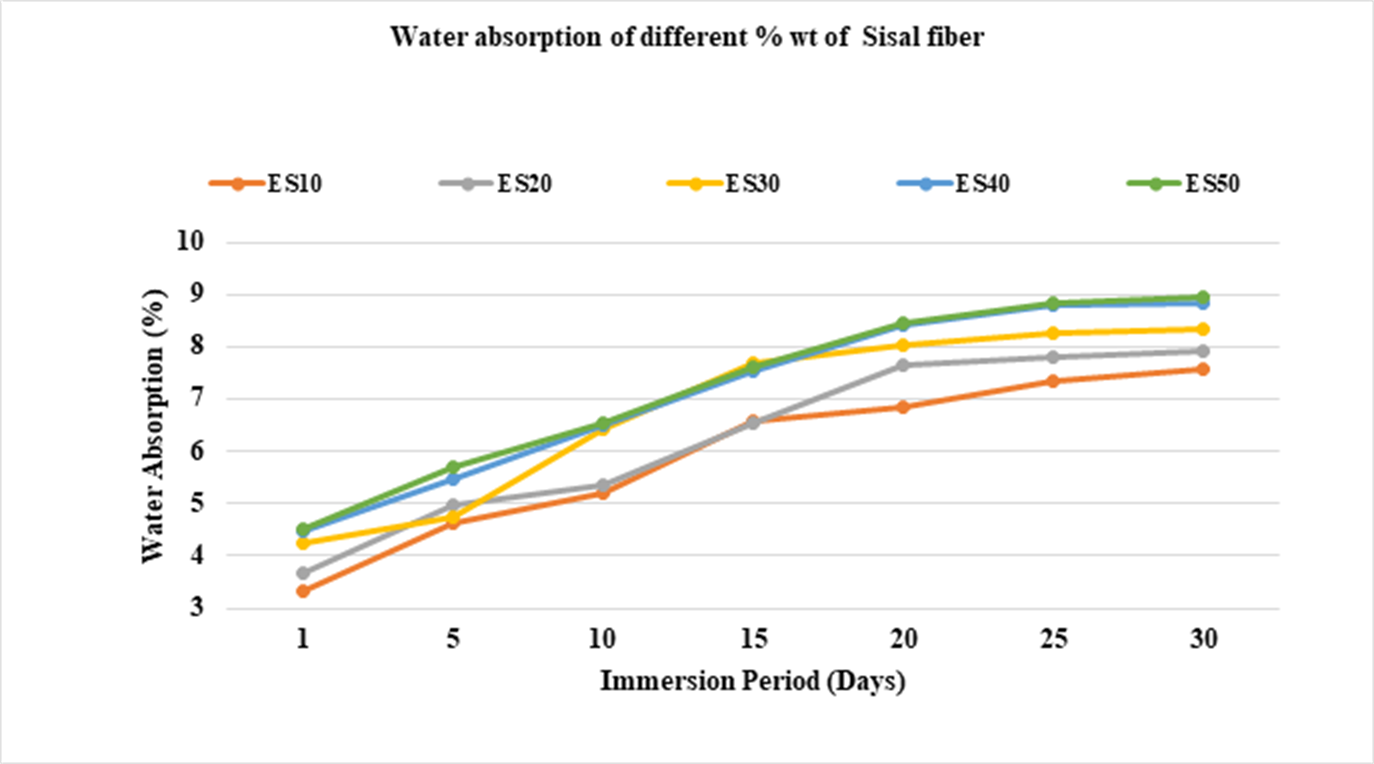
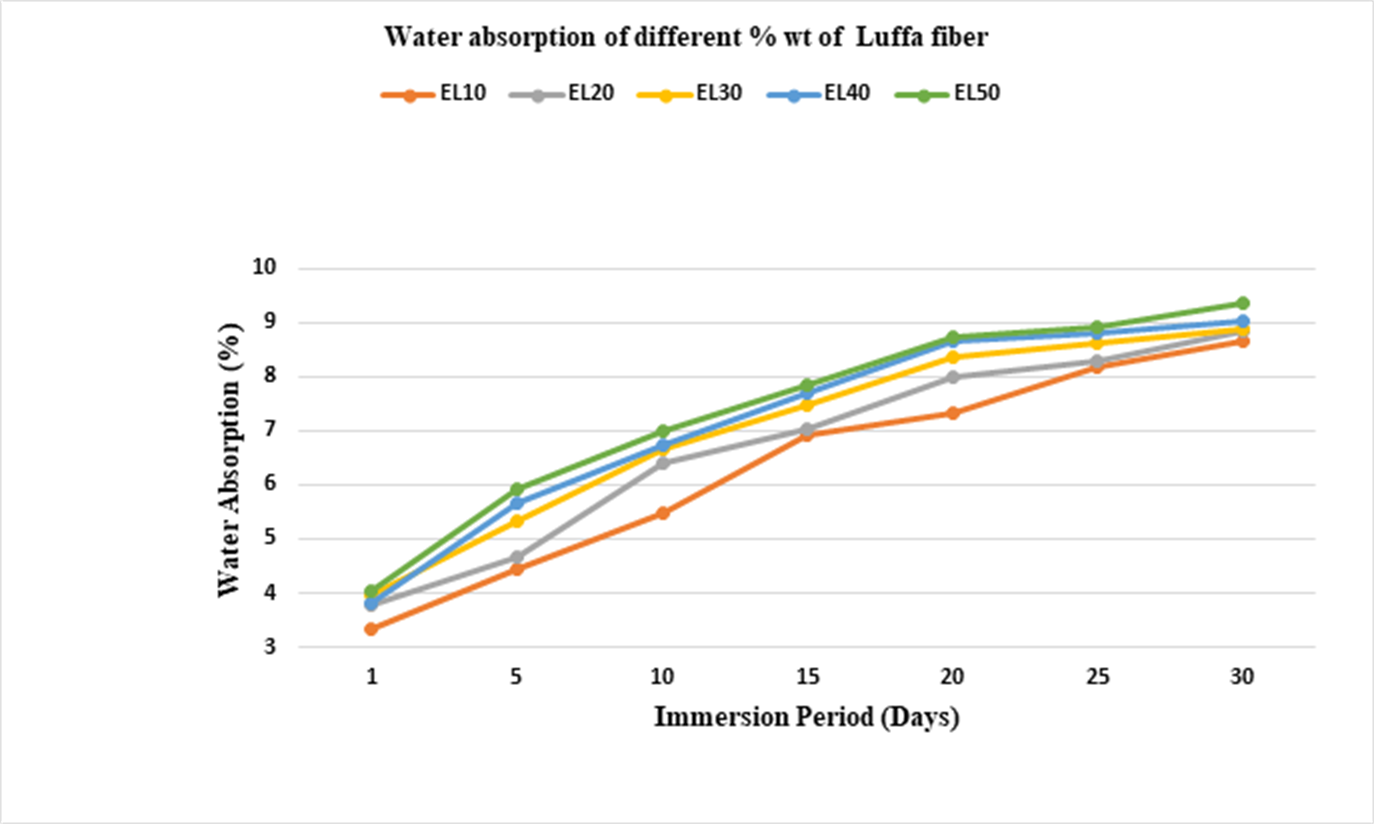
The Figure 1a and 1b illustrates the water absorption (%) of sisal and luffa fiber-reinforced epoxy composites over 30 days, with fiber weight percentages of 10%, 20%, 30%, 40%, and 50%. It shows the water absorption increases over time and varies with fiber content. For all composites, water absorption rises over 30 days, with the steepest increase occurring during the first 10–15 days. After 20 days, the rate of absorption slows, approaching saturation. Composites with higher fiber content ES50 and EL50 show the greatest water absorption, as fibers are hydrophilic and tend to absorb moisture whereas Lower fiber content ES10 and EL10 composites absorb less water due to the dominant epoxy matrix, which is hydrophobic. Water absorption for higher fiber contents ES50, EL50 8–9% by 30 days. Lower fiber percentages ES10, EL10 stabilize below 4–5%. Luffa composites generally show higher water absorption compared to sisal composites due to their higher porosity and hydrophilicity.
The higher water absorption in luffa composites may also be associated with the porous structure and greater moisture affinity of luffa fibers, which allows easier penetration of water into the composite structure. Water absorption increases over time for all fiber contents, with higher fiber percentages (50%) absorbing the most moisture. Luffa 50% exhibits the highest water absorption among all configurations.
3.2. Mechanical Properties
Mechanical tests for tensile strength, flexural strength, hardness and impact strength were conducted in this study. These tests provide insights into the load-bearing capacity and potential applications of the composites. A thorough analysis was carried out to evaluate their overall performance.
3.2.1. Tensile test
The tensile test was performed in accordance with ASTM D 638 standards on Universal Testing Machine (UTM) with maximum load of 100 kN. The composite specimens having 165 mm x 12.7 mm x 3.2 mm cross section were prepared and then tested on (Universal Testing Machine) UTM at a cross-head speed of 2.5 mm/min.
The specimens with different compositions were tested on the Universal Testing Machine (UTM), and the samples were loaded until rupture to obtain the ultimate tensile strength. Stress-strain diagram was plotted to determine the ultimate tensile strength. The tensile strength, flexural strength, hardness, and impact strength of all composite specimens are presented in Table 3.
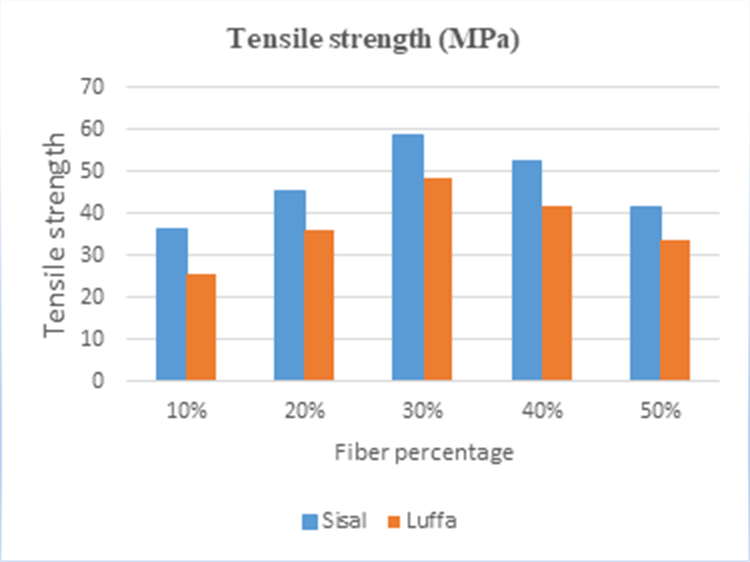
The Figure 2 illustrates the effect of fiber quantity on tensile strength, showing an increase up to 30% fiber content, followed by a decline. Across all fiber loadings, sisal fiber composites demonstrate higher tensile strength than luffa fiber composites, with a consistent performance gap between the two.
The peak tensile strength occurs at 30% fiber loading for both fiber types with 58.6MPa and 48.42MPa respectively. The improvement in tensile strength up to 30 wt.% fiber loading may be attributed to better stress transfer between the fiber and matrix. Beyond this level, higher fiber loading may lead to poor wetting, fiber agglomeration, and void formation. Among the two, sisal fibers consistently exhibit superior tensile strength compared to luffa.
Table 3: Mechanical properties of composites
| Composite | Tensile strength (MPa) | Flexural strength (MPa) | Hardness | Impact strength (J/m2) |
|---|---|---|---|---|
| ES10 | 36.2 | 51.52 | 70.86 | 8.98 |
| ES20 | 45.14 | 63.37 | 73.38 | 10.72 |
| ES30 | 58.6 | 72.4 | 75.8 | 13.91 |
| ES40 | 52.38 | 67.25 | 78.14 | 16.52 |
| ES50 | 41.7 | 58.45 | 79.96 | 15.76 |
| EL10 | 25.35 | 42.8 | 69.98 | 6.37 |
| EL20 | 36.2 | 54.4 | 72.76 | 9.56 |
| EL30 | 48.42 | 63.68 | 75.36 | 13.04 |
| EL40 | 41.81 | 46.72 | 77.42 | 16.23 |
| EL50 | 33.75 | 37.75 | 78.82 | 15.68 |
3.2.2. Flexural test
Flexural test was conducted to determine flexural strength along with flexural modulus and maximum deflection. These tests were performed on (Universal testing Machine) UTM and follows ASTM D790 standard, using three-point bending setup. The cross section of the specimens was 127 mm long, 12.7 mm wide and 3.2 mm thick.
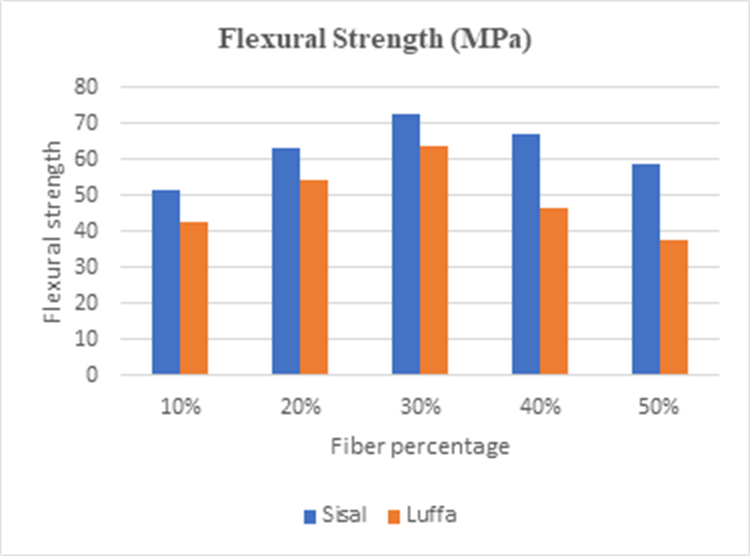
The Figure 3 shows the variation in flexural strength of sisal and luffa fiber composites. Flexural strength increases with fiber loading up to 30%, after which it declines. The improvement in flexural strength up to 30 wt.% fiber loading may be due to better fiber–matrix interaction and effective stress distribution within the composite. Beyond this level, reduction in strength may occur because of poor fiber dispersion, insufficient resin wetting, and increased void formation.
At all fiber loadings, sisal composites outperform luffa composites, indicating superior reinforcement properties. The peak flexural strength occurs at 30% fiber loading, with a decline beyond this point. At 10% fiber loading, the reinforcement effect is minimal, while at 50%, weak fiber dispersion and excessive fiber content reduce matrix integrity, weakening the composite. Flexural strength of sisal increases from 51.52MPa to 72.4MPa and for luffa fiber it increases from 42.8MPa to 63.68MPa
3.2.3. Hardness test
Hardness test was conducted on ‘Rockwell hardness testing setup’ in accordance with ASTM D785 standards. For this test scale L was chosen with a 2.5 mm steel ball under a minor load of 10 kg and a major load of 60 kg. The L scale is used to calculate the relative hardness of soft materials like plastic, polymer and rubber. This test measures the indentation of a standard indenter into the material under standard force and time conditions. The test specimen is positioned on a hard flat surface. Rockwell Hardness is a measure of a material's resistance to deformation or penetration.
The data indicates that increasing fiber percentage enhances this resistance, making the material harder and likely more durable.
As depicted in Figure 4 for both types of fibers, the Rockwell Hardness increases as the fiber percentage increases from 10% to 50%. This shows that the fiber content has a significant influence on improving hardness.
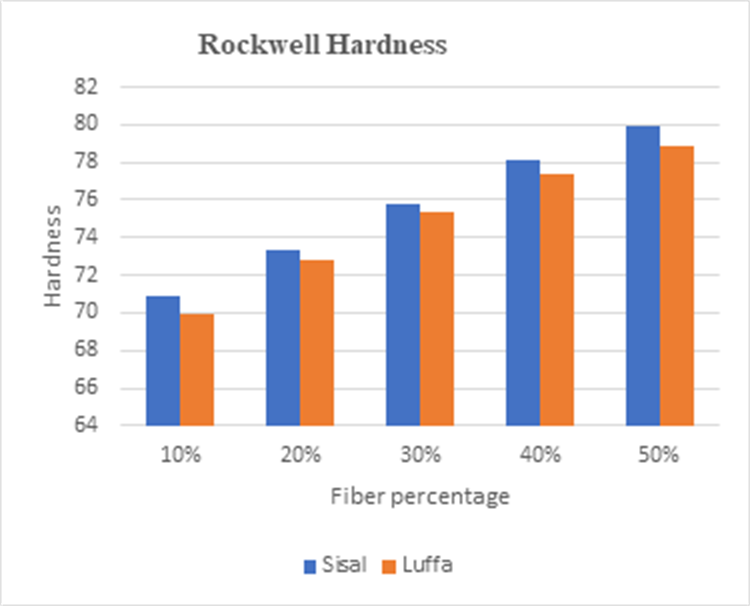
The increase in hardness with higher fiber loading may be attributed to the higher stiffness of natural fibers, which improves the resistance of the composite surface against indentation and deformation.
The Figure 4 illustrates the Rockwell hardness of composites under varying fiber percentages. The results reveal that both composites exhibit an increasing trend in hardness as the fiber percentage rises, indicating that adding more fibers enhances the mechanical property of hardness. For the Sisal fiber composite (ES10 to ES50), the hardness increases from 70.86 to 79.96, while for the Luffa fiber composite (EL10 to EL50), it rises from 69.98 to 78.82. At every fiber percentage, the Sisal fiber composite demonstrates higher hardness values than the Luffa fiber composite. However, the difference between the two remains relatively small, ranging from 1% to 2% across all fiber percentages.
3.2.4. Impact test
Izod impact test was performed on notched composite specimens in accordance with to ASTM D256 standards. This impact test which is also known as the V-notch test, is a standardized high strain-rate test used to determine the quantity of energy absorbed by a material before fracture. Specimen dimensions were taken as 63.5mm length, 12.7mm width and 3.2 mm thickness with notch depth as 10 mm. The specimen was fixed as a vertical cantilever beam and strike by a single swing of a pendulum drop at angle of 90° to break. The pendulum speed during strike at face of the notch remains 3.857m/s.
The impact strength increased with fiber loading up to 40 wt.% for both sisal and luffa fiber composites. A slight decrease was observed at 50 wt.% fiber loading. This indicates that increasing fiber content up to 40 wt.% enhances the material's ability to absorb energy during impact.
The improved impact strength at higher fiber loading may be attributed to the enhanced energy absorption capability of the fibers during fracture and crack propagation.
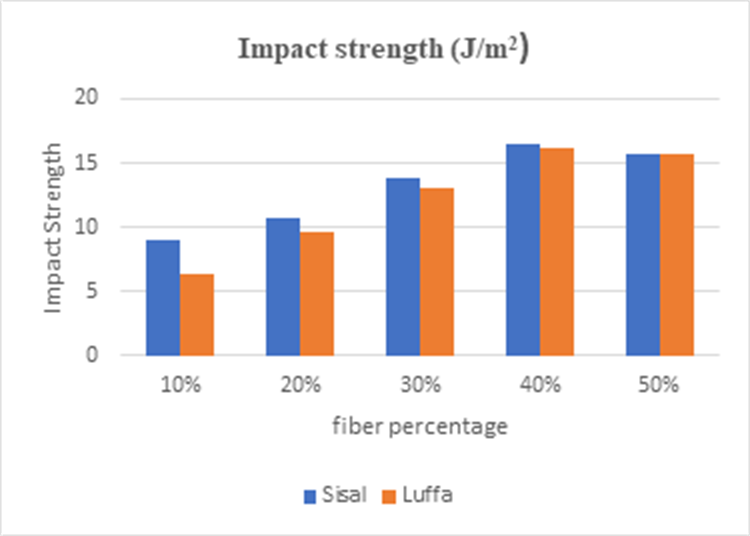
The results of impact strength for sisal and luffa fiber are shown in Figure 5. At lower fiber percentages, ES10 and ES20 show higher impact strength than EL10 and EL20, indicating that sisal performs better at lower fiber contents. Figure 5 shows that the impact strength increased with fiber loading up to 40 wt.% for both composite systems. However, a slight decrease was observed at 50 wt.% fiber loading, which may be due to poor resin distribution and weaker fiber–matrix bonding at higher fiber loadings. As the fiber percentage increases, the impact strength of luffa approaches that of sisal, and at 40 wt.% and 50 wt.%, both composites exhibit nearly similar impact strength values. This suggests that the difference in impact performance between the two composites becomes very small at higher fiber loadings.
4. Conclusions
This study investigated the physical and mechanical characteristics of luffa and sisal fiber-reinforced epoxy composites for potential automobile applications. The results indicate that fiber content significantly influences the composite's performance. Sisal fiber composites demonstrated higher tensile and flexural strength, making them suitable for structural applications requiring high load-bearing capacity. Luffa fiber composites, on the other hand, exhibited superior impact resistance, indicating their suitability for energy-absorbing components.
The study also revealed that void fraction and moisture absorption increased with higher fiber loading, affecting dimensional stability. Sisal composites showed lower void content and water absorption compared to luffa composites, highlighting their better compatibility with epoxy resin.
The optimum fiber loading for both composites was observed at 30-40%, beyond which mechanical properties declined due to fiber agglomeration and poor matrix bonding. The findings suggest that these eco-friendly natural fiber composites can serve as viable alternatives to synthetic materials in automotive applications, with sisal being preferable for load-bearing components and luffa for impact-resistant parts. Sisal fiber composites may be suitable for automobile interior components such as door trim panels, dashboard panels, and interior side panels, whereas luffa fiber composites can be considered for roof liners, package trays, and acoustic insulation panels due to their better impact resistance and lightweight nature. Further surface treatment and hybridization techniques can be explored to enhance their performance for broader engineering applications.
References
- L. Prabhu, V. Krishnaraj, S. Gokulkumar, S. Sathish, & M. Ramesh. “Mechanical, chemical and acoustical behaviour of sisal–tea waste–glass fiber reinforced epoxy based hybrid polymer composites” Materials Today: Proceedings, 16 653-660 (2019). https://doi.org/10.1016/j.matpr.2019.05.142 [DOI]
- M. K Gupta, & R. K Srivastava, “Mechanical, thermal and water absorption properties of hybrid sisal/jute fiber reinforced polymer composite,” Indian journal of Engineering and material sciences 23 231-238 (2016)
- B. Karacor & M. Ozcanlı, “Investigation of use of hybrid composite materials in automobile interior,” International Journal of Automotive Engineering and Technologies, 9 (4) 214-228 (2020). https://doi.org/10.18245/ijaet.827239 [DOI]
- R. Ramasubbu & S. Madasamy “Fabrication of automobile component using hybrid natural fiber reinforced polymer composite”. Journal of Natural Fibers, 19 (2) 736-746 (2022). https://doi.org/10.1080/15440478.2020.1761927 [DOI]
- V. Ordonez, H. Baykara, A.Riofrio, M. Cornejo & R. Rodríguez, “Preparation and Characterization of Ecuadorian Bamboo Fiber-Low-Density Polyethylene (LDPE) Biocomposites” Evergreen Joint Journal of Novel Carbon Resource Sciences & Green Asia Strategy, 10 (1) 43-54 (2023). https://doi.org/10.5109/6781037 [DOI]
- D. S. Patil & M. M. Bhoomkar, “Investigation on Mechanical Behaviour of Fiber-Reinforced Advanced Polymer Composite Materials”, Evergreen Joint Journal of Novel Carbon Resource Sciences & Green Asia Strategy, 10 (1) 55-62 (2023). https://doi.org/10.5109/6781040 [DOI]
- N. K. Yadav, N. S. Rajput, and M. K. Gupta. "Investigation of the mechanical and wear properties of epoxy resin composite (ERCs) made with nano particle TiO2 and cotton fiber reinforcement." Evergreen Joint Journal of Novel Carbon Resource Sciences & Green Asia Strategy, 10 (1) 63-77 (2023). https://doi.org/10.5109/6781041 [DOI]
- A. Saravana Kumar, P. Maivizhi Selvi & L. Rajeshkumar, “Delamination in drilling of sisal/banana reinforced composites produced by hand lay-up process” Applied Mechanics and Materials 867 29-33 (2017). https://doi.org/10.4028/www.scientific.net/AMM.867.29 [DOI]
- B. Ravishankar, S. K Nayak & M. A. Kader, “Hybrid composites for automotive applications–A review”, Journal of Reinforced Plastics and Composites, 38 (18) 835-845 (2019).https://doi.org/10.1177/0731684419849708 [DOI]
- D. Chandramohan, & J. Bharanichandar, “Natural fiber reinforced polymer composites for automobile accessories,” American Journal of Environmental Sciences, 9, (6) 494-504 (2013). doi:10.3844/ajessp.2013.494.504
- S.Blazewicz, J. Chlopek, A. Litak, C. Wajler & E. Staszkow, “Experimental study of mechanical properties of composite carbon screws,” Biomaterial, 18 (5) 437-439 (1997), https://doi.org/10.1016/S0142-9612(96)00067-1 [DOI]
- S. Singh, L. Nagdeve, H. Kumar & K. Dhakar, “Rice straw based natural fiber reinforced polymer for sustainable bio-composites: a systematic review,” Evergreen Joint Journal of Novel Carbon Resource Sciences & Green Asia Strategy, 10, (2) 1041-1052 (2023), https://doi.org/10.5109/6793661 [DOI]
- R. A., Kurien, D. P Selvaraj, M Sekar, & C. P Koshy. “Green composite materials for green technology in the automotive industry,” IOP conference series: materials science and engineering IOP Publishing 872 (1) 012064, (2020).DOI 10.1088/1757-899X/872/1/012064 [DOI]
- M. J. A.Van den Oever, H. L. Bos & M. J. J. M. Van Kemenade, “Influence of the physical structure of flax fibres on the mechanical properties of flax fibre reinforced polypropylene composites,” Applied Composite Materials, 7, 387-402 (2000) https://link.springer.com/article/10.1023/A:1026594324947
- A. Shalwan & B. F. Yousif, “In state of art: mechanical and tribological behaviour of polymeric composites based on natural fibres,” Materials & Design, 48, 14-24, (2013), https://doi.org/10.1016/j.matdes.2012.07.014 [DOI]
- V. L. P. Salazar, A. L. Leao, D. S. Rosa, J. G. C. Gomez & R. C. P. Alli, “Biodegradation of coir and sisal applied in the automotive industry,” Journal of Polymers and the Environment, 19 677-688 (2011), https://link.springer.com/article/10.1007/s10924-011-0315-3
- K. Hariprasad, K. Ravichandran, V. Jayaseelan, & T. Muthuramalingam, Acoustic and mechanical characterisation of polypropylene composites reinforced by natural fibres for automotive applications,” Journal of Materials Research and Technology, 9 (6) 14029-14035, (2020). https://doi.org/10.1016/j.jmrt.2020.09.112 [DOI]
- A. Veerasimman, V. Shanmugam, S. Rajendran, D. J. Johnson, A. Subbiah, J. Koilpichai & U. Marimuthu, “Thermal properties of natural fiber sisal based hybrid composites–a brief review,” Journal of Natural Fibers, 19(12) 4696-4706 (2022). https://doi.org/10.1080/15440478.2020.1870619 [DOI]
- S. M. K. Thiagamani, S. Krishnasamy, C. Muthukumar, J. Tengsuthiwat, R. Nagarajan, S. Siengchin & S. O. Ismail, “Investigation into mechanical, absorption and swelling behaviour of hemp/sisal fibre reinforced bioepoxy hybrid composites: Effects of stacking sequences”, International journal of biological macromolecules, 140 637-646 (2019). https://doi.org/10.1016/j.ijbiomac.2019.08.166 [DOI]
- J. Naveen, M. Jawaid, P. Amuthakkannan, & M. Chandrasekar, “Mechanical and physical properties of sisal and hybrid sisal fiber-reinforced polymer composites,” Mechanical and physical testing of biocomposites, fibre-reinforced composites and hybrid composites Woodhead Publishing, 427-440 (2019). https://doi.org/10.1016/B978-0-08-102292-4.00021-7 [DOI]
- N. Dhandapani & A. Megalingam, “Mechanical and sound absorption behavior of sisal and palm fiber reinforced hybrid composites,” Journal of Natural Fibers, 19 (12) 4530-4543 (2022), https://doi.org/10.1080/15440478.2020.1863893 [DOI]
- P. Sahu & M. K. Gupta, “Sisal (Agave sisalana) fibre and its polymer-based composites: a review on current developments,” Journal of Reinforced Plastics and Composites, 36 (24) 1759-1780, (2017). https://doi.org/10.1177/0731684417725584 [DOI]
- M. Saxena, A. Pappu, R. Haque, R & A. Sharma, “Sisal fiber-based polymer composites and their applications,” Cellulose Fibers: Bio-and nano-polymer composites: Green chemistry and technology, 589-659 (2011) https://link.springer.com/chapter/10.1007/978-3-642-17370-7_22
- C. A. Adeyanju, S. Ogunniyi, J.O. Ighalo, A. G. Adeniyi, & S. A. Abdulkareem, “Review on Luffa fibres and their polymer composites,” Journal of Materials Science, 56, 4 2797-2813 (2021). https://doi.org/10.1007/s10853-020-05432-6 [DOI]
- P. Panicker, L. V. Vigneshwaran, & M. P. Manjusha, “Review on Luffa acutangula L.: ethnobotany, phytochemistry, nutritional value and pharmacological properties”, Pharma Science Monitor, ISSN: 0976-7908, 10 (3) 152-159 (2019)
- M. Alhijazi, B. Safaei, Q. Zeeshan, M. Asmael, A. Eyvazian & Z. Qin, “Recent developments in luffa natural fiber composites”, Sustainability, 12 (18) 7683, (2020), https://www.mdpi.com/2071-1050/12/18/7683#
- H. Koruk, & G. Genc, “Acoustic and mechanical properties of luffa fiber-reinforced biocomposites”, Mechanical and physical testing of biocomposites, fibre-reinforced composites and hybrid composites, Woodhead Publishing, 325-341 (2019). https://doi.org/10.1016/B978-0-08-102292-4.00017-5 [DOI]
- I. O. Mazali & O.L. Alves, O. L. “Morphosynthesis: High fidelity inorganic replica of the fibrous network of loofa sponge (Luffa cylindrica),” Anais da Academia Brasileira de Ciências, ISSN 0001-3765 77 (1) 25-31 (2005). https://doi.org/10.1590/S0001-37652005000100003 [DOI]
- S. Partap, A. Kumar, N. K. Sharma, & K. K. Jha, “Luffa Cylindrica: An important medicinal plant. Journal of Natural Product and Plant Resources”, J. Nat. Prod. Plant Resour, ISSN: 2231 – 3184, 2 (1) 127-134 (2012).
- J.Shen, Y. M. Xie, X. Huang, , S. Zhou, & D. Ruan, “Mechanical properties of luffa sponge”, Journal of the mechanical behaviour of biomedical materials, 15, 141-152 (2012). https://doi.org/10.1016/j.jmbbm.2012.07.004 [DOI]
- N. Mohanta & S.K. Acharya, “Mechanical and tribological performance of Luffa Cylindrica fibre – reinforced epoxy composite,” Bio Resources 10 (4) 8364–8377 (2015) 10.15376/biores.10.4.8364-8377
- V. Naik & M. Kumar, “A review on natural fiber composite material in automotive applications,” Engineered Science, 18 1-10 (2021) http://dx.doi.org/10.30919/es8d589 [DOI]
- Y. Chen, F. Yuan, Q. Su, C. Yu, K. Zhang, P. Luo & Y Guo, “A novel sound absorbing material comprising discarded luffa scraps and polyester fibers,” Journal of Cleaner Production, 245 118917 (2020). https://doi.org/10.1016/j.jclepro.2019.118917 [DOI]
- S. H. Kamarudin, M. S. Salit, M. R. M. Asyraf, M. N. M. Ansari & M. R. Ishak, “A Review on Natural Fiber Reinforced Polymer Composites (NFRPC) for Sustainable Industrial Applications,” Polymers, 14(17), 3698 (2022). https://doi.org/10.3390/polym14173698 [DOI]
- Mbatha Abednigo Jabu, A. A. Alugongo & N. Z. Nkomo, “Application of Natural Fibre Composites in Interior Panels in the Automotive Industry: A Review,” International Journal of Engineering Trends and Technology, 72(3), 91–98(2024).https://doi.org/10.14445/22315381/IJETT-V72I3P109 [DOI]
- Sharma, A., & Patnaik, A. (2018). Experimental investigation on mechanical and thermal properties of marble dust particulate-filled needle-punched nonwoven jute fiber/epoxy composite. Jom, 70, (7) 1284-1288. https://doi.org/10.1007/s11837-018-2828-x [DOI]
- L. J., Broutman, & B. D Agarwal, “Analysis and performance of fiber composites,” New York: Wiley, ISBN: 978-81-265-3636-8 (1980).
- A. Ashori, & S. Sheshmani, “Hybrid composites made from recycled materials: moisture absorption and thickness swelling behavior,” Bioresource technology, 101 (12) 4717-4720 (2010). https://doi.org/10.1016/j.biortech.2010.01.060 [DOI]
- D. Ariawan,, W. P. Raharjo, K. Diharjo, W. Raharjo & B. Kusharjanta, B. Influence of Water Immersion on Flexural and Impact Strength of Microcrystalline Cellulose-added Unsaturated Polyester-matriced Composites Strengthened by Untreated, Fumigated and Alkalized Cantala Fibers, Evergreen Joint Journal of Novel Carbon Resource Sciences & Green Asia Strategy, 11 (3) 2164-2174 (2024) https://doi.org/10.5109/7236860 [DOI]