
Abstract
This research analyzed the frequency and severity of workplace accidents in Peruvian mining (2020–2024). The unit of analysis was the mining concession/UEA record (concession-year); of 10,051 monthly records from the Ministry of Energy and Mines, 1,808 (18%) reported at least one incident or accident, and after cadastral validation 1,774 valid records (566 concessions) were analyzed. Serious accidents (disabling + fatal; 5,665 events) were modeled with multiple linear regression with cluster-robust standard errors (β coefficients with 95% CI). In metallic mining, the small-scale-producer regime, larger concession size, a larger number of company workers and contractors, and higher man-hours were associated with greater severity. In non-metallic mining, the small-scale-producer regime, a larger number of company workers and higher man-hours were associated with greater severity, while larger concession size was associated with fewer serious accidents. Operational workload (man-hours) and workforce size were associated with greater severity across both sectors, supporting occupational-safety policies differentiated by mineral type and operation size.
Keywords: Accidents, mining, safety indicators, work
Outline
1. Introduction
Mining is one of the most important sectors for the Peruvian economy, representing approximately 10% of the Gross Domestic Product and more than 60% of national exports in recent years, with investments exceeding USD 5.2 billion1). However, this economic prominence contrasts with the high levels of occupational risk that characterize mining activity2) becoming harmful not only to the worker, but also to the surrounding communities, the economy and the environment3). According to official reports4), the mining sector in Peru has registered more than 800 disabling accidents and more than 100 work-related deaths per year between 2020 and 2023, which demonstrates a persistent problem in occupational health and safety5). Added to this is the diversity of operational, technical and geographical conditions in the country, which can aggravate or mitigate the risk depending on the type of exploitation and the regional context where the extractive activity takes place6).
In the mining industry, both lighting and ventilation must be provided artificially, and it is necessary to control factors such as gas emissions, dust production, and noise generated by explosions or rock fragmentation7). Furthermore, aspects such as ergonomic postures, the use of heavy machinery, vehicles, and transport systems like conveyor belts must be considered8). Added to this are potential new risks arising from technological advancements, new interactions between the various elements of the system, the link between human behavior and technologies, and increasing social demands9). Consequently, workers in the mining sector face a variety of complex hazards, which can lead to occupational illnesses, injuries, disabilities, or even death10), since working in the mining sector, whether in an open-pit or underground mine, carries greater risks than most sectors of the national economy11). In this sense, mining accidents represent a combination of multiple and varied risks12).
In this context, this study aims to analyze the frequency and severity of workplace accidents in the Peruvian mining sector during the period 2020–2024, as well as to identify the associated factors that related their occurrence, using a quantitative approach that incorporates categorical, numerical, and geographical variables. The results obtained seek to contribute to strengthening occupational safety and health policies in the country's mining operations.
2. Literature review
Workplace accidents can be linked to the characteristics of the work environment, as well as to collective and individual activities13,14). In this sense, various factors are associated with their occurrence and severity of workplace accidents. Among them are productive characteristics such as the type of mineral mined (metallic or non-metallic), with metallic mining known to have higher accident rates than non-metallic mining15), associated with collapses, explosives, rockfalls, equipment use, and exposure to metallic dust10), with the accident rate being even higher in underground metallic mines16).
On the other hand, the type of mining concession (general regime or small producer)17), considering that the accident rate in small-scale mining is generally more than six times higher than in large-scale mining16), linked to the intensive use of labor, low technological development and precarious hygiene and safety conditions18). Likewise, the execution time of the mining project is an influential variable19), taking into account that a longer period of work allows for better structuring and implementation of safety management systems in companies, allowing a reduction in accidents20).
It is worth noting that operational variables such as man-hours worked21), are relevant, given that 12-hour shifts (quite common in the mining sector) tend to have a higher accident rate due to the level of fatigue experienced by workers22). Similarly, the number of direct employees and contractors in operations is linked to accident rates23), considering that the level of workforce outsourcing is inversely associated with accident rates, so more contractors mean fewer accidents24). Likewise, geographical conditions, such as altitude and region24) are other factors associated with adverse health effects on mining workers, considering that high altitudes and low atmospheric pressure, followed by a return to low altitudes, often trigger conditions such as chronic intermittent hypobaric hypoxia, mainly in men25).
These combined elements play a decisive role, as they can affect the implementation of safety protocols, access to medical services, and workplace fatigue26), creating a risk landscape that requires comprehensive analysis to establish patterns and factors associated with incidents. This is why industries worldwide have recently shown increasing interest in adopting safety practices as a means to reduce accidents and disasters occurring at unsustainable levels27), since the health consequences commonly reported in mining include mortality, average days lost due to accidents, and permanent partial or total disability28).
3. Materials and Methods
3.1. Population and Sample
To obtain information on workplace accidents in mining companies, the public database of the Peruvian Ministry of Energy and Mines (MINEM) was accessed, from which the monthly workplace accident reports available in Microsoft Excel format were downloaded. Reports from January 2020 to December 2024 were considered, resulting in a total of 60 monthly reports.
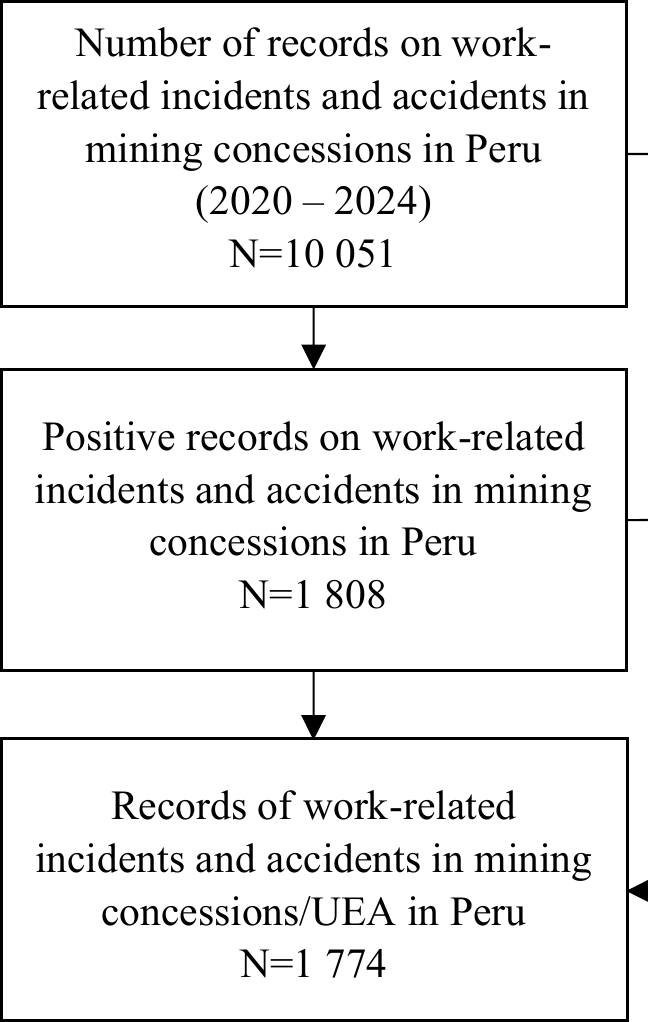
The study population consisted of all mining companies registered in Peru that reported workplace incidents and accidents to the Ministry of Energy and Mines (MINEM) from January 1, 2020, to December 31, 2024.
Initially, 10,051 records of workplace incidents and accidents reported during the analysis period were collected. However, during the selection process shown in Figure 1, 8,243 records (81.9%) with a value of "zero" were excluded, indicating the absence of incidents or accidents during those months. This allowed for the identification of 1,808 records that accurately corresponded to workplace incidents and accidents.
Subsequently, a further review was conducted to ensure data quality, resulting in the exclusion of 34 mining concessions lacking the complete information necessary for statistical analysis. The analytical unit of this study was the mining concession/UEA record contained in the monthly reports issued by MINEM. The final database comprised 1,774 valid records corresponding to 566 mining concessions/UEA that reported at least one workplace incident or accident during the study period. Because a concession/UEA could appear in multiple reporting periods, several records could correspond to the same concession/UEA. Additional geographic and cadastral variables were compiled only for these analytical records.
3.2. Design
This was an observational analytical study based on secondary administrative records from the Ministry of Energy and Mines covering the period 2020–2024. The analytical unit was the concession-year record. Although some concessions contributed records in multiple years, the objective was not to evaluate temporal changes within concessions but rather to assess associations between concession characteristics and the number of serious accidents reported during each concession-year. Therefore, the data were analysed as pooled cross-sectional records rather than as a longitudinal or panel dataset.
3.3. Variables
3.3.1. Dependent Variable
The main dependent variable was the number of serious accidents recorded in the monthly workplace accident reports of the Peruvian Ministry of Energy and Mines (MINEM). Workplace events were classified as incidents, minor accidents, disabling accidents, and fatal accidents. Serious accidents were defined as the sum of disabling and fatal accidents reported in each concession-year record; therefore, the dependent variable represents a count of serious accidents per analytical record rather than a binary occurrence measure. This composite outcome was selected because both categories represent severe occupational events according to the Peruvian mining accident classification system and are routinely monitored as indicators of mining safety performance.
3.3.2. Independent Variables
Characteristics of the Mining Concession
Operational and administrative variables obtained from the monthly workplace accident reports published by the Ministry of Energy and Mines (MINEM) were included. The variables considered were the following:
a)Categorical Variables
1)Type of mineral: metallic / non-metallic.
2)Type of mining concession: general regime / small-scale mining producer.
3)Year of the workplace accident: 2020, 2021, 2022, 2023, and 2024.
b)Numerical variables
1)Man-hours worked.
2)Number of mining company (MCC) employees.
3)Number of mining contractor (MC) employees.
4)Other workers (OTHER)
The variables were collected from the monthly reports of the Ministry of Energy and Mines (MINEM). For the numerical variables, the annual average per mining concession was calculated to obtain a representative and homogeneous value, given that these Figures may vary monthly.
c)Mining Cadastre Variables
The structural characteristics of the mining concessions were obtained through the GeoCatmin system of the Geological, Mining, and Metallurgical Institute (INGEMMET) (https://geocatmin.ingemmet.gob.pe/geocatmin/), which provides public information on officially registered mining concessions.
However, it was identified that a subset of reporting mining companies did not correspond to formally registered concessions, but rather to Economic Administrative Units (UEA). Therefore, the SIDEMCAT platform (https://digital.ingemmet.gob.pe/serviciosdigitales/app/sidemcat/consulta) of the same agency was used to supplement the missing information. The variables extracted from both sources included:
•Date of concession or UEA issuance
•Total area (hectares)
•Department and province of administrative location
The integration of both databases allowed for the completion of data for 566 mining companies, ensuring adequate territorial and administrative coverage for the analysis.
d)Geographic Variables
To characterize the territorial context, the following were considered:
1)Geographic altitude: In the absence of specific topographic records for each mining concession, altitude was approximated using the elevation of the corresponding provincial capital. For provinces with a large territorial extension and geographical heterogeneity, a representative average value for the region was calculated. This strategy allowed for the establishment of a standardized proxy variable for the analysis.
2)Natural region: a standardized classification based on altitude and geographic location was applied:
•Coast: < 500 masl
•Highlands: 500 – 4,500 masl
•Rainforest: located in the Amazon region
Continuous operational variables (e.g., concession area, number of workers, contractors, other workers, and man-hours) were categorized into tertiles to facilitate interpretation and comparison across concessions with different operational scales.
3.4. Statistical Analysis
The 60 monthly reports of workplace accidents over five years (1,774 records) were consolidated in Excel format and integrated with a second database, processed in parallel, containing information on 566 mining concessions. This second database included variables such as year of concession issuance, geographic region, department, province, concession size in hectares, and average altitude of the province in meters above sea level (masl). The integration was performed using the merge command in Stata, thus generating a unified and complete database. Stata and R Studio were used for statistical processing, the latter for graphical purposes.
Descriptive analyses were performed using Tables and graphs. Categorical variables were summarized using absolute and relative frequencies, whereas numerical variables were described using means and standard deviations.
To identify factors associated with the number of serious accidents, crude and adjusted multiple linear regression models were fitted, considering the quantitative nature of the dependent variable. Because the same mining concession could contribute records in more than one year, standard errors were adjusted for within-concession correlation using clustered standard errors at the concession level (vce(cluster id) in Stata).
Variables with a p-value < 0.20 in the crude analyses were considered candidates for the multivariable model. To minimize multicollinearity, only variables with a Variance Inflation Factor (VIF) < 6 were retained in the final adjusted model. Regression coefficients (β), 95% confidence intervals (95% CI), and p-values were reported. Statistical significance was established at p < 0.05.
4. Results
4.1. Descriptive Analysis
The study analyzed 10,051 records related to workplace incidents and accidents in the Peruvian mining sector during the period 2020–2024. Of these, 8,243 records (82%) did not report any type of incident or accident, while 1,808 records (18%) corresponded to events with at least one reported incident or accident.
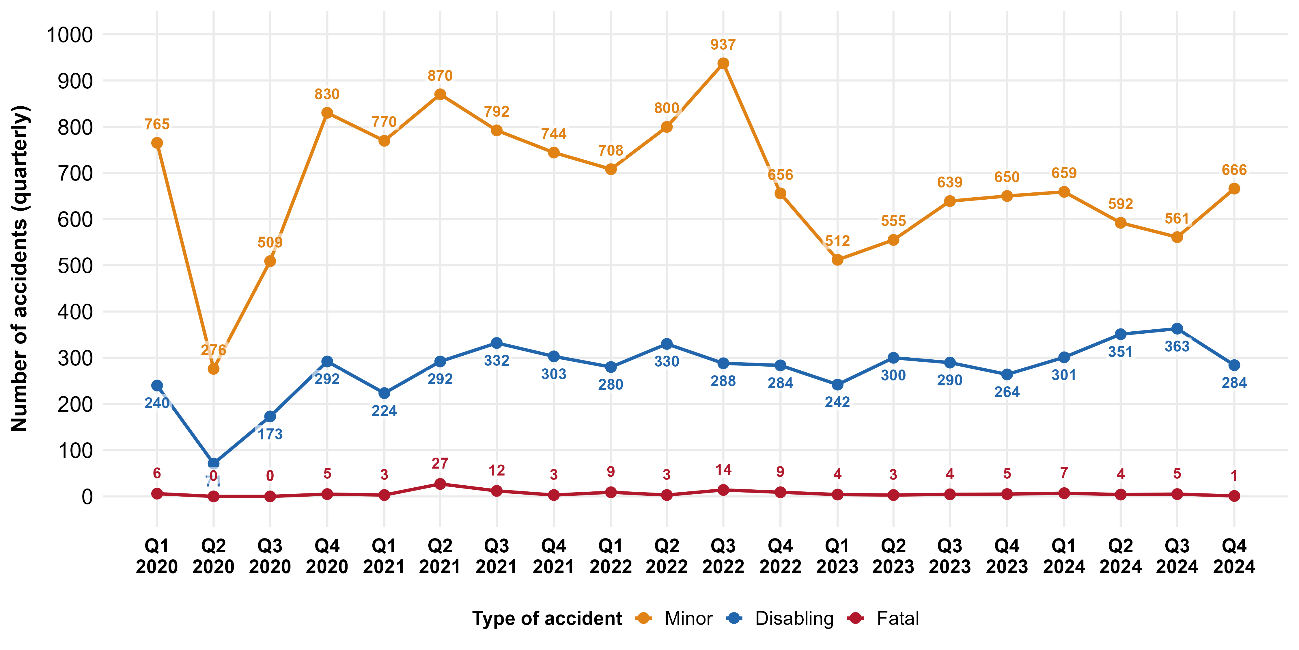
Figure 2 shows the temporal trend of workplace accidents in Peru during the study period, classified according to their severity as minor, disabling, and fatal accidents. Two marked decreases in the occurrence of disabling and minor accidents were identified: the first in April 2020 and the second in August 2023. A significant peak was also observed in July 2022, which could be associated with seasonal factors or an increase in operational activity.
Between 2020 and 2024, Across the analyzed records, a total of 5,665 serious workplace accidents were reported, primarily concentrated in the metal sector, where 1,507 mining concessions reported accidents or incidents, compared to 267 in the non-metal sector.
Workplace incidents totaled 120,278, with a significantly higher average in the metal sector (72.81 ± 274.29) compared to the non-metal sector (39.51 ± 90.56). Similarly, disabling and fatal accidents were more frequent in the metal sector, with averages of 3.44 ± 7.25 and 0.10 ± 1.03, respectively, compared to lower values in the non-metal sector. Disabling and fatal accidents were less frequent, although still prevalent, in the metal sector. These data reflect greater exposure and risk in activities related to the metal sector (Table 1).
Table 1 presents the distribution of workplace accidents recorded in the Peruvian mining sector between 2020 and 2024, broken down by type of concession (metallic and non-metallic). A total of 1,774 monthly mining records corresponding to 566 mining concessions (UEAs) were analyzed. Of these records, 1,507 (84.95%) were from metallic mining operations and 267 (15.05%) from non-metallic operations. The total number of workplace incidents reached 120,278 cases, with an average of 67.80 ± 255.50 per concession, being more frequent in metallic concessions (72.81 ± 274.29) than in non-metallic ones (39.51 ± 90.56). Regarding minor accidents, 13,675 cases were reported, with an overall average of 7.71 ± 23.70, again with a higher incidence in metallic mining concessions (8.92 ± 25.50) compared to non-metallic ones (0.86 ± 2.34).
Serious accidents totaled 5,665 cases, comprised of 5,507 disabling accidents and 158 fatal accidents. The overall average of serious accidents was 3.19 ± 7.10 per concession, with higher averages observed in metallic mining concessions (3.54 ± 7.44) than in non-metallic ones (1.21 ± 4.20). Fatal accidents were rare, with an overall average of 0.09 ± 0.95, slightly higher in metallic concessions (0.10 ± 1.03) than in non-metallic ones (0.01 ± 0.09).
Table 2 presents the characteristics of the 1,774 mining concessions with records of workplace accidents and incidents between 2020 and 2024, differentiated according to the type of mineral extracted. 84.95% correspond to metallic concessions and 15.05% to non-metallic concessions. Metallic concessions are concentrated under the general mining regime (66.95%), while non-metallic concessions predominate under the small-scale mining producer regime (64.79%). Metallic concessions are mostly more recent (39.88% are between 1 and 15 years old), while non-metallic concessions are older (49.81% are between 16 and 25 years old).
Regarding size, metallic concessions are distributed evenly, with a slight concentration in the upper tercile (≥1,400 ha: 34.91%), while non-metallic concessions predominate in intermediate sizes (43.82%). Metallic mining operations are mostly conducted at high altitudes (≥3400 m above sea level: 35.83%), while non-metallic mining operations are concentrated at low altitudes (≤2645 m above sea level: 42.70%). The majority of concessions are located in the Sierra region (71.98%), both metallic (72.73%) and non-metallic (67.79%).
Regarding personnel, metallic mining concessions employ more direct workers (37.16% in the top tercile), contractors (36.30%), and other workers (37.36%), while non-metallic mining concessions are predominantly small-scale: 71.16% with ≤15 workers, 51.31% without contractors, and 57.68% without other workers. Finally, the hours worked are also higher in metallic mining (36.83% in the top tercile), while 64.42% of non-metallic concessions register less than 37,600 hours.
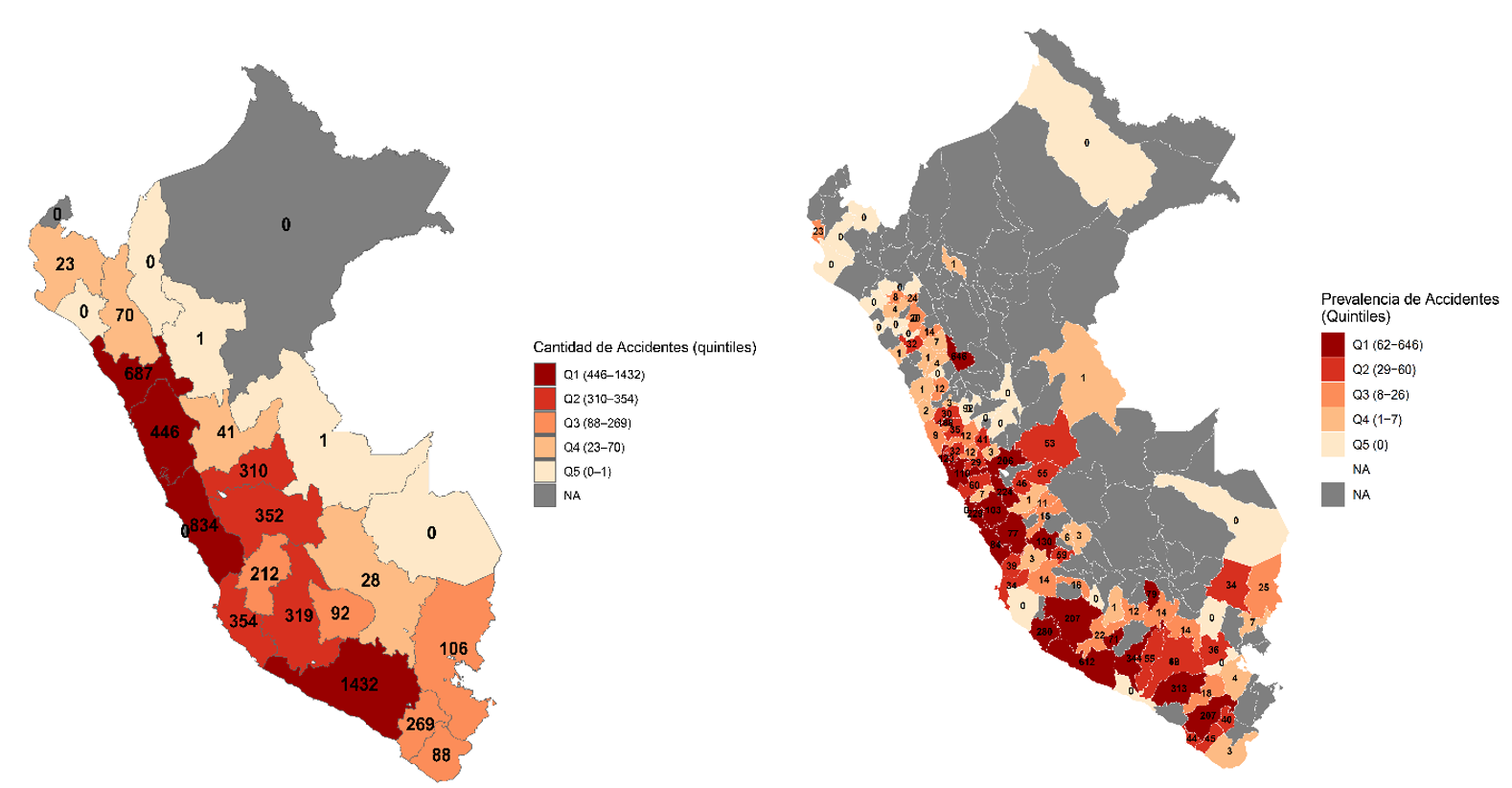
Figure 3 shows the geographical distribution of serious workplace accidents in Peru during the period 2020–2024, grouped into quintiles at both the departmental (A) and provincial (B) levels. At the departmental level, the highest quintile (Q1: 446–1432 accidents) includes Arequipa (1432), Lima (834), La Libertad (681), and Ica (446), regions mostly located in the Andes and the southern coast of the country, where the highest number of serious accidents is concentrated. At the opposite end of the spectrum, regions such as Loreto, San Martín, and Madre de Dios have minimal or no accidents, while Tumbes, Loreto, and the constitutional province of Callao report no mining concessions with workplace accidents or incidents. At the provincial level, a high concentration of cases is observed in traditionally mining areas of the southern Andes and central part of the country, such as in the provinces of Arequipa, Cusco, Apurímac and Moquegua, reflecting a spatial distribution closely linked to the intensity of extractive activity.
Table 1: Distribution of records of work-related incidents and accidents reported by mining concessions and their distribution according to the mineral extracted, 2020 - 2024
| Characteristics | Total N=1774 | Total (M+SD) | Metallic Concessions N=1507 (M+SD) | Non-Metallic Concessions N=267 (M+SD) |
|---|---|---|---|---|
| Workplace Incidents | 120 278 | 67.80±255.50 | 72.81±274.29 | 39.51±90.56 |
| Minor Accidents | 13 675 | 7.71±23.70 | 8.92±25.50 | 0.86±2.34 |
| Serious Accidents Disabling Fatal | 5 665 5507 158 | 3.19±7.10 3.10±6.92 0.09±0.95 | 3.54±7.44 3.44±7.25 0.10±1.03 | 1.21±4.20 1.20±4.18 0.01±0.09 |
M: mean; SD: standard deviation
Table 2: Characteristics of mining concessions reporting occupational accidents and incidents, by type of mineral extracted, 2020-2024
| Characteristics | Characteristics of monthly mining records N = 1,774(%) | Metallic mining records N=1507 (84.95%) | Non-Metallic mining records N=267 (15.05%) |
|---|---|---|---|
| Type of Mining Concession General Regime Small-Scale Mining Producer | 1103 (62.18) 671 (37.82) | 1009 (66.95) 495 (33.05) | 94 (35.21) 173 (64.79) |
| Years since Application (terciles) 1-15 years 16-25 years 26-97 years | 646 (36.41) 540 (30.44) 588 (33.15) | 601 (39.88) 407 (27.01) 499 (33.11) | 45 (16.85) 133 (49.81) 89 (33.33) |
| Concession Area (terciles) 0-220 ha 221-1399 ha 1400-95925 ha | 592 (33.43) 590 (33.31) 589 (33.26) | 506 (33.64) 473 (31.45) 525 (34.91) | 86 (32.21) 117 (43.82) 64 (23.97) |
| Concession Altitude (terciles) 5 to 2645 msnm 2646 to 3399 msnm 3400 to 4500 msnm | 595 (33.54) 591 (33.31) 588 (33.15) | 481 (31.92) 486 (32.25) 540 (35.83) | 114 (42.70) 105 (39.33) 48 (17.98) |
| Region of Location Rainforest Highlands Coast | 64 (3.61) 1277 (71.98) 433 (24.41) | 57 (3.78) 1096 (72.73) 354 (23.49) | 7 (2.62) 181 (67.79) 79 (29.59) |
| Number of Company Employees (terciles) 0-15 people 16-96 people 97-3606 people | 601 (33.88) 582 (32.81) 591 (33.31) | 411 (27.27) 536 (35.57) 560 (37.16) | 190 (71.16) 46 (17.23) 31 (11.61) |
| Contractor Workers (terciles) 0 people 6-21 people 22-6498 people | 990 (55.81) 193 (10.88) 591 (33.31) | 853 (56.60) 107 (7.10) 547 (36.30) | 137 (51.31) 86 (32.21) 44 (16.48) |
| Other workers (terciles) 0 people 1-49 people 50-21965 people | 810 (45.66) 373 (21.03) 591 (33.31) | 656 (43.53) 288 (19.11) 563 (37.36) | 154 (57.68) 85 (31.84) 28 (10.49) |
| Hours worked (terciles) 0-37599 hours 37600-299999 hours 300000-38500000 hours | 592 (33.37) 591 (33.31) 591 (33.31) | 420 (27.87) 532 (35.30) 555 (36.83) | 172 (64.42) 59 (22.10) 36 (13.48) |
4.2. Multivariate Regression Analysis
Our multivariate analysis identified distinct predictors across mining sectors (Table 3). In the metallic mining sector, the small-scale producer regime was significantly associated with an increase in serious accidents (β: 2.07; 95% CI: 0.88 to 3.26), as were larger concession areas (β: 2.52; 95%
CI: 0.85 to 4.19). This trend extended to labor metrics, where a higher number of both company workers (β: 3.63; 95% CI: 2.18 to 5.08) and contractors (β: 2.97; 95% CI: 1.91 to 4.03) predicted higher accident frequencies, along with increased man-hours (β: 1.40; 95% CI: 0.29 to 2.50). In contrast, intermediate contractor presence (6–21) demonstrated an inverse association (β: −1.14; 95% CI: −1.97 to −0.31).
In the non-metallic mining sector, the small-scale producer regime similarly emerged as a significant predictor of accidents (β: 2.88; 95% CI: 0.32 to 5.45), alongside company workers (β: 5.61; 95% CI: 0.93 to 10.29) and total man-hours (β: 3.22; 95% CI: 0.28 to 6.16). Yet, larger concession areas were linked to fewer accidents (β: −2.36; 95% CI: −4.54 to −0.18). Altitude (3,400–4,500 masl) did not reach statistical significance (β: −1.86; 95% CI: −3.96 to 0.24, p = 0.083) within this sector.
5. Discussion
Workplace accidents in the Peruvian mining sector during the period 2020–2024 are characterized by high geographical, structural, and operational heterogeneity13,14). The analysis showed that workplace accidents were more frequently reported in general-regime concessions, in concessions located in high-altitude Andean areas, and in those dedicated to the exploitation of metallic minerals.
Of the total number of incident and accident records (10,051), 18% corresponded to events with at least one reported incident or accident. The temporal trend of workplace accidents during the study period shows two significant decreases in the occurrence of disabling and minor accidents; the first in April 2020, coinciding with the beginning of restrictions due to the COVID-19 pandemic, and the second in August 2023. This decline is atypical and lacks a clear explanation, as no trend is observed in the preceding or subsequent months.
Figure 2 shows a peak in accidents in July 2022, which may have been associated with increased mining activity during that period. This pattern may be related to factors such as longer workdays, the accelerated hiring of less experienced personnel, and pressure to meet production targets following the reactivation of mining and processing operations after the pandemic. Furthermore, seasonal factors such as national holidays have been associated with changes in employee vigilance and risk perception, which may be relevant to workplace safety29).
According to Table 1, during the study period, the mining sector recorded 120,278 incidents, 13,675 minor accidents, 5,507 disabling accidents, and 158 fatal accidents. Comparing these dates with the model of30), reveals a similar proportional structure, although with differences in the magnitude of the ratios.
Table 3: Factors associated with serious accidents (adjusted model)
Table 3: Factors associated with serious accidents (adjusted model)
| Variable (reference = lowest tertile) | Adjusted β (95% CI) | p-value |
|---|---|---|
| Small-scale producer regime | 2.07 (0.88, 3.26) | 0.001 |
| Concession area ≥1,400 ha | 2.52 (0.85, 4.19) | 0.003 |
| Company workers ≥97 | 3.63 (2.18, 5.08) | <0.001 |
| Contractors 6–21 | −1.14 (−1.97, −0.31) | 0.007 |
| Contractors ≥22 | 2.97 (1.91, 4.03) | <0.001 |
| Man-hours ≥300,000 | 1.40 (0.29, 2.50) | 0.013 |
| Altitude 3,400–4,500 masl | −2.37 (−6.01, 1.28) | 0.203 |
| Variable (reference = lowest tertile) | Adjusted β (95% CI) | p-value |
|---|---|---|
| Small-scale producer regime | 2.88 (0.32, 5.45) | 0.028 |
| Concession area ≥1,400 ha | −2.36 (−4.54, −0.18) | 0.034 |
| Company workers ≥97 | 5.61 (0.93, 10.29) | 0.019 |
| Man-hours ≥300,000 | 3.22 (0.28, 6.16) | 0.032 |
| Altitude 3,400–4,500 masl | −1.86 (−3.96, 0.24) | 0.083 |
Non-significant covariates (years since formulation, region, other workers) are omitted.
Using the 158 fatal accidents as a reference, the approximate ratio is obtained:
•Disabling accidents: 5,507 / 158 ≈ 35 for every fatal accident
•Minor accidents: 13,675 / 158 ≈ 87 for every fatal accident
•Incidents without injury: 120,278 / 158 ≈ 761 for every fatal accident
These proportions reflect a wider base than suggested by the theoretical pyramid. This broadening of the base may be interpreted positively, as it is consistent with a management system that encourages the identification and reporting of incidents without injury, an element frequently considered important in occupational risk management.
Likewise, the proportion of disabling and minor accidents is also consistent with the model's approach, in which the most serious events represent a minimal fraction of the total. Taken together, these data are consistent with the usefulness of Bird's Pyramid as a conceptual framework for interpreting risk levels in mining operations and highlight the potential value of preventive actions targeting incidents and substandard conditions. Beyond their human consequences, serious accidents in Peruvian mining also entail substantial economic costs that are frequently underestimated, which reinforces the value of investing in prevention31).
The study of environmental factors associated with the occurrence of workplace accidents is presented below:
a)Type of mineral extracted
The descriptive results show that a high proportion of the concessions that reported workplace accidents are dedicated to the extraction of metallic minerals (85%) and operate primarily under the general regime (62.18%). While metallic mining entails specific operational risks—such as the intensive use of machinery, underground work, and demanding geotechnical conditions, the type of mineral extracted does not appear to show an independent statistical association with accident occurrence. The specialized literature suggests that accident rates are more commonly associated with operational factors such as extraction methods, geological conditions, technological level, and the effectiveness of occupational safety and health management systems32).
From an organizational perspective33), it is argued that the incidence of accidents responds to both environmental conditions and internal structural factors, including the culture of prevention and staff training. In this regard, the multivariate analysis of this study revealed a significant association between being a small-scale mining producer and the occurrence of serious accidents in metallic mineral concessions, while this relationship was not observed in non-metallic mineral concessions. These findings highlight the potential relevance of differentiated risk management strategies that consider not only the type of resource extracted, but also the legal framework, organizational level, and technical capabilities of each operation.
b)Type of concession
Multivariate analysis showed that metal mining concessions operating under the small-scale producer regime were associated with a higher number of serious workplace accidents, even though the general regime accounts for 62.18% of reported cases. This finding may reflect the presence of unfavorable structural conditions, such as technical limitations, insufficient supervision, and deficiencies in risk management, that have been described in the literature as factors associated with more severe occupational events16,34). While large companies face complex operational risks related to their scale and level of automation, they generally have greater resources available for occupational safety management10), supporting the consideration of differentiated occupational safety approaches according to concession characteristics
In contrast, small-scale metal producers often operate in precarious conditions, with low mechanization35), inadequate spaces36) and unsafe work designs37), which may hinder the implementation of preventive measures. Furthermore, human factors such as limited training, low motivation, or insufficient experience may contribute to this vulnerability38). Along these lines39), highlights that maintaining consistent motivation toward safety objectives is difficult in small businesses, and40) warns that health and safety are rarely considered priorities for business success in these types of units, unlike areas such as quality. Taken together, these results reinforce the need to design differentiated occupational health and safety strategies that consider not only the operation's scale and size, but also the nature of the mineral, the operating environment, and the institutional and cultural capacity of each concession.
c)Years since the Formulation (Antiquity)
Regarding the age of the concession, the results show no statistically significant differences in the frequency of workplace accidents, suggesting that the project's age alone was not independently associated with the occurrence of workplace accidents in the present study, possibly due to the application of standardized regulations and common operating practices that transcend the length of operation. In contrast19,34), indicate that companies with a longer history may have more consolidated safety management systems, being associated with lower accident frequencies, while41) document that newer companies adopting emerging technologies have reported lower injury rates, highlighting the lack of consensus on considering age as a factor associated with the severity of workplace accidents.
d)Extent
Regarding territorial extent, larger concessions were associated with a higher number of serious accidents. This association may be related to factors such as personnel dispersion, the presence of multiple work fronts, and greater logistical complexity in monitoring safety conditions.
e)Region and Altitude
The distribution recorded in Table 2 confirms that 71.98% of accidents occur in the Andean region, compared to 24.41% on the coast and only 3.61% in the jungle. This distribution reflects both the geology favorable to metallic mining and the historical predominance of medium- and large-scale concessions in the Peruvian highlands. However, this concentration is also associated with specific safety challenges, as factors such as altitude, difficult access, and adverse weather conditions have been described as conditions related to greater operational risk. In this context, provinces such as Caravelí, Yauli, and Pataz stand out for registering the highest percentages of incidents, which may support the implementation of risk-management policies in these mining centers. As argued in point10), geographical and regulatory conditions have been associated with differences in accident rates through variations in the operating environment, available infrastructure, and levels of institutional control.
Likewise, altitude, with a median of 3,065 meters above sea level for the analyzed concessions, represents a key contextual factor. Although accidents are distributed relatively evenly across different altitude ranges, the highest areas may present particular safety challenges related to continuous exposure to hypobaric conditions, extreme temperatures, and logistical limitations42) warn that heavy rains, storms, or frosts have been reported as contributing to falls, slips, and equipment failures, and may be associated with a greater occurrence of incidents. These environmental factors, together with the structural characteristics of the terrain, may create challenges for the implementation of effective safety systems. Therefore, geographic location should not be considered merely as contextual information, but rather as a contextual characteristic that may be associated with operational safety and should be considered when designing prevention and response strategies for occupational hazards in mining.
f)Company Employees – Contractors
Concessions employing more than 22 contractors and having more than 50 additional support workers showed a significant association with a higher number of serious accidents. This pattern may reflect the greater organizational heterogeneity frequently observed in outsourced operational structures, particularly within occupational health and safety management systems (OHSMS), which may be associated with difficulties in the uniform implementation of protocols, traceability of controls, and monitoring of regulatory compliance. This organizational fragmentation is exacerbated when multiple entities operate simultaneously, each with different levels of technical competence, preventive culture, and procedural rigor, potentially increasing the complexity of risk management. According to43), a significant proportion of workplace accidents are attributed to organizational factors and unsafe operating practices, supporting the importance of considering structural components of the work environment as factors associated with occupational accidents. Similarly44), highlights that institutional safety policies and organizational configuration have been associated with differences in individual behavior and the effectiveness of prevention systems.
Furthermore, high staff turnover, coupled with the presence of immigrant labor, often in informal employment, may be associated with lower levels of training and accumulated experience in mining operations. This job instability particularly affects young or low-skilled workers, which may hinder the consolidation of safety competencies. Studies45) have shown that in environments such as construction in Finland, accidents have been reported more frequently among workers with low occupational status, reduced wages, and less job security, conditions that are replicated in many mining subcontracting scenarios46) underscores the importance of continuous training in safe procedures, as workers may adopt alternative work methods in the absence of continuous supervision and reinforcement. In this context, outsourcing may introduce coordination and control challenges and may be associated with difficulties in maintaining a consistent preventive culture within highly complex operational environments.
g)Man-Hours
One of the most consistent findings of the study was the strong association between operational workload and accident severity. Concessions that recorded a higher number of man-hours worked and employed a larger direct staff were significantly associated with a higher number of serious accidents. This result is consistent with the hypothesis that greater operational activity, and therefore greater exposure time, may be associated with a higher number of high-severity incidents21). In turn, a large number of workers may hinder the uniform and effective implementation of safety protocols, especially in complex operational contexts with limited supervision22). This challenge may be further intensified intensified in environments where control systems are weak or a safety culture is not fully institutionalized.
Furthermore, long working hours and the accumulation of shifts without adequate rest periods constitute additional risk factors. Work-related fatigue has been associated with impaired cognitive and physical performance, including reduced attention, judgment, and reaction time, which may contribute to operational errors29) warns that accident occurrence has been reported to be higher after 42 consecutive days of work without leave, suggesting a potential cumulative effect of physical and mental exhaustion on occupational safety. Similarly28), highlights that inadequate shift scheduling can significantly contribute to fatigue and decreased alertness44,47) agree that fatigue, stress, and health problems have been associated with impaired judgment and attention, factors that may contribute to human error; furthermore, environmental factors may also be associated with psychological stress and reduced operational performance.
The results of this study offer useful evidence for improving occupational safety and health management in the Peruvian mining industry. The high proportion of serious accidents observed in general-regime concessions, particularly those located in Andean regions, suggests the potential value of policies differentiated by geographic location and type of operation. Extreme weather conditions, altitude, and geographical dispersion may warrant specific prevention and response protocols, with an emphasis on managing fatigue, limited accessibility, and environmental risks. In this context, the findings support consideration of contextual risk assessment tools and strengthen the technical capabilities of safety teams in high-accident regions such as Caravelí, Yauli, and Pataz. Such tools are consistent with evidence identifying operational uncertainty and complexity as central concerns for safety management in mining operations48).
Furthermore, the observed associations between workload, outsourcing, and accident severity support the importance of clearer and more shared safety governance in concessions with high staff turnover and extensive use of contractors. Efforts to harmonize management systems may be beneficial between concession holders and third parties, ensuring common standards, continuous training, and integrated control mechanisms. In contractor-intensive operations, the implementation of critical controls has been associated with reductions in the frequency of incidents and accidents in Peruvian mining49). Particular attention may be warranted for strengthening a preventative culture in small-scale metal mining operations, where technical, organizational, and human vulnerabilities may coexist. The findings may support the review of current supervision and oversight schemes, incorporating indicators of workplace fatigue, reporting of incidents without injury, and job stability as critical variables for anticipating risk scenarios. Taken together, these findings may inform the development of more realistic intervention plans adapted to the diverse realities of the Peruvian mining sector.
One of the main strengths of this study is the use of a comprehensive, up-to-date, and systematized national database, which allowed for a rigorous analysis of workplace accident patterns in the mining sector over a representative period. The combination of descriptive and multivariate analysis provided a more complete view of the factors associated with the occurrence and severity of accidents, incorporating both technical and contextual variables (type of concession, workload, outsourcing, geographic location, among others). Furthermore, the applied approach facilitates the identification of groups and operational contexts associated with a greater burden of serious accidents, which is highly valuable for designing differentiated intervention strategies.
This study has several limitations that should be considered when interpreting the findings. First, the use of secondary administrative records makes the analysis dependent on the quality, completeness, and accuracy of the available information. Consequently, potentially relevant variables such as safety culture, psychosocial conditions, leadership practices, and workers’ risk perceptions could not be incorporated into the models.
Second, the analysis was restricted to concessions that reported at least one occupational incident or accident during the study period. Therefore, the findings should be interpreted as factors associated with the burden of serious accidents among reporting concessions rather than as factors associated with accident occurrence across the entire mining sector. In addition, the observational design does not allow causal inferences, and all reported relationships should be understood as statistical associations.
Third, disabling and fatal accidents were analysed as a composite outcome because both are classified as serious occupational events within the Peruvian mining reporting system. Nevertheless, these outcomes differ in severity and consequences; therefore, the identified associations reflect the overall burden of serious accidents rather than the determinants of specific accident categories.
Fourth, some degree of information bias cannot be excluded because the database relies on company-reported records, which may be affected by underreporting, particularly among smaller operations with more limited oversight and reporting capacity.
Finally, certain variables were measured using proxy indicators. Altitude was estimated from provincial-level geographic information rather than the exact elevation of each mining operation, which may have introduced non-differential measurement error, particularly in geographically heterogeneous provinces. Likewise, several highly skewed continuous variables were categorized into tertiles to reduce the influence of extreme values and improve interpretability; however, this approach may have resulted in some loss of information relative to the original continuous measurements.
Future studies should evaluate the complete population of mining concessions, including those without reported incidents or accidents, using count-based modelling approaches. Additional research incorporating inspection records, audit information, organizational variables, and mine-specific geographic data could provide a more comprehensive understanding of occupational safety patterns in the mining sector. Longitudinal designs may also help clarify how operational, organizational, and environmental factors are associated with accident trends over time.
6. Conclusions
This study analysed 1,774 concession-year records corresponding to 566 mining concessions/UEAs that reported at least one occupational event during 2020–2024, comprising 5,665 serious accidents (5,507 disabling and 158 fatal accidents). Using multiple linear regression models with cluster-robust standard errors, larger workforce size and higher man-hours were consistently associated with a greater number of serious accidents in both metallic and non-metallic mining. Operating under the small-scale-producer regime was also associated with a higher burden of serious accidents in both sectors.
Additional differences were observed according to mining sector. In metallic mining, larger concessions and a greater number of contractors were associated with more serious accidents, whereas in non-metallic mining, larger concessions were associated with fewer serious accidents. Altitude showed an inverse but non-significant association in non-metallic mining.
Overall, the findings suggest that operational scale, workforce characteristics, and workload are more strongly associated with the burden of serious accidents than the type of mineral itself, although the pattern of associations differs between metallic and non-metallic mining. These results may inform occupational-safety policies tailored to operation size and mining context, particularly regarding workload management, contractor oversight, and technical support for small-scale producers. Given the observational design and the restriction of the analysis to concessions reporting occupational events, the findings should be interpreted as statistical associations and not as evidence of causal relationships.
Acknowledgements
We are grateful to the Newman Graduate School for funding this research.
Author Contributions
Sandra Pajares-Centeno: Conceptualization, research, project management, obtaining funding, resources.
Leo Tirado-Rebaza: Formal analysis, Methodology, supervision, writing – review and editing.
Rodrigo Flores-Palacios: Data curation, Validation, Software, Writing – original draft.
References
- C.J. Alvarado-Cerna, M.A. Cotrina-Teatino, H. Ascate-Anampa, Y.J. Henriquez-Sánchez, M.D. Sandoval-Carranza, E.M. Noriega-Vidal, and J.C. Rodriguez-Soto, “Mining as a driving force in the economic development of Peru,” 2nd LACCEI - LEIRD 2022, December 5-7 (1-9) (2022) doi:10.18687/LEIRD2022.1.1.49.
- I. Milošević, A. Stojanović, Đ. Nikolić, I. Mihajlović, A. Brkić, M. Perišić, and V. Spasojević-Brkić, “Occupational health and safety performance in a changing mining environment: identification of critical factors,” Saf. Sci., 184 106745 (2025). doi:10.1016/j.ssci.2024.106745.
- S. Noraishah Ismail, A. Ramli, and H. Abdul Aziz, “Research trends in mining accidents study: a systematic literature review,” Saf. Sci., 143 105438 (2021). doi:10.1016/j.ssci.2021.105438.
- C. Baron, “Peru: number of mining deaths 2024,” Stat. Res. Dep., (2024). https://www.statista.com/statistics/1031543/number-deaths-mining-accidents-peru/?srsltid=AfmBOoo15HTDI2sKaMD2xezeUN3b7T4r5v9ZxcQZHKwqGPIjKGKVsjeC (accessed March 27, 2026).
- Y. Cano, G. Quispe, H. Chávez, N. Mamani, C. Raymundo, and F. Domínguez, “Occupational Health and Safety Management Model for Mining Contracts,” Saltador Nat. Suiza, 1152 (486–492) (2020). doi:10.1007/978-3-030-44267-5_74.
- L. Yang, G.E. Birhane, J. Zhu, and J. Geng, “Mining employees safety and the application of information technology in coal mining: review,” Front. Public Health, 9 709987 (2021). doi:10.3389/fpubh.2021.709987.
- B. Zhang, X. Yin, Y. Guo, and R. Tong, “What occupational risk factors significantly affect miners’ health: findings from meta-analysis and association rule mining,” J. Safety Res., 89 197–209 (2024). doi:10.1016/j.jsr.2024.02.010.
- S.A.B. Naeini, and A. Badri, “Identification and categorization of hazards in the mining industry: a systematic review of the literature,”. Int. Rev. of Applied Sc. Eng., 15 (1) 1-19 (2023). doi:10.1556/1848.2023.00621.
- W. Qiao, X. Li, and Q. Liu, “Systemic approaches to incident analysis in coal mines: comparison of the stamp, fram and ‘2–4’ models,” Resour. Policy, 63 101453 (2019). doi:10.1016/j.resourpol.2019.101453.
- X. Baraza, N. Cugueró-Escofet, and R. Rodríguez-Elizalde, “Statistical analysis of the severity of occupational accidents in the mining sector,” J. Safety Res., 86 364–375 (2023). doi:10.1016/j.jsr.2023.07.015.
- T. Malysa, K. Nowacki, K. Lakomy, and S. Lykholat, “The impact of employment restriction on the risk of an accident at work in the mining industry in poland,” Prod. Eng. Arch., 30 (1) 67–74 (2024). doi:10.30657/pea.2024.30.6.
- W. Qiao, “Analysis and measurement of multifactor risk in underground coal mine accidents based on coupling theory,” Reliab. Eng. Syst. Saf., 208 107433 (2021). doi:10.1016/j.ress.2021.107433.
- J. Apaza, A. Pérez, R.L. Quispe, L. Quea, and J. Apaza, “ACCIDENT RATE ANALYSIS IN THE PERUVIAN MINING SECTOR – PERIOD 2010 - 2021,” in: Editora Científica Digital, 2024: pp. 143–158. http://www.editoracientifica.com.br/artigos/accident-rate-analysis-in-the-peruvian-mining-sector-period-2010-2021 (accessed June 9, 2025).
- J. Maiti, and A. Bhattacherjee, “Evaluation of risk of occupational injuries among underground coal mine workers through multinomial logit analysis,” J. Safety Res., 30 (2) 93–101 (1999). doi:10.1016/S0022-4375(99)00003-1.
- Supervisory Agency for Investment in Energy and Mining [OSINERGMIN], “Statistical Safety Analysis and Illustrative Compendium of Accidents in the Medium- and Large-Scale Mining Sector – 2019,” Lima, Peru, 2020. http://www.osinerg.gob.pe/seccion/centro_documental/mineria/Documentos/Publicaciones/Compendio-Ilustrativo-Accidentes-Mineria-2015.pdf.
- H. Herrera, “Safety, Health, and Risk Prevention in Mining,” Higher Technical School of Mining Engineering, Polytechnic University of Madrid, 2009. https://oa.upm.es/10673/.
- L. Sanmiquel, M. Bascompta, J.M. Rossell, H.F. Anticoi, and E. Guash, “Analysis of occupational accidents in underground and surface mining in spain using data-mining techniques,” Int. J. Environ. Res. Public. Health, 15 (3) 462 (2018). doi:10.3390/ijerph15030462.
- Natural Resources and Infrastructure Division of Chile, “So-called Small-Scale Mining: A Renewed Business Approach,” CEPAL, Santiago of Chile, Chile, 2000.
- S. Ren, C.A. Beeche, Z. Shi, M.A. Garcia, K. Zychowski, S. Leng, P. Roghanchi, and J. Pu, “Causal relationship network of risk factors impacting workday loss in underground coal mines,” Comp. Science, 2402 (2024). doi:10.48550/arXiv.2402.05940.
- A. González, J. Bonilla, M. Quintero, C. Reyes, and A. Chavarro, “Analysis of the causes and consequences of workplace accidents on two construction projects,” Rev. Ing. Constr., 31 (1) 05–16 (2016). doi:10.4067/S0718-50732016000100001.
- J. Tian, Y. Wang, and S. Gao, “Analysis of mining-related injuries in chinese coal mines and related risk factors: a statistical research study based on a meta-analysis,” Int. J. Environ. Res. Public. Health, 19 (23) 16249 (2022). doi:10.3390/ijerph192316249.
- P. del P. Gallardo, “Relationship between the workday and workplace accident frequency rates at a mining center in Peru during 2019 and 2020,” Master’s Thesis, Universidad Peruana Cayetano Heredia, 2024. https://repositorio.upch.edu.pe/handle/20.500.12866/16503 (accessed June 9, 2025).
- Y. Li, X. Wu, X. Luo, J. Gao, and W. Yin, “Impact of safety attitude on the safety behavior of coal miners in china,” Sustainability, 11 (22) 6382 (2019). doi:10.3390/su11226382.
- P.J. Alejo, G.S. Chircca, J.J. Velásquez, and P.P. Zamora, “Analysis of factors affecting mining accident rates, with an emphasis on work systems,” Esc. Postgrado GĚRENS, (2016). http://repositorio.gerens.edu.pe/handle/20.500.12877/20 (accessed June 9, 2025).
- D. Alcántara, “Effect of chronic intermittent hypobaric hypoxia on prostate-specific antigen (PSA) levels in Chilean miners,” Doctoral Thesis, University of Chile, 2020. https://repositorio.uchile.cl/handle/2250/181031 (accessed June 15, 2025).
- Y. Shekarian, E. Rahimi, M. Rezaee, and P. Roghanchi, “A systematic review of occupational exposure to respirable coal mine dust (rcmd) in the u.s. mining industry,” Int. J. Coal Sci. Technol., 10 (1) 29 (2023). doi:10.1007/s40789-023-00586-5.
- E.J. Tetzlaff, K.A. Goggins, A.L. Pegoraro, S.C. Dorman, V. Pakalnis, and T.R. Eger, “Safety culture: a retrospective analysis of occupational health and safety mining reports,” Saf. Health Work, 12 (2) 201–208 (2021). doi:10.1016/j.shaw.2020.12.001.
- L. Cruz-Ausejo, N.A. Cama-Ttito, P.F. Solano, A. Copez-Lonzoy, and V.J. Vera-Ponce, “Occupational accidents in mining workers: scoping review of studies published in the last 13 years,” BMJ Open, 14 (10) e080572 (2024). doi:10.1136/bmjopen-2023-080572.
- D. Pranitasari, and A. Alfarius, “Unearthing hazards: investigating the root causes of workplace accidents at pt indo muro kencana’s gold mines,” J. Ecoment Glob., 8 (3) 177–188 (2023). doi:10.36982/jeg.v8i3.3723.
- F. Bird, and G. Germain, “Practical Loss Control Leadership,” Loganville, Georgia, USA: Institute Publishing, 1985.
- S.M. Arango-Retamozo, M.A. Cotrina-Teatino, J.J. Marquina-Araujo, H.R. Portilla-Rodríguez, C.M. Torres-Rivera, and J.A. Vega-Gonzalez, “Estimating the economic impact of mining accidents: a case study from peru,” Int. J. Saf. Secur. Eng., 13 (3) 539–545 (2023). doi:10.18280/ijsse.130316.
- W. Pei, “Research on safety standardization in metal and non-metal mines,” Cienc. Tecnol. Segur. China, (6) 119–122 (2009). https://d.wanfangdata.com.cn/Periodical/zgzyaqwsgltxrz200906025 (accessed March 27, 2026).
- G. Malta, S. Fruscione, F. Plescia, A. Argo, and E. Cannizzaro, “Accidents at work: a meta-analysis to improve risk assessment and health surveillance,” Med. and Pharmac. 202402 1-18 (2024). doi:10.20944/preprints202402.0558.v1.
- Y. Lu, “Occupational safety management in the mining sectors of China and Australia: a brief introduction,” Med. Econ., 2 (1) 1–2 (2016). https://health-medical-economics.imedpub.com/occupational-safety-management-in-the-mining-sectors-of-china-and-australia-a-short-introduction.pdf.
- S.E. Asogwa, “The health benefits of mechanization at the nigerian coal corporation,” Accid. Anal. Prev., 20 (2) 103–108 (1988). doi:10.1016/0001-4575(88)90025-5.
- B. Fabiano, F. Currò, and R. Pastorino, “Occupational injuries in italy: risk factors and long term trend (1951-98),” Occup. Environ. Med., 58 (5) 330–338 (2001). doi:10.1136/oem.58.5.330.
- J. Rasmussen, “Reasons, Causes, and Human Error,” in: J. Rasmussen, K. Duncan, J. Leplat (Eds.), New Technol. Hum. Error, Wiley, Chichester, 1987: pp. 293–301.
- T.A. Kletz, “Accident data—the need for a new look at the sort of data that are collected and analysed,” Saf. Sci., 16 (3) 407–415 (1993). doi:10.1016/0925-7535(93)90061-H.
- J.H.T.H. Andriessen, “Safe behaviour and safety motivation,” J. Occup. Accid., 1 (4) 363–376 (1978). doi:10.1016/0376-6349(78)90006-8.
- L. Vassie, and S. Cox, “Small and medium size enterprises (sme) interest in voluntary certification schemes for health and safety management: preliminary results,” Saf. Sci., 29 (1) 67–73 (1998). doi:10.1016/S0925-7535(98)00017-4.
- B.M. Kunar, A. Bhattacherjee, and N. Chau, “A matched case-control study of occupational injury in underground coalmine workers,” J. South. Afr. Inst. Min. Metall., 110 (1) 1–9 (2010). http://www.scielo.org.za/scielo.php?script=sci_abstract&pid=S2225-62532010000100004&lng=en&nrm=iso&tlng=en (accessed March 29, 2026).
- G. Abdillah, M.K. Caraka, R.A. Arioyudanto, S. Ahya, and D.O. Radianto, “Case study of the causes of fatal workplace accidents in mineral mines: analysis of human, technical, and environmental factors,” J. Educ. Innov. Public Health, 2 (2) 42–51 (2024). doi:10.55606/innovation.v2i2.2843.
- A. Naeimi, M. Kamani, H. Ahmadi, M. Arefi, and M. Roveshti, “Investigating occupational accidents based on the human factors analysis and system classification method: a case study in an industrial and mining company,” J. Occup. Hyg. Eng., 11 (1) 5 (2024).
- L.M. Floris, E.G. Carvalho, B.C.R. Faustino, and C.L.L. Calegario, “Workplace accidents as a consequence of human error: an empirical study in a gold mine / os acidentes de trabalho como consequência dos erros humanos: um estudo de caso em uma mina de ouro no brasil,” Rev. FSA Cent. Univ. St. Agostinho, 18 (1) 74–99 (2021). doi:10.12819/2021.18.1.4.
- A. Saloniemi, and H. Oksanen, “Accidents and fatal accidents—some paradoxes,” Saf. Sci., 29 (1) 59–66 (1998). doi:10.1016/S0925-7535(98)00016-2.
- P. Verhaegen, “Absenteeism, accidents and risk-taking: a review ten years later,” Saf. Sci., 16 (3) 359–366 (1993). doi:10.1016/0925-7535(93)90055-I.
- A. Grodzicka, “Assessing risky behaviors based on the indicator analysis of statistics on accidents at work,” Manag. Syst. Prod. Eng., 31 (4) 389–397 (2023). doi:10.2478/mspe-2023-0043.
- J. Polo Salinas, J.J. Marquina Araujo, and M.A. Cotrina Teatino, “Uncertainty in underground mining operations: a bibliometric and systematic literature review analysis,” World J. Eng., 22 (6) 1328–1343 (2025). doi:10.1108/WJE-07-2024-0388.
- M.C. Gamboa-Sánchez, M.A. Cotrina-Teatino, J.A. Vega-Gonzalez, E.M. Noriega-Vidal, S.M. Arango-Retamozo, and J.J. Marquina-Araujo, “Effective critical risk management in welding operations for mining: a case study on incident reduction,” Int. J. Saf. Secur. Eng., 14 (4) 1039–1047 (2024). doi:10.18280/ijsse.140403.