
Abstract
This study evaluated the material-level properties and full-scale structural response of three-layer concrete sandwich wall panels containing a rice-husk lightweight concrete (RHLC) core. Five RHLC mixtures were prepared with untreated rice husk as the lightweight organic filler by varying the water-to-cement ratio (0.45-0.55) and compaction coefficient (1.15-1.30). Mix 3, with a hardened density of 511 kg/m³, was selected for the panel core. Laboratory tests included density, cube compressive strength, thermal-conductivity screening, and freeze-thaw screening, followed by eccentric-compression tests on six full-scale panels with and without openings. The selected RHLC exhibited a cube compressive strength of 1.62 MPa, whereas the dense-concrete facings reached 17.10 MPa. Experimental-to-theoretical failure-load ratios ranged from 0.90 to 1.25; the mean absolute percentage error was 10.69%, and close agreement was obtained for WP-1-WP-4. Thermal-conductivity values across the investigated formulations ranged from 0.11 to 0.18 W/(m•K). Supplementary RHLC formulations with densities of 700-900 kg/m³ retained strength coefficients of 0.75-0.82 after 35 freeze-thaw cycles; these results were not extrapolated to the 511 kg/m³ core. The study demonstrated the short-term feasibility of using RHLC as a protected, non-load-bearing insulating core, while identifying cold-climate durability and interface behavior as priorities for further validation.
Keywords: bio-based lightweight concrete, concrete sandwich wall panel, eccentric compression, rice husk, thermal conductivity
Outline
1. Introduction
The construction sector increasingly seeks materials that reduce virgin-resource consumption, lower embodied impacts, and improve building-envelope energy performance. Bio-based cementitious materials can valorize renewable or residual biomass, but their adoption remains limited by variability, moisture sensitivity, durability, and the need to reconcile thermal and structural functions 1,2).
Rice husk is a low-density, porous lignocellulosic residue with potential for use in building materials. Marques et al. investigated rice-husk cement-based composites for acoustic barriers and thermal insulating layers 3), while Aravind et al. examined rice-husk-incorporated foam-concrete wall panels for thermal insulation 4). António et al. used rice husk in composite boards 5), whereas Antunes et al. investigated rice-husk–earth-based panels 6). Chabannes et al. studied raw rice husk as a natural aggregate in lightweight insulating concrete 7). These studies showed that direct rice-husk incorporation can reduce density and thermal conductivity, while the resulting mechanical properties depend strongly on husk content, moisture condition, binder continuity, and processing.
These studies showed that direct rice-husk incorporation can reduce density and thermal conductivity, but the resulting mechanical properties depend strongly on husk content, moisture condition, binder continuity, and processing.
Regional and waste-utilization studies further demonstrated the value of composition optimization and local secondary resources. Zhanatuly et al. applied mathematical modeling to the composition of composite materials based on agricultural plant waste in South Kazakhstan8). Sharma et al. investigated insulation building panels produced from agricultural waste and gypsum9), while Zhakypova et al. evaluated fine-grained concrete incorporating Kazakhstan ash10). Singh et al. reviewed rice-straw-based natural-fiber biocomposites11), and Handika et al. examined the mechanical properties and fracture patterns of oil-palm-shell concrete produced with different cement types12). Collectively, these studies emphasize that material selection and processing should be matched to the intended structural or insulating function.
The direct use of rice husk differs from the use of rice-husk ash because it avoids a separate calcination stage but retains organic extractives and a highly absorbent porous skeleton. Research on cellulosic-fiber cement composites has shown that sugars, extractives, water uptake, and the filler-matrix interface can delay hydration and reduce durability unless the mixture and curing regime are controlled 13–15). Studies of other plant-based concretes also demonstrated that density, moisture content, and pore structure have a coupled influence on thermal conductivity and moisture transfer 16–18).
These limitations motivate the use of layered wall systems rather than the independent structural use of very low-density bio-based concrete. Pozo-Lora et al. reviewed the materials, design principles, and construction methods of concrete sandwich wall panels19), while O'Hegarty and Kinnane summarized developments and innovations in precast concrete sandwich panels20). The PCI state-of-the-art report provided established guidance on precast/prestressed concrete sandwich wall-panel behavior21). Experimental studies by Lameiras et al. investigated both connector pull-out response and the overall mechanical behavior of sandwich panels incorporating fiber-reinforced polymer connectors22,23). These studies identify facing stiffness, connector behavior, opening geometry, core properties, and composite action as important structural parameters.
In such systems, the outer concrete layers can provide the principal load-bearing and protective functions, while the core can reduce mass and heat transfer.
Recent work has also examined the eco-efficiency of concrete sandwich panels, broader bio-based or green sandwich concepts, cork-based insulating cores, and wall elements containing rice-husk recycled concrete 24–27). Environmental claims nevertheless require evidence beyond the use of a waste-derived constituent. Research on lower-carbon concrete, composite eco-efficiency indicators, prefabricated construction, and life-cycle assessment of sandwich panels has shown that system boundaries, cement content, transport, production route, durability, and functional equivalence can change the sustainability outcome 28–31).
The principal research gap was therefore the lack of a combined material-to-structure assessment of full-scale concrete sandwich wall panels containing a very low-density rice-husk lightweight concrete (RHLC) core under a loading condition representative of wall service. A second gap concerned the transparent comparison of measured and analytical failure loads for panels with and without openings.
The objective of this study was to determine whether RHLC could be integrated as a protected, non-load-bearing core in full-scale concrete sandwich wall panels and to quantify the agreement between measured and analytical failure loads under eccentric compression. The novelty consisted of: (i) linking RHLC mix-design parameters to material performance; (ii) using the selected RHLC in full-scale three-layer panels; (iii) validating the analytical estimates through panel-specific ratios and error metrics; and (iv) assessing structural, thermal, freeze-thaw, and resource-use evidence within explicitly stated experimental limits.
2. Materials and Methods
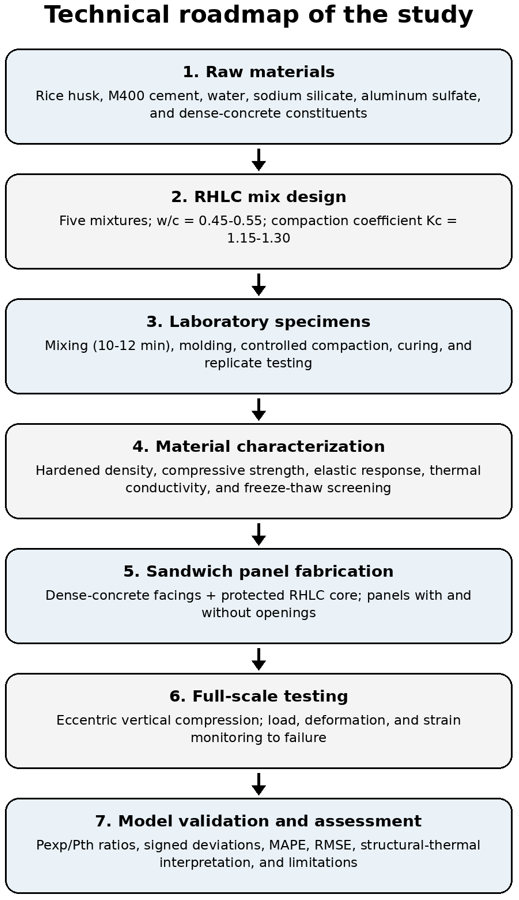
The experimental program combined RHLC mix optimization, laboratory material characterization, fabrication of three-layer wall panels, eccentric-compression testing, and analytical validation. The sequence of the work is summarized in Figure 1.
2.1. Research concept
The wall element consisted of two dense-concrete facings and a central RHLC layer. The facings were assigned the primary load-bearing and protective functions, whereas the RHLC was designed as a lightweight insulating core. The program therefore evaluated both the material response of RHLC and the behavior of the complete layered wall system.
2.2. Raw materials and specimen preparation
Untreated rice husk was used as the organic filler. Portland cement of grade M400 was used as the binder. Sodium silicate and aluminum sulfate were incorporated into the RHLC mixtures to limit the adverse influence of water-soluble lignocellulosic compounds and to support early hardening. The dense-concrete facings contained cement, fine aggregate, coarse aggregate, water, and SP-1 superplasticizer. The preparation and testing principles for the rice-husk composite were aligned with GOST 19222-84 for arbolite-type products; this standard was not treated as a specification for the rice husk itself.
Fresh RHLC was mixed for approximately 10-12 min and placed in metal molds. Cube specimens measured 150 × 150 × 150 mm, and prism specimens measured 150 × 150 × 600 mm. Compaction was applied for 30-60 s depending on mixture consistency. The compaction coefficient Kc was defined as the ratio of the compacted fresh-mixture density to the reference uncompacted density.
Table 1: Mix proportions and processing parameters of the RHLC mixtures and dense-concrete facings.
Table 1: Mix proportions and processing parameters of the RHLC mixtures and dense-concrete facings.
| Mix | C/RH/W/SS/AS, kg/m³ | w/c | Kc | ρh, kg/m³ |
|---|---|---|---|---|
| 1 | 280/140/126.0/10/6 | 0.45 | 1.15 | 502 |
| 2 | 285/145/128.3/10/6 | 0.45 | 1.20 | 510 |
| 3 | 290/150/145.0/11/7 | 0.50 | 1.25 | 511 |
| 4 | 300/155/150.0/12/7 | 0.50 | 1.25 | 515 |
| 5 | 305/160/167.8/12/8 | 0.55 | 1.30 | 525 |
C = cement; RH = rice husk; W = water; SS = sodium silicate; AS = aluminum sulfate; ρh = hardened density
| Component | Value |
|---|---|
| Cement | 360 kg/m³ |
| Fine aggregate | 750 kg/m³ |
| Coarse aggregate | 1100 kg/m³ |
| Water | 162 kg/m³ |
| SP-1 superplasticizer | 2.8 kg/m³ |
| Water/cement ratio | 0.45 |
| Hardened density | 2360 kg/m³ |
Note: The reported densities refer to hardened materials
Five RHLC mixtures were produced by varying the water-to-cement ratio and compaction coefficient while maintaining the same constituent system. The actual batch proportions are given in Table 1. Mix 3, which reached a hardened density of 511 kg/m³, was selected as the core material for the full-scale panels.
All laboratory mixtures were prepared at 20 ± 2 °C. At least three specimens were tested for each laboratory material result, and mean values were reported. This replicate statement applies to material specimens only; the full-scale panels were tested as paired specimens within each configuration.
2.3. Material testing
Cube compressive strength was determined on 150 mm cubes using a hydraulic testing machine at a controlled loading rate of 0.5 MPa/s in accordance with the reference-specimen approach of GOST 10180-2012. The initial elastic response was evaluated from the approximately linear portion of the prism stress-strain curve.
Thermal conductivity was measured under steady-state laboratory conditions following the methodological principles of GOST 7076-99. The reported 0.11-0.18 W/(m·K) interval represents the range obtained across the investigated screening formulations and should not be interpreted as a single value for every RHLC mixture.
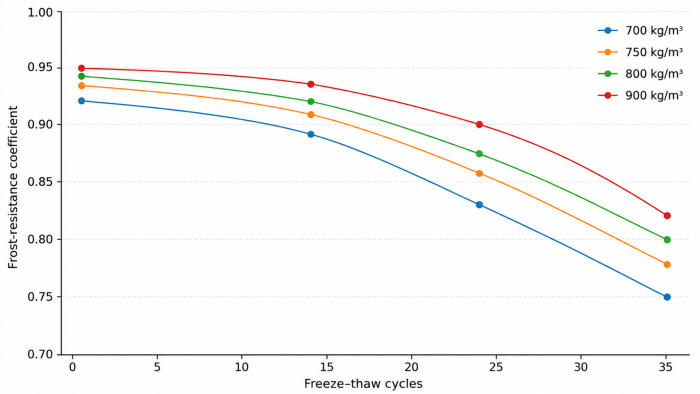
Freeze-thaw screening followed the cyclic principles of GOST 10060-2012. Strength was evaluated after 15, 25, and 35 cycles for supplementary RHLC formulations with hardened densities of 700-900 kg/m³. The frost-resistance coefficient Kf was calculated as the ratio of residual compressive strength after n cycles to the initial compressive strength. These specimens were denser than the selected 511 kg/m³ panel core; therefore, the results were treated as supplementary screening data rather than direct validation of that core.
2.4. Wall-panel fabrication and full-scale testing
The panels were fabricated as three-layer elements with two dense-concrete facings and an internal RHLC core. Three paired configurations were investigated: external wall panels with a window opening (WP-1 and WP-2), internal panels with a door opening (WP-3 and WP-4), and panels without openings (WP-5 and WP-6). The tested elements were approximately 1.2-1.5 m wide and 200-300 mm thick, depending on configuration.
The panels were loaded monotonically in eccentric vertical compression using a hydraulic loading system. Load, displacement, and strain were monitored continuously until failure. The paired specimens were used to assess the consistency of the response for each wall configuration.
2.5. Analytical validation procedure
The theoretical failure loads were obtained from the simplified analytical procedure used in the original experimental program for eccentrically compressed layered wall panels. The validation assumed full contact between layers before failure, short-term monotonic loading, and primary axial-bending resistance in the dense-concrete facings; the RHLC core maintained separation between facings and participated in composite interaction. Openings were represented through the effective geometry of each tested configuration. No parameter was fitted to the six measured failure loads.
For each panel i, the validation ratio was defined as Ri = Pexp,i/Pth,i, and the signed deviation was ei = 100(Pexp,i - Pth,i)/Pth,i. Overall agreement was summarized by the mean absolute percentage error, MAPE = (1/n)Σ|ei|, and the root-mean-square error, RMSE = [Σ(Pexp,i - Pth,i)²/n]1/2. Ratios below 1.0 indicated analytical overprediction, whereas ratios above 1.0 indicated underprediction.
2.6. Environmental scope
The experimental environmental indicator available from the batch records was the direct utilization of 150 kg of rice husk per cubic meter of the selected Mix 3. The rice husk was incorporated into a wet cementitious matrix and was enclosed by dense-concrete facings in the finished panel. Dedicated life-cycle assessment, leaching, volatile-emission, or construction-site dust measurements were not included in the original program. Consequently, the revision limits environmental claims to agricultural-residue utilization and does not claim experimentally verified absence of construction-site pollution.
3. Results
3.1. Rice-husk composition and mix-design response
The rice husk contained 39.4% cellulose, 23.6% lignin, 18.9% hemicellulose, 15.8% silica-rich ash, and 2.3% extractives (Table 2). The lignocellulosic fraction explained the low density and moisture sensitivity of the filler, whereas the extractives were relevant to cement hydration and justified the use of the chemical-admixture system.
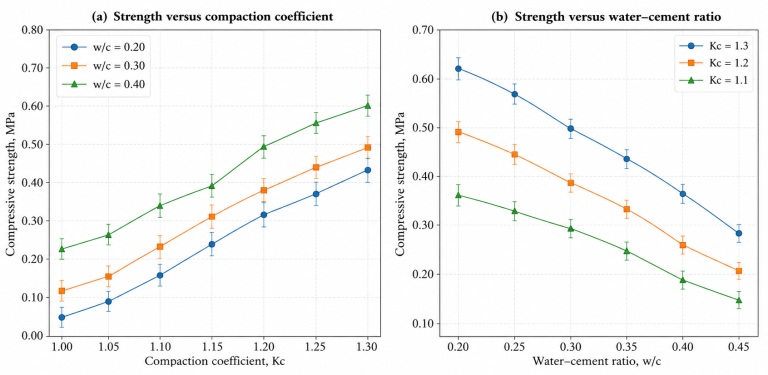
Figure 2 showed that compressive strength increased with the compaction coefficient and decreased as the water-to-cement ratio increased at comparable compaction. These trends confirmed that RHLC performance depended on processing as well as composition.
Symbols represent means of three specimens; error bars indicate ±1 standard deviation.
Figure 3 linked density to the water-to-cement ratio and compressive strength. The most suitable formulations were not the lowest-density mixtures, but those that maintained binder continuity while preserving the lightweight character of the composite.
| Component | Content (%) |
|---|---|
| Cellulose | 39.4 |
| Lignin | 23.6 |
| Hemicellulose | 18.9 |
| Ash (rich in SiO₂) | 15.8 |
| Extractives | 2.3 |
Note: The values describe the organic lignocellulosic fraction and the mineral ash fraction of the investigated rice husk
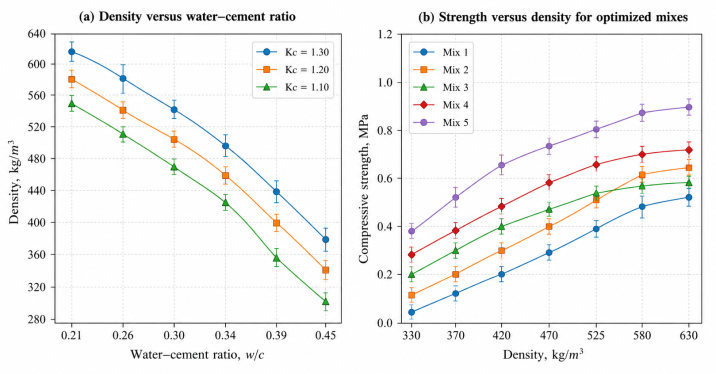
The selected Mix 3 combined a hardened density of 511 kg/m³ with the highest practical balance between low density and compressive performance within the tested program.
3.2. Properties of the selected RHLC core and dense-concrete facings
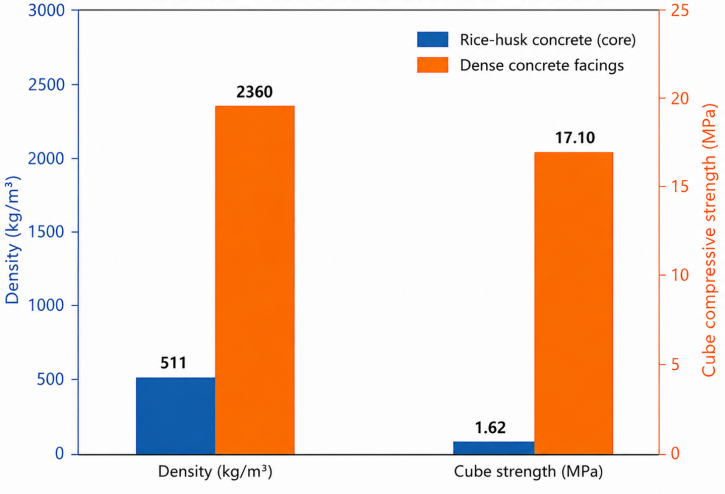
The selected RHLC core had a hardened density of 511 kg/m³ and a mean cube compressive strength of 1.62 MPa, whereas the dense-concrete facings had a density of 2360 kg/m³ and a cube strength of 17.10 MPa (Table 3 and Figure 4). This contrast represented deliberate functional separation: the facings carried the principal structural actions, while the core reduced mass and contributed to thermal insulation.
The value of 1.62 MPa was an experimentally measured property of the selected formulation, not a universal target determined by density alone. Its engineering adequacy was therefore evaluated through the response of the complete panel system.
| Material | Average density / kg·m⁻³ | Cube compressive strength / MPa |
|---|---|---|
| RHLC core | 511 | 1.62 |
| Dense concrete facing | 2360 | 17.10 |
3.3. Full-scale structural performance and analytical validation
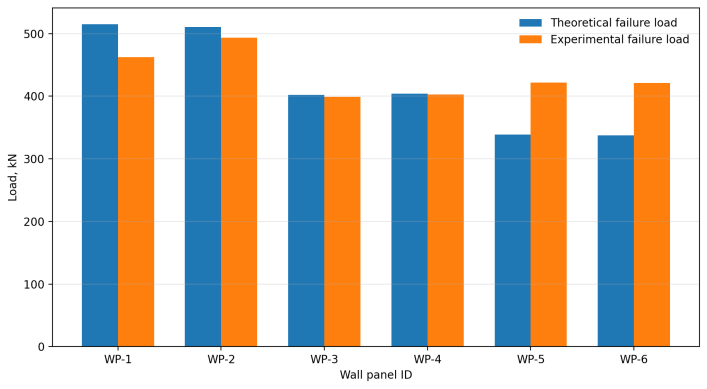
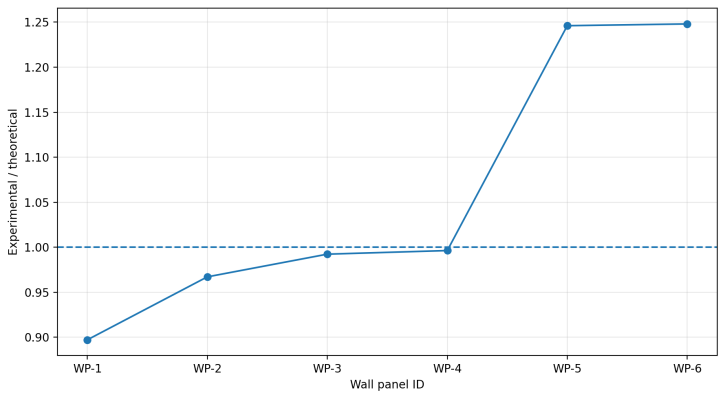
The external panels WP-1 and WP-2 produced experimental-to-theoretical ratios of 0.90 and 0.97, respectively. The panels with door openings WP-3 and WP-4 produced ratios of 0.99 and 1.00, whereas the panels without openings WP-5 and WP-6 produced ratios of 1.25 (Table 4 and Figures 5-6).
WP-1-WP-6 correspond to the tested panel configurations described in Section 2.4.
Agreement was close for WP-1-WP-4, with signed deviations between -10.29% and -0.37%. For WP-5 and WP-6, the analytical procedure underpredicted the measured capacity by approximately 24.6-24.8%. The model was therefore configuration-dependent rather than uniformly conservative.
A ratio close to 1.0 indicated close agreement; values below and above 1.0 indicated analytical overprediction and underprediction, respectively.
| Panel ID | Pth / kN | Pexp / kN | Pexp/Pth |
|---|---|---|---|
| WP-1 | 515.20 | 462.20 | 0.90 |
| WP-2 | 510.30 | 493.50 | 0.97 |
| WP-3 | 402.00 | 398.90 | 0.99 |
| WP-4 | 404.00 | 402.50 | 1.00 |
| WP-5 | 338.70 | 422.05 | 1.25 |
| WP-6 | 337.45 | 421.15 | 1.25 |
WP = wall panel. Across the six panels, the mean ratio was 1.06, the MAPE was 10.69%, and the RMSE was 53.32 kN
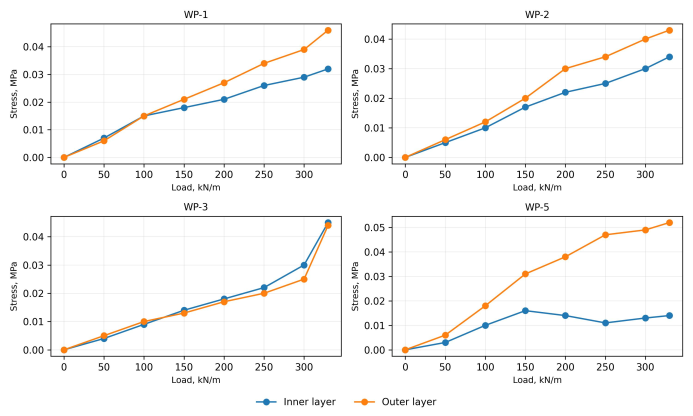
The stress-load diagrams in Figure 7 remained approximately linear over a substantial part of the loading history. Greater divergence between monitored zones near failure, particularly in WP-5, indicated localized damage and redistribution of internal forces.
3.4. Thermal-conductivity and freeze-thaw screening
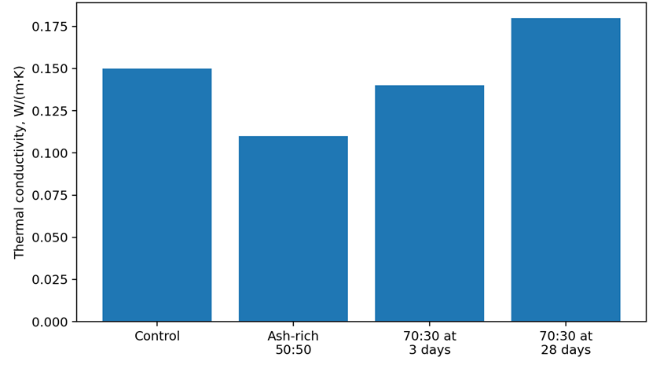
Thermal-conductivity screening across the investigated formulations yielded values from 0.11 to 0.18 W/(m·K) (Figure 8). The variation reflected differences in composition, porosity, moisture condition, and curing-related densification. Because the screening formulations were not identical, the range was used as a material-development interval rather than as a single design value for the 511 kg/m³ core.
The supplementary freeze-thaw formulations with densities of 700-900 kg/m³ retained coefficients of 0.75-0.82 after 35 cycles (Table 5 and Figure 9). The coefficients decreased progressively with cycle number, without an abrupt loss of strength within the tested interval.
These data demonstrated the response of the denser screening formulations only. They did not directly establish the long-term freeze-thaw durability of the selected 511 kg/m³ panel core.
| Density / kg·m⁻³ | 15 cycles | 25 cycles | 35 cycles | Comment |
|---|---|---|---|---|
| 700 | 0.92 | 0.83 | 0.75 | Stable trend |
| 750 | 0.94 | 0.86 | 0.78 | Stable trend |
| 800 | 0.94 | 0.87 | 0.80 | Most balanced |
| 900 | 0.95 | 0.90 | 0.82 | Highest coefficient |
3.5. Resource-use indicator and practical implementation
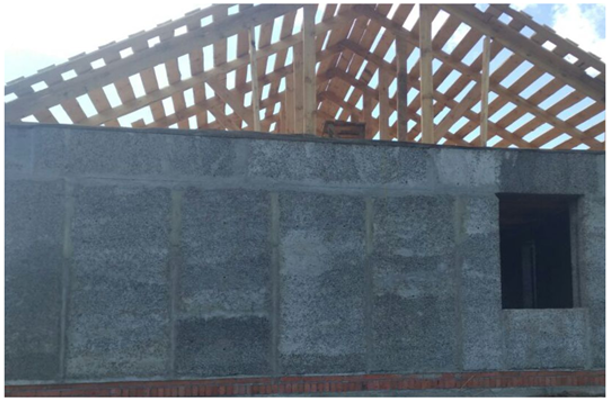
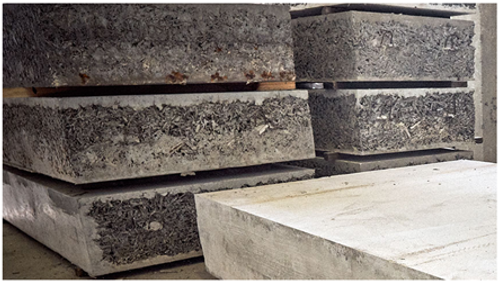
The selected RHLC mixture incorporated 150 kg/m³ of rice husk, providing a directly measured material-utilization indicator. Figure 10 documented a wall segment and fabricated layered specimens, confirming the practical scale of the concept. The photographs were not treated as quantitative evidence of emissions, leaching, or construction-site pollution.
In the completed element, the rice-husk composite was bound within the cementitious core and protected by dense-concrete facings. The demonstrated scope was therefore the fabrication and short-term structural testing of the layered system.
4. Discussion
The results supported the system-level use of RHLC rather than its use as an independent load-bearing concrete. Reviews and established guidance identify facing properties, connectors, geometry, and composite interaction as major factors controlling concrete sandwich-panel behavior19–21). Experimental studies of fiber-reinforced polymer connectors further demonstrated the importance of connector response and overall mechanical interaction between the layers22,23). More recent studies have extended sandwich-panel research toward eco-efficiency, bio-based configurations, cork-based insulating cores, and wall systems incorporating rice-husk recycled concrete24–27). The full-scale tests in the present study therefore constituted the principal structural validation of the proposed material arrangement.
The full-scale tests therefore constituted the principal structural validation of the proposed material arrangement.
RHLC and foamed concrete are different classes of low-density cement-based materials. RHLC achieved reduced density through porous rice-husk particles and controlled compaction, whereas foamed concrete achieved a cellular structure through preformed foam or a foaming agent. Published reviews and experimental studies showed that foamed-concrete strength and thermal conductivity vary widely with density, pore structure, binder system, water content, and curing 32–35). The measured RHLC values were consequently used for contextual comparison only and did not demonstrate general superiority over foamed concrete.
The principal practical distinction of RHLC was the direct use of locally available rice husk and its integration as a protected core in a full-scale concrete wall system. The thermal-conductivity interval of 0.11-0.18 W/(m·K) confirmed insulating potential, but differences in specimen moisture, density, composition, and test procedure prevented a strict ranking against published materials.
Compaction and water content strongly affected RHLC strength. Higher compaction improved binder-filler contact, while excess water increased the likelihood of discontinuity and porosity. Reviews of cellulosic- and vegetable-fiber cement composites describe the importance of fiber-matrix compatibility, water uptake, and organic constituents for material performance and durability13,14). Accelerated-aging studies have also examined the durability of lightweight cementitious composites incorporating rice husk under aggressive exposure conditions15). Studies of hemp-based concretes further demonstrated the influence of formulation, density, water content, and moisture behavior on thermal properties 16–18). The measured 1.62 MPa was therefore a property of the selected formulation and not a universal strength value defined by density alone.
. The measured 1.62 MPa was therefore a property of the selected formulation and not a universal strength value defined by density alone.
The corrected structural-validation results required a more nuanced interpretation than the original manuscript. The ratio range was 0.90-1.25, not 0.89-1.40. WP-1-WP-4 showed close agreement, whereas WP-5 and WP-6 showed model underprediction of approximately 25%. Thus, the analytical approach was useful for preliminary assessment but was configuration-dependent and should not be described as uniformly conservative.
Cold-climate application also required caution. The dense facings reduced direct exposure of the core, but protection by facings did not substitute for direct durability testing. Because freeze-thaw screening was performed on formulations with densities of 700-900 kg/m³, those results could not be extrapolated to the selected 511 kg/m³ core. Direct coupled moisture-temperature testing of the selected composition and the facing-core interfaces remains necessary.
The environmental evidence was limited to material utilization. Mix 3 incorporated 150 kg/m³ of rice husk, but the study did not include a life-cycle assessment, pollutant-release measurements, or construction-site dust monitoring. Research on concrete-sandwich-panel eco-efficiency shows that the choice of insulation core can influence the environmental performance of the complete system24). Wargadipura et al. addressed sustainable high-performance concrete for infrastructure applications28), whereas de Souza et al. developed composite eco-efficiency indicators for concrete29). Life-cycle studies comparing prefabricated and conventional construction and evaluating composite sandwich panels further demonstrated the importance of material selection, production route, functional units, and system boundaries 30,31). Accordingly, the manuscript reports rice-husk utilization without claiming complete environmental superiority or absence of pollution.
Accordingly, the manuscript reports rice-husk utilization without claiming complete environmental superiority or absence of pollution.
The study was limited by the absence of long-term creep, shrinkage, fire resistance, direct interface-shear tests, hygrothermal monitoring, and environmental-emission measurements. Nevertheless, the full-scale tests provided evidence that a protected RHLC core can participate in a layered wall system when the dense concrete facings are assigned the primary structural role.
5. Conclusions
The five-mixture program showed that RHLC properties depended on both water-to-cement ratio and compaction. The selected Mix 3 had a hardened density of 511 kg/m³ and a cube compressive strength of 1.62 MPa and was used as a protected, non-load-bearing core.
The six full-scale panels reached experimental-to-theoretical failure-load ratios of 0.90-1.25. WP-1-WP-4 agreed closely with the analytical estimates, whereas WP-5 and WP-6 exceeded them by approximately 25%. The overall MAPE was 10.69%; therefore, the analytical procedure was useful for preliminary assessment but was not uniformly conservative across configurations.
Thermal-conductivity screening yielded 0.11-0.18 W/(m·K). Freeze-thaw coefficients of 0.75-0.82 after 35 cycles were obtained for supplementary formulations with densities of 700-900 kg/m³ and were not used as direct proof of durability for the 511 kg/m³ core.
The measured resource-utilization indicator was 150 kg of rice husk per cubic meter of the selected RHLC. Because no life-cycle, leaching, emission, or site-dust tests were performed, broader environmental-safety claims were not made.
Future work should directly test the selected 511 kg/m³ RHLC under coupled moisture and freeze-thaw exposure, quantify shear transfer and long-term degradation at the facing-core interface, evaluate creep, shrinkage and fire performance, and conduct wall-level hygrothermal monitoring and life-cycle assessment.
References
- S. Bourbia, H. Kazeoui, and R. Belarbi, “A review on recent research on bio-based building materials and their applications,” Mater. Renew. Sustain. Energy, 12 117–139 (2023). doi:10.1007/s40243-023-00234-7.
- K.L. Scrivener, V.M. John, and E.M. Gartner, “Eco-efficient cements: Potential economically viable solutions for a low-CO2 cement-based materials industry,” Cem. Concr. Res., 114 2–26 (2018). doi:10.1016/j.cemconres.2018.03.015.
- B. Marques, J. Almeida, A. Tadeu, J. António, M.I. Santos, J. de Brito, and M. Oliveira, “Rice husk cement-based composites for acoustic barriers and thermal insulating layers,” J. Build. Eng., 39 102297 (2021). doi:10.1016/j.jobe.2021.102297.
- N.R. Aravind, D. Sathyan, and K.M. Mini, “Rice husk incorporated foam concrete wall panels as a thermal insulating material in buildings,” Indoor Built Environ., 29 (5) 721–729 (2020). doi:10.1177/1420326X19862017.
- J. António, A. Tadeu, B. Marques, J.A.S. Almeida, and V. Pinto, “Application of rice husk in the development of new composite boards,” Constr. Build. Mater., 176 432–439 (2018). doi:10.1016/j.conbuildmat.2018.05.028.
- A. Antunes, P. Faria, V. Silva, and A. Brás, “Rice husk-earth based composites: A novel bio-based panel for buildings refurbishment,” Constr. Build. Mater., 221 99–108 (2019). doi:10.1016/j.conbuildmat.2019.06.074.
- M. Chabannes, J.-C. Bénézet, L. Clerc, and E. Garcia-Diaz, “Use of raw rice husk as natural aggregate in a lightweight insulating concrete: An innovative application,” Constr. Build. Mater., 70 428–438 (2014). doi:10.1016/j.conbuildmat.2014.07.025.
- S. Zhanatuly, S. Uderbayev, A. Zhapakhova, G. Zhakapbayeva, G. Zhakypova, and A. Sarsenbayeva, “Mathematical modeling of the raw material composition of composite material from agricultural plant waste in South Kazakhstan,” J. Compos. Sci., 10 (4) 202 (2026). doi:10.3390/jcs10040202.
- P. Sharma, R.C. Sharma, A.N. Tiwari, and V. Sharma, “Mechanical and morphological characterization of insulation building panel made by using agricultural waste and gypsum board: An experiment-based study,” Evergreen, 12 (1) 135–146 (2025). doi:10.5109/7342445.
- G. Zhakypova, S. Uderbayev, N. Saktaganova, G. Abyieva, A. Budikova, and A. Zhapakhova, “Properties of fine-grained concrete using ash of Kazakhstan,” Evergreen, 10 (2) 830–841 (2023). doi:10.5109/6792835.
- S. Singh, L. Nagdeve, H. Kumar, and K. Dhakar, “Rice straw based natural fiber reinforced polymer for sustainable bio-composites: A systematic review,” Evergreen, 10 (2) 1041–1052 (2023). doi:10.5109/6793661.
- N. Handika, B.O.B. Sentosa, S. Astutiningsih, A.G. Manohara, C.S. Putri, and D. Rahmadhanti, “Mechanical properties and fracture patterns in oil palm shell concrete with various cement types using digital image correlation,” Evergreen, 11 (2) 1375–1382 (2024). doi:10.5109/7183449.
- M. Ardanuy, J. Claramunt, and R.D. Toledo Filho, “Cellulosic fiber reinforced cement-based composites: A review of recent research,” Constr. Build. Mater., 79 115–128 (2015). doi:10.1016/j.conbuildmat.2015.01.035.
- V. Agopyan, H. Savastano, V.M. John, and M.A. Cincotto, “Developments on vegetable fibre-cement based materials in São Paulo, Brazil: An overview,” Cem. Concr. Compos., 27 (5) 527–536 (2005). doi:10.1016/j.cemconcomp.2004.09.004.
- E.C. Pachla, D.B. Silva, F.L. Bolina, D.M. Perez, Â.G. Graeff, L.S. Lorenzi, and L.C.P. da Silva Filho, “Durable lightweight cementitious composites incorporating rice husk: Accelerated aging studies with acidic and basic solutions,” J. Build. Eng., 95 110057 (2024). doi:10.1016/j.jobe.2024.110057.
- F. Collet, and S. Prétot, “Thermal conductivity of hemp concretes: Variation with formulation, density and water content,” Constr. Build. Mater., 65 612–619 (2014). doi:10.1016/j.conbuildmat.2014.05.039.
- R. Walker, and S. Pavía, “Moisture transfer and thermal properties of hemp-lime concretes,” Constr. Build. Mater., 64 270–276 (2014). doi:10.1016/j.conbuildmat.2014.04.081.
- P. de Bruijn, and P. Johansson, “Moisture fixation and thermal properties of lime-hemp concrete,” Constr. Build. Mater., 47 1235–1242 (2013). doi:10.1016/j.conbuildmat.2013.06.006.
- F.F. Pozo-Lora, T.J. Sorensen, S. Al-Rubaye, and M. Maguire, “State-of-the-art and practice review in concrete sandwich wall panels: Materials, design, and construction methods,” Sustainability, 17 (8) 3704 (2025). doi:10.3390/su17083704.
- R. O'Hegarty, and O. Kinnane, “Review of precast concrete sandwich panels and their innovations,” Constr. Build. Mater., 233 117145 (2020). doi:10.1016/j.conbuildmat.2019.117145.
- PCI Precast Sandwich Wall Panels Committee, “State of the Art of Precast/Prestressed Concrete Sandwich Wall Panels, Second Edition,” PCI J., 56 (2) 131–176 (2011). doi:10.15554/pcij56.2-06.
- R. Lameiras, J.A.O. Barros, I.B. Valente, and M. Azenha, “Development of sandwich panels combining fibre reinforced concrete layers and fibre reinforced polymer connectors. Part I: Conception and pull-out tests,” Compos. Struct., 105 446–459 (2013). doi:10.1016/j.compstruct.2013.06.022.
- R. Lameiras, J.A.O. Barros, M. Azenha, and I.B. Valente, “Development of sandwich panels combining fibre reinforced concrete layers and fibre reinforced polymer connectors. Part II: Evaluation of mechanical behaviour,” Compos. Struct., 105 460–470 (2013). doi:10.1016/j.compstruct.2013.06.015.
- B. Moura, T. Ramos da Silva, N. Soares, and H. Monteiro, “Eco-efficiency of concrete sandwich panels with different insulation core materials,” Sustainability, 17 (4) 1687 (2025). doi:10.3390/su17041687.
- P.R. Oliveira, M. May, T.H. Panzera, and S. Hiermaier, “Bio-based/green sandwich structures: A review,” Thin-Walled Struct., 177 109426 (2022). doi:10.1016/j.tws.2022.109426.
- N. Lakreb, U. Şen, E. Toussaint, S. Amziane, E. Djakab, and H. Pereira, “Physical properties and thermal conductivity of cork-based sandwich panels for building insulation,” Constr. Build. Mater., 368 130420 (2023). doi:10.1016/j.conbuildmat.2023.130420.
- D. Chen, M. Du, Y. Tian, and W. Du, “Mechanical performance of eco-friendly sandwich wall with rice husk recycled concrete,” Adv. Civ. Eng., 2021 6655198 (2021). doi:10.1155/2021/6655198.
- A.H.S. Wargadipura, O. Masniari, E.C. Dewi, C.R. Darmawan, S. Rahayu, and N. Asriana, “Sustainable high-performance concrete for transportation infrastructure developments,” Evergreen, 11 (4) 3653–3672 (2024). doi:10.5109/7326997.
- A.M. de Souza, G.E.S. de Lima, G.H. Nalon, M.M.S. Lopes, A.L. de Oliveira Júnior, G.J.R. Lopes, M.J.A. Olivier, L.G. Pedroti, J.C.L. Ribeiro, and J.M.F. de Carvalho, “Application of the desirability function for the development of new composite eco-efficiency indicators for concrete,” J. Build. Eng., 40 102374 (2021). doi:10.1016/j.jobe.2021.102374.
- V. Tavares, N. Soares, N. Raposo, P. Marques, and F. Freire, “Prefabricated versus conventional construction: Comparing life-cycle impacts of alternative structural materials,” J. Build. Eng., 41 102705 (2021). doi:10.1016/j.jobe.2021.102705.
- M. Demertzi, J.D. Silvestre, and V. Durão, “Life cycle assessment of the production of composite sandwich panels for structural floor’s rehabilitation,” Eng. Struct., 221 111060 (2020). doi:10.1016/j.engstruct.2020.111060.
- M. Abd Elrahman, P. Sikora, S.-Y. Chung, and D. Stephan, “The performance of ultra-lightweight foamed concrete incorporating nanosilica,” Arch. Civ. Mech. Eng., 21 79 (2021). doi:10.1007/s43452-021-00234-2.
- K. Ramamurthy, E.K.K. Nambiar, and G.I.S. Ranjani, “A classification of studies on properties of foam concrete,” Cem. Concr. Compos., 31 (6) 388–396 (2009). doi:10.1016/j.cemconcomp.2009.04.006.
- Y.H.M. Amran, N. Farzadnia, and A.A. Abang Ali, “Properties and applications of foamed concrete; a review,” Constr. Build. Mater., 101 990–1005 (2015). doi:10.1016/j.conbuildmat.2015.10.112.
- A. Raj, D. Sathyan, and K.M. Mini, “Physical and functional characteristics of foam concrete: A review,” Constr. Build. Mater., 221 787–799 (2019). doi:10.1016/j.conbuildmat.2019.06.052.