
Abstract
This study aims to develop a Ni–Mn bimetallic electrocatalyst for the selective oxidation of 5-hydroxymethylfurfural (HMF) to 2,5-diformylfuran (DFF) via electrodeposition. The NiMn electrocatalyst was synthesized by varying precursor concentrations to tune its structural and electrochemical properties. The results show that an optimal concentration produces a highly crystalline NiMn structure with improved electrochemical performance. The optimized catalyst achieves 98.8% selectivity and 8.5% yield for DFF at 1.75 V vs. RHE over 6 hours, while simultaneously enabling hydrogen evolution at the cathode, demonstrating efficient biomass upgrading with value-added hydrogen production.
Keywords: 2.5‐diformylfuran, 5-hydroxymethylfurfural, electrocatalyst, electrodeposition, oxidation
Outline
1. Introduction
Electrochemistry is one of the manufacturing processes that has several benefits, such as the capability to be utilized on an industrial scale, the capacity to easily manage the output that is required, and the capability to operate on green energy as a source of electrical power1–4). There is now a significant amount of research being carried out on a wide range of electrode materials, including both precious and non-precious metals5). It is believed that the various types of materials employed can influence the activities occurring at the electrode. These processes include the acceleration of their kinetics6,7), the control of the course of reactions in complicated reactions8,9), and the improvement of Faraday efficiency in electrochemical systems10,11). The shortage of precious metals is a distinct problem that has to be addressed, although they are still widely utilized as electrodes in industry due to the better qualities they provide12,13). Because of this, it is necessary to conduct research into other ways to substitute valuable metals that are restricted. It is well known that materials used for electrodes made of transition metals exhibit powerful catalytic activity in various electrochemical processes, such as the splitting of water or the transformation of biomass14–18). As an additional point of interest, transition metals are well-known for their vast availability, low cost, and environmental safety19,20).
According to several studies that have been conducted on transition metal-based materials that include catalytic capabilities, the combination of nickel and manganese is incredibly intriguing since it possesses much higher performance than it does when it is in its solitary condition21,22). In addition, previous studies have demonstrated that the utilization of NiMn as a heterogeneous catalyst is the most effective method for the production of DFF (2,5-furandicarboxaldehyde)21), a chemical platform that is crucial in a number of different industrial sectors, including medicines, fungicides, furan-urea-based resins, and the ligand industry23–26). However, the commercial use of homogeneous systems still needs further separation processes27–30), while heterogeneous catalysts are limited due to the existence of high-pressure and high-temperature gases that are required for their development31–33).
Nickel- and manganese-based materials have attracted considerable attention as electrocatalysts due to their abundance34,35), low cost36,37), and relatively low toxicity38) compared with noble metals. Both metals are widely available transition metals and exhibit good electrochemical activity as well as chemical stability in alkaline or mildly alkaline electrolytes39–41). When synthesizing NiMn catalysts as electrodes, particularly for the creation of electrochemical DFF, it is necessary to pay particular attention to the aforementioned requirements. For the purpose of this inquiry, NiMn electrocatalysts were made by the process of electrodeposition because of the ease and accuracy with which it governs structure, thickness, and other features42–44). As an additional point of interest, the findings of this research indicate that the concentration of the precursor during the electrodeposition process has a substantial influence on the crystal structure of the NiMn. Additionally, this study investigates the effect of precursor concentration on the formation of the NiMn crystal structure and its influence on the electrochemical oxidation of HMF to DFF. The process simultaneously produces hydrogen gas at the cathode, highlighting the coupled value-added production of DFF and clean hydrogen energy.
2. Materials and Methods
2.1. Materials
Chemicals utilized in this study include the following: 5-hydroxymethyl-2-furaldehyde (HMF) (99%, Sigma-Aldrich); 2,5-furandicarboxaldehyde (DFF) (97%, Sigma-Aldrich); Ni(NO₃)₂.6H₂O (99%, Sigma-Aldrich); MnSO₄.H₂O (99%, Sigma-Aldrich); Na₂B₄O₇ (pH 9.6) (98%, Merck); Nickel Plate; Aquadest. The electrochemical system employs a cell without a separator and a three-electrode arrangement, with Ag/AgCl 3 M KCl and platinum mesh operating as the reference and counter electrodes, respectively. This study employed a potentiostat (PalmSens) for driving the electrochemical process. The material was characterized using X-ray powder diffraction (D8 Advance (Bruker)), and the product was examined using high-performance liquid chromatography (Nexera LC-40) with a UV detector and the C18 column at 55°C, with an eluent containing 5 mM sulfuric acid.
2.2. Methods
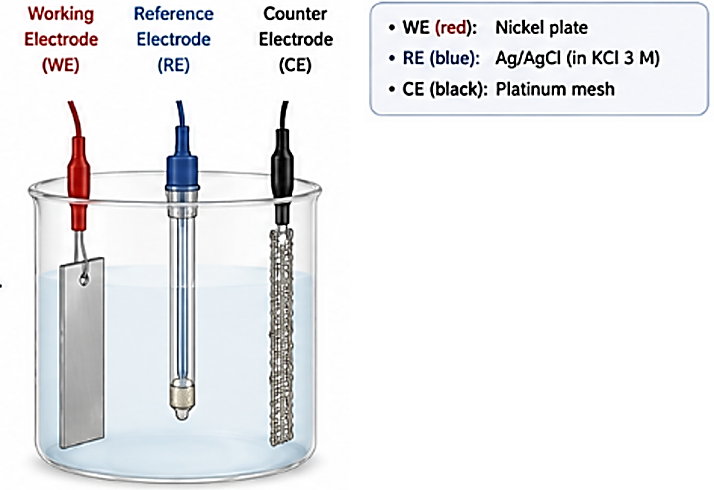
The nickel plate went through cleaning with a sonicator in 3 M HCl, acetone, and ethanol for 15 minutes each prior to usage45). The nickel plate was subsequently dried and restricted to an area of 1 cm² on each side. This study employed an electrodeposition method to produce a NiMn electrocatalyst on a nickel plate substrate as in Figure 1.
A constant voltage of -1.0 V vs. Ag/AgCl46) was applied to the electrochemical cell for a duration of 60 seconds, utilizing the nickel plate as the working electrode. This investigation employed a precursor solution comprising Ni(NO₃)₂ at varying concentrations (0.03 M, 0.10 M, 0.15 M, and 0.20 M) and MnSO₄ in a 1:247) ratio relative to Ni(NO₃)₂. The resulting NiMn deposits were designated as NiMn-0.03, NiMn-0.10, NiMn-0.15, and NiMn-0.20 according to the Ni(NO₃)₂ concentration used, respectively.
The NiMn deposit on the nickel plate's surface was subsequently washed with distilled water and dried at room temperature prior to use. The i-v curve presented in this study was obtained through cyclic voltammetry (CV) within a potential range of 0.0 to 1.0 V relative to Ag/AgCl. The measurements employed a potential step of 0.01 V and a scan rate of 0.01 V/s across three scans using a 0.1 M Na₂B₄O₇ electrolyte. The NiMn electrocatalyst exhibiting the lowest overpotential will subsequently be utilized to generate DFF from the HMF oxidation reaction over a duration of 6 hours, employing the chronoamperometry method. The parameters utilized included room temperature, a 1 mM concentration of HMF, and stirring with a magnetic stirrer. For product analysis, 200 μL of electrolyte was collected before and after the reaction, diluted with distilled water to a final volume of 2 mL, and subsequently injected into the HPLC48,49). The HPLC curve will be analyzed in relation to the previously obtained standard curves for HMF and DFF. The HPLC results will be employed to calculate the HMF conversion, DFF yield, and DFF selectivity according to equations (1), (2), and (3), respectively50).
3. Results and Discussion
3.1. Effect of precursor concentration on electrochemical characteristics
Changing the concentration of the precursor has a significant influence on the electrochemical performance of the NiMn electrocatalyst, particularly on the overpotential required for the water oxidation reaction. This effect is evident from the i–v curves (Figure 2), which were recorded from the anodic scan using the cyclic voltammetry (CV) technique. Among the tested precursor
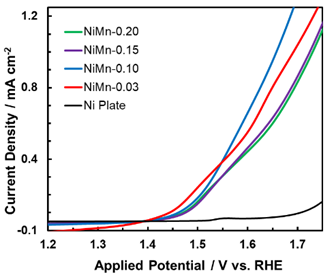
concentrations, the electrocatalyst synthesized from 0.10 M Ni(NO₃)₂ and 0.05 M MnSO₄ exhibited the most superior catalytic activity, indicating an optimal balance between metal ion availability and deposition kinetics. At this concentration, the electrode displays the highest current density, signifying an enhanced charge transfer rate during oxidation reaction51).
In contrast, at lower precursor concentrations (e.g., NiMn-0.03), the electrode exhibits a higher overpotential to reach 1.0 mA/cm², suggesting that insufficient ion concentration during electrodeposition results in a thinner or less compact catalyst layer with fewer active centers52,53). Conversely, when the precursor concentration becomes too high (NiMn-0.15 or NiMn-0.20), although the current density initially increases, excessive deposition may lead to denser films that hinder electrolyte penetration and reduce the number of accessible active sites, ultimately limiting performance54). Notably, the overpotential of NiMn-0.10 decreases by approximately 400 mV compared to NiMn-0.03 at a current density of 1.0 mA/cm². This substantial reduction confirms that optimizing precursor concentration is a key factor in achieving efficient oxidation reaction catalysis.
3.2. Effect of precursor concentration on material characteristics
Furthermore, the XRD result shown in Figure 3 reveals how varying the precursor concentration affects the crystal structure of the NiMn electrocatalyst. The diffraction peaks at 44.69°, 52.02°, and 76.61° correspond to the (111), (200), and (220) planes of nickel55,56), while those at 44.69° and 76.61° are also related to the (400) and (622) planes of NiMn oxide57). The higher intensity of these peaks in NiMn-0.10 indicates better crystallinity and improved lattice ordering58) compared to NiMn-0.03.
A new peak appearing at 16.91° is observed only in NiMn-0.10, which may corresponds to either the (111) plane of
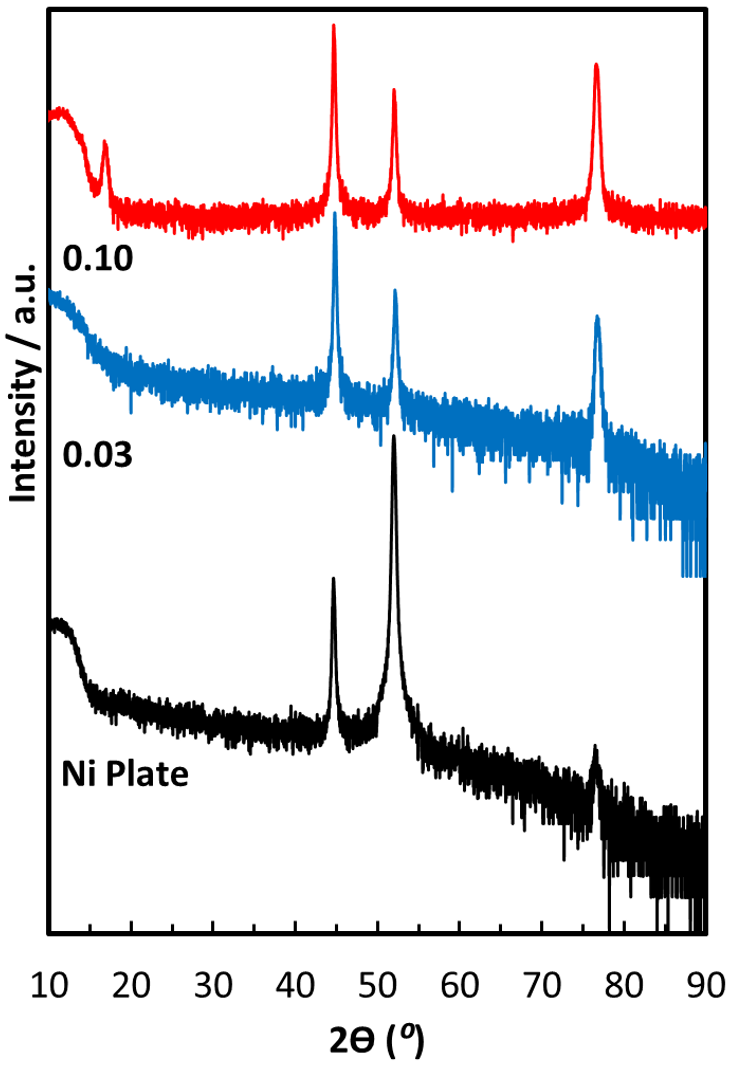
NiMn₂O₄59) or metal hydroxide (001)60–62). The overlapping nature of these possible assignments suggests that this feature likely originates from structural modification induced by Mn incorporation, rather than providing definitive evidence for a specific crystalline phase. This observation suggests that an optimal precursor concentration promotes improved structural organization and possible short-range ordering within the Ni–Mn system. In contrast, the broader peaks of NiMn-0.03 indicate a more amorphous nature with smaller crystallite domains. At excessively high precursor concentrations, however, rapid nucleation and deposition can hinder atom rearrangement into an ordered lattice, resulting in disordered growth and lattice defects63). Thus, while a moderate concentration (NiMn-0.10) enhances crystallinity, overly concentrated solutions may instead yield a less ordered, amorphous structure. Overall, NiMn-0.10 presents the most balanced crystalline structure, supporting better catalytic performance.
The FTIR spectra shown in Figure 4 display the characteristic vibration bands of NiMn electrocatalysts synthesized with different precursor concentrations. The broad absorption band around 3400 cm⁻¹ corresponds to the O–H stretching vibration64,65), indicating the presence of surface hydroxyl groups and adsorbed water molecules. The band at approximately 1630 cm⁻¹ is attributed to the bending vibration of –OH, confirming the existence of interlayer or surface-bound water66,67).
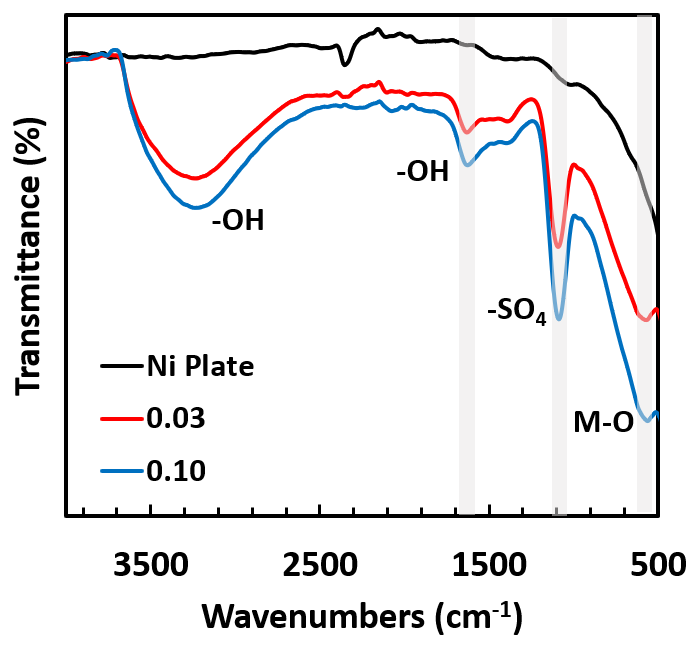
A distinct absorption around 1100–1200 cm⁻¹ is assigned to the SO₄²⁻ stretching mode68,69), derived from the intercalated anion70). In the lower wavenumber region (around 550–600 cm⁻¹), the peaks correspond to metal–oxygen (M–O) vibrations71), characteristic of Ni–O and Mn–O bonds within the oxide or hydroxide lattice. The NiMn-0.10 sample exhibits a stronger M–O band compared to NiMn-0.03, implying a higher degree of metal–oxygen network formation or stronger metal–oxygen bonding at NiMn-0.10. This could be related to variations in nucleation behavior and electrodeposition process, resulting in a better-defined oxide structure72).
3.3. Application for HMF oxidation reaction
The electrochemical oxidation of HMF can proceed through two possible reaction pathways. In the first pathway, HMF is sequentially oxidized to 2,5‑Diformylfuran (DFF), followed by the formation of 5‑Formyl‑2‑furancarboxylic acid (FFCA), and finally 2,5‑Furandicarboxylic acid (FDCA)73–75). In the second pathway, HMF is first converted to 5‑Hydroxymethyl‑2‑furancarboxylic acid (HMFCA), which is subsequently oxidized to FFCA and FDCA76–78). The two possible HMF oxidation pathways are illustrated in Figure 5.
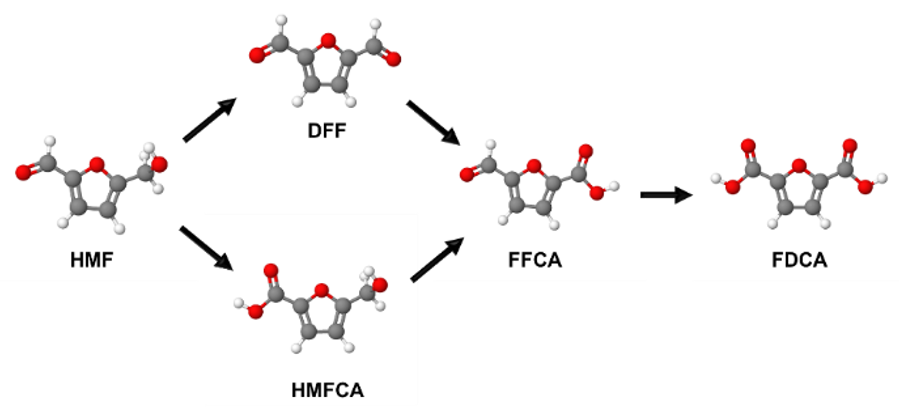
Selective formation of DFF requires the reaction to proceed through the first pathway. This route is generally favored under acidic to near-neutral conditions79), whereas increasingly alkaline environments tend to promote the second pathway, leading to the formation of HMFCA as the primary intermediate80).
In this study, Sodium tetraborate (Na2B4O7) was employed as the electrolyte to direct the oxidation of HMF through the DFF pathway rather than the HMFCA pathway. The electrolyte provides a mildly alkaline environment, which remains sufficiently stable for the operation of transition-metal-based electrocatalysts81,82) while still allowing the reaction to proceed via the DFF intermediate. Consequently, the use of Na2B4O7 helps maintain suitable reaction conditions for achieving selective oxidation toward DFF.
The effectiveness of NiMn-0.10 as an electrocatalyst was further assessed by its employment in the electrochemical reaction of HMF oxidation to create DFF. DFF is a compound that has a high economic value and is employed as an intermediary in the production of various chemical products and materials. Following a period of 6 hours during which the reaction process was carried out, the electrolyte solution that contained the products of the reaction was subsequently examined. Figure 6 exhibits the product analysis of HMF electro-oxidation every 2 hours for 6 hours. Furthermore, the DFF’s yield has increased over time due to more charges passing into the system. However, the selectivity of the DFF also increases over time, indicating that the HMF transformation to become DFF is more effective.
The study has provided an overview of the major impact that the change in precursor concentration during electrodeposition has on the crystal structure of the electrocatalyst that is produced as a result of the process. The crystallinity of the material can be greatly increased, and new crystal planes can form, if the ideal precursor
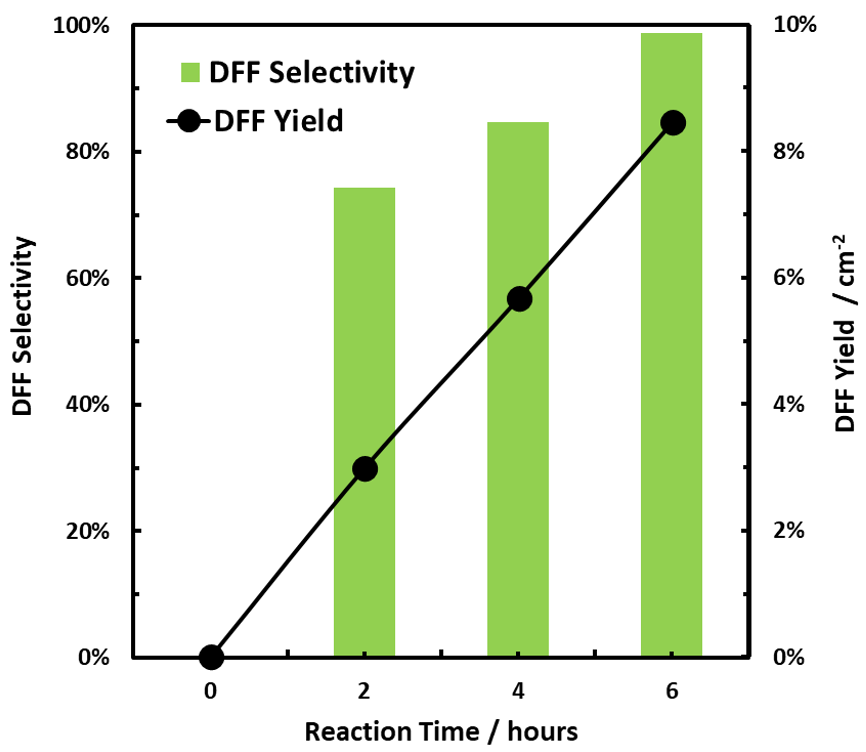
Table 1: DFF production comparison from HMF oxidation reaction
| System | Condition | DFF Selectivity | Reference |
|---|---|---|---|
| metal bromide with acetic acid | 75 °C, 7000 kPa air | 61.00 % | 27) |
| V2O5/TiO2 | 90 °C, 1600 kPa air | 85.00% | 28) |
| immobilized vanadyl pyridine | 130 °C | 82.00 % | 29) |
| Fe3BiMo12O42 | 140 °C, 100 kPa O2 | 99.00 % | 31) |
| β-MnO2 | 140 °C, 100 kPa O2 | 99.00 % | 32) |
| AC-SO3H@Ag | 140 °C | 77.90 % | 33) |
| Pt/Fe3O4/rGO | 140 °C, 500 kPa O2 | 32.80 % | 83) |
| Room temperature | 94.40 % | ||
| Fe3O4 | 80 °C | 99.3 % | 84) |
| Fe-Co | 100 °C, 1 MPa O2 | 99.0 % | 85) |
| Pt | Room temperature | 26.51 % | 86) |
| Pt | 50 °C, 150 kPa O2 | 73.00 % | 87) |
| Ru/γAl2O3 | 50 wt% in DMF, 35 °C, 0.5 MPa O2 | 70-80% | 88) |
| SGH‐TiO2 | UV light (λ=515 nm) | 87.0 % | 89) |
| Mn/UiO-66(Zr/Hf)-NH2 | 300 W xenon lamp, 10 mL / min O2 | 84.8 % | 90) |
| CdS@MXene | Light Emitting Diode (LED) lamp (λ > 420 nm) | 91.63 % | 91) |
| Nb2O5/g‐C3N4 | Sunlight Irradiation | 70.00 % | 92) |
| MnOx | 60 °C | 68.21 % | 93) |
| Ru-NiO | Room temperature, 1.283 V | 90.00 % | 94) |
| Co8Ce2Ox | Room temperature, 1.50 V | 92.00 % | 95) |
| NiMn | Room temperature, 1.75 V | 98.8 % | This work |
concentration is used in the production of NiMn-0.10. A contribution from the (111) plane, which is exclusively present in the NiMn-0.10 sample, is thought to be responsible for the improvement in electrocatalyst performance, according to estimates. Compared to other studies using electrocatalysts, the utilization of NiMn-0.10 for the oxidation of HMF shows highly favorable results. A comparison of DFF production from HMF oxidation using different electrocatalytic systems is presented in Table 1. With a DFF selectivity of 98.8% and a product yield of 8.5%, the NiMn-0.10 electrocatalyst demonstrates superior performance in HMF conversion, highlighting its efficiency among electrocatalytic approaches.
Although this study demonstrates the high selectivity and efficiency of the NiMn-0.10 electrocatalyst for the oxidation of HMF to DFF, the scope of this work primarily focuses on the anodic reaction and the resulting DFF selectivity and yield. Therefore, hydrogen production at the cathode was not quantitatively evaluated in this study. Thermodynamically, the anodic oxidation of HMF must be balanced by a cathodic reduction reaction96). Under aqueous conditions, this reaction is the Hydrogen Evolution Reaction (HER) in equation (4)97):
In this work, an anodic potential of 1.75 V vs. RHE was applied to the working electrode to drive HMF oxidation (equation (5)98)), while the counter electrode functions as the cathode where HER is expected to occur, producing
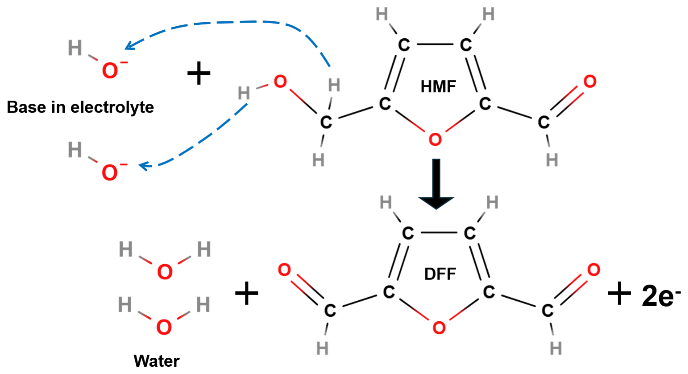
Hydrogen as the complementary reaction. In addition, many previous studies have also confirmed the generation of H₂ gas at the cathode during electrochemical HMF oxidation systems10,98–101). Furthermore, the mechanism of the transformation of HMF into DFF under alkaline conditions is illustrated in Figure 7.
3.4. Synergistic Effect of Ni and Mn
The Mott–Schottky plots in the Figure 8 show the relationship between 1/C² and potential for nickel hydroxide and manganese hydroxide. Both materials exhibit a positive slope, indicating that they are n-type semiconductors, where electrons are the majority charge carriers. The main difference is observed in the intercept position along the potential axis, which is related to the flat band potential. Manganese hydroxide shows a more negative flat band potential compared to nickel hydroxide, indicating that its electronic energy level is higher (more reductive). However, after overcoming the activation
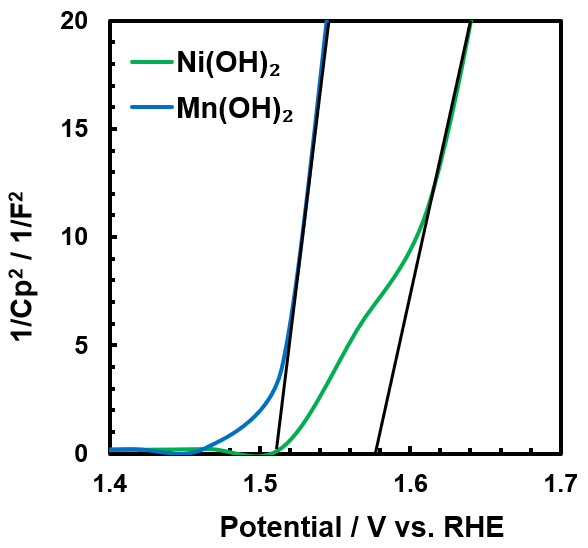
potential, nickel hydroxide exhibits higher electrocatalytic activity.
In addition, differences in the slope of the plots indicate differences in charge carrier density between the two materials. A smaller slope corresponds to a higher carrier density, which contributes to improved conductivity and electron transfer kinetics. In this case, nickel hydroxide tends to exhibit better charge transfer capability compared to manganese hydroxide. Overall, the Mott–Schottky analysis suggests that although manganese hydroxide is more easily activated electronically (more negative flat band potential), nickel hydroxide possesses characteristics more favorable for electrocatalytic processes, particularly in terms of charge transfer and active species formation. This indicates a potential synergistic effect in the Ni–Mn bimetallic system, where Mn facilitates the initial activation, while Ni acts as the primary active site for the oxidation reaction.
4. Conclusion
This study identified the optimal Ni(NO₃)₂ concentration for the preparation of NiMn electrocatalysts and examined its influenced on the crystal structures. The enhancement in electrocatalyst performance, indicated by a reduction in overpotential, is attributed to improved crystallinity and structural modification These important findings offer comprehensive details about the development of transition metal-based electrocatalysts through precursor concentration optimization. The use of the NiMn electrocatalyst in DFF production demonstrated 98.8% selectivity for the resulting product, achieving a 8.5% yield of 8.57% conversion of HMF. This achievement demonstrates that NiMn-0.10 can selectively and efficiently produce DFF, despite a low HMF conversion rate. This electrochemical approach to DFF synthesis is simpler and more environmentally friendly than previous methods documented in the literature, which necessitate extreme conditions such as high temperatures or pressurized oxygen gas. It can be conducted at room temperature and atmospheric pressure without the need for external oxidants. This work demonstrates the significant potential of NiMn-0.10 for applications in the conversion of biomass into high-value compounds through a more sustainable process. Furthermore, the integration of HMF oxidation with the hydrogen evolution reaction at the cathode presents a promising strategy for improving the overall efficiency and sustainability of electrochemical biomass valorization.
Acknowledgements
The authors gratefully acknowledge the facilities and scientific and technical support provided by the Advanced Characterization Physics Laboratories Serpong, National Research and Innovation Agency (BRIN) through E-Layanan Sains, as well as the Analytical Laboratory, Unit Pelayanan pada Masyarakat, Department of Chemical Engineering, Faculty of Engineering, Universitas Indonesia.
Funding
This research was funded by Ministry of Finance Education Fund Management Institute (LPDP) through the Scientific Research Grant Program.
Nomenclature
| Symbol | Description (Unit) |
|---|---|
| C_HMF | HMF conversion (%) |
| HMF innitial amount (mole) | |
| HMF final amount (mole) | |
| DFF yield (%) | |
| DFF final amount (mole) |
References
- B.P. Chaplin, “Chapter 17 - Advantages, Disadvantages, and Future Challenges of the Use of Electrochemical Technologies for Water and Wastewater Treatment,” in: C.A. Martínez-Huitle, M.A. Rodrigo, O. Scialdone (Eds.), Electrochem. Water Wastewater Treat., Butterworth-Heinemann, 2018: pp. 451–494. doi:10.1016/B978-0-12-813160-2.00017-1.
- R. Xia, S. Overa, and F. Jiao, “Emerging electrochemical processes to decarbonize the chemical industry,” JACS Au, 2 (5) 1054–1070 (2022). doi:10.1021/jacsau.2c00138.
- A.C. Ferretti, B. Cohen, L. Deng, M. Diwan, M.O. Frederick, and D. Lehnherr, “Adoption of electrochemistry within the pharmaceutical industry: insights from an industry-wide survey,” Org. Process Res. Dev., 29 (2) 322–332 (2025). doi:10.1021/acs.oprd.4c00353.
- L. Janssen, “The role of electrochemistry and electrochemical technology in environmental protection,” Chem. Eng. J., 85 (2–3) 137–146 (2002). doi:10.1016/S1385-8947(01)00218-2.
- D.M. Heard, and A.J.J. Lennox, “Electrode materials in modern organic electrochemistry,” Angew. Chem. Int. Ed., 59 (43) 18866–18884 (2020). doi:10.1002/anie.202005745.
- D. Rosestolato, J. Fregoni, S. Ferro, and A. De Battisti, “Influence of the nature of the electrode material and process variables on the kinetics of the chlorine evolution reaction. the case of iro2-based electrocatalysts,” Electrochimica Acta, 139 180–189 (2014). doi:10.1016/j.electacta.2014.07.037.
- V. Stamenković, T.J. Schmidt, P.N. Ross, and N.M. Marković, “Surface composition effects in electrocatalysis: kinetics of oxygen reduction on well-defined pt3 ni and pt3 co alloy surfaces,” J. Phys. Chem. B, 106 (46) 11970–11979 (2002). doi:10.1021/jp021182h.
- M. Yoo, D. Choi, M. Shin, S. Jung, J. Lee, and H.J. Kim, “Selective electrocatalytic oxidation of glycerol to high-value c1–c3 products: from chemistry to scalability,” Chem. Eng. J., 518 164743 (2025). doi:10.1016/j.cej.2025.164743.
- E. Ginoux, T. Rafaïdeen, P. Cognet, L. Latapie, and C. Coutanceau, “Selective electrooxidation of glucose towards gluconic acid on ni@au foam electrodes,” Electrochimica Acta, 509 145307 (2025). doi:10.1016/j.electacta.2024.145307.
- L. Gidi, J. Amalraj, C. Tenreiro, and G. Ramírez, “Recent progress, trends, and new challenges in the electrochemical production of green hydrogen coupled to selective electrooxidation of 5-hydroxymethylfurfural (hmf),” RSC Adv., 13 (40) 28307–28336 (2023). doi:10.1039/D3RA05623F.
- J. Lin, S. Yan, Q. Hu, Z. Wei, and Z. Cheng, “An exploration on co faradaic efficiency with catalyst surface wettability ranging from hydrophilic to superhydrophobic,” Chem. Eng. J., 461 141945 (2023). doi:10.1016/j.cej.2023.141945.
- C. Li, and J.-B. Baek, “Recent advances in noble metal (pt, ru, and ir)-based electrocatalysts for efficient hydrogen evolution reaction,” ACS Omega, 5 (1) 31–40 (2020). doi:10.1021/acsomega.9b03550.
- M. Farajzadeh, and F.R. Rahsepar, “A review of the recent advances in development of noble metal‐free materials as electrocatalysts for hydrogen and oxygen evolution reactions,” ChemElectroChem, 11 (6) e202300516 (2024). doi:10.1002/celc.202300516.
- M.N. Lakhan, A. Hanan, A. Hussain, I. Ali Soomro, Y. Wang, M. Ahmed, U. Aftab, H. Sun, and H. Arandiyan, “Transition metal-based electrocatalysts for alkaline overall water splitting: advancements, challenges, and perspectives,” Chem. Commun., 60 (39) 5104–5135 (2024). doi:10.1039/D3CC06015B.
- C. Coutanceau, N. Neha, and T. Rafaïdeen, “Electrocatalytic transformation of biosourced organic molecules,” Curr. Opin. Electrochem., 38 101210 (2023). doi:10.1016/j.coelec.2023.101210.
- X. Cao, T. Wang, and L. Jiao, “Transition-metal (fe, co, and ni)-based nanofiber electrocatalysts for water splitting,” Adv. Fiber Mater., 3 (4) 210–228 (2021). doi:10.1007/s42765-021-00065-z.
- H. Wang, X. Li, and C. Si, “Electrocatalytic oxidation of biomass-derived chemicals using non-precious metal catalysts: design strategies, performance characteristics and perspectives,” Green Chem., 27 (35) 10346–10371 (2025). doi:10.1039/D5GC00719D.
- H. Zhou, Y. Ren, B. Yao, Z. Li, M. Xu, L. Ma, X. Kong, L. Zheng, M. Shao, and H. Duan, “Scalable electrosynthesis of commodity chemicals from biomass by suppressing non-faradaic transformations,” Nat. Commun., 14 (1) 5621 (2023). doi:10.1038/s41467-023-41497-y.
- N. Mumtazah, C.-H. Chan, S. Catherine, M.-T.H. Pham, J. Choi, J.S. Yoo, and C.-Y. Chiang, “Modulating surface chemistry of copper oxides through annealing environment for enhanced selective hmf oxidation: a dft-electrochemical approach,” J. Environ. Chem. Eng., 12 (5) (2024). doi:10.1016/j.jece.2024.113444.
- M. Cai, Y. Zhang, Y. Zhao, Q. Liu, Y. Li, and G. Li, “Two-dimensional metal–organic framework nanosheets for highly efficient electrocatalytic biomass 5-(hydroxymethyl)furfural (hmf) valorization,” J. Mater. Chem. A, 8 (39) 20386–20392 (2020). doi:10.1039/d0ta07793c.
- W. Zhou, Z. Kong, Z. Wu, S. Yang, Y. Wang, and Y. Liu, “Efficient oxidation of biomass derived 5-hydroxymethylfurfural into 2,5-diformylfuran catalyzed by nimn layered double hydroxide,” Catal. Commun., 151 106279 (2021). doi:10.1016/j.catcom.2021.106279.
- K. Zhao, Y. Shu, F. Li, and G. Peng, “Bimetallic catalysts as electrocatalytic cathode materials for the oxygen reduction reaction in microbial fuel cell: a review,” Green Energy Environ., 8 (4) 1043–1070 (2023). doi:10.1016/j.gee.2022.10.007.
- A. Takagaki, M. Takahashi, S. Nishimura, and K. Ebitani, “One-pot synthesis of 2,5-diformylfuran from carbohydrate derivatives by sulfonated resin and hydrotalcite-supported ruthenium catalysts,” ACS Catal., 1 (11) 1562–1565 (2011). doi:10.1021/cs200456t.
- J. Ma, Z. Du, J. Xu, Q. Chu, and Y. Pang, “Efficient aerobic oxidation of 5-hydroxymethylfurfural to 2,5-diformylfuran, and synthesis of a fluorescent material,” ChemSusChem, 4 (1) 51–54 (2011). doi:10.1002/cssc.201000273.
- J. Nie, and H. Liu, “Aerobic oxidation of 5-hydroxymethylfurfural to 2,5-diformylfuran on supported vanadium oxide catalysts: structural effect and reaction mechanism,” Pure Appl. Chem., 84 (3), 765–777 (2011). doi:10.1351/PAC-CON-11-07-02.
- X. Li, “Current approaches of the functional and synergetic catalytic systems for converting renewable carbohydrates into 2, 5-diformylfuran,” Mol. Catal., 551 113629 (2023). doi:10.1016/j.mcat.2023.113629.
- W. Partenheimer, and V.V. Grushin, “Synthesis of 2,5-diformylfuran and furan-2,5-dicarboxylic acid by catalytic air-oxidation of 5-hydroxymethylfurfural. unexpectedly selective aerobic oxidation of benzyl alcohol to benzaldehyde with metal=bromide catalysts,” Adv. Synth. Catal., 343 (1) 102–111 (2001). doi:10.1002/1615-4169(20010129)343:1<102::AID-ADSC102>3.0.CO;2-Q. [DOI]
- C. Moreau, M.N. Belgacem, and A. Gandini, “Recent catalytic advances in the chemistry of substituted furans from carbohydrates and in the ensuing polymers,” Top. Catal., 27 (1) 11–30 (2004). doi:10.1023/B:TOCA.0000013537.13540.0e.
- A. Corma, S. Iborra, and A. Velty, “Chemical routes for the transformation of biomass into chemicals,” Chem. Rev., 107 (6) 2411–2502 (2007). doi:10.1021/cr050989d.
- S. Pumrod, N. Akkarawatkhoosith, A. Kaewchada, T. Tongtummachat, K.-Y. Andrew Lin, and A. Jaree, “Optimization of diformylfuran production from 5-hydroxymethylfurfural via catalytic oxidation in a packed-bed continuous flow reactor,” RSC Adv., 14 (40) 29014–29023 (2024). doi:10.1039/D4RA05816J.
- X. Xu, J. Shi, Q. Sun, Q. Cao, Y. She, M. Li, and Z. Shen, “High-efficiency synthesis of 2,5-diformylfuran from 5-hydroxymethylfurfural using iron-bismuth-molybdenum oxides,” Mol. Catal., 570 114681 (2025). doi:10.1016/j.mcat.2024.114681.
- K.-Y.A. Lin, W.-D. Oh, M.-W. Zheng, E. Kwon, J. Lee, J.-Y. Lin, X. Duan, and F. Ghanbari, “Aerobic oxidation of 5-hydroxymethylfurfural into 2,5-diformylfuran using manganese dioxide with different crystal structures: a comparative study,” J. Colloid Interface Sci., 592 416–429 (2021). doi:10.1016/j.jcis.2021.02.030.
- L.T. Nguyen, V.T.C. Doan, T.H. Nguyen, H.B. Phan, V.V. Pham, C.V. Dang, and P.H. Tran, “One-pot aerobic conversion of fructose to 2,5-diformylfuran using silver-decorated carbon materials,” Renew. Energy, 221 119850 (2024). doi:10.1016/j.renene.2023.119850.
- M. Burks, S. Friedrich, J. Goldsten, L. Heffern, N. Hines, G.-B. Kim, D.J. Lawrence, V. Mozin, and P. Peplowski, “Measuring the surface abundance of iron and nickel on the asteroid (16) psyche in the presence of large solar particle events,” Planet. Space Sci., 240 105832 (2024). doi:10.1016/j.pss.2023.105832.
- R. Monier, “The mean overabundance of manganese over the surface of 21 com from its midultraviolet spectra recorded by iue,” Res. Notes AAS, 5 (9) 203 (2021). doi:10.3847/2515-5172/ac236e.
- D. Mladenović, M. Martins, M. Samancı, M. Charneca, A. Paul, D.M.F. Santos, A. Bayrakçeken, and B. Šljukić, “Low-cost transition metals (fe, ni, co) on carbon aerogel for water electrolysis and supercapacitor applications,” Electrochimica Acta, 540 147226 (2025). doi:10.1016/j.electacta.2025.147226.
- J. Hu, Y. Zhou, Y. Liu, Z. Xu, and H. Li, “Recent advances in manganese-based materials for electrolytic water splitting,” Int. J. Mol. Sci., 24 (7) 6861 (2023). doi:10.3390/ijms24076861.
- G. Genchi, A. Carocci, G. Lauria, M.S. Sinicropi, and A. Catalano, “Nickel: human health and environmental toxicology,” Int. J. Environ. Res. Public. Health, 17 (3) 679 (2020). doi:10.3390/ijerph17030679.
- S.K. Suram, L. Zhou, A. Shinde, Q. Yan, J. Yu, M. Umehara, H.S. Stein, J.B. Neaton, and J.M. Gregoire, “Alkaline-stable nickel manganese oxides with ideal band gap for solar fuel photoanodes,” Chem. Commun., 54 (36) 4625–4628 (2018). doi:10.1039/C7CC08002F.
- S. Liang, P. Wang, J. Deng, J. Liu, B. Zhu, C. Chen, B. Zhu, X. Zhang, P. Zhu, S. Zhao, H. Gong, and J. Liu, “Nickel/manganese oxide as a high-performance catalyst for high-current-density hydrogen evolution in alkaline media,” J. Power Sources, 662 238730 (2026). doi:10.1016/j.jpowsour.2025.238730.
- H. Sharan, A. Kausalya, S. Lakshmipathi, J. Madhavan, P. Karthikesan, and A. Mani, “Unveiling the nickel–manganese sulfide electrocatalyst for enhanced overall alkaline water splitting,” ACS Appl. Energy Mater., 8 (18) 13752–13762 (2025). doi:10.1021/acsaem.5c02072.
- R.C. Rohit, A.D. Jagadale, S.K. Shinde, and D.Y. Kim, “A review on electrodeposited layered double hydroxides for energy and environmental applications,” Mater. Today Commun., 27 (2021). doi:10.1016/j.mtcomm.2021.102275.
- Z. Yan, H. Liu, Z. Hao, M. Yu, X. Chen, and J. Chen, “Electrodeposition of (hydro)oxides for an oxygen evolution electrode,” Chem Sci, 11 (39) 10614–10625 (2020). doi:10.1039/d0sc01532f.
- W. Ji, Y. He, T.C. Zhang, Y. Wang, and S. Yuan, “Nickel-based non-noble metal layered double hydroxide grown on carbon cloth for boosting electrocatalytic oxidation of as(iii),” Appl. Surf. Sci., 618 (2023). doi:10.1016/j.apsusc.2023.156631.
- N.I. Watson, M. Keegan, B. Van Den Bosch, N. Yan, and G. Rothenberg, “The influence of metal impurities on niooh electrocatalytic activity in the oxygen evolution reaction,” ChemElectroChem, 11 (13) e202400223 (2024). doi:10.1002/celc.202400223.
- S. Yoon, J.-Y. Yun, J.-H. Lim, and B. Yoo, “Enhanced electrocatalytic properties of electrodeposited amorphous cobalt-nickel hydroxide nanosheets on nickel foam by the formation of nickel nanocones for the oxygen evolution reaction,” J. Alloys Compd., 693 964–969 (2017). doi:10.1016/j.jallcom.2016.09.247.
- Y. Tang, H. Shen, J. Cheng, Z. Liang, C. Qu, H. Tabassum, and R. Zou, “Fabrication of oxygen‐vacancy abundant nimn‐layered double hydroxides for ultrahigh capacity supercapacitors,” Adv. Funct. Mater., 30 (11) 1908223 (2020). doi:10.1002/adfm.201908223.
- Y. Huo, G. Pan, Y. Zhang, Q. Zhang, Z. Liu, G. Yang, and F. Peng, “Investigation on the electrocatalytic oxidation of 5-hydroxymethylfurfural in a flow electrolytic cell using ni(oh)2 /nf,” Ind. Eng. Chem. Res., 65 (5) 2577–2586 (2026). doi:10.1021/acs.iecr.5c04331.
- P. Cao, Y. Liu, R. Yang, Y. Li, Y. Cheng, J. Yu, X. Zhang, P. Phiri, X. Yuan, Y. Yang, N. Liu, Y. Liu, and H. Li, “Enhanced adsorption ability of cos-doped cus for promoting electrochemical oxidation of hmf,” Catalysts, 15 (5) 422 (2025). doi:10.3390/catal15050422.
- N. Mumtazah, N. Syahlani, M. Ibadurrohman, and M. Nasikin, “Electrodeposition of Nickel-Based Thin Layered Double Hydroxides Electrocatalyst for 2,5-Diformylfuran Production,” Eng. Proc., 105 (1) 9 (2025). doi:10.3390/engproc2025105009.
- N.N.S.B.M. Musa, and A.S. Tijani, “Effect of exchange current density and charge transfer coefficient on performance characteristics of voltage of alkaline electrolysis,” Appl. Energy, 394 126186 (2025). doi:10.1016/j.apenergy.2025.126186.
- L. Royer, J. Guehl, M. Zilbermann, T. Dintzer, C. Leuvrey, B.P. Pichon, E. Savinova, and A. Bonnefont, “Influence of the catalyst layer thickness on the determination of the oer activity of fe3o4@cofe2o4 core-shell nanoparticles,” Electrochimica Acta, 446 141981 (2023). doi:10.1016/j.electacta.2023.141981.
- M. Roschger, S. Wolf, K. Mayer, A. Billiani, B. Genorio, S. Gorgieva, and V. Hacker, “Influence of the electrocatalyst layer thickness on alkaline defc performance,” Sustain. Energy Fuels, 7 (4) 1093–1106 (2023). doi:10.1039/D2SE01729F.
- R.K. Patel, R.N. Jenjeti, R. Kumar, N. Bhattacharya, S. Kumar, S.K. Ojha, Z. Zhang, H. Zhou, K. Qu, Z. Wang, Z. Yang, C. Klewe, P. Shafer, S. Sampath, and S. Middey, “Thickness dependent oer electrocatalysis of epitaxial thin film of high entropy oxide,” Appl. Phys. Rev., 10 (3) 031407 (2023). doi:10.1063/5.0146005.
- H. Wang, X. Kou, J. Zhang, and J. Li, “Large scale synthesis and characterization of ni nanoparticles by solution reaction method,” Bull. Mater. Sci. - BULL MATER SCI, 31 97–100 (2008). doi:10.1007/s12034-008-0017-1.
- D.K. Bora, P.P. Bavdane, V. Dave, S. Sreenath, G. Sethia, A.K. Satpati, and R.K. Nagarale, “Fabrication of alkaline electrolyzer using ni@mwcnt as an effective electrocatalyst and composite anion exchange membrane,” ACS Omega, 7 (18) 15467–15477 (2022). doi:10.1021/acsomega.2c00070.
- H. Wei, J. Wang, L. Yu, Y. Zhang, D. Hou, and T. Li, “Facile synthesis of nimn2o4 nanosheet arrays grown on nickel foam as novel electrode materials for high-performance supercapacitors,” Ceram. Int., 42 (13) 14963–14969 (2016). doi:10.1016/j.ceramint.2016.06.140.
- M. Inoue, and I. Hirasawa, “The relationship between crystal morphology and xrd peak intensity on caso4·2h2o,” J. Cryst. Growth, 380 169–175 (2013). doi:10.1016/j.jcrysgro.2013.06.017.
- M. John Abel, A. Pramothkumar, V. Archana, N. Senthilkumar, K. Jothivenkatachalam, and J. Joseph Prince, “Facile synthesis of solar light active spinel nickel manganite (nimn2o4) by co-precipitation route for photocatalytic application,” Res. Chem. Intermed., 46 (7) 3509–3525 (2020). doi:10.1007/s11164-020-04159-y.
- M.A. Zunaidi, I. Setiawan, S. Oediyani, J. Irawan, A.R. Rhamdani, and A.N. Syahid, “IRON removal process from nickel pregnant leach solution using sodium hydroxide,” Metalurgi, 37 (3) (2022). doi:10.14203/metalurgi.v37i3.665.
- T.N. Ramesh, and V. Pavagada Sreenivasa, “Removal of indigo carmine dye from aqueous solution using magnesium hydroxide as an adsorbent,” J. Mater., 2015 1–10 (2015). doi:10.1155/2015/753057.
- Y. Qu, W. Zhou, X. Miao, Y. Li, L. Jiang, K. Pan, G. Tian, Z. Ren, G. Wang, and H. Fu, “A new layered photocathode with porous nio nanosheets: an effective candidate for p‐type dye‐sensitized solar cells,” Chem. – Asian J., 8 (12) 3085–3090 (2013). doi:10.1002/asia.201300707.
- H. Ahmed, M. Woo, N. Dumaresq, P. Trevino Lara, R. Fong, S.-J. Lee, G. Lazaris, N. Mubarak, N. Brodusch, D.-H. Seo, R. Gauvin, G.P. Demopoulos, and J. Lee, “Nucleation-promoting and growth-limiting synthesis of disordered rock-salt li-ion cathode materials,” Nat. Commun., 16 (1) 5806 (2025). doi:10.1038/s41467-025-60946-4.
- M.A. González-Gómez, S. Belderbos, S. Yañez-Vilar, Y. Piñeiro, F. Cleeren, G. Bormans, C.M. Deroose, W. Gsell, U. Himmelreich, and J. Rivas, “Development of superparamagnetic nanoparticles coated with polyacrylic acid and aluminum hydroxide as an efficient contrast agent for multimodal imaging,” Nanomaterials, 9 (11) 1626 (2019). doi:10.3390/nano9111626.
- N. Ghanbari, and H. Ghafuri, “Preparation of novel zn–al layered double hydroxide composite as adsorbent for removal of organophosphorus insecticides from water,” Sci. Rep., 13 (1) 10215 (2023). doi:10.1038/s41598-023-37070-8.
- B.L. Mojet, S.D. Ebbesen, and L. Lefferts, “Light at the interface: the potential of attenuated total reflection infrared spectroscopy for understanding heterogeneous catalysis in water,” Chem. Soc. Rev., 39 (12) 4643 (2010). doi:10.1039/c0cs00014k.
- K. Park, Y. Kim, and K.J. Lee, “Analysis of deuterated water contents using ftir bending motion,” J. Radioanal. Nucl. Chem., 322 (2) 487–493 (2019). doi:10.1007/s10967-019-06734-z.
- C.R. China, A. Hilonga, M.M. Maguta, S.S. Nyandoro, S.V. Kanth, G.C. Jayakumar, and K.N. Njau, “Preparation of aluminium sulphate from kaolin and its performance in combination tanning,” SN Appl. Sci., 1 (8) 920 (2019). doi:10.1007/s42452-019-0979-1.
- A. Idboufrade, B. Bouargane, B. Ennasraoui, M.G. Biyoune, A. Bachar, B. Bakiz, A. Atbir, and S. Mançour-Billah, “Phosphogypsum two-step ammonia-carbonation resulting in ammonium sulfate and calcium carbonate synthesis: effect of the molar ratio oh−/ca2+ on the conversion process,” Waste Biomass Valorization, 13 (3) 1795–1806 (2022). doi:10.1007/s12649-021-01600-0.
- Y. Liu, and Z. Yang, “Intercalation of sulfate anions into a zn–al layered double hydroxide: their synthesis and application in zn–ni secondary batteries,” RSC Adv., 6 (73) 68584–68591 (2016). doi:10.1039/C6RA09096F.
- S. Kumar, S. Baruah, and A. Puzari, “Poly(p-phenylenediamine)-based nanocomposites with metal oxide nanoparticle for optoelectronic and magneto-optic application,” Polym. Bull., 77 (1) 441–457 (2020). doi:10.1007/s00289-019-02760-9.
- D. Grujicic, and B.M. Pešić, “Electrodeposition of copper: the nucleation mechanisms,” Electrochimica Acta, 47 (18) (2002). doi:10.1016/S0013-4686(02)00161-5.
- A. Boisen, T.B. Christensen, W. Fu, Y.Y. Gorbanev, T.S. Hansen, J.S. Jensen, S.K. Klitgaard, S. Pedersen, A. Riisager, T. Ståhlberg, and J.M. Woodley, “Process integration for the conversion of glucose to 2,5-furandicarboxylic acid,” Chem. Eng. Res. Des., 87 (9) 1318–1327 (2009). doi:10.1016/j.cherd.2009.06.010.
- X. Li, and R. Zhu, “Solvent-promoted and acid- controlled selectivity oxidation of 5-hydroxymethylfurfural over metal-free tempo catalyst,” Appl. Catal. Gen., 636 118600 (2022). doi:10.1016/j.apcata.2022.118600.
- T. Su, D. Zhao, Y. Wang, H. Lü, R.S. Varma, and C. Len, “Innovative protocols in the catalytic oxidation of 5‐hydroxymethylfurfural,” ChemSusChem, 14 (1) 266–280 (2021). doi:10.1002/cssc.202002232.
- M.-K. Ke, Y. Min, S.-C. Mei, H.-W. Zeng, Z.-H. Wang, T.-W. Hua, J.-J. Chen, G.-X. Huang, and H.-Q. Yu, “Highly selective oxidation of 5-hmf to hmfca via a facile pt-ag co-catalytic strategy,” Appl. Catal. B Environ. Energy, 358 124431 (2024). doi:10.1016/j.apcatb.2024.124431.
- N. Ayoub, J. Toufaily, E. Guénin, and G. Enderlin, “Metal vs. metal‐free catalysts for oxidation of 5‐hydroxymethylfurfural and levoglucosenone to biosourced chemicals,” ChemSusChem, 15 (13) e202102606 (2022). doi:10.1002/cssc.202102606.
- G. Totaro, L. Sisti, P. Marchese, M. Colonna, A. Romano, C. Gioia, M. Vannini, and A. Celli, “Current advances in the sustainable conversion of 5‐hydroxymethylfurfural into 2,5‐furandicarboxylic acid,” ChemSusChem, 15 (13) e202200501 (2022). doi:10.1002/cssc.202200501.
- P. McDonagh, N. Skillen, P. Robertson, and D. McCrudden, “In situ electrochemical determination of 2,5-diformylfuran (dff) from the photocatalytic oxidation of 5-hydroxymethylfurfural (hmf),” Electrochem. Commun., 142 107365 (2022). doi:10.1016/j.elecom.2022.107365.
- Y. Yang, and T. Mu, “Electrochemical oxidation of biomass derived 5-hydroxymethylfurfural (hmf): pathway, mechanism, catalysts and coupling reactions,” Green Chem., 23 (12) 4228–4254 (2021). doi:10.1039/D1GC00914A.
- L.-F. Huang, M.J. Hutchison, R.J. Santucci, J.R. Scully, and J.M. Rondinelli, “Improved electrochemical phase diagrams from theory and experiment: the ni–water system and its complex compounds,” J. Phys. Chem. C, 121 (18) 9782–9789 (2017). doi:10.1021/acs.jpcc.7b02771.
- R.D. Crapnell, and C.E. Banks, “Electroanalytical overview: the determination of manganese,” Sens. Actuators Rep., 4 100110 (2022). doi:10.1016/j.snr.2022.100110.
- C. Zhou, W. Shi, X. Wan, Y. Meng, Y. Yao, Z. Guo, Y. Dai, C. Wang, and Y. Yang, “Oxidation of 5-hydroxymethylfurfural over a magnetic iron oxide decorated rgo supporting pt nanocatalyst,” Catal. Today, 330 92–100 (2019). doi:10.1016/j.cattod.2018.05.037.
- R. Jaiswal, and K.V.S. Ranganath, “Carbon nanoparticles on magnetite: a new heterogeneous catalyst for the oxidation of 5-hydroxymethylfurfural (5-hmf) to 2,5-diformoylfuran (dff),” J. Inorg. Organomet. Polym. Mater., 31 (12) 4504–4511 (2021). doi:10.1007/s10904-021-02062-6.
- R. Fang, R. Luque, and Y. Li, “Selective aerobic oxidation of biomass-derived hmf to 2,5-diformylfuran using a mof-derived magnetic hollow fe–co nanocatalyst,” Green Chem., 18 (10) 3152–3157 (2016). doi:10.1039/C5GC03051J.
- K.R. Vuyyuru, and P. Strasser, “Oxidation of biomass derived 5-hydroxymethylfurfural using heterogeneous and electrochemical catalysis,” Catal. Today, 195 (1) 144–154 (2012). doi:10.1016/j.cattod.2012.05.008.
- T. Cao, M. Wu, V.V. Ordomsky, X. Xin, H. Wang, P. Metivier, and M. Pera-Titus, “Selective electrogenerative oxidation of 5-hydroxymethylfurfural to 2,5-furandialdehyde,” ChemSusChem, 10 (24) 4851–4854 (2017). doi:10.1002/cssc.201702119.
- T. Boonyakarn, J.J. Wiesfeld, M. Asakawa, L. Chen, A. Fukuoka, E.J.M. Hensen, and K. Nakajima, “Effective oxidation of 5‐hydroxymethylfurfural to 2,5‐diformylfuran by an acetal protection strategy,” ChemSusChem, 15 (7) e202200059 (2022). doi:10.1002/cssc.202200059.
- A. Khan, M. Goepel, A. Kubas, D. Łomot, W. Lisowski, D. Lisovytskiy, A. Nowicka, J.C. Colmenares, and R. Gläser, “Selective oxidation of 5‐hydroxymethylfurfural to 2,5‐diformylfuran by visible light‐driven photocatalysis over in situ substrate‐sensitized titania,” ChemSusChem, 14 (5) 1351–1362 (2021). doi:10.1002/cssc.202002687.
- H. Xie, H. Ma, Z. Li, Y. Gu, F. Li, and Y. Wu, “Green piezo‐photocatalytic oxidation of hmf to dff over mn‐doped zr/hf‐based uio‐66 frameworks under mild conditions,” ChemSusChem, 19 (1) e202502033 (2026). doi:10.1002/cssc.202502033.
- C. Zhang, P. Zhan, H. Shan, W. Ren, Y. Liu, X. Liu, S. Zheng, Z. Liao, D. Cai, and P. Qin, “Research on highly efficient photocatalytic selective oxidation of hmf to dff using cds@mxene composites: construction of schottky junctions and mechanistic investigation,” Chem. Eng. J., 506 159946 (2025). doi:10.1016/j.cej.2025.159946.
- S. Sharma, S. Kumar, S.M. Arumugam, M. Palanisami, V. Shanmugam, and S. Elumalai, “Nb2 o5 /g‐c3 n4 heterojunction facilitates 2,5‐diformylfuran production via photocatalytic oxidation of 5‐hydroxymethylfurfural under direct sunlight irradiation,” ChemPhotoChem, 6 (2) e202100199 (2022). doi:10.1002/cptc.202100199.
- S.R. Kubota, and K.S. Choi, “Electrochemical oxidation of 5-hydroxymethylfurfural to 2,5-furandicarboxylic acid (fdca) in acidic media enabling spontaneous fdca separation,” ChemSusChem, 11 (13) 2138–2145 (2018). doi:10.1002/cssc.201800532.
- R. Ge, Y. Wang, Z. Li, M. Xu, S.-M. Xu, H. Zhou, K. Ji, F. Chen, J. Zhou, and H. Duan, “Selective electrooxidation of biomass-derived alcohols to aldehydes in a neutral medium: promoted water dissociation over a nickel-oxide-supported ruthenium single-atom catalyst,” Angew. Chem. Int. Ed., 61 (19) e202200211 (2022). doi:10.1002/anie.202200211.
- T.-H.-H. Le, T.-G. Vo, and C.-Y. Chiang, “Highly efficient amorphous binary cobalt-cerium metal oxides for selective oxidation of 5-hydroxymethylfurfural to 2,5-diformylfuran,” J. Catal., 404 560–569 (2021). doi:10.1016/j.jcat.2021.10.032.
- X. Jiang, W. Li, Y. Liu, L. Zhao, Z. Chen, L. Zhang, Y. Zhang, and S. Yun, “Electrocatalytic oxidation of 5‐hydroxymethylfurfural for sustainable 2,5‐furandicarboxylic acid production—from mechanism to catalysts design,” SusMat, 3 (1) 21–43 (2023). doi:10.1002/sus2.109.
- G.K. Gebremariam, A.Z. Jovanović, and I.A. Pašti, “The effect of electrolytes on the kinetics of the hydrogen evolution reaction,” Hydrogen, 4 (4) 776–806 (2023). doi:10.3390/hydrogen4040049.
- Y. Sun, J. Wang, Y. Qi, W. Li, and C. Wang, “Efficient electrooxidation of 5‐hydroxymethylfurfural using co‐doped ni3 s2 catalyst: promising for h2 production under industrial‐level current density,” Adv. Sci., 9 (17) 2200957 (2022). doi:10.1002/advs.202200957.
- Y. Xie, L. Sun, X. Pan, Z. Zhou, and G. Zhao, “Selective two-electron electrocatalytic conversion of 5-hydroxymethylfurfural boosting hydrogen production under neutral condition over co(oh)2-ceo2 catalyst,” Appl. Catal. B Environ., 338 123068 (2023). doi:10.1016/j.apcatb.2023.123068.
- M. Park, M. Gu, and B.-S. Kim, “Tailorable electrocatalytic 5-hydroxymethylfurfural oxidation and h2 production: architecture–performance relationship in bifunctional multilayer electrodes,” ACS Nano, 14 (6) 6812–6822 (2020). doi:10.1021/acsnano.0c00581.
- N. Jiang, B. You, R. Boonstra, I.M. Terrero Rodriguez, and Y. Sun, “Integrating electrocatalytic 5-hydroxymethylfurfural oxidation and hydrogen production via co–p-derived electrocatalysts,” ACS Energy Lett., 1 (2) 386–390 (2016). doi:10.1021/acsenergylett.6b00214.