
Abstract
Nowadays, chemical attacks, particularly sulphate assault, pose a significant challenge to the durability of concrete buildings exposed to sea water, swamp water, groundwater, wastewater, and drinking water, among others. This research investigates concrete, including crumb rubber (CR) and PVA fibre, to enhance its strength and resistance to chemical penetration. The purpose of this investigation is to use the 10% to 30% of CR as substitution for sand along with 1% to 1.5% of PVA fiber (PVAF) to determine the durability characteristics due to sulphate attack. The cubical and prism samples were made of CR concrete reinforced with various quantity of PVAF and these samples were tested after 28 days submerged in 10% of sodium solution. The mix containing 10% CR and 1.5% PVAF achieved a compressive strength of 51.45 MPa, indicating minimal deterioration under sulphate exposure. Besides, the weight gain and expansion were recorded dropping as the quantity of PVAF and CR rises in concrete. The integration of 10% CR with 1 to 1.5% PVAF yields optimal results for the building sector.
Keywords: Compressive Strength, Crumb rubber, durability behavior, PVAF, sulphate attack
Outline
1. Introduction
The European Union, United States, and Turkey produce over 3.4 million tonnes, 250 million tonnes, and 10 million tonnes of scrap tires annually, respectively1–3). A worldwide issue has arisen about the inappropriate disposal of over 500 million scrap tires after they have reached the end of their intended purpose4). The primary issue with this alarming growth arises from the direct and incidental threats it presents to human welfare, environmental stability5–8), and security9–11). The disposal of old tires in garbage dumps and landfills not only encourages rat infestation but also poses an ongoing challenge owing to their slow biodegradation, which heightens environmental dangers, particularly in the event of a fire12). The recycling of old tires into crumb rubber (CR) for construction is growing as a feasible solution to this issue. This innovative approach not only aids in restoring ecological balance but also offers significant economic advantages13).
CR, derived from the outer surface of tyre scraps, is used as a fractional replacement for sand in matrix, frequently referred to as rubberized concrete14–18). This inventive concrete variant offers numerous benefits over conventional concrete, such as decreased density1,3), boosted plastic capability19), elevated durability20), better resistance to impact21), greater penetration resistance22), lowered thermal conductivity23), and better electrical resistivity2). Rubberized concrete is renowned for its exceptional energy distribution, longevity, and damping characteristics24). In spite of these benefits, rubberized concrete encounters certain disadvantages, including a drop in strength, and modulus of elasticity, with a rising quantity of CR substituting sand. The decreased strength may be attributed to the insufficient adhesion between the mortar and the CR component, stemming from the hydrophobic properties of CR created during tyre production using zinc stearate24). The CR's ability to repel water creates an impermeable, non-polar barrier, increasing the thickness of ITZ between the mortar and the CR component resulting in weak bond. The concentration of stress on this weak bond induces the production of tiny cracks, causing premature failure4,23,25,26).
Therefore, integrating fibers into concrete is an advantageous technique for improving the material's strength and reducing microcracks. Numerous research has investigated the effect of various fibre types, including rice straw fiber27), polypropylene, steel fibre, nylon fibre, polyvinyl alcohol (PVA), basalt fibre, and jute fibre, on the hardened assets of CR concrete structures. Many studies28-31) have demonstrated that fibres boost the strength and toughness of concrete by facilitating bridging performance.
Researchers have thoroughly developed and examined the properties of CR concrete with the incorporation PVA fiber31–33). The research indicated that PVA fibre is very effective for strengthening CR concrete. The research found polyvinyl alcohol (PVA) fibre as an exceptionally suitable polymeric fibre for reinforcing rubberized concrete. Fiber reinforced concrete (FRC) is frequently utilized for diverse applications, including precast building components, concrete flooring, and high-durability concrete32,34,35). The use of PVA fibres markedly enhances the longevity of rubberized concrete by improving its fracture resistance, flexibility, and resistance to chemical attacks. PVA fibres facilitate the bridging of microcracks36) and inhibit their growth, a critical function in rubberized concrete, because crumb rubber enhances porosity and diminishes bonding strength. PVA fibres mitigate fracture development by restricting the penetration of deleterious chemicals such as water and sulphates, which diminishes the likelihood of degradation due to sulphate assault and other chemical interactions37). PVA fibres uniformly disperse stresses within the matrix, strengthening the concrete's performance under cyclic loading and adverse climatic conditions, extending its operational life and improving long-term durability38,39). Furthermore, several studies were performed on CR concrete and PVA fibre separately to assess their mechanical and durability characteristics. However, only limited research has been conducted on CR concrete, including various concentrations of PVA fibre, to evaluate the durability properties of CR concrete against sulphate attack. Therefore, this study examines the durability properties of CR concrete using fluctuating extents of PVAF due to sulphate attack.
2. Materials and Methods
2.1. Materials
The Portland cement (PC) type I was served in this study work as binding agent by conforming to ASTM C150. The chemical composition of PC is shown in Table 1. However, the natural river sand was served as fine aggregates (FA) and it passed from #4 sieve while the crushed stone having 20 mm in size was used as coarse aggregates (CA) in the study by following ASTM C33. Besides, the crumb rubber (CR) with a specific gravity (SG) of 0.92 which contains the particle size range from 0.3 mm to 1.18 mm and it is utilized as a partial volumetric substitute for sand. Besides, polyvinyl alcohol fibre (PVAF) was incorporated into the concrete according to its volumetric percentage, and the fibre surface was coated with 1.2% oil by the fibre's weight for controlling the interface characteristics between the fibre and matrix40–43). In addition, a polycarboxylate-based superplasticizer (SP) was included in the CR concrete to improve the fluidity of green mixture by following the ASTM C494 Type F/G standard. Furthermore, the potable water was applied in the preparation of the concrete and the curing of the rubberized samples by confirming the ASTM C1602/C1602M-18.
2.2. Mix Ratio
The different trial mixes were conducted to obtained the targeted compressive strength about 45 MPa at 28 days using DOE method. Then the obtained mix proportion technique was employed to prepare ten different mixtures blended with 0%, 10%, 20%, and 30% of sand replaced CR and 1% to 2% of PVAF by fractional volume of concrete. From ten mixtures, one mixture was manufactured with cement only, and the remaining all mixtures were prepared with PVA fibre and CR together for determining the durability characteristics due to sulphate attack. The details of the of the mix proportions of each ingredient used in rubberized concrete are revealed in Table 2.
Table 1: Chemical Composition of PC44–48)
| PC | Compounds |
|---|---|
| SiO2 | 20.76 |
| CaO | 61.4 |
| Fe2O3 | 3.35 |
| Al2O3 | 5.54 |
| MgO | 2.48 |
| Na2O | 0.19 |
| K2O | 0.78 |
| SG | 3.15 |
| Blaine fineness (m2/Kg) | 325 |
| Loss on ignition | 2.20 |
Table 2: Mix ratio of CR Concrete
| Mix ID | Ingredients (%) | Amount of Components used in CR concrete (kg/m3) | ||||||
|---|---|---|---|---|---|---|---|---|
| PVAF | CR | PC | CA | FA | CR | SP | Water | |
| M0 | 0 | 0.00 | 495 | 1210 | 550 | 0 | 4.95 | 175 |
| M1 | 1 | 10 | 495 | 1210 | 513.80 | 36.20 | 4.95 | 175 |
| M2 | 1 | 20 | 495 | 1210 | 477.61 | 72.39 | 4.95 | 175 |
| M3 | 1 | 30 | 495 | 1210 | 441.41 | 108.59 | 4.95 | 175 |
| M4 | 1.5 | 10 | 495 | 1210 | 513.80 | 36.20 | 4.95 | 175 |
| M5 | 1.5 | 20 | 495 | 1210 | 477.61 | 72.39 | 4.95 | 175 |
| M6 | 1.5 | 30 | 495 | 1210 | 441.41 | 108.59 | 4.95 | 175 |
| M7 | 2 | 10 | 495 | 1210 | 513.80 | 36.20 | 4.95 | 175 |
| M8 | 2 | 20 | 495 | 1210 | 477.61 | 72.39 | 4.95 | 175 |
| M9 | 2 | 30 | 495 | 1210 | 441.41 | 108.59 | 4.95 | 175 |
2.3. Testing Methods
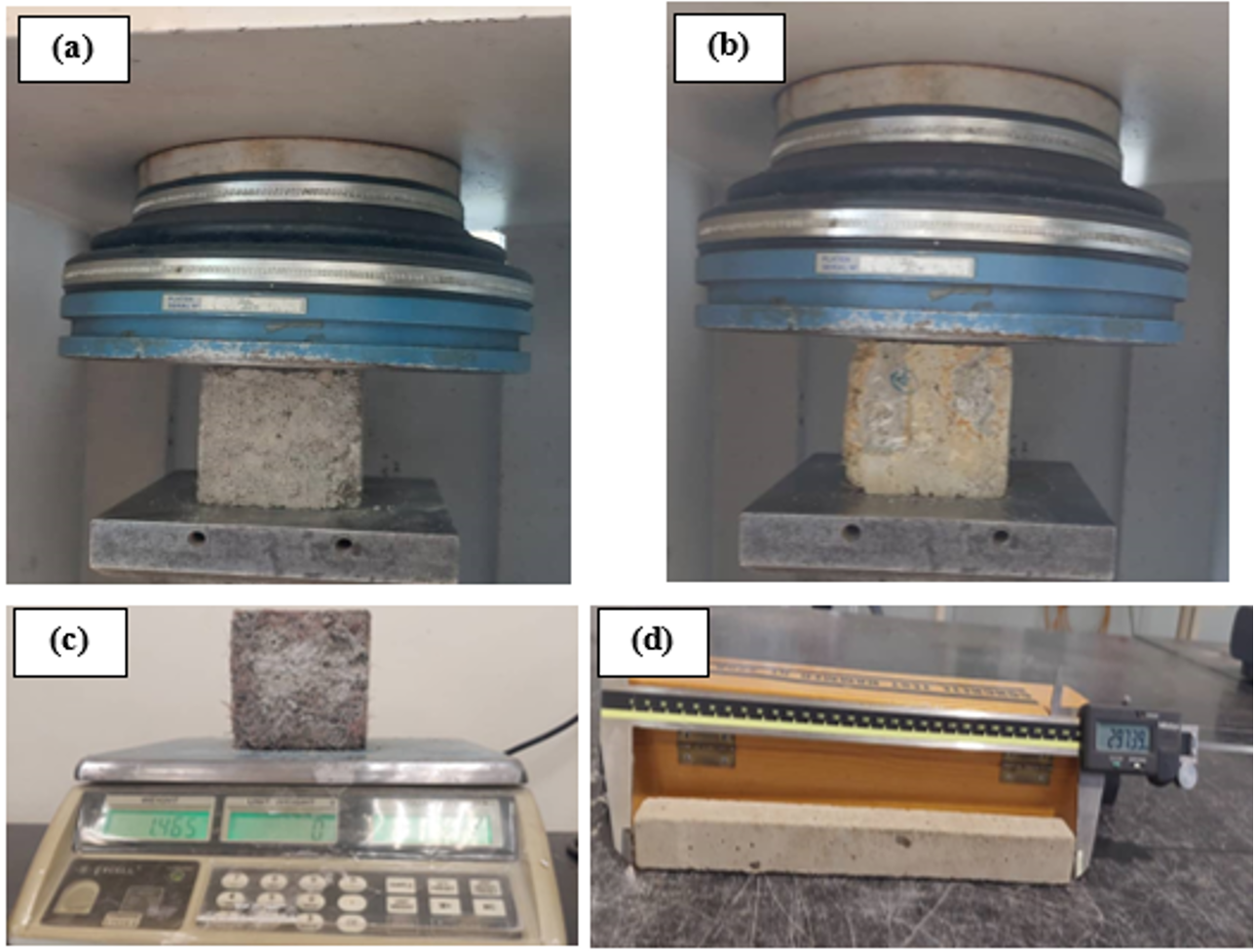
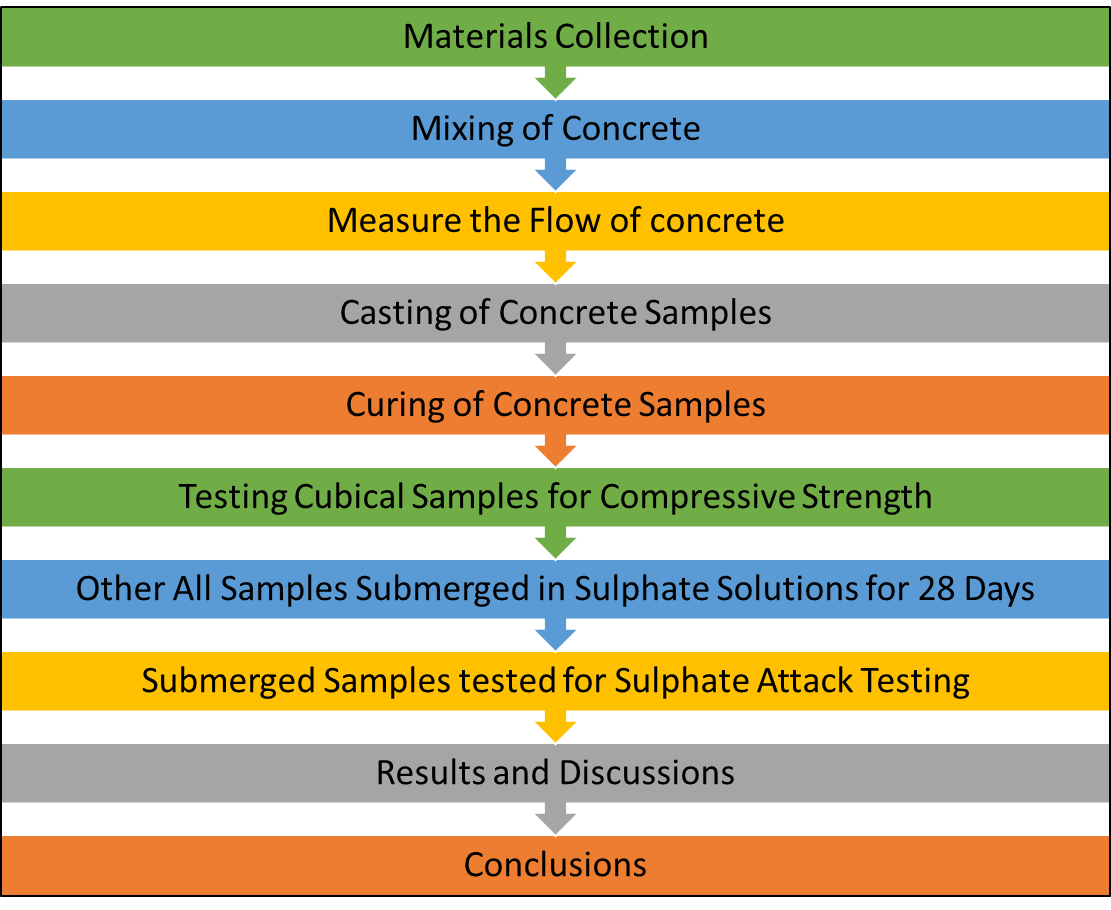
The research investigated the durability parameters of a rubberized a mixture with varying quantities of PVA fibre. The cube specimens measuring 100 mm x 100 mm x 100 mm were evaluated for compressive strength in agreement with BS EN 12390-349) at 28 days. Moreover, cubes and prism samples (285 mm 25 mm 25 mm) were fabricated and put in a 10% Na2SO4 mixture for 28 days and then these immersed specimens after 28 days to evaluate weight gain, CS, and expansion, respectively. The monthly measurements of weight gain, CS, and length variation of the specimens were recorded. Moreover, the 28-day sulphate exposure is selected due to time constraints and the primary focus on early-age resistance and comparative performance of the investigated mixtures and this concentration has been commonly used in previous studies as an aggressive environment to simulate severe sulfate conditions and to obtain measurable deterioration in a shorter time frame45,50,51). The Experimental set up and workflow of this research is shown in Figure 1 and Figure 2 respectively.
3. Results and Discussions
3.1. Compressive Strength (CS)
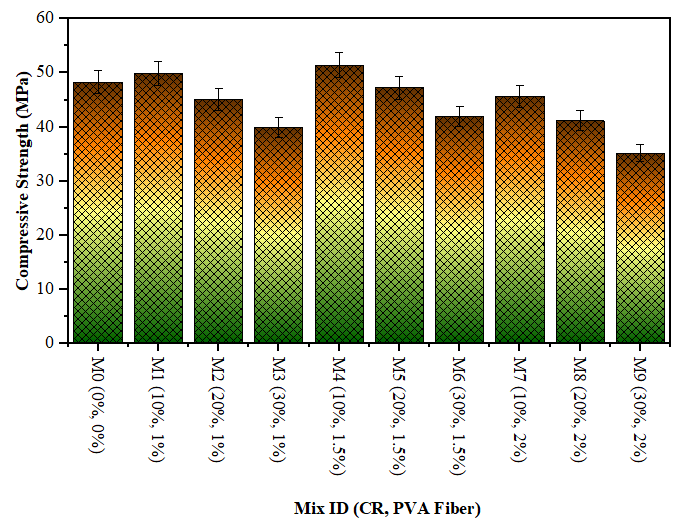
A CS examination was conducted on PVAF-CR concrete specimens for each combination, with testing carried out at 28 days. Figure 3 illustrates the outcomes of incorporating 10%–30% and 1%–2% of CR and PVA fibres, respectively. The combination of 10% CR and 1.5% PVA fibres yields the maximum CS of 51.45 MPa after 28 days. However, at 28 days, the combination containing 30% CR and 2% PVA fibres yields the lowest CS of 35.17 MPa. As CR increases, CS decreases; this is consistent with the findings presented by52) regarding CR incorporation. Replacing 10% of sand solely with CR and 1.5% PVAF results in a 6.5% enhancement in strength. The incorporation of PVA fiber resulted in a strength enhancement of up to 1.5%, which increased over time. The enhancement in strength could be attributed to the strength and performance of the PVA fiber, together with the effective physical and chemical bonding between the PVA fiber and the mixture. Consequently, fiber may inhibit the proliferation of microcracks, hence enhancing the strength of concrete. Moreover, there is a notable decrease in CS of 27.18% when employing 30% CR and 2% PVA fibres compared to CM. The decline may be associated to the smooth surface structure of CR53), which has been reported to reduce CS because of an increase in CR, resulting in the formation of more voids11,54–56). Investigator57) has shown that the lightweight rubber at elevated substituting levels progressively encounters challenges in avoiding voids. The increased volume of fibres in the combination complicates vibration, resulting in the formation of more voids, which contributes to the decline in CS58). The strength deteriorates owing to balling and inadequate interaction with concrete upon the addition of 2% PVA fiber to concrete. Comparable investigations have demonstrated a drop in strength owing to a rise in fibre volume36,59).
3.2. Loss in Compressive Strength (CS)
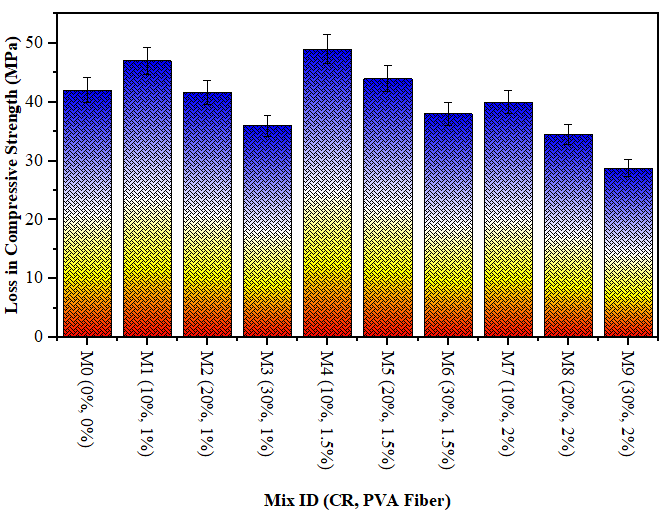
A loss in CS examination was conducted on PVA-CR concrete specimens for each combination, with testing carried out at 28 days under the sulphate attack solution after curing of 28 days. Figure 4 illustrates the outcomes of incorporating 10%–30% and 1%–2% of CR and PVA fibres due to sulphate attack, respectively. The combination of 10% CR and 1.5% PVA fibers provides the minimum loss in CS due to sulphate attack as compared to control mixture while the maximum loss in CS was observed when the use of CR rises after 10% and fiber increases after 1.5% in mixture due to sulphate attack after 28 days immersed in solution correspondingly. From the findings, it was observed that the loss in CS due to sulphate attack is recorded to reducing while the accumulation of 10% CR and 1.5% PVA fiber in concrete. The decreased CS of rubberized concrete, including PVA fibres, during sulphate exposure is attributed to heightened porosity and a compromised matrix caused by the softer CR, facilitating the ingress of sulphate ions that generate expansive compounds such as gypsum and ettringite. The inadequate adhesion between the rubber and PC paste, along with the stress concentrations caused by PVA fibres, further undermines the concrete's structure, resulting in further degradation during sulphate exposure. Similar type of experimental was performed in prior studies41,60).
3.3. Waight Gain
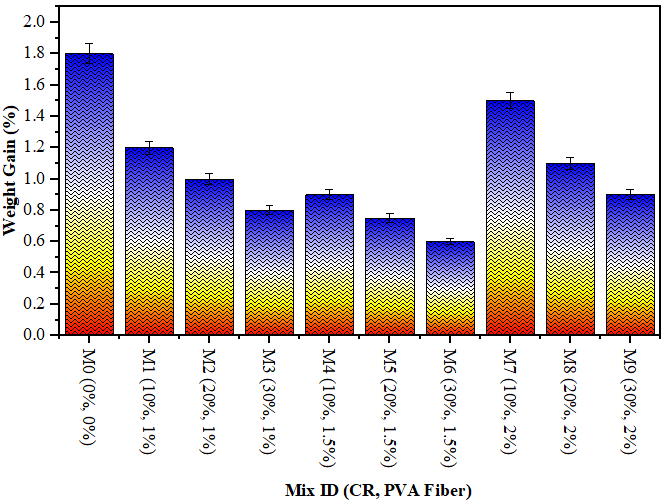
The sulphate resistance evaluation was performed on CR samples of concrete added with 1% to 2% PVA fibre. The research was conducted with samples immersed in a 10% sodium sulphate (Na2SO4) mixture for 28 days after curing. It was measured by examining changes in physical characteristics and recorded surface dry weight of samples after 28 days. The specimens were further immersed in distilled water for comparison. The CR concrete sample showed minor changes on 28 days of exposure to Na2SO4. Figure 5 illustrates the weight variation of CR concrete samples integrated with different PVA fibres subjected to sodium sulphate for 28 days. Figure 5 illustrates the results of the Na2SO4 attack on the proportionate mass variation of samples from the standard concrete mix and the CR concrete, containing different amounts of PVA fibre, relative to the initial weight of the specimens after 28 days. The proportion of mass increase was quite significant for the control concrete. Nonetheless, as the proportions of CR and PVA fibre in matrix increase, the mass gain of concrete drops. The weight gain of concrete decreases as the concentration of CR and PVA fibres rises. This is because CR has a lower density than denser aggregates, which lowers the total mass. Both materials' increased porosity allows for moisture absorption without significantly increasing weight. This combination results in a lighter concrete mix that absorbs less weight when subjected to environmental circumstances. Similar type of
experimental was performed in prior studies60).
3.4. Expansion of CR Concrete
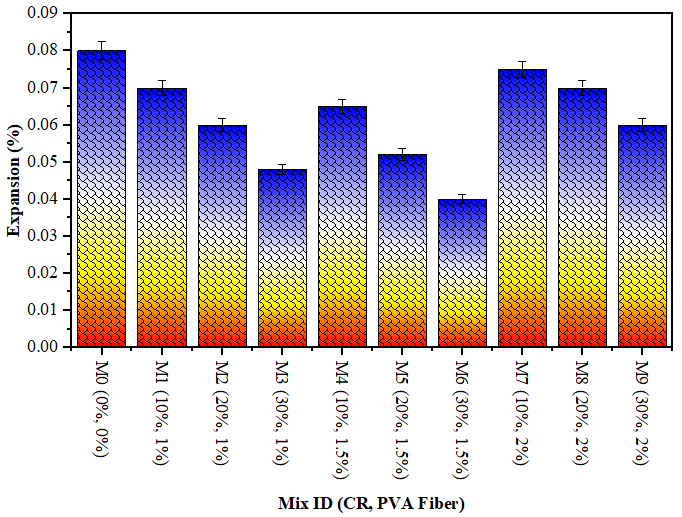
Figure 6 illustrates the results of sulphate attack-induced expansion on the CR matrix with varying amounts of PVA fibre. It was calculated by gauging the overall length of specimens prior to and after 28 days of submerged in a 10% Na2SO4 mixture. The % increment in length was subsequently determined. The maximum expansion was found by 0.08% at CM while the lowest value of expansion was attained by 0.04% at 10% of CR along with 1.5% of PVAF at 28 days correspondingly. From experimental data, it has been found that the expansion is attaining reduced as the quantity of CR and PVAF rises in concrete. Adding more CR and PVA fibres to concrete makes it more flexible, which makes it better able to handle pressures from expanding compounds like gypsum and ettringite. This makes the concrete less likely to expand due to sulphate attack. Crumb rubber decreases density, but PVA fibres enhance ductility and fracture resistance, enabling a more uniform distribution of stress inside the matrix. This combination, therefore, restricts internal pressure accumulation and reduces total expansion compared to traditional concrete mixtures. This aligns with prior studies regarding the impact of sulfate on concrete41,60–62).
4. Conclusions
This assessment involved evaluating CR concrete with varying quantities of PVAF to determine its durability properties. Based on the scientific data and evidence collected, the key points can be drawn:
•The highest CS was attained by 51.45 MPa at 10% of CR along with 1.5% of PVA fiber while the lowest CS was achieved by 35.17 MPa at 30% of CR and 2% of PVAF together consistently.
•The inclusion of 1.5% PVAF and 10% CR to concrete reduces sulphate attack loss, while the control mixture experiences maximum loss after 28 days, indicating a reduction in sulphate attack.
•The weight gain of CR concrete is recorded dropped while the extent of PVAF and CR increases than that of CM for 28 days.
•The maximum expansion was found by 0.08% at CM whereas the smallest value of expansion was attained by 0.04% at 10% of CR along with 1.5% of PVAF at 28 days consistently. From experimental data, it has been found that the expansion is attaining dropped as the extent of CR and PVAF rises in concrete.
•From the experimental outcomes, the usage of 10% CR as substitute for sand along with 1.5% of PVA fiber is offering good findings therefore, it is suggested for practical applications.
5. Study Limitations
a)Long term Durability
The longest documented sulfate exposure is 240 days; no reports have yet emerged regarding 5–10-year outdoor data from a sulfate solution. Ettringite-induced expansion could appear after 3 to 5 years, rendering current declarations of "enhanced durability" technically inapplicable.
b)Rubber content sweet-spot versus strength loss
All resilience characteristics (sulphate, acid, freeze-thaw) enhance just when rubber constitutes < 10% of the sand content. Exceeding that level, the hydrophobic void network surpasses the advantages of crack arrestation. Most structural engineers want 25–35 MPa at 28 days; adhering to these parameters is challenging without costly silica fume or nanographene additives.
c)Cyclic loading
Genuine foundations, airport pavements, and harbor slabs experience concurrent traffic fatigue and sulphate wetness. Only one study has evaluated this link; fatigue life decreased by 40% after 240 days of sulphate immersion, even with hybrid fibres, but the dataset comprises only 18 beams insufficient for a design equation.
Acknowledgements
The researchers acknowledge the financial assistance to the UTP provided under YUTP; Malaysia grant with cost center 015LC0-391& 015LC0-461.
Nomenclature
| Symbol | Description |
|---|---|
| CA | Coarse Aggregates |
| CM | Control Mixture |
| CR | Crumb Rubber |
| CS | Compressive Strength |
| FA | Fine Aggregates |
| FRC | Fiber reinforced concrete |
| Na2SO4 | sodium sulphate |
| PC | Portland cement |
| PVAF | Polyvinyl Alcohol Fiber |
| SG | Specific Gravity |
| SP | Superplasticizer |
| UTP | Universiti Teknologi Petronas |
References
- F. Demir, B. Yesilata, P. Turgut, H. Bulut, and Y. Isiker, “Investigation of the effects of ph, aging and scrap tire content on the dissolution behaviors of new scrap tire-concrete mixture structures,” J. Clean. Prod., 93 38–46 (2015). doi:10.1016/j.jclepro.2015.01.043.
- O. Onuaguluchi, and D.K. Panesar, “Hardened properties of concrete mixtures containing pre-coated crumb rubber and silica fume,” J. Clean. Prod., 82 125–131 (2014). doi:10.1016/j.jclepro.2014.06.068.
- B.S. Mohammed, A.B. Awang, S.S. Wong, and C.P. Nhavene, “Properties of nano silica modified rubbercrete,” J. Clean. Prod., 119 66–75 (2016). doi:10.1016/j.jclepro.2016.02.007.
- B.S. Thomas, R.C. Gupta, and V.J. Panicker, “Recycling of waste tire rubber as aggregate in concrete: durability-related performance,” J. Clean. Prod., 112 504–513 (2016). doi:10.1016/j.jclepro.2015.08.046.
- S. Kumari, S. Jaglan, A. Chouksey, R. Walia, A. Ahlawat, A. Garg, and M. Verma, “Carbon footprint analysis of cement production in india,” Evergreen, 11 (4) 2881–2889 (2024). doi:10.5109/7326930.
- A. Hamid, Suranto, D.C. Istiyanto, R.C. Yuniardi, S.A. Aziiz, Y.T.D. Harita, A.B. Widagdo, S.A. Latief, I. Wulandari, and R. Firmansyah, “Structural performance of parallel concrete panel container towards green coastal and port’s retaining wall: a comparison of tie rod configurations,” Evergreen, 11 (3) 2783–2790 (2024). doi:10.5109/7236917.
- S. Ram, A. Dengri, and R. Kumar, “Assessment of compressive strength in ordinary portland cement concrete: a study of curing methods and duration,” Evergreen, 11 (2) 640–651 (2024). doi:10.5109/7183321.
- A.H. Santosa Wargadipura, O. Masniari, E.C. Dewi, C.R. Darmawan, S. Rahayu, and N. Asriana, “Sustainable high-performance concrete for transportation infrastructure developments,” Evergreen, 11 (4) 3653–3672 (2024). doi:10.5109/7326997.
- I. Abdulkadir, B.S. Mohammed, M.S. Liew, and M.M.A. Wahab, “Modelling and optimization of the impact resistance of graphene oxide modified crumb rubber-ecc using response surface methodology,” IOP Conf. Ser. Mater. Sci. Eng., 1197 (1) 012043 (2021). doi:10.1088/1757-899x/1197/1/012043.
- V.C. Khed, B.S. Mohammed, M.S. Liew, and N.A.W. Abdullah Zawawi, “Development of response surface models for self-compacting hybrid fibre reinforced rubberized cementitious composite,” Constr. Build. Mater., 232 (2020). doi:10.1016/j.conbuildmat.2019.117191.
- B.S. Mohammed, and M. Adamu, “Mechanical performance of roller compacted concrete pavement containing crumb rubber and nano silica,” Constr. Build. Mater., 159 234–251 (2018). doi:10.1016/j.conbuildmat.2017.10.098.
- F. Pelisser, N. Zavarise, T.A. Longo, and A.M. Bernardin, “Concrete made with recycled tire rubber: effect of alkaline activation and silica fume addition,” J. Clean. Prod., 19 (6–7) 757–763 (2011). doi:10.1016/j.jclepro.2010.11.014.
- Y.C. Guo, J.H. Zhang, G. Chen, G.M. Chen, and Z.H. Xie, “Fracture behaviors of a new steel fiber reinforced recycled aggregate concrete with crumb rubber,” Constr. Build. Mater., 53 32–39 (2014). doi:10.1016/j.conbuildmat.2013.11.075.
- M. Adamu, B.S. Mohammed, and M. Shahir Liew, “Mechanical properties and performance of high volume fly ash roller compacted concrete containing crumb rubber and nano silica,” Constr. Build. Mater., 171 521–538 (2018). doi:10.1016/j.conbuildmat.2018.03.138.
- Y.G.A.P. Giri, B.S. Mohammed, M.S. Liew, N.A.W.A. Zawawi, I. Abdulkadir, P. Singh, and G. Ravindran, “Mechanical and microstructural properties of rubberized geopolymer concrete: modeling and optimization,” Buildings, 13 (8) (2023). doi:10.3390/buildings13082021.
- P.M. Appana, B.S. Mohammed, I. Abdulkadir, M.O.A. Ali, and M.S. Liew, “Mechanical, microstructural and drying shrinkage properties of naoh-pretreated crumb rubber concrete: rsm-based modeling and optimization,” Materials (Basel)., 15 (7) (2022). doi:10.3390/ma15072588.
- I. Abdulkadir, B.S. Mohammed, A.M. Al-Yacouby, E.L. Woen, and T. Tafsirojjaman, “Tailoring an engineered cementitious composite with enhanced mechanical performance at ambient and elevated temperatures using graphene oxide and crumb rubber,” J. Mater. Res. Technol., 28 4508–4530 (2024). doi:10.1016/j.jmrt.2024.01.059.
- I. Abdulkadir, B.S. Mohammed, E.L. Woen, W.L. Sing, and A.M. Al-Yacouby, “Optimizing sulfate and acid resistance in rubberized engineered cementitious composite with graphene oxide-pretreated crumb rubber: a response surface methodology approach,” Dev. Built Environ., 18 (2024). doi:10.1016/j.dibe.2024.100405.
- B.S. Mohammed, N.J. Azmi, and M. Abdullahi, “Evaluation of rubbercrete based on ultrasonic pulse velocity and rebound hammer tests,” Constr. Build. Mater., 25 (3) 1388–1397 (2011). doi:10.1016/j.conbuildmat.2010.09.004.
- B.S. Mohammed, “Structural behavior and m-k value of composite slab utilizing concrete containing crumb rubber,” Constr. Build. Mater., 24 (7) 1214–1221 (2010). doi:10.1016/j.conbuildmat.2009.12.018.
- E. Ganjian, M. Khorami, and A.A. Maghsoudi, “Scrap-tyre-rubber replacement for aggregate and filler in concrete,” Constr. Build. Mater., 23 (5) 1828–1836 (2009). doi:10.1016/j.conbuildmat.2008.09.020.
- M. Bravo, and J. De Brito, “Concrete made with used tyre aggregate: durability-related performance,” J. Clean. Prod., 25 42–50 (2012). doi:10.1016/j.jclepro.2011.11.066.
- B.S. Mohammed, K.M. Anwar Hossain, J.T. Eng Swee, G. Wong, and M. Abdullahi, “Properties of crumb rubber hollow concrete block,” J. Clean. Prod., 23 (1) 57–67 (2012). doi:10.1016/j.jclepro.2011.10.035.
- O. Youssf, M.A. Elgawady, J.E. Mills, and X. Ma, “An experimental investigation of crumb rubber concrete confined by fibre reinforced polymer tubes,” Constr. Build. Mater., 53 522–532 (2014). doi:10.1016/j.conbuildmat.2013.12.007.
- D.M. Sadek, and M.M. El-Attar, “Structural behavior of rubberized masonry walls,” J. Clean. Prod., 89 174–186 (2015). doi:10.1016/j.jclepro.2014.10.098.
- G. Li, Z. Wang, C.K.Y. Leung, S. Tang, J. Pan, W. Huang, and E. Chen, “Properties of rubberized concrete modified by using silane coupling agent and carboxylated sbr,” J. Clean. Prod., 112 797–807 (2016). doi:10.1016/j.jclepro.2015.06.099.
- S. Singh, L. Nagdeve, H. Kumar, and K. Dhakar, “Rice straw based natural fiber reinforced polymer for sustainable bio- composites: a systematic review,” Evergreen, 10 (2) 1041–1052 (2023). doi:10.5109/6793661.
- H. Zhong, E.W. Poon, K. Chen, and M. Zhang, “Engineering properties of crumb rubber alkali-activated mortar reinforced with recycled steel fibres,” J. Clean. Prod., 238 (2019). doi:10.1016/j.jclepro.2019.117950.
- S. Hesami, I. Salehi Hikouei, and S.A.A. Emadi, “Mechanical behavior of self-compacting concrete pavements incorporating recycled tire rubber crumb and reinforced with polypropylene fiber,” J. Clean. Prod., 133 228–234 (2016). doi:10.1016/j.jclepro.2016.04.079.
- A.I. Al-Hadithi, A.T. Noaman, and W.K. Mosleh, “Mechanical properties and impact behavior of pet fiber reinforced self-compacting concrete (scc),” Compos. Struct., 224 (2019). doi:10.1016/j.compstruct.2019.111021.
- J. Wang, Q. Dai, R. Si, and S. Guo, “Investigation of properties and performances of polyvinyl alcohol (pva) fiber-reinforced rubber concrete,” Constr. Build. Mater., 193 631–642 (2018). doi:10.1016/j.conbuildmat.2018.11.002.
- V.C. Li, S. Wang, and C. Wu, “Tensile Strain-Hardening Behavior of Polyvinyl Alcohol Engineered Cementitious Composite (PVA-ECC),” ACI Mater. J., 98(6), 483–492 (2001). doi:10.14359/10851.
- V.C. Li, C. Wu, S. Wang, A. Ogawa, and T. Saito, “Interface tailoring for strain-hardening polyvinyl alcohol-engineered cementitious composite (pva-ecc),” ACI Mater. J., 99 (5) 463–472 (2002). doi:10.14359/12325.
- A.M. Alhozaimy, P. Soroushian, and F. Mirza, “Mechanical properties of polypropylene fiber reinforced concrete and the effects of pozzolanic materials,” Cem. Concr. Compos., 18 (2) 85–92 (1996). doi:10.1016/0958-9465(95)00003-8.
- M. Anas, M. Khan, H. Bilal, S. Jadoon, and M.N. Khan, “Fiber reinforced concrete: a review †,” Eng. Proc., 22 (1) (2022). doi:10.3390/engproc2022022003.
- N. Bheel, B.S. Mohammed, M.O. Ahmed Ali, N. Shafiq, E. Mohamed Tag-eldin, and M. Ahmad, “Effect of polyvinyl alcohol fiber on the mechanical properties and embodied carbon of engineered cementitious composites,” Results Eng., 20 (2023). doi:10.1016/j.rineng.2023.101458.
- W. Bai, X. Wang, C. Yuan, J. Guan, K. Cao, and C. Xie, “Study on mechanical properties and meso-damage mechanism of carbon-polyvinyl alcohol hybrid fiber reinforced recycled coarse aggregate concrete under the coupling action of sodium sulfate and dry-wet cycles,” Eng. Fract. Mech., 307 (2024). doi:10.1016/j.engfracmech.2024.110303.
- C. Wang, J. Liu, S. Chen, F. Chen, and Z. Gao, “Polyvinyl alcohol fiber cement-stabilized macadam: a review and performance evaluation,” J. Traffic Transp. Eng. (English Ed.), 11 (3) 406–423 (2024). doi:10.1016/j.jtte.2024.01.001.
- P. Zhang, S. Wei, J. Wu, Y. Zhang, and Y. Zheng, “Investigation of mechanical properties of pva fiber-reinforced cementitious composites under the coupling effect of wet-thermal and chloride salt environment,” Case Stud. Constr. Mater., 17 (2022). doi:10.1016/j.cscm.2022.e01325.
- I. Abdulkadir, B.S. Mohammed, M.S. Liew, and M.M.A. Wahab, “Modelling and optimization of the mechanical properties of engineered cementitious composite containing crumb rubber pretreated with graphene oxide using response surface methodology,” Constr. Build. Mater., 310 (2021). doi:10.1016/j.conbuildmat.2021.125259.
- B.S. Mohammed, L.Y. Yen, S. Haruna, M.L. Seng Huat, I. Abdulkadir, A. Al-Fakih, M.S. Liew, and N.A.W. Abdullah Zawawi, “Effect of elevated temperature on the compressive strength and durability properties of crumb rubber engineered cementitious composite,” Materials (Basel)., 13 (16) (2020). doi:10.3390/MA13163516.
- I. Abdulkadir, B.S. Mohammed, M.O.A. Ali, and M.S. Liew, “Effects of graphene oxide and crumb rubber on the fresh properties of self-compacting engineered cementitious composite using response surface methodology,” Materials (Basel)., 15 (7) (2022). doi:10.3390/ma15072519.
- N. Bheel, M.O.A. Ali, M.S. Kırgız, N. Shafiq, and R. Gobinath, “Effect of graphene oxide particle as nanomaterial in the production of engineered cementitious composites including superplasticizer, fly ash, and polyvinyl alcohol fiber,” Mater. Today Proc., (2023). doi:10.1016/j.matpr.2023.03.010.
- N. Bheel, B.S. Mohammed, I. Abdulkadir, M.S. Liew, and N.A.W.A. Zawawi, “Effects of graphene oxide on the properties of engineered cementitious composites: multi-objective optimization technique using rsm,” Buildings, 13 (8) (2023). doi:10.3390/buildings13082018.
- N. Bheel, B.S. Mohammed, M.S. Liew, and N.A.W.A. Zawawi, “Effect of graphene oxide as a nanomaterial on the durability behaviors of engineered cementitious composites by applying rsm modelling and optimization,” Buildings, 13 (8) (2023). doi:10.3390/buildings13082026.
- N. Bheel, B.S. Mohammed, M.O.A. Ali, N. Shafiq, and D. Radu, “Effect of graphene oxide as a nanomaterial on the bond behaviour of engineered cementitious composites by applying rsm modelling and optimization,” J. Mater. Res. Technol., 26 1484–1507 (2023). doi:10.1016/j.jmrt.2023.07.278.
- N. Bheel, and B.S. Mohammed, “Modelling and optimization of long-term modulus of elasticity and poisson’s ratio of graphene oxide based engineered cementitious composites by using response surface methodology,” Diam. Relat. Mater., 143 (2024). doi:10.1016/j.diamond.2024.110949.
- N. Bheel, B.S. Mohammed, H. Mohamad, M.H. Sutanto, and T. Tafsirojjaman, “Synergetic effect of multiwalled carbon nanotubes on mechanical and deformation properties of engineered cementitious composites: rsm modelling and optimization,” Diam. Relat. Mater., 147 (2024). doi:10.1016/j.diamond.2024.111299.
- BS EN 12390-3:2009, “Testing Hardened Concrete - Part 3: Compressive Strength of Test Specimens,” British Standards Institution (BSI), London, UK (2009).
- N. Bheel, I.M. Chohan, A.S. Alraeeini, M. Alwetaishi, S.A. Waheeb, L. Alkhattabi, and O. Benjeddou, “Optimization of durability characteristics of engineered cementitious composites combined with titanium dioxide as a nanomaterial applying rsm modelling,” Sci. Rep., 15 (1) (2025). doi:10.1038/s41598-025-94382-7.
- N. Bheel, B.S. Mohammed, M.S. Liew, and N.A.W.A. Zawawi, “Durability behaviours of engineered cementitious composites blended with carbon nanotubes against sulphate and acid attacks by applying rsm modelling and optimization,” Buildings, 13 (8) (2023). doi:10.3390/buildings13082032.
- K. Bisht, and P. V. Ramana, “Evaluation of mechanical and durability properties of crumb rubber concrete,” Constr. Build. Mater., 155 811–817 (2017). doi:10.1016/j.conbuildmat.2017.08.131.
- G.M.S. Abdullah, I.M. Chohan, M. Ali, N. Bheel, M. Ahmad, T. Najeh, Y. Gamil, and H.R. Almujibah, “Effect of titanium dioxide as nanomaterials on mechanical and durability properties of rubberised concrete by applying rsm modelling and optimizations,” Front. Mater., 11 (2024). doi:10.3389/fmats.2024.1357094.
- Q. Dong, B. Huang, and X. Shu, “Rubber modified concrete improved by chemically active coating and silane coupling agent,” Constr. Build. Mater., 48 116–123 (2013). doi:10.1016/j.conbuildmat.2013.06.072.
- P.L. Meyyappan, S.D. Anitha Selvasofia, M. Asmitha, S. Janani Praveena, and P. Simika, “Experimental studies on partial replacement of crumb rubber as a fine aggregate in m30 grade concrete,” Mater. Today Proc., 74 985–992 (2023). doi:10.1016/j.matpr.2022.11.350.
- T. Gupta, S. Chaudhary, and R.K. Sharma, “Assessment of mechanical and durability properties of concrete containing waste rubber tire as fine aggregate,” Constr. Build. Mater., 73 562–574 (2014). doi:10.1016/j.conbuildmat.2014.09.102.
- A. Benazzouk, O. Douzane, T. Langlet, K. Mezreb, J.M. Roucoult, and M. Quéneudec, “Physico-mechanical properties and water absorption of cement composite containing shredded rubber wastes,” Cem. Concr. Compos., 29 (10) 732–740 (2007). doi:10.1016/j.cemconcomp.2007.07.001.
- N. Bheel, A.V. Baikerikar, and B.S. Mohammed, “Using optimization techniques on mechanical characteristics and sustainability assessment of rubberized concrete blended with pva fiber through response surface methodology,” Int. J. Concr. Struct. Mater., 19 (1) (2025). doi:10.1186/s40069-024-00740-6.
- A. Noushini, B. Samali, and K. Vessalas, “Effect of polyvinyl alcohol (pva) fibre on dynamic and material properties of fibre reinforced concrete,” Constr. Build. Mater., 49 374–383 (2013). doi:10.1016/j.conbuildmat.2013.08.035.
- T. Ran, J. Pang, and J. Yu, “Performance of rubber concrete containing polypropylene and basalt fibers under coupled sulfate attack and freeze–thaw conditions: an experimental evaluation,” Polymers (Basel)., 15 (9) (2023). doi:10.3390/polym15092066.
- K. Ramyar, and G. Inan, “Sodium sulfate attack on plain and blended cements,” Build. Environ., 42 (3) 1368–1372 (2007). doi:10.1016/j.buildenv.2005.11.015.
- K. Van Tittelboom, N. De Belie, and D. Hooton, “A critical review on test methods for evaluating the resistance of concrete against sulfate attack,” Chapter 4 Perform. Cem. Mater. Aggress. Aqueous Environ. RILEM PROCEEDINGS. PRO 63, (June) 298–306 (2009).