
Abstract
This research focused on analyzing the effect of high cooling rates at cryogenic temperatures, referred to as sub-zero treatment, on the retained austenite fraction in the High Strength Low Alloy steel during the hardening heat treatment process. Sub-zero treatment was carried out after the quenching process. The treatment involved cooling the steel to −176 °C, followed by a double tempering process. This study focused on analyzing the percentage of retained austenite in as-quenched and as-subzero-treated samples, as well as in as-quench double-tempered (QTT) and as-quench sub-zero double-tempered (QSTT) samples. Furthermore, the hardness of all treatment variables is also compared. The microstructure characterization was carried out using an optical microscope and a Scanning Electron Microscope (SEM), and the calculation of the percentage of retained austenite phase was performed using ImageJ software. Hardness testing was conducted using Rockwell macro hardness testing. The results of this study show that a decrease in the amount of retained austenite from 6.8% to 3.9% occurs in as-quenched samples without and with sub-zero treatment. After a double temper, the retained austenite decreases from 3.37% to 1.2% in as-QTT and as-QSTT samples. Additionally, there was an increase in hardness from 48 HRC to 49 HRC in the sample with double temper treatment. Thus, sub-zero treatment could reduce the percentage of residual austenite and increase the hardness of the HSLA steel.
Keywords: High Strength Low Alloy, Quenching, Retained Austenite, Sub-zero treatment
Outline
1. Introduction
High-strength low-alloyed steels (HSLA steels), also referred to as micro-alloyed steels, are a class of materials engineered to deliver superior mechanical performance and enhanced resistance to atmospheric corrosion when compared to conventional carbon steels. Unlike ordinary alloy steels, HSLA steels are specifically designed to achieve targeted mechanical properties rather than strictly adhering to a fixed chemical composition1). These steels typically exhibit yield strengths exceeding 275 MPa (or 40 ksi), making them suitable for a broad range of structural and engineering applications1,2). HSLA steels are characterized by relatively low carbon content (typically 0.05–0.25% C), ensuring adequate formability and weldability. Their compositions are further enhanced by microalloying elements such as niobium, vanadium, and titanium, which contribute to grain refinement and precipitation strengthening3–5).
Despite their favorable mechanical performance, HSLA steels, like other alloyed steels, are susceptible to the formation of retained austenite. Retained austenite is a metastable phase that can significantly influence service behavior and refers to the portion of austenite that fails to transform into martensite during quenching. This retained phase may remain stable under certain conditions but can transform into martensite under external stress, strain, or temperature fluctuations, resulting in delayed cracking and dimensional instability in service6,7). The volume fraction and morphology of retained austenite are influenced by several factors, including the steel’s chemical composition, austenitizing temperature, quenching rate, and tempering parameters8). In engineering applications, the presence of excessive retained austenite is often undesirable due to its role in reducing dimensional stability and increasing the likelihood of microcrack initiation over time, particularly in fatigue-loaded or thermally cycled components9).
Retained austenite plays a critical role in determining the mechanical stability of steels, particularly under cyclic loading and thermal fluctuations. Retained austenite stability is governed by mechanical, chemical, and thermal factors, including carbon enrichment, morphology, and surrounding phase constraints10–13). From a thermodynamic perspective, the incomplete transformation of austenite during quenching is closely related to the martensite start (Ms) and martensite finish (Mf) temperatures. In many alloyed steels, the Mf temperature lies below room temperature, resulting in retained austenite after quenching14–17). The Koistinen-Marburger relationship describes the fraction of martensite formed as a function of undercooling below the Ms temperature18,19). Its application to high-strength and other low-alloy steel demonstrated that cooling conditions belom Ms strongly influenced the extent of martensitic transformation20–22).
One well-established method to reduce the retained austenite content is sub-zero treatment, also known as cryogenic treatment. This process involves cooling the material to sub-ambient temperatures, typically ranging from -80 °C and up to -196 °C, depending on the martensite finish temperature (Mf) of the steel23). Cryogenic treatment enhances martensitic transformation by increasing the driving force for nucleation and suppressing diffusion, while also promoting fine carbide precipitation during subsequent tempering24–27). Sub-zero treatment facilitates the further transformation of metastable austenite to martensite that was not achieved during conventional quenching, thereby increasing hardness, wear resistance, and dimensional stability28,29). Studies have demonstrated that the effectiveness of sub-zero treatment is influenced by several variables, including the cooling rate, holding time, and final sub-zero temperature30). When optimized, sub-zero treatment can refine the microstructure, improve hardness homogeneity, and reduce the incidence of delayed cracking caused by austenite decomposition during service31–33). Moreover, subsequent tempering after sub-zero treatment can stabilize the newly formed martensite and reduce internal stresses, which is critical for achieving the desired mechanical performance34).
Although sub-zero treatment has been extensively investigated in high-carbon and tool steels such as AISI D2 and M23,28,35), its application in HSLA steels remains relatively underexplored. Compared to tool steels, HSLA steels exhibit lower carbon content and different retained austenite stability, making the application of sub-zero treatment less explored and requiring further investigation36,37). Paper on HSLA alloys commonly address the cryogenic service behavior38). Given the growing importance of dimensional stability and fatigue resistance in structural applications, this gap represents a critical opportunity. Therefore, this study aims to investigate the effect of sub-zero treatment on retained austenite reduction and hardness evolution in HSLA steel, with particular emphasis on its potential application for improving dimensional stability and reducing cracking susceptibility in structural and automotive components. By combining microstructural characterization with macrohardness measurements, the work provides new insights into how cryogenic processing can be adapted to optimize the phase stability and mechanical performance of HSLA steels.
2. Experiment Procedures
The material used in this research is High-Strength Low-Alloy (HSLA) steel, which is often applied to components of heavy equipment vehicles, with the composition as shown in Table 1.
The heat treatment process stage for this research was first carried out, starting with sample preparation, which involved cutting the sample to 40x40x1 mm. Furthermore, normalization is carried out at a temperature of 970 °C for 1 hour, followed by a pre-tempering process at 677 °C. After this, austenization is carried out for this study at a temperature of 926 °C with a holding time of 1 hour. Quenching in a water medium with 1% Polyalkylene Glycol (PAG) will reduce the sample temperature from the austenitizing temperature of 926 °C to room temperature. This treatment prevents the material from cracking and reduces distortion from extreme temperature changes. After quenching, the treatment was continued with sub-zero or cryogenic treatment. Sub-zero treatment was carried out at a temperature of -176 °C for 1 hour. The sub-zero treatment temperature of −176 °C was selected to facilitate further martensitic transformation below the estimated martensite finish (Mf) temperature of the steel. In HSLA and other alloyed steels, incomplete transformation during conventional quenching may occur because the Mf temperature can be lower than room temperature, leading to retained austenite formation. By applying sub-zero treatment significantly below room temperature, the driving force for martensitic transformation increases, enabling the transformation of metastable retained austenite into martensite and reducing the retained austenite fraction in the final microstructure. After that, it was double tempered at a temperature of 205 °C for 4.5 hours each. Samples that have been heat treated will produce steel products, namely as-QTT and as-QSTT.
Table 1: Chemical Composition of HSLA Steel
| Element | C | Si | Mn | P | S | Ni |
|---|---|---|---|---|---|---|
| % | 0.28 | 1.40 | 0.95 | 0.025 | 0.009 | 0.70 |
| Element | Cr | Mo | Ca | Cu | Al | |
| % | 1.80 | 0.27 | 0.003 | 0.02 | 0.035 |
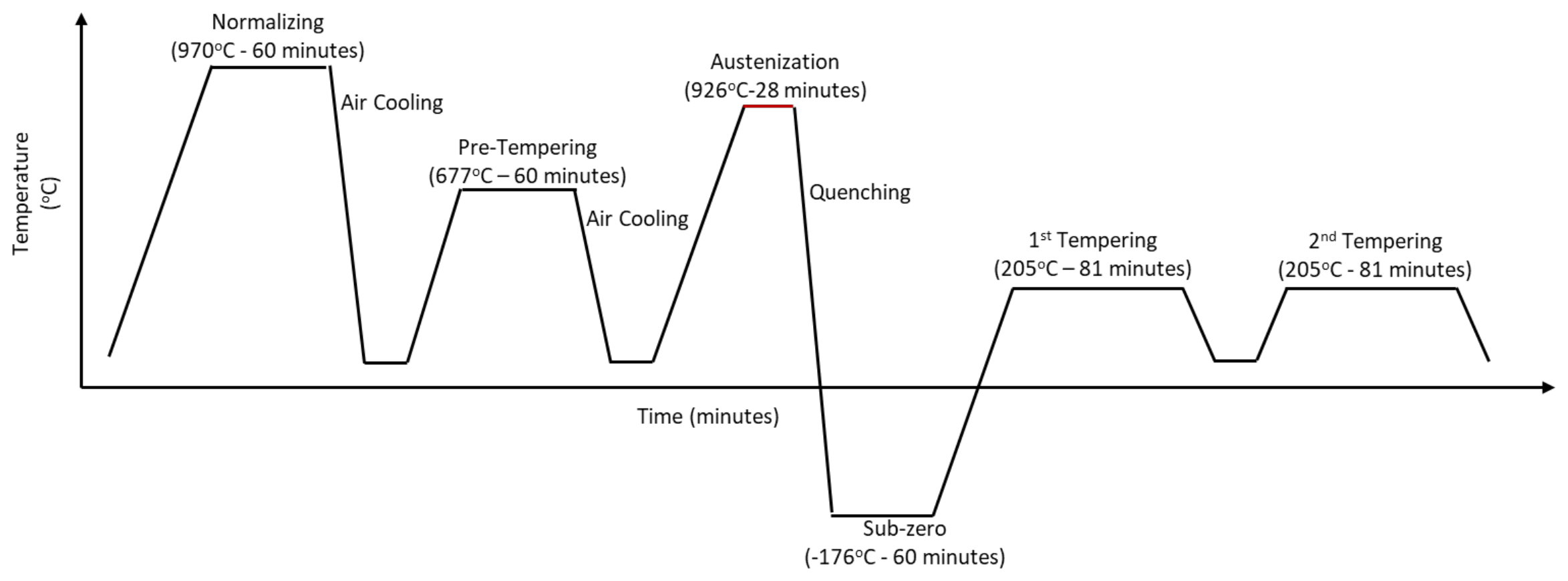
The microstructure characterization was carried out by using an optical microscope and Scanning Electron Microscope (SEM), and the calculation of the percentage of the retained austenite phase using software of Image J. The retained austenite fraction was estimated using ImageJ image analysis based on the contrast differences observed in the microstructure. This method was employed primarily for comparative evaluation among different treatment conditions and to observe relative trends in retained austenite evolution after sub-zero treatment. Although image-based analysis provides useful microstructural information, the quantitative values obtained should be interpreted as semi-quantitative estimations due to limitations associated with phase contrast sensitivity, image thresholding, and localized observation areas. To improve measurement reliability and minimize localized observation bias, the analysis was conducted using a minimum of five measurements obtained from three different microstructure images for each treatment condition. The reported retained austenite values represent the average of these measurements, while the error bars shown in the corresponding graph indicate the variation of the measured data. Hardness testing was carried out using macro hardness testing, Rockwell C. Heat treatment carried out in this study can be briefly seen in the flow chart in Figure 1.
3. Results and Discussion
3.1. Microstructure Analysis by OM
The microstructure of the material was observed at the surface and the core of the sample. The aim is to observe the homogeneity of the microstructure on the surface and in the core, including if there is decarburization on the surface of the sample. Decarburization is the loss of Carbon on the surface of the material. The factors that influence the occurrence of this phenomenon are high temperatures, a low concentration of Carbon around the material, and a high concentration of oxygen in the atmosphere.
Prawoto et al. and Hui Wang et al.39,40) identified the phenomenon of decarburization in steel (0.8 wt% C). Ferrite was found on the surface in the white/light area, and mixed pearlite and Widmanstätten ferrite in the dark area towards the core. At high temperatures, the rate of carbon diffusion from the material to the environment is very high, resulting in decarburization. Carbon atoms diffuse from the bulk material toward the surface41). In Figure 2, there is no decarburization phenomenon found in all samples, which usually forms a ferrite phase on the surface. In general, the surface of the sample is dominated by the formation of a transformation zone.
The transformation zone is an area where the bainite has not fully transformed42). The transformation zone has a high hardness, ranging from 500 to 520 HV. The high hardness is due to the Transformation zone consisting of fresh martensite and/or retained austenite and bainite that form around it42). Based on this, it can be assumed that the bright phase formed in the microstructure of as-subzero consists of a mixture of martensite with retained austenite and bainite with retained austenite. Figure 3 shows the microstructure of the core parts of the as-quenched, as-subzero, as-QTT, and as-QSTT samples, which were previously austenized at a temperature of 927 °C and quenched with water and 1% Polyalkylene Glycol.
Figure 3(a) and (b) illustrate the similarities and differences in the microstructures formed from the as-quenched and as-subzero samples. The presence of martensite, bainite, and austenite phases characterizes both samples. The microstructure is dominated by martensite because the rapid cooling rate suppresses carbon diffusion. However, it can be seen that the difference exists in the martensite structure that is formed, where the as-subzero product has a finer martensite structure (i.e., it shrinks) and is more uniformly dispersed. Similar martensitic refinement after sub-zero treatment has also been reported by Bhawar et al.43). The refinement of martensitic structure observed in sub-zero treated samples can be attributed to increased nucleation density and restricted carbon diffusion at low temperatures, resulting in finer lath or
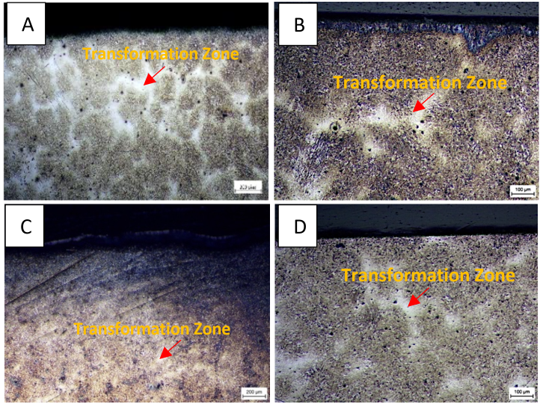
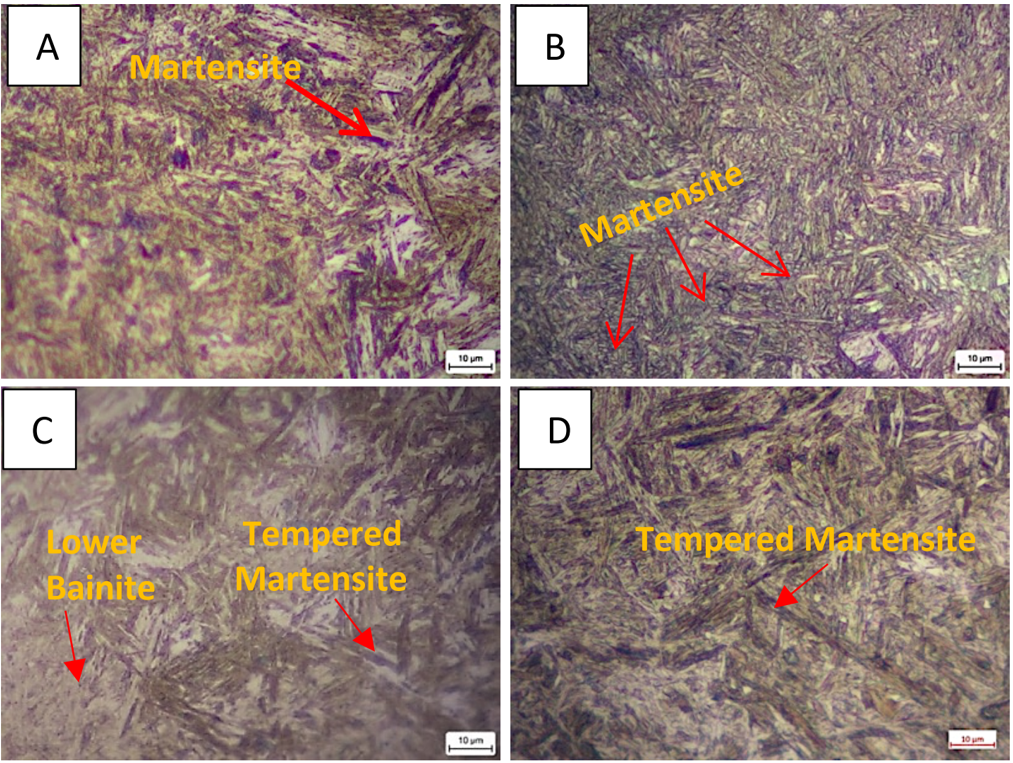
plate structures34,44,45). Additionally, the reduction in temperature suppresses atomic mobility, leading to a more homogeneous distribution of martensite and retained austenite phases46–49).
Figure 3(c) and (d) show the differences in the microstructure formed from the as-QTT and as-QSTT samples; both samples exhibit the presence of tempered martensite and bainite phases. However, in general, the difference is evident in the formation of coarser martensite in the QSTT sample. These results are consistent with research conducted by Speich et al.6), who observed morphological differences in the martensite phase between the as-QTT and as-QSTT samples. Speich et al.6), have demonstrated that the microstructural evolution during tempering involves the coarsening of martensite and the precipitation and growth of carbides. According to the morphological comparison of the two samples, the microstructure of the samples treated with cryogenic showed a very coarse martensite structure (coarse).
3.2. Microstructure Analysis by SEM
SEM results of the sample microstructure, as-QTT, as-
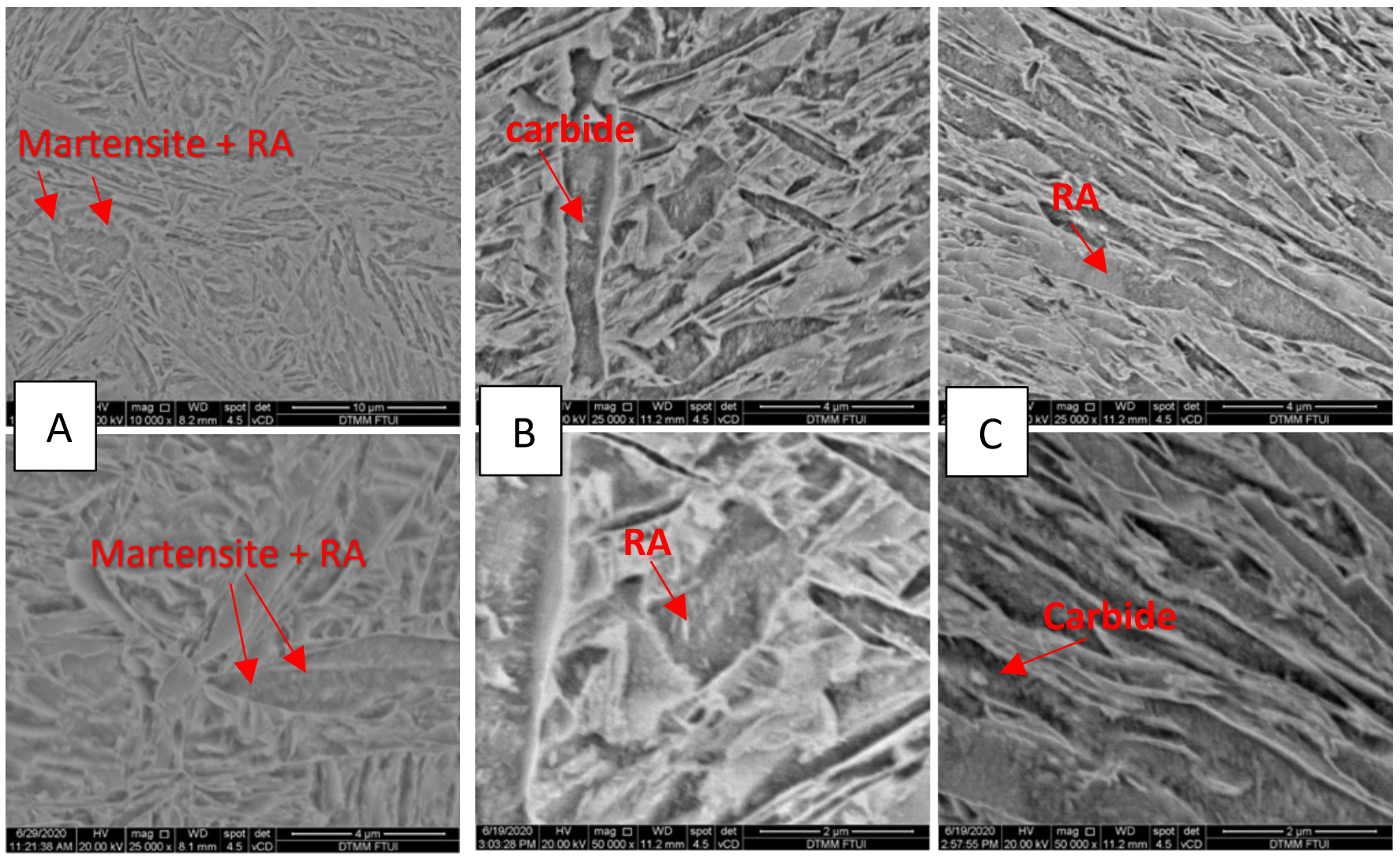
subzero, and as-QSTT, are shown in Figure 4. The Figure displays the SEM results of the martensite, bainite, and transformation zone areas. This is consistent with the resulting microhardness measurements of phases on the as- subzero, as-QTT, and as-QSTT microstructure samples. Phase determination in the sample is based on the literature from Campos et al., which states that the hardness value range for the martensite structure is >550 HV, lower bainite in the range of 350 – 490 HV, a mixture of martensite and lower bainite in the range of 450 – 550 HV, upper bainite in the range of 225 – 275 HV, and a mixture of bainite in the range of 275 – 350 HV50).
In Figure 4 (a), the microstructure is dominated by tempered martensite and several granular bainite matrices, in which several granules are thought to be retained austenite and/or fresh martensite. This is consistent with a study from Campos50). The existence of a significant amount of bainitic matrix can be due to the high Si content of the steel, which lowers the bainite start temperature and decreases the free energy of the ferrite, thereby increasing the driving force for bainitic reactions51,52). Furthermore, Cr and Mn are known to support the formation of bainite in steel during continuous cooling. The microstructural results obtained in this study are similar to those of the research conducted by Sebastien TP et al.53) regarding carbide investigation on 0.3 wt% C as-QTT steel. The results show the presence of a retained austenite phase,
SEM test results on samples subjected to the sub-zero process are shown in Figure 4(b). As seen in Figure 4(b), the SEM microstructure, with a magnification of 50000x, reveals the formation of a martensite. On the inside, as shown in Figure 4(b) at 25000x magnification, there are several irregularly shaped granules, which are retained austenite and the presence of carbides. The SEM test results on the as-QSTT sample are shown in Figure 4 (c). In this Figure, a martensite containing retained austenite (irregular shape) and carbide on the inside, as shown in Figure 4(c). Based on morphological comparison, the martensite observed corresponds to lath martensite typical of low-carbon steels, while bainite may be classified as upper or lower depending on carbide distribution54–57). The presence of retained austenite in blocky or film-like morphology also influences mechanical behavior and transformation stability58–60).
3.3. Analysis of the Percentage of Retained Austenite and Macro Hardness
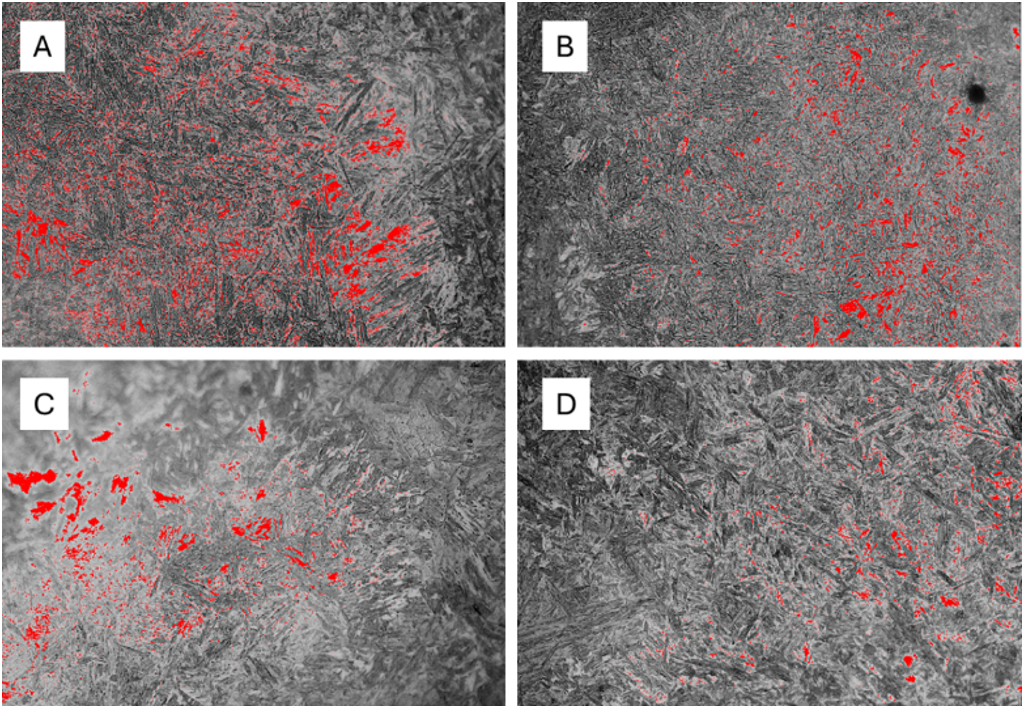
HSLA steels that have been cooled (as-quenched, as-subzero) and double tempered (as-QTT, as-QSTT) undergo quantitative phase calculations using ImageJ. In the core of the sample, there is a phase that is brightly colored and in the shape of an irregular shape, which is the retained austenite phase, the percentage of which is calculated based on % area after three measurements. The illustration of ImageJ measurements can be seen in Figure 5.
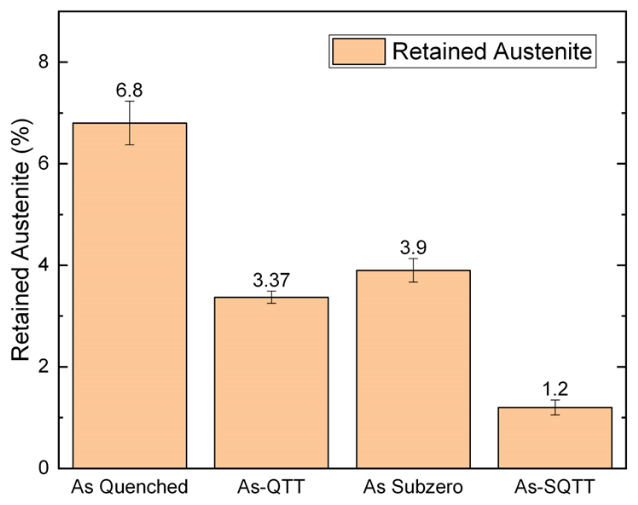
Figure 6 shows a graphical comparison of the retained austenite percentage from the ImageJ measurements. The as-quenched sample exhibited the highest retained austenite fraction, with an average value of 6.8%. Sub-zero treatment reduced the retained austenite fraction to an average value of 3.9%. Without temper process, the retained austenite amount is relatively high in the sample. On the other hand, the sample with a double temper exhibited a lower retained austenite. The average amount of retained austenite is at 3.37% average and 1.2% average for the sample with and without subzero treatment respectively. It should be noted that the retained austenite values obtained in this study are based on image analysis and therefore represent semi-quantitative estimations. Future investigations using XRD analysis are recommended to provide more precise phase quantification. The sample resulting from the as-QTT treatment has a greater amount of retained austenite when compared to the results of the as-QSTT treatment because the low sub-zero temperature will increase the value of the cooling rate, which will ultimately suppress the diffusion process because the low cooling temperature forces the material below the martensite start temperature and
touches the martensite finish line before transforming into bainite61).
The transformation kinetics of retained austenite are strongly dependent on temperature and carbon content. Sub-zero treatment accelerates the transformation of metastable austenite into martensite by increasing undercooling below Mf3,7,61–63). During tempering, retained austenite can become destabilized and decomposed, with its stability depending on the tempering conditions and surrounding microstructure64–66). Rapid or high-temperature tempering has also been reported to alter retained austenite stability and the microstructural evolution of bainitic steels67,68). The thermal and mechanical stability of retained austenite during cryogenic and tempering treatments have been investigated in relation to its surrounding microstructure and phase condition69,70). Carbon enrichment and partitioning during quenching and tempering can further modify retained austenite stability and microstructural evolution71–73). The observed reduction in retained austenite is consistent with thermodynamic descriptions of martensitic transformation74,75). Kinetic framework models have also been used to describe austenite decomposition and evolution in low-alloy and high-strength steels75–78).
The decrease in the amount of retained austenite occurred after double tempering at 205 °C for 5 hours. During the first tempering process, precipitation of ε-iron carbide or other carbide phases occurs, accompanied by a reduction in the excess carbon content present in martensite. The Carbon is then slowly partitioned into the retained austenite. During the second tempering process, the retained austenite that has not been transformed into the material decomposes into bainitic ferrite or ferrite carbide. Talebi et al. specifically found that the retained austenite will decompose to lower bainite during the tempering process79).
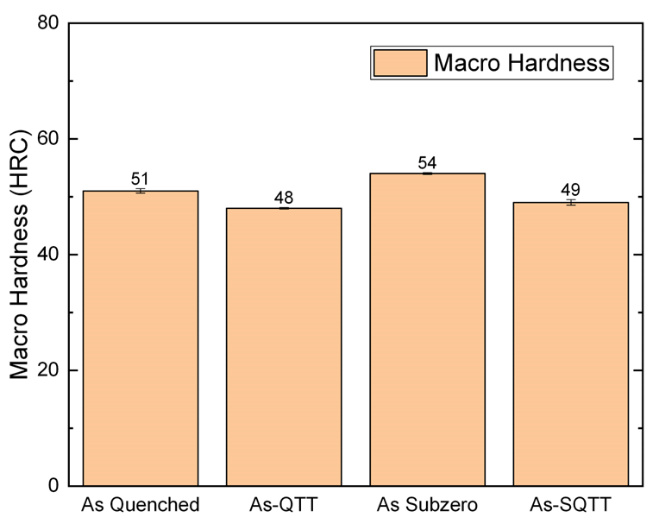
Macro hardness testing was conducted on the HRC scale. Figure 7 shows a graph of macro hardness between conventional treatment and sub-zero treatment. The as-quenched sample has a hardness of 51 HRC. After tempering at a temperature of 205°C, the hardness is decreasing to 48 HRC. The same trend also occurred for the sample with subzero treatment. The hardness for the subzero sample with and without double tempering process is 54 HRC and 49 HRC respectively. The decrease in hardness value after the double tempering process is caused because the tempering process produces carbide precipitates, which bind the solid solution elements to the matrix, thereby decreasing the material's hardness80).
There are differences in hardness values between the as-QTT sample and the as-QSTT sample; the as-QSTT sample has a slightly higher hardness than the as-QTT hardness81,82). The as-QTT hardness value is 48 HRC, while the as-QSTT hardness value is 49 HRC. Although the increase in hardness after sub-zero treatment is relatively small, the primary objective of this study is the reduction of retained austenite rather than maximizing hardness improvement. The transformation behavior of retained austenite during sub-zero treatment and subsequent tempering is complex, as the retained austenite may transform not only into martensite but also contribute to the formation of bainitic ferrite and carbide precipitates during tempering. Consequently, the increase of overall hardness may appear limited. Nevertheless, the slight increase in hardness observed in the as-QSTT sample remains consistent with the reduction of retained austenite, which is generally softer and less stable compared to martensitic phases. These results are consistent with research conducted by Das D. et al.23). The research explained the effect of sub-zero treatment on the microstructure and hardness of AISI D2 steel. The increase of hardness in AISI D2 steel after sub-zero treatment has been associated with changes in the martensitic microstructure and carbide precipitation81). Related studies have also reported changes in microstructure and mechanical properties following sub-zero treatment in maraging stainless steel, and Cr-V ledeburitic steels83,84).
Reviews and experimental studies further discuss the microstructure-toughness relationship and strengthening behavior of sub-zero treated steels85–87). Precipitation strengthening occurs due to the formation of transition carbides such as ε-carbide during tempering, which impede dislocation motion88–91). The relationship between martensite fraction and hardness is well established, with higher martensite content leading to increased hardness values 61,92–95).
The reduction in retained austenite has significant implications for engineering applications, particularly in automotive and structural components subjected to cyclic loading96–99). Lower retained austenite content improves dimensional stability and reduces the risk of delayed cracking caused by stress-induced martensitic transformation97,100,101). In service conditions, reducing retained austenite provides several advantages, particularly in lowering the risk of cracking. Metastable retained austenite can transform into martensite under applied stress, strain, or hydrogen exposure, leading to local volume expansion and stress concentrations that may cause delayed cracking and dimensional instability102). By minimizing unstable retained austenite, these transformation-induced strains are reduced, thereby decreasing the likelihood of cracking. Moreover, sub-/deep-cryogenic treatments are widely reported to decrease retained austenite and improve dimensional stability, both of which contribute to a lower susceptibility to service-related cracking103). In short, the overall mechanism of retained austenite reduction involves three main stages: (1) incomplete martensitic transformation during quenching, (2) further transformation of retained austenite into martensite during sub-zero treatment, and (3) carbide precipitation and phase stabilization during tempering3,43,54,68,74,88,90,104). Our findings of reduced retained austenite after sub-zero treatment are consistent with these observations.
4. Conclusion
Based on the test results, sub-zero treatment significantly influences the retained austenite content and hardness of HSLA steel. Cooling the material to -176 °C effectively reduces the retained austenite, lowering it from 3.37% in the as-QTT sample to 1.2% in the as-QSTT sample which means a reduction of 2.17% compared to conventional treatment. This reduction is due to the increased cooling rate at extremely low temperatures, which suppresses diffusion and drives the transformation process fully past the martensite start and toward the martensite finish line before any bainite forms. As a result, the hardness improves, reaching 49 HRC which is attributed to the formation of a more uniform carbide structure. Furthermore, the reduced retained austenite lowers the isothermal transformation rate and the resulting strain volume, helping to minimize the risk of delayed cracking after heat treatment.
Importantly, these findings highlight the practical implications of applying sub-zero treatment to HSLA steels. By reducing retained austenite and enhancing hardness the treatment may improve dimensional stability and reduce susceptibility to microcrack initiation, both of which are critical for components exposed to cyclic loading or thermal fluctuations. This suggests that sub-zero treatment has the potential to extend fatigue life and enhance long-term reliability of HSLA steels in demanding structural and engineering applications.
Acknowledgment
The authors would like to express their gratitude to the Center of Material Processing and Failure Analysis (CMPFA) Universitas Indonesia for their support in the characterization process. The authors would also like to thank Mr. Naufal Haq Dja’far for their meaningful assistance with the technical aspects of this research.
References
- R. Branco, and F. Berto, “Mechanical behavior of high-strength, low-alloy steels,” Metals, 8 (8) 610 (2018). doi:10.3390/met8080610.
- S. Illescas, J. Fernández, J. Asensio, M. Sánchez-Soto, and J.M. Guilemany, “Study of the mechanical properties of low carbon content HSLA steels,” Rev. Metal., 45 (6) 424–431 (2009). doi:10.3989/revmetalm.0902.
- M.A. Mochtar, W.N. Putra, and M. Abram, “Effect of tempering temperature and subzero treatment on microstructures, retained austenite, and hardness of aisi d2 tool steel,” Mater. Res. Express, 10 (5) 056511 (2023). doi:10.1088/2053-1591/acd61b.
- T. Kang, Z. Zhao, J. Liang, J. Guo, and Y. Zhao, “Effect of the austenitizing temperature on the microstructure evolution and mechanical properties of q&p steel,” Materials Science and Engineering: A, 771 138584 (2020). doi:10.1016/j.msea.2019.138584.
- S. Danijela, “HIGH-strength low-alloy (hsla) steels,” Materiali in Tehnologije, 45 (4) 295–301 (2011).
- G.R. Speich, and W.C. Leslie, “Tempering of steel,” METALLURGICAL TRANSACTIONS, 3 1043–1054 (1972). doi:10.1007/BF02642436.
- A. Wong, “Modelling the stability and transformation kinetics of retained austenite in steels,” Materials Science and Technology, 38 (11) 676–688 (2022). doi:10.1080/02670836.2022.2063539.
- H. Zhao, and E.J. Palmiere, “Influence of cooling rate on the grain-refining effect of austenite deformation in a hsla steel,” Materials Characterization, 158 109990 (2019). doi:10.1016/j.matchar.2019.109990.
- I.D. Diego-Calderón, P. Rodriguez-Calvillo, A. Lara, J.M. Molina-Aldareguia, R.H. Petrov, D. De Knijf, and I. Sabirov, “Effect of microstructure on fatigue behavior of advanced high strength steels produced by quenching and partitioning and the role of retained austenite,” Materials Science and Engineering: A, 641 215–224 (2015). doi:10.1016/j.msea.2015.06.034.
- A. Molkeri, F. Pahlevani, I. Emmanuelawati, and V. Sahajwalla, “Thermal and mechanical stability of retained austenite in high carbon steel: an in-situ investigation,” Materials Letters, 163 209–213 (2016). doi:10.1016/j.matlet.2015.10.083.
- R. Voothaluru, V. Bedekar, D. Yu, Q. Xie, K. An, P. Pauskar, and R.S. Hyde, “Investigating the difference in mechanical stability of retained austenite in bainitic and martensitic high-carbon bearing steels using in situ neutron diffraction and crystal plasticity modeling,” Metals, 9 (5) 482 (2019). doi:10.3390/met9050482.
- A. Grajcar, A. Kilarski, A. Kozłowska, and K. Radwański, “Microstructure evolution and mechanical stability of retained austenite in thermomechanically processed medium-mn steel,” Materials, 12 (3) 501 (2019). doi:10.3390/ma12030501.
- X.X. Dong, Y.F. Shen, N. Jia, and Y.T. Zhu, “Improving mechanical properties and retained-austenite stability of a medium carbon q&p steel by adjusting phase ratio,” Materials Science and Engineering: A, 833 142580 (2022). doi:10.1016/j.msea.2021.142580.
- S.M.C. van Bohemen, and J. Sietsma, “Effect of composition on kinetics of athermal martensite formation in plain carbon steels,” Materials Science and Technology, 25 (8) 1009–1012 (2009). doi:10.1179/174328408X365838.
- D. Bublíková, H. Jirková, K. Rubešová, M. Pekovič, J. Volkmannová, and M. Graf, “EFFECTS of cooling rate on the volume fraction of retained austenite in forgings from high-strength mn-si steels,” Acta Metall Slovaca, 25 (2) 93–100 (2019). doi:10.12776/ams.v25i2.1266.
- J. Kobayashi, D. Ina, N. Yoshikawa, and K. Sugimoto, “Effects of the addition of cr, mo and ni on the microstructure and retained austenite characteristics of 0.2% c–si–mn–nb ultrahigh-strength trip-aided bainitic ferrite steels,” ISIJ International, 52 (10) 1894–1901 (2012). doi:10.2355/isijinternational.52.1894.
- F.G. Caballero, and H.K.D.H. Bhadeshia, “Very strong bainite,” Current Opinion in Solid State and Materials Science, 8 (3) 251–257 (2004). doi:10.1016/j.cossms.2004.09.005.
- D.P. Koistinen, and R.E. Marburger, “A general equation prescribing the extent of the austenite-martensite transformation in pure iron-carbon alloys and plain carbon steels,” Acta Metallurgica, 7 (1) 59–60 (1959). doi:10.1016/0001-6160(59)90170-1.
- L. Liu, and B. Guo, “Dilatometric analysis and kinetics research of martensitic transformation under a temperature gradient and stress,” Materials (Basel), 14 (23) 7271 (2021). doi:10.3390/ma14237271.
- E.A. Wilson, and S.F. Medina, “Application of koistinen and marburger’s athermal equation for volume fraction of martensite to diffusional transformations obtained on continuous cooling 0·13%c high strength low alloy steel,” Materials Science and Technology, 16 (6) 630–633 (2000). doi:10.1179/026708300101508397.
- F. Huyan, P. Hedström, and A. Borgenstam, “Modelling of the fraction of martensite in low-alloy steels,” Materials Today: Proceedings, 2 S561–S564 (2015). doi:10.1016/j.matpr.2015.07.347.
- J.H. Liu, N. Binot, D. Delagnes, and M. Jahazi, “Influence of the cooling rate below ms on the martensitic transformation in a low alloy medium-carbon steel,” Journal of Materials Research and Technology, 12 234–242 (2021). doi:10.1016/j.jmrt.2021.02.075.
- D. Das, A.K. Dutta, and K.K. Ray, “Influence of varied cryotreatment on the wear behavior of aisi d2 steel,” Wear, 266 (1–2) 297–309 (2009). doi:10.1016/j.wear.2008.07.001.
- M.R.R. Fatih, H.-J. Chen, and H.-C. Lin, “The effect of cryogenic treatment and tempering duration on the microstructure and mechanical properties of martensitic stainless steel 13cr-2ni-2mo,” Materials, 18 (8) 1784 (2025). doi:10.3390/ma18081784.
- P. Jurči, and I. Dlouhý, “Cryogenic treatment of martensitic steels: microstructural fundamentals and implications for mechanical properties and wear and corrosion performance,” Materials, 17 (3) 548 (2024). doi:10.3390/ma17030548.
- G. Xu, P. Huang, Z. Feng, Z. Wei, and G. Zu, “Effect of deep cryogenic time on martensite multi-level microstructures and mechanical properties in aisi m35 high-speed steel,” Materials, 15 (19) 6618 (2022). doi:10.3390/ma15196618.
- F. Shang, J. Kong, D. Du, Z. Zhang, and Y. Li, “Effect of cryogenic treatment on internal residual stresses of hydrogen-resistant steel,” Micromachines, 12 (10) 1179 (2021). doi:10.3390/mi12101179.
- S. Katoch, R. Sehgal, V. Singh, M.K. Gupta, M. Mia, and C.I. Pruncu, “Improvement of tribological behavior of h-13 steel by optimizing the cryogenic-treatment process using evolutionary algorithms,” Tribology International, 140 105895 (2019). doi:10.1016/j.triboint.2019.105895.
- M.A. Essam, A.Y. Shash, M.K. El-Fawakhry, E. El-Kashif, and H. Megahed, “Influence of micro-alloying elements and deep cryogenic treatment on microstructure and mechanical properties of s5 cold work shock resisting tool steel,” Results in Materials, 17 100374 (2023). doi:10.1016/j.rinma.2023.100374.
- A. Bensely, A. Prabhakaran, D. Mohan Lal, and G. Nagarajan, “Enhancing the wear resistance of case carburized steel (en 353) by cryogenic treatment,” Cryogenics, 45 (12) 747–754 (2005). doi:10.1016/j.cryogenics.2005.10.004.
- W. Chen, W. Wu, C. Li, and X. Meng, “Influence of deep cryogenic treatment and secondary tempering on microstructure and mechanical properties of medium-carbon low-alloy steels,” J. of Materi Eng and Perform, 29 (1) 10–22 (2020). doi:10.1007/s11665-019-04532-y.
- F. Pusavec, D. Kramar, P. Krajnik, and J. Kopac, “Transitioning to sustainable production – part ii: evaluation of sustainable machining technologies,” Journal of Cleaner Production, 18 (12) 1211–1221 (2010). doi:10.1016/j.jclepro.2010.01.015.
- I.P. Widiantara, A.P. Mahendradhany, D.P. Putra, H.W. Yang, K.S. Park, and Y.G. Ko, “Achieving high fracture toughness and tribological properties in high-carbon steels via sub-zero treatment and low-temperature tempering,” Journal of Alloys and Compounds, 821 153195 (2020). doi:10.1016/j.jallcom.2019.153195.
- P. Jovičević-Klug, and B. Podgornik, “Review on the effect of deep cryogenic treatment of metallic materials in automotive applications,” Metals, 10 (4) 434 (2020). doi:10.3390/met10040434.
- S.S. Gill, J. Singh, R. Singh, and H. Singh, “Effect of cryogenic treatment on aisi m2 high speed steel: metallurgical and mechanical characterization,” J. of Materi Eng and Perform, 21 (7) 1320–1326 (2012). doi:10.1007/s11665-011-0032-z.
- A.I. Rudskoi, and S.G. Parshin, “Advanced trends in metallurgy and weldability of high-strength cold-resistant and cryogenic steels,” Metals, 11 (12) 1891 (2021). doi:10.3390/met11121891.
- L. Tóth, “Effect of heat treatment on the properties of tool steel,” Acta Materialia Transylvanica, 6 (2) 114–120 (2023). doi:10.33924/amt-2023-02-09.
- J. Lu, S. Wang, H. Yu, and X. Mao, “Achieving enhanced cryogenic toughness in a 1 gpa grade hsla steel through reverse transformation of martensite,” Journal of Materials Research and Technology, 27 6696–6708 (2023). doi:10.1016/j.jmrt.2023.11.154.
- Y. Prawoto, M.A. Mat Yajid, and K.J. Lee, “Microstructural consideration on quantitative analysis of thermal treatment: application to decarburization of steel,” Journal of King Saud University - Engineering Sciences, 25 (2) 141–147 (2013). doi:10.1016/j.jksues.2012.05.001.
- H. Wang, F. Su, and Z. Wen, “Study on decarburization mechanism and law of gcr15 bearing steel during heat treatment,” Advances in Materials Science and Engineering, 2022 1–11 (2022). doi:10.1155/2022/3723680.
- H.D. Alvarenga, T.V. De Putte, N. Van Steenberge, J. Sietsma, and H. Terryn, “Influence of carbide morphology and microstructure on the kinetics of superficial decarburization of c-mn steels,” Metall Mater Trans A, 46 (1) 123–133 (2015). doi:10.1007/s11661-014-2600-y.
- Z. Changle, F. Hanguang, M. Shengqiang, Y. Dawei, L. Jian, X. Zhenguo, and L. Yongping, “Effect of mn content on microstructure and properties of wear-resistant bainitic steel,” Mater. Res. Express, 6 (8) 086581 (2019). doi:10.1088/2053-1591/ab1c8d.
- V. Bhawar, S. Khot, P. Kattire, M. Mehta, and R. Singh, “Influence of deep cryogenic treatment (dct) on thermo mechanical performance of aisi h13 tool steel,” MSCE, 05 (01) 91–101 (2017). doi:10.4236/msce.2017.51013.
- J. Yan, C. Zhang, J. Guo, G. Dong, S. Wang, J. Gao, H. Wu, H. Zhao, J. Lu, Y. Huang, and X. Mao, “Investigating the influence mechanisms of cryogenic treatment on mechanical properties and wear resistance of aisi 4340 steel,” Journal of Materials Research and Technology, 38 3264–3276 (2025). doi:10.1016/j.jmrt.2025.08.142.
- S. Li, M. Xiao, G. Ye, K. Zhao, and M. Yang, “Effects of deep cryogenic treatment on microstructural evolution and alloy phases precipitation of a new low carbon martensitic stainless bearing steel during aging,” Materials Science and Engineering: A, 732 167–177 (2018). doi:10.1016/j.msea.2018.07.012.
- B. He, “On the factors governing austenite stability: intrinsic versus extrinsic,” Materials, 13 (15) 3440 (2020). doi:10.3390/ma13153440.
- M.J. Santofimia, J.G. Speer, A.J. Clarke, L. Zhao, and J. Sietsma, “Influence of interface mobility on the evolution of austenite–martensite grain assemblies during annealing,” Acta Materialia, 57 (15) 4548–4557 (2009). doi:10.1016/j.actamat.2009.06.024.
- J.-B. Seol, D. Raabe, P.-P. Choi, Y.-R. Im, and C.-G. Park, “Atomic scale effects of alloying, partitioning, solute drag and austempering on the mechanical properties of high-carbon bainitic–austenitic trip steels,” Acta Materialia, 60 (17) 6183–6199 (2012). doi:10.1016/j.actamat.2012.07.064.
- Y.F. Shen, L.N. Qiu, X. Sun, L. Zuo, P.K. Liaw, and D. Raabe, “Effects of retained austenite volume fraction, morphology, and carbon content on strength and ductility of nanostructured trip-assisted steels,” Materials Science and Engineering: A, 636 551–564 (2015). doi:10.1016/j.msea.2015.04.030.
- M. Campos, J. Sicre-Artalejo, J.J. Muñoz, and J.M. Torralba, “Effect of austempering conditions on the microstructure and tensile properties of low alloyed sintered steel,” Metall Mater Trans A, 41 (7) 1847–1854 (2010). doi:10.1007/s11661-010-0212-8.
- B.P.J. Sandvik, “The bainite reaction in fe-si-c alloys: the primary stage,” Metall Trans A, 13 (5) 777–787 (1982). doi:10.1007/bf02642391.
- H.K.D.H. Bhadeshia, “BAINITE : overall transformation kinetics,” J. Phys. Colloques, 43 (C4) C4-443-C4-448 (1982). doi:10.1051/jphyscol:1982468.
- S. Dixit, V. Chaudhari, and D.M. Kulkarni, “Effect of tempering time on mechanical and fracture behavior of sa 387 gr.11 pressure vessel steel,” Journal of Materials Processing Technology, 276 116419 (2020). doi:10.1016/j.jmatprotec.2019.116419.
- N. Takayama, G. Miyamoto, and T. Furuhara, “Chemistry and three-dimensional morphology of martensite-austenite constituent in the bainite structure of low-carbon low-alloy steels,” Acta Materialia, 145 154–164 (2018). doi:10.1016/j.actamat.2017.11.036.
- D. De-Castro, A. Eres-Castellanos, J. Vivas, F.G. Caballero, D. San-Martín, and C. Capdevila, “Morphological and crystallographic features of granular and lath-like bainite in a low carbon microalloyed steel,” Materials Characterization, 184 111703 (2022). doi:10.1016/j.matchar.2021.111703.
- X.Y. Long, J. Kang, B. Lv, and F.C. Zhang, “Carbide-free bainite in medium carbon steel,” Materials & Design, 64 237–245 (2014). doi:10.1016/j.matdes.2014.07.055.
- H. Kitahara, R. Ueji, N. Tsuji, and Y. Minamino, “Crystallographic features of lath martensite in low-carbon steel,” Acta Materialia, 54 (5) 1279–1288 (2006). doi:10.1016/j.actamat.2005.11.001.
- G. Kumar, T.K. Bhandakkar, S.K. Mishra, and A.A. Gokhale, “Micromechanics-based understanding of the stability of film-like austenite in steels,” Materials Science and Technology, 39 (18) 3300–3307 (2023). doi:10.1080/02670836.2023.2249746.
- F. Zhao, P. Chen, B. Xu, Q. Yu, R.D.K. Misra, G. Wang, and H. Yi, “Martensite transformation of retained austenite with diverse stability and strain partitioning during tensile deformation of a carbide-free bainitic steel,” Materials Characterization, 179 111327 (2021). doi:10.1016/j.matchar.2021.111327.
- J. Li, F. Liu, S. Wang, J. Li, Y. Liu, and Q. Meng, “Effect of two-step bainite treatment on the morphology and texture of retained austenite and mechanical properties of austenitizing pretreated transformation-induced plasticity steel,” Materials Science and Engineering: A, 771 138567 (2020). doi:10.1016/j.msea.2019.138567.
- W.N. Putra, P. Pramaditya, P. Pramuka, and M.A. Mochtar, “Effect of sub zero treatment on microstructures, mechanical properties, and dimensional stability of aisi d2 cold work tool steel,” MSF, 929 136–141 (2018). doi:10.4028/www.scientific.net/MSF.929.136.
- M. Villa, M.F. Hansen, K. Pantleon, and M.A.J. Somers, “Thermally activated growth of lath martensite in fe–cr–ni–al stainless steel,” Materials Science and Technology, 31 (1) 115–122 (2015). doi:10.1179/1743284714Y.0000000583.
- X.G. Yan, and D.Y. Li, “Effects of the sub-zero treatment condition on microstructure, mechanical behavior and wear resistance of w9mo3cr4v high speed steel,” Wear, 302 (1) 854–862 (2013). doi:10.1016/j.wear.2012.12.037.
- K. Wang, X. Gui, B. Bai, and G. Gao, “Effect of tempering on the stability of retained austenite in carbide-free bainitic steel,” Materials Science and Engineering: A, 850 143525 (2022). doi:10.1016/j.msea.2022.143525.
- J. Hidalgo, K.O. Findley, and M.J. Santofimia, “Thermal and mechanical stability of retained austenite surrounded by martensite with different degrees of tempering,” Materials Science and Engineering: A, 690 337–347 (2017). doi:10.1016/j.msea.2017.03.017.
- A. Saha Podder, and H.K.D.H. Bhadeshia, “Thermal stability of austenite retained in bainitic steels,” Materials Science and Engineering: A, 527 (7) 2121–2128 (2010). doi:10.1016/j.msea.2009.11.063.
- J. Wang, H. Li, Q. Wang, Z. Liang, S. Gao, L. Sun, X. Gao, Z. Yang, Y. Li, and F. Zhang, “Effect of rapid tempering at high temperature on microstructure, mechanical properties and stability of retained austenite of medium carbon ultrafine bainitic steel,” Journal of Materials Research and Technology, 28 3144–3154 (2024). doi:10.1016/j.jmrt.2023.12.238.
- V. Ruiz-Jimenez, M. Kuntz, T. Sourmail, F.G. Caballero, J.A. Jimenez, and C. Garcia-Mateo, “Retained austenite destabilization during tempering of low-temperature bainite,” Applied Sciences, 10 (24) 8901 (2020). doi:10.3390/app10248901.
- E. De Moor, S. Lacroix, A.J. Clarke, J. Penning, and J.G. Speer, “Effect of retained austenite stabilized via quench and partitioning on the strain hardening of martensitic steels,” Metall Mater Trans A, 39 (11) 2586–2595 (2008). doi:10.1007/s11661-008-9609-z.
- X. Qiao, L. Han, W. Zhang, and J. Gu, “Thermal stability of retained austenite in high-carbon steels during cryogenic and tempering treatments,” ISIJ International, 56 (1) 140–147 (2016). doi:10.2355/isijinternational.ISIJINT-2015-248.
- G.G. Ribamar, J.D. Escobar, A. Kwiatkowski da Silva, N. Schell, J.A. Ávila, A.S. Nishikawa, J.P. Oliveira, and H. Goldenstein, “Austenite carbon enrichment and decomposition during quenching and tempering of high silicon high carbon bearing steel,” Acta Materialia, 247 118742 (2023). doi:10.1016/j.actamat.2023.118742.
- I. Harding, I. Mouton, B. Gault, D. Raabe, and K.S. Kumar, “Carbon partitioning and microstructure evolution during tempering of an fe-ni-c steel,” Scripta Materialia, 172 38–42 (2019). doi:10.1016/j.scriptamat.2019.06.036.
- J. Speer, D.K. Matlock, B.C. De Cooman, and J.G. Schroth, “Carbon partitioning into austenite after martensite transformation,” Acta Materialia, 51 (9) 2611–2622 (2003). doi:10.1016/S1359-6454(03)00059-4.
- S. Gaudez, J. Macchi, G. Geandier, S. Denis, and S.Y.P. Allain, “Thermodynamic approach to describe the martensite phase transformation kinetics via the stabilization of austenite,” Metall Mater Trans A, 55 (3) 812–826 (2024). doi:10.1007/s11661-023-07287-3.
- R.C. Reed, and H.K.D.H. Bhadeshia, “Kinetics of reconstructive austenite to ferrite transformation in low alloy steels,” Materials Science and Technology, 8 (5) 421–436 (1992). doi:10.1179/mst.1992.8.5.421.
- L. Kaufman, and M. Cohen, “Thermodynamics and kinetics of martensitic transformations,” Progress in Metal Physics, 7 165–246 (1958). doi:10.1016/0502-8205(58)90005-4.
- Z. Dai, R. Ding, Z. Yang, C. Zhang, and H. Chen, “Thermo-kinetic design of retained austenite in advanced high strength steels,” Acta Materialia, 152 288–299 (2018). doi:10.1016/j.actamat.2018.04.040.
- K. Jeyabalan, S.D. Catteau, J. Teixeira, G. Geandier, B. Denand, J. Dulcy, S. Denis, G. Michel, and M. Courteaux, “Modeling of the austenite decomposition kinetics in a low-alloyed steel enriched in carbon and nitrogen,” Materialia, 9 100582 (2020). doi:10.1016/j.mtla.2019.100582.
- S. Talebi, M. Jahazi, and H. Melkonyan, “Retained austenite decomposition and carbide precipitation during isothermal tempering of a medium-carbon low-alloy bainitic steel,” Materials, 11 (8) 1441 (2018). doi:10.3390/ma11081441.
- Z. Ławrynowicz, “Diagnostics of the bainite transformation mechanism and the effect of normalizing and tempering on the hardness and microstructure of the new cr-mo-v-ti steel for operation at elevated temperature,” MATEC Web Conf., 182 02006 (2018). doi:10.1051/matecconf/201818202006.
- D. Das, A.K. Dutta, and K.K. Ray, “Sub-zero treatments of aisi d2 steel: part i. microstructure and hardness,” Materials Science and Engineering: A, 527 (9) 2182–2193 (2010). doi:10.1016/j.msea.2009.10.070.
- G. Xu, P. Huang, Z. Wei, Z. Feng, and G. Zu, “Microstructural variations and mechanical properties of deep cryogenic treated aisi m35 high-speed steel tempered at various temperatures,” Journal of Materials Research and Technology, 17 3371–3383 (2022). doi:10.1016/j.jmrt.2022.02.083.
- P.-H. Chiu, Z.-W. Chen, C.-Y. Chen, and J.-R. Yang, “Effect of sub-zero treatment on the microstructural characteristics and mechanical properties of maraging stainless steel,” J. of Materi Eng and Perform, 33 (10) 4815–4830 (2024). doi:10.1007/s11665-023-08294-6.
- P. Jurči, J. Ďurica, I. Dlouhý, J. Horník, R. Planieta, and D. Kralovič, “Application of −140 °c sub-zero treatment for cr-v ledeburitic steel service performance improvement,” Metall Mater Trans A, 50 (5) 2413–2434 (2019). doi:10.1007/s11661-019-05180-6.
- P. Jurči, J. Ptačinová, M. Sahul, M. Dománková, and I. Dlouhy, “Metallurgical principles of microstructure formation in sub-zero treated cold-work tool steels – a review,” Matériaux & Techniques, 106 (1) 104 (2018). doi:10.1051/mattech/2018022.
- J. Ptačinová, V. Sedlická, M. Hudáková, I. Dlouhý, and P. Jurči, “Microstructure – toughness relationships in sub-zero treated and tempered vanadis 6 steel compared to conventional treatment,” Materials Science and Engineering: A, 702 241–258 (2017). doi:10.1016/j.msea.2017.07.007.
- S.-H. Chang, H.-C. Chang, and K.-T. Huang, “Evaluation of the strengthening mechanism and mechanical properties of high alloyed pm 23−nbc–tac composite materials through vacuum sintering, sub-zero and heat treatments,” Vacuum, 187 110132 (2021). doi:10.1016/j.vacuum.2021.110132.
- V.G. Gavriljuk, V.A. Sirosh, Yu.N. Petrov, A.I. Tyshchenko, W. Theisen, and A. Kortmann, “Carbide precipitation during tempering of a tool steel subjected to deep cryogenic treatment,” Metall Mater Trans A, 45 (5) 2453–2465 (2014). doi:10.1007/s11661-014-2202-8.
- Y. Kawahara, K. Kaneko, H. Sawada, and J. Takahashi, “Transition from carbon clusters to ε, θ-carbides in a quenched and aged low-carbon ferritic steel,” Acta Materialia, 252 118919 (2023). doi:10.1016/j.actamat.2023.118919.
- D. Ning, C.R. Dai, J.L. Wu, Y.D. Wang, Y.Q. Wang, Y. Jing, and J. Sun, “Carbide precipitation and coarsening kinetics in low carbon and low alloy steel during quenching and subsequently tempering,” Materials Characterization, 176 111111 (2021). doi:10.1016/j.matchar.2021.111111.
- G. Sahoo, K. Singh, and V. Kumar, “Quenched and tempered high strength steel::a review,” Journal of Metals, Materials and Minerals, 30 (4) 19–29 (2020). doi:10.55713/jmmm.v30i4.925.
- J. Mola, and M. Ren, “On the hardness of high carbon ferrous martensite,” IOP Conf. Ser.: Mater. Sci. Eng., 373 (1) 012004 (2018). doi:10.1088/1757-899X/373/1/012004.
- J. Mola, E.J. Seo, and L. Cho, “Correlation between mechanical stability and hardness of austenite in martensite/austenite mixtures,” Materials Science and Engineering: A, 822 141687 (2021). doi:10.1016/j.msea.2021.141687.
- Kresnodrianto, S. Harjanto, W.N. Putra, G. Ramahdita, S.S. Yahya, and E.P. Mahiswara, “Characterization of water based nanofluid for quench medium,” IOP Conf. Ser.: Mater. Sci. Eng., 348 012009 (2018). doi:10.1088/1757-899X/348/1/012009.
- S.S. Yahya, S. Harjanto, W.N. Putra, and G. Ramahdita, “Characterization and observation of water-based nanofluids quench medium with carbon particle content variation,” AIP Conference Proceedings, 1964 (1) 1–10 (2018). doi:10.1063/1.5038288.
- P.I. Christodoulou, A.T. Kermanidis, G.N. Haidemenopoulos, D. Krizan, and K. Polychronopoulou, “Effect of retained austenite stability on cyclic deformation behavior of low-alloy transformation-induced plasticity steels,” Fatigue & Fracture of Engineering Materials & Structures, 42 (5) 1085–1099 (2019). doi:10.1111/ffe.12972.
- M. Abareshi, and E. Emadoddin, “Effect of retained austenite characteristics on fatigue behavior and tensile properties of transformation induced plasticity steel,” Materials & Design, 32 (10) 5099–5105 (2011). doi:10.1016/j.matdes.2011.06.018.
- S.K. Paul, N. Stanford, and T. Hilditch, “Austenite plasticity mechanisms and their behavior during cyclic loading,” International Journal of Fatigue, 106 185–195 (2018). doi:10.1016/j.ijfatigue.2017.10.005.
- J. Chiang, B. Lawrence, J.D. Boyd, and A.K. Pilkey, “Effect of microstructure on retained austenite stability and work hardening of trip steels,” Materials Science and Engineering: A, 528 (13) 4516–4521 (2011). doi:10.1016/j.msea.2011.02.032.
- Z. Wang, Y. Wang, Y. Li, P. Zhang, and L. Li, “Influence of retained austenite on the fatigue crack growth behavior of c-si-mn trip steel,” Fatigue & Fracture of Engineering Materials & Structures, 49 (1) 183–192 (2026). doi:10.1111/ffe.70109.
- W. Guo, W. Sun, Q. Guo, R. Ding, C. Liu, and Y. Liu, “Effect of stress loading on microstructural evolution and precipitate behavior during high-temperature creep of transient liquid phase bonded rafm steel joints,” Materials Science and Engineering: A, 949 149403 (2026). doi:10.1016/j.msea.2025.149403.
- J. He, X. Guo, J. Lian, S. Münstermann, and W. Bleck, “Delayed cracking behavior of a meta-stable austenitic stainless steel under bending condition,” Materials Science and Engineering: A, 768 138470 (2019). doi:10.1016/j.msea.2019.138470.
- Y. Yan, Z. Luo, K. Liu, C. Zhang, M. Wang, and X. Wang, “Effect of cryogenic treatment on the microstructure and wear resistance of 17cr2ni2movnb carburizing gear steel,” Coatings, 12 (2) 281 (2022). doi:10.3390/coatings12020281.
- C. Goulas, M.G. Mecozzi, and J. Sietsma, “Bainite formation in medium-carbon low-silicon spring steels accounting for chemical segregation,” Metall Mater Trans A, 47 (6) 3077–3087 (2016). doi:10.1007/s11661-016-3418-6.