
Abstract
Eco-fashion addresses the fashion industry’s environmental harms by adopting sustainable materials and cleaner production. This study develops marketing strategies for Indonesian Gen Y and Z using Structural Equation Modeling (SEM) and the VIKOR decision method. SEM shows environmental concern, altruism, social influence, and eWOM significantly raise purchase intention and willingness to pay. Multi-group results reveal few cohort differences, except purchase intention drives eWOM more strongly for Gen Y. VIKOR prioritizes collaborations with sustainability-focused influencers, social-media campaigns, and transparent communication of sustainability values. Overall, the integrated approach offers actionable guidance to expand eco-fashion’s market share and encourage sustainable consumption in Indonesia.
Keywords: eco-fashion, marketing strategy, SEM, VIKOR, willingness to pay (WTP)
Outline
1. 1. Introduction
Global climate change has been a pressing issue in recent decades, with the textile and fashion industries being significant contributors to environmental degradation. Textile waste in Indonesia is estimated to reach 2.3 million tons per year, and this Figure is projected to continue to increase if there is no adequate intervention1). Apart from that, the waste management system in Indonesia is still facing significant challenges, where 16.2 million tons of waste were recorded as not being appropriately managed in 20232). In this context, eco-fashion emerged as a sustainable solution designed to minimize the use of natural resources and reduce waste through environmentally friendly materials, such as organic cotton and recycled fibers, as well as responsible production processes3).
Generation Y and Generation Z, who currently dominate Indonesia's young population, have a strategic role in driving eco-fashion product adoption4). Generation Z, who grew up in the digital era, is known as a generation that is very critical of sustainability issues and prioritizes authenticity and transparency in the brands they choose5). However, price and accessibility often become obstacles for them in adopting the eco-fashion product. In contrast, Generation Y tends to be more attached to brand loyalty and shopping experiences, although they also have concerns about sustainability issues6). These different characteristics create interesting dynamics in eco-fashion product consumption patterns.
Indonesia, with its large young population and increasing environmental awareness, has massive potential as a market for eco-fashion7). Based on a survey, 81% of respondents in Indonesia expressed concern about the impact of climate change, which significantly influences their intention to support environmentally friendly products8). Therefore, this research aims to: (1) identify the behavioral determinants, specifically environmental concern, altruism, and social influence, that drive eco-fashion purchase intention and willingness to pay a premium price among Indonesian consumers; (2) examine whether significant differences exist in these behavioral patterns between Generation Y and Generation Z; and (3) prioritize actionable marketing strategies using the VIKOR method based on empirically derived criteria weights from the SEM results. It is hoped that the findings can provide evidence-based strategic recommendations for industry players in maximizing the market potential of eco-fashion in Indonesia and encouraging more sustainable consumption behavior.
Despite growing interest in eco-fashion, most prior studies have focused on developed countries or examined isolated factors such as environmental concern, altruism, or social influence separately. Limited research has integrated these factors with electronic word-of-mouth (eWOM) and willingness to pay a price premium (WTP) in the context of Generations Y and Z in Indonesia, a rapidly emerging market with unique cultural and economic characteristics. Moreover, while existing reviews have discussed eco-fashion in general, they rarely address the integration of socio-economic challenges, cultural contexts, and policy perspectives in developing countries. This study addresses this gap by developing and validating a hybrid SEM–VIKOR model to identify and prioritize determinants of eco-fashion purchase intention and WTP, thereby contributing both theoretical insights and practical implications for marketers and policymakers in developing country contexts.
2. 2. Literature Review
2.1. 2.1 Eco-fashion And Sustainable Fashion
Sustainable fashion is a movement and commitment aimed at driving change in fashion products and the fashion industry towards greater ecological integrity and social justice9). It promotes more conscious consumption by emphasizing the quality and long-term durability of clothing10). Sustainable fashion is a subset of eco-fashion, which has a broader scope11).
Eco-fashion combines ethics and aesthetics, representing the motto of the modern era and the philosophy of new fashion12). This definition is rooted in the rational use of manual labor, as well as a concern for health and the environment13). It refers to clothing and accessories produced with minimal use of chemicals, pesticides, and toxic pigments, and advocates for the use of organic fibers such as cotton, hemp, and bamboo, which significantly reduce the ecological impact14). In addition to focusing on raw materials, efficient water usage, resource optimization, reducing production cycles, and minimizing transportation costs are also essential factors in eco-fashion15).
2.2. 2.2 Theory of Planned Behaviour (TPB)
The Theory of Planned Behavior (TPB) was developed to explain and predict human behavior across various fields16). This theory is an extension of the Theory of Reasoned Action (TRA) and aims to address the limitations in the relationship between attitudes and behavior identified in TRA. The issue arises from the difference in measurement levels, where attitudes are assessed at a more general level, while behavior is measured at a more specific level17). To overcome this, an approach is needed that aligns the measurement levels of attitudes and behavior to improve predictive accuracy18).
The Theory of Planned Behavior (TPB) is a psychological model that highlights three main components of human behavior: attitudes, subjective norms, and perceived behavioral control16). These components are interconnected and influence each other, collectively shaping behavior and mediating the relationship with actual behavior19). Each component is based on fundamental beliefs: attitudinal beliefs form positive or negative attitudes toward a behavior, normative beliefs generate social pressure or subjective norms, and control beliefs create the perception of behavioral control (PBC), which influences an individual’s belief in their ability to perform the behavior16).
Prior studies have demonstrated the viability of integrating SEM with VIKOR for strategic prioritization, showing that empirically derived weights from SEM produce more objective and reproducible rankings than expert elicitation alone20). This approach has been applied across various contexts including Internet service benchmarking and perceived quality assessment in gated communities20,21). In the eco-fashion domain, generational differences in sustainable consumption have been documented, though recent literature suggests these differences are narrowing as both cohorts converge around digital engagement and environmental awareness5,6). Key determinants such as perceived value, price sensitivity, and social influence have been shown to vary in their relative importance across generational cohorts and market contexts, underscoring the need for an empirically grounded weighting approach when prioritizing strategies, precisely the contribution of the hybrid SEM-VIKOR model employed in this study.
3. 3. Research Methodology
This study employed a mixed-methods quantitative research design that integrates Structural Equation Modeling (SEM) and the VIKOR multi-criteria decision-making method. SEM was used to examine the causal relationships between psychological and social factors influencing consumers' purchase intentions and their willingness to pay premium prices for eco-fashion products21). Subsequently, the VIKOR method was applied to prioritize various marketing strategies based on the weights derived from the SEM results, thereby providing a structured decision-making framework for marketers20).
The study targeted Indonesian consumers from Generations Y (1980–1995) and Z (1996–2010) through an online survey, yielding 450 valid responses (230 Gen Y; 220 Gen Z). Demographic data on age, gender, education, income, and eco-fashion experience were collected to capture their characteristics and preferences, providing insights into factors shaping eco-fashion purchasing decisions.
The sample was dominated by female respondents (76.49%) and evenly split between Generation Z (17–27 years) and Generation Y (28–43 years). Slightly more than half were unmarried (51.79%). Most had a high school (48.51%) or bachelor’s degree (33.33%). In terms of occupation, private employees (34.23%), entrepreneurs (20.83%), and students (19.35%) were most common. The majority lived in urban provinces, especially West Java (27.98%), Jakarta (22.62%), and Central Java (13.10%). Monthly income was mainly IDR 2.5–5 million (37.20%) and IDR 5–7.5 million (20.54%), with 31.55% earning below IDR 2.5 million. Overall, the respondents represent predominantly young, urban, female consumers with moderate incomes, matching the target group most engaged in eco-fashion behavior.
This study examines how social influence, environmental concern, and altruism affect consumers’ purchase intentions and willingness to pay for eco-fashion, with eWOM as a mediator using PLS-SEM. The VIKOR method is further applied to prioritize marketing strategies for sustainable fashion in Indonesia. The VIKOR method22), was employed as an established multi-criteria decision-making (MCDM) tool. In this study, the method was not newly developed but adapted from the established framework, with calculation steps (normalization, identification of best–worst values, computation of S, R, and Q, and ranking) strictly following the original formulation22). Expert judgment was involved in the formulation, evaluation, and validation of the alternative strategies, with input collected from five domain experts: one store manager in a global apparel retail company, two professionals in Marketing and Public Relations, and two local eco-fashion business owners. These experts, with backgrounds in business, management, and fashion, contributed their insights to ensure the practical validity of the model.
The alternative marketing strategies (S1–S9) were derived through a two-stage process: first, a systematic review of the eco-fashion and sustainable marketing literature was conducted to generate an initial pool of candidate strategies; second, these candidates were presented to the five-member expert panel described above, who refined, consolidated, and validated the final set through structured discussion, ensuring both theoretical grounding and practical applicability in the Indonesian market context. Criteria weights for the VIKOR analysis were determined objectively by normalizing the total effect values obtained
from the PLS-SEM results (Table 8), not by direct expert weight elicitation; the role of the expert panel was limited to evaluating each alternative strategy against the criteria in the VIKOR decision matrix. The VIKOR compromise index Q was computed using parameter v = 0.5, representing equal weighting of group utility (S) and individual regret (R).
The VIKOR calculation followed the standard procedure established by Opricovic and Tzeng (2004)22). First, the decision matrix was constructed by having the expert panel score each alternative strategy (S1–S9) against each criterion (EC, AL, SI, PI, eWOM) on a scale of 1–5. Second, the matrix was normalized and best (f*j) and worst (fj−) values identified for each criterion. Third, the utility measure Si and regret measure Ri were computed using the criteria weights from Table 8. Fourth, the compromise index Qi was computed as follows:
where S* = min Si, S⁻ = max Si, R* = min Ri, R⁻ = max Ri, and v = 0.5 assigns equal weight to group utility maximization and individual regret minimization. Finally, strategies were ranked by ascending Qi values; the strategy with the smallest Q is the recommended compromise solution, subject to the acceptable advantage and stability conditions.
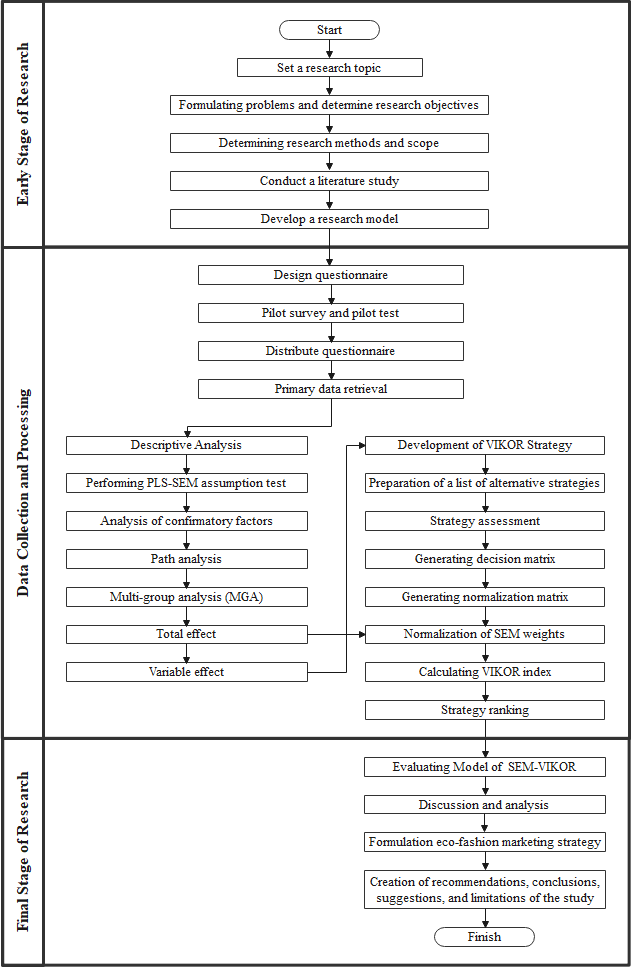
Figure 1 illustrates the integration of SEM and VIKOR methods, providing a clear roadmap for the study. This framework ensures robust results that guide targeted marketing strategies for Indonesian consumers, while contributing valuable insights to support sustainable consumption and the growth of the eco-fashion market.
The conceptual model in this study is developed based on the integration of the Theory of Planned Behavior (TPB), the Value-Belief-Norm (VBN) theory, and the Normative Conduct Theory (NCT) to identify the key factors driving purchase intention for eco-fashion (PIEF)23). This approach ensures the model has strong predictive and explanatory capabilities. Consistent with previous research, the study identifies environmental concern (EC), social influence (SI), and altruism (AL) as antecedents of PIEF, with electronic Word of Mouth (eWOM) and willingness to pay (WTP) as outcomes. The study aims to explore the relationships between these variables in eco-fashion, thereby contributing to the growing body of literature in this field. Figure 2 presents the conceptual model, which includes six latent variables and related hypotheses.
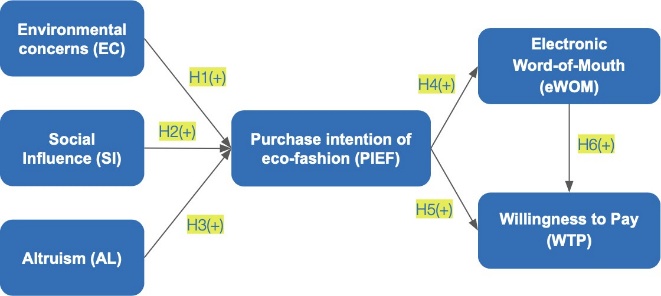
Table 1: Research hypothesis
| Hypothesis | Description | Brief Rationale |
|---|---|---|
| H1 | Environmental concern has a significant effect on purchase intention eco-fashion. | Environmental concern shapes positive attitudes in TPB; confirmed to boost Gen Z sustainable apparel intention16,24,25). |
| H2 | Social influence has a significant effect on purchase intention eco-fashion. | Social norms in TPB drive eco-fashion decisions16,24,26). |
| H3 | Altruism has a significant effect on purchase intention eco-fashion. | Altruism fosters sustainable apparel adoption27–29). |
| H4 | Purchase intention of eco-fashion significant effect on eWOM. | Higher intention increases positive online sharing30,31). |
| H5 | Eco-fashion purchase intention (PIEF) has a significant effect on WTP a price premium. | Strong intention correlates with higher WTP for sustainable apparel32,33). |
| H6 | eWOM has a significant effect on WTP a price premium. | Positive eWOM enhances value perception and WTP34,35). |
| H7 | eWOM mediates the relationship between purchase intention of eco-fashion (PIEF) and WTP. | eWOM strengthens intention–WTP link via social proof30,36). |
The conceptual model was developed, followed by the formulation of seven hypotheses regarding consumer behavior in purchasing eco-fashion products23). A summary of the hypotheses is shown in Table 1.
4. 4. Results
4.1. 4.1 Structural Equation Modeling (SEM) Model
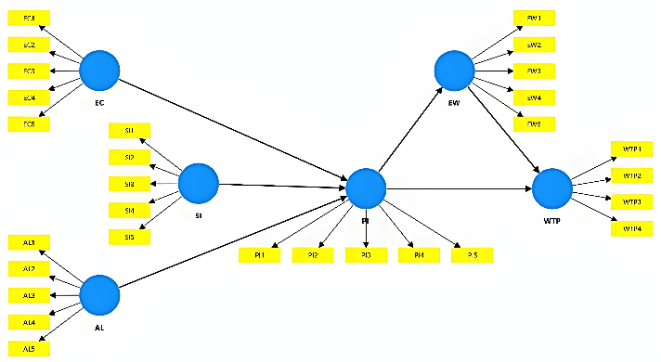
The PLS-SEM analysis began by constructing the structural and measurement model in SmartPLS 4, derived from the conceptual framework of latent variables and indicators. Figure 3 illustrates the structural and measurement model derived from the problem formulation for eco-fashion product purchasing behavior.
4.2. 4.2 Measurement Model (Outer Model)
As presented in Table 2, EC1 (0.661) and EW5 (0.691) recorded loadings below the threshold and were therefore removed. Following their elimination, all remaining indicators satisfied the discriminant validity requirements. This was further confirmed through cross-loading results and the Fornell–Larcker criterion, as shown in Table 3.
The assessment of Internal Consistency Reliability in Table 4 is conducted using Composite Reliability, with a critical value set at > 0.7. All six variables have values exceeding 0.8, indicating that the variables exhibit internal consistency. Subsequently, validity testing is performed using Convergent Validity to determine whether the indicators used are appropriate. Based on the AVE values presented in Table 4, the Convergent Validity test reveals that all six variables are valid.
Table 2: Indicator reliability and discriminant validity (cross loadings) test results
| Variables | Before Elimination of EC1 and EW5 Indicators | After Elimination of EC1 and EW5 Indicators | ||||||||||
|---|---|---|---|---|---|---|---|---|---|---|---|---|
| AL | EC | EW | PI | SI | WTP | AL | EC | EW | PI | SI | WTP | |
| AL1 | 0.857 | 0.576 | 0.67 | 0.652 | 0.43 | 0.575 | 0.857 | 0.58 | 0.67 | 0.652 | 0.43 | 0.575 |
| AL2 | 0.880 | 0.688 | 0.679 | 0.707 | 0.39 | 0.614 | 0.88 | 0.677 | 0.648 | 0.706 | 0.39 | 0.614 |
| AL3 | 0.865 | 0.707 | 0.707 | 0.731 | 0.414 | 0.64 | 0.865 | 0.705 | 0.682 | 0.731 | 0.414 | 0.64 |
| AL4 | 0.821 | 0.603 | 0.681 | 0.6 | 0.449 | 0.554 | 0.821 | 0.603 | 0.689 | 0.6 | 0.449 | 0.554 |
| AL5 | 0.788 | 0.647 | 0.738 | 0.652 | 0.525 | 0.681 | 0.788 | 0.633 | 0.743 | 0.653 | 0.525 | 0.681 |
| EC1 | 0.451 | 0.611 | 0.425 | 0.441 | 0.253 | 0.412 | ||||||
| EC2 | 0.602 | 0.819 | 0.618 | 0.69 | 0.255 | 0.543 | 0.602 | 0.819 | 0.573 | 0.689 | 0.255 | 0.542 |
| EC3 | 0.607 | 0.81 | 0.611 | 0.679 | 0.38 | 0.615 | 0.607 | 0.828 | 0.576 | 0.678 | 0.38 | 0.615 |
| EC4 | 0.626 | 0.841 | 0.621 | 0.694 | 0.338 | 0.58 | 0.626 | 0.845 | 0.576 | 0.693 | 0.338 | 0.579 |
| EC5 | 0.681 | 0.803 | 0.681 | 0.752 | 0.442 | 0.723 | 0.681 | 0.818 | 0.662 | 0.753 | 0.442 | 0.723 |
| EW1 | 0.69 | 0.654 | 0.852 | 0.634 | 0.493 | 0.658 | 0.69 | 0.656 | 0.868 | 0.636 | 0.493 | 0.658 |
| EW2 | 0.71 | 0.67 | 0.870 | 0.665 | 0.479 | 0.662 | 0.71 | 0.671 | 0.88 | 0.666 | 0.479 | 0.662 |
| EW3 | 0.678 | 0.615 | 0.836 | 0.664 | 0.469 | 0.597 | 0.678 | 0.613 | 0.842 | 0.664 | 0.469 | 0.597 |
| EW4 | 0.715 | 0.542 | 0.816 | 0.59 | 0.595 | 0.663 | 0.715 | 0.541 | 0.845 | 0.591 | 0.595 | 0.664 |
| EW 5 | 0.556 | 0.646 | 0.691 | 0.639 | 0.385 | 0.505 | ||||||
| PI1 | 0.619 | 0.699 | 0.575 | 0.752 | 0.287 | 0.518 | 0.619 | 0.702 | 0.512 | 0.75 | 0.287 | 0.518 |
| PI2 | 0.622 | 0.636 | 0.62 | 0.799 | 0.437 | 0.562 | 0.622 | 0.638 | 0.58 | 0.798 | 0.437 | 0.562 |
| PI3 | 0.689 | 0.773 | 0.65 | 0.879 | 0.413 | 0.648 | 0.689 | 0.773 | 0.615 | 0.879 | 0.413 | 0.647 |
| PI4 | 0.669 | 0.741 | 0.633 | 0.889 | 0.379 | 0.643 | 0.669 | 0.744 | 0.592 | 0.888 | 0.379 | 0.643 |
| PI5 | 0.681 | 0.65 | 0.739 | 0.806 | 0.583 | 0.788 | 0.681 | 0.661 | 0.746 | 0.809 | 0.583 | 0.789 |
| SI1 | 0.473 | 0.43 | 0.498 | 0.488 | 0.845 | 0.523 | 0.473 | 0.429 | 0.47 | 0.489 | 0.845 | 0.523 |
| SI2 | 0.419 | 0.332 | 0.523 | 0.387 | 0.878 | 0.536 | 0.419 | 0.327 | 0.522 | 0.388 | 0.878 | 0.537 |
| SI3 | 0.507 | 0.392 | 0.544 | 0.451 | 0.878 | 0.558 | 0.507 | 0.381 | 0.549 | 0.452 | 0.878 | 0.558 |
| SI4 | 0.368 | 0.273 | 0.425 | 0.367 | 0.806 | 0.473 | 0.368 | 0.283 | 0.443 | 0.368 | 0.806 | 0.474 |
| SI5 | 0.408 | 0.366 | 0.502 | 0.449 | 0.795 | 0.545 | 0.408 | 0.363 | 0.499 | 0.45 | 0.795 | 0.546 |
| WTP1 | 0.639 | 0.636 | 0.674 | 0.661 | 0.593 | 0.884 | 0.639 | 0.63 | 0.679 | 0.663 | 0.593 | 0.885 |
| WTP2 | 0.638 | 0.594 | 0.69 | 0.648 | 0.607 | 0.861 | 0.638 | 0.59 | 0.698 | 0.649 | 0.607 | 0.862 |
| WTP3 | 0.619 | 0.645 | 0.609 | 0.685 | 0.468 | 0.852 | 0.619 | 0.658 | 0.585 | 0.686 | 0.468 | 0.85 |
| WTP4 | 0.6 | 0.688 | 0.629 | 0.657 | 0.486 | 0.832 | 0.6 | 0.686 | 0.611 | 0.658 | 0.486 | 0.831 |
Table 3: Discriminant validity (fornell-larcker criterion) test results
| Variables | AL | EC | EW | PI | SI | WTP |
|---|---|---|---|---|---|---|
| AL | 0.843 | |||||
| EC | 0.762 | 0.827 | ||||
| EW | 0.813 | 0.723 | 0.859 | |||
| PI | 0.796 | 0.851 | 0.744 | 0.826 | ||
| SI | 0.522 | 0.43 | 0.592 | 0.516 | 0.841 | |
| WTP | 0.728 | 0.746 | 0.751 | 0.774 | 0.629 | 0.857 |
Table 4: Internal consistency reliability and convergent validity test results
| Variable | Composite Reliability | Critical Value | Evaluation of Results | AVE | Critical Value | Evaluation of Results |
|---|---|---|---|---|---|---|
| AL | 0.925 | > 0,7 | Reliable | 0.71 | > 0,5 | Valid |
| EC | 0.886 | Reliable | 0.61 | Valid | ||
| eWOM | 0.908 | Reliable | 0.665 | Valid | ||
| PI | 0.915 | Reliable | 0.683 | Valid | ||
| SI | 0.924 | Reliable | 0.708 | Valid | ||
| WTP | 0.917 | Reliable | 0.735 | Valid |
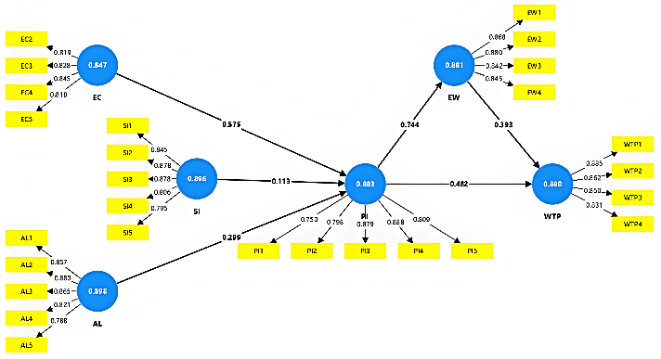
The validity and reliability tests indicate the need to eliminate two indicators. The respecified model can now be used for the next stage, which is testing the inner model. Figure 4 presents the respecified SEM model, which is based on the results of the validity and reliability tests, including the removal of the EC1 and EW5 indicators.
4.3. 4.3 Measurement Model (Inner Model)
The inner model testing evaluates the model’s predictive power, validates hypotheses, and examines construct relationships. The evaluation steps include testing for collinearity, significance, and the relationships between constructs, as well as assessing R², f², predictive relevance (Q²), and q², which are presented in Table 5.
Based on Table 5, all exogenous variables show VIF values below 5, confirming no collinearity issues. Path coefficients indicate that eWOM has the strongest link with eco-fashion purchase intention (r = 0.744). Among predictors of purchase intention, environmental concern is the strongest (0.575), followed by altruism (0.299) and social influence (0.113). For willingness to pay a premium, both eWOM (0.393) and purchase intention (0.482) show positive effects. The R² values meet the thresholds for substantial explanatory power37), noting that values in human behavior research are often below 20% due to the complexity of predicting behavior.
The next evaluation is the f² value in Table 5, which explains the strength of the effect of exogenous variables on endogenous variables. Contributions are considered large if f² ≥ 0.35, moderate if f² ≥ 0.15, and weak if f² ≤ 0.0238). Purchase intention of eco-fashion exerts a strong effect on eWOM (f² = 1.243). Among its predictors, environmental concern demonstrates the most substantial influence (0.647), followed by altruism with a moderate effect (0.157), while social influence remains weak (0.043). Both eWOM (0.207) and purchase intention (0.311) show modest effects on willingness to pay a premium price.
The inner model's predictive relevance (Q²) was assessed, with values greater than 0 indicating relevance for the endogenous variables. Q² values of 0.35, 0.15, and 0.02 indicate significant, moderate, and weak effects, respectively. The analysis reveals that environmental concerns have a significant impact on purchase intention, while altruism and social influence have a weak to moderate effect. Other variables show weak predictive relevance. Overall, the model is robust, allowing for subsequent hypothesis testing.
4.4. 4.4 Test and Evaluate Research Hypotheses
The t-statistics and p-values are indicators used in hypothesis testing. The significance level of the relationships between constructs can be assessed through bootstrapping procedures, which are available in the SmartPLS 4 software. Table 6 presents the output from this procedure.
Table 5: Structural model test results
| Relation | VIF | Critical Value | Evaluation Collinearity | Path Coefficient | R2 | f2 | Q2 | q2 |
|---|---|---|---|---|---|---|---|---|
| GO -> PI | 2.676 | < 5 | Low | 0.299 | 0.786 | 0.157 | 0.779 | 0.140 |
| EC -> PI | 2.389 | Low | 0.575 | 0.647 | 0.638 | |||
| SI -> PI | 1.379 | Low | 0.113 | 0.043 | 0.032 | |||
| EW -> WTP | 2.243 | Low | 0.393 | 0.668 | 0.207 | 0.637 | 0.000 | |
| PI -> WTP | 2.243 | Low | 0.482 | 0.311 | 0.022 | |||
| PI -> IT | 1 | Low | 0.744 | 0.554 | 1.243 | 0.641 | -0.201 |
Table 6: Results of model bootstrapping procedure
| Relation | T statistics | Critical Value | Evaluation | P values | Critical Value | Evaluation |
|---|---|---|---|---|---|---|
| GO -> PI | 4.76 | > 1.96 | Significant | <0.001 | < 0.05 | Accepted |
| EC -> PI | 9.53 | Significant | <0.001 | Accepted | ||
| EW -> WTP | 7.97 | Significant | <0.001 | Accepted | ||
| PI -> IT | 21.33 | Significant | <0.001 | Accepted | ||
| PI -> WTP | 10.18 | Significant | <0.001 | Accepted | ||
| SI -> PI | 3.10 | Significant | 0.001 | Accepted | ||
| PI -> WTP (indirect effect) | 7.57 | Significant | <0.001 | Accepted |
Table 6 shows that altruism (AL), environmental concerns (EC), and social influence (SI) significantly impact purchase intention of eco-fashion (PI), while electronic Word of Mouth (eWOM) and purchase intention (PI) significantly affect willingness to pay a premium price (WTP). Additionally, purchase intention (PI) influences eWOM. These findings indicate that all latent variables significantly affect consumers' purchase intentions and willingness to spend on eco-fashion products in Indonesia.
4.5. 4.5 Multi Group Analysis (MGA)
4.6. Multi-group analysis (MGA) tests for differences in eco-fashion purchasing behavior between Generation Y and Z, processed separately and simultaneously. Path coefficient significance is evaluated in Table 7, with differences assessed using a permutation procedure in SmartPLS 4.
A significant difference was found between PIEF and eWOM (p = 0.001), with Generation Y showing stronger influence than Generation Z. While Y tends to share detailed reviews, Z prefers visual platforms, and no major generational differences appeared for other variables.
4.7. 4.6 Strategic Planning
The VIKOR method is used to formulate marketing strategies for eco-fashion products based on PLS-SEM analysis of consumer behavior in Indonesia. Table 8 presents the VIKOR criteria weights, which were derived empirically by summing the PLS-SEM total effect values of each construct across both outcome variables (purchase intention and WTP), then normalizing by dividing each sum by the grand total (1.932). This approach ensures that criteria weights reflect the relative empirical importance of each factor in driving consumer behavior, replacing subjective expert elicitation for the weighting step.
The strategy level is determined based on the VIKOR index ranking. The alternative strategies with the smallest VIKOR index values receive the highest strategy ratings. The strategies are ranked in ascending order of their VIKOR index values. Table 9 presents the VIKOR index and the corresponding product marketing strategy levels for eco-fashion in Indonesia.
Table 7: Multi group analysis (MGA) results
| Relation | Original | t value | p value | p values (all) | Permutation p value | Evaluate Differences | |||
|---|---|---|---|---|---|---|---|---|---|
| Gen Y | Gen Z | Gen Y | Gen Z | Gen Y | Gen Z | ||||
| GO -> PI | 0.4 | 0.266 | 5.411 | 3.4 | <0.001 | <0.001 | <0.001 | 0.205 | Not Significant |
| EC -> PI | 0.531 | 0.538 | 7.634 | 6.621 | <0.001 | <0.001 | <0.001 | 0.464 | Not Significant |
| EW -> WTP | 0.425 | 0.38 | 4.21 | 6.433 | <0.001 | <0.001 | <0.001 | 0.344 | Not Significant |
| PI -> IT | 0.857 | 0.65 | 26.223 | 13.449 | <0.001 | <0.001 | <0.001 | 0.001 | Significant |
| PI -> WTP | 0.466 | 0.483 | 4.994 | 8.779 | <0.001 | <0.001 | <0.001 | 0.457 | Not Significant |
| SI -> PI | 0.063 | 0.159 | 1.325 | 2.815 | 0.093 | 0.002 | 0.001 | 0.069 | Not Significant |
Table 8: Weight of strategy assessment criteria
| Description | Criteria | Total | ||||
|---|---|---|---|---|---|---|
| EC | AL | EW | PI | E-WOM | ||
| Total Effects | 0.445 | 0.232 | 0.088 | 0.774 | 0.393 | 1.932 |
| Criteria Weight | 0.230 | 0.120 | 0.046 | 0.401 | 0.203 | 1 |
Table 9: VIKOR index value and strategy ranking
| Strategy Level | VIKOR Index (Q) | Strategy Alternatives | |
|---|---|---|---|
| Code | Description | ||
| 1 | 0.019 | S3 | Collaborate with sustainable influencers to promote eco-fashion products. |
| 2 | 0.035 | S1 | Digital marketing and social media strategies involve utilizing platforms like Instagram and TikTok to promote eco-fashion products. |
| 3 | 0.405 | S8 | Communicate the brand's commitment to sustainability and ethical values, including the use of eco-friendly materials, sustainable production practices, and initiatives aimed at reducing waste. |
| 4 | 0.431 | S2 | Content usage is user-generated by encouraging consumers to share their experiences using the product Eco-Fashion on social media |
| 5 | 0.581 | S6 | Organize pop-up events or festivals with a sustainability theme to provide a direct product experience. |
| 6 | 0.636 | S4 | Build a community around the brand through events focused on sustainability. |
| 7 | 0.925 | S5 | Hold educational campaigns about the importance of eco-fashion. |
| 8 | 0.990 | S9 | Use storytelling to share the product's journey from raw materials to the final item. |
| 9 | 1 | S7 | Transparency in the supply chain by providing clear information about the origin of raw materials and production processes. |
5. 5. Discussion
The analysis began with validity and reliability testing of the latent variable indicators, leading to the removal of two that did not meet the criteria, leaving 27 valid indicators. Results showed all hypothesized relationships were significant, confirming that environmental concern positively influences eco-fashion purchase intention, consistent with prior studies on ecological concern and sustainable consumption39,40).
Social influence (SI) significantly shapes eco-fashion purchase intention (PIEF), showing the strong role of norms, peers, and influencers. These findings align with research showing that collectivist cultures, like Indonesia, have a greater need for social conformity41). Altruism (AL) significantly increases eco-fashion purchase intention, indicating that altruistic consumers are more inclined to support products benefiting society and the environment, consistent with prior studies on sustainable consumption42,43).
The relationship between purchase intention of eco-fashion (PIEF) and electronic word-of-mouth (eWOM) is significant, with a high t-statistic and p-value < 0.05. This suggests that consumers with high purchase intentions are more likely to spread positive eWOM about eco-fashion brands, supporting research that links purchase intention to the spread of positive eWOM3). The results show that purchase intention of eco-fashion (PIEF) significantly influences willingness to pay (WTP) a price premium. Consumers with higher purchase intentions are more willing to pay higher prices for eco-fashion products, supporting research linking strong purchase intentions to a willingness to pay more for sustainable products42).
The relationship between eWOM and WTP is significant, with a high t-statistic and p-value < 0.05. This suggests that positive eWOM can motivate consumers to pay a premium for eco-fashion products, aligning with research highlighting eWOM's role in enhancing perceived product value23). Mediation analysis shows that eWOM significantly mediates the relationship between purchase intention of eco-fashion (PIEF) and willingness to pay a price premium, strengthening the influence of purchase intention. This supports research suggesting that eWOM is key to enhancing environmentally friendly purchasing behavior23,41).
The analysis of hypotheses shows that all relationships between latent variables in the research model are significant, supporting the proposed conceptual model and providing a solid foundation for eco-fashion marketing strategies targeting Generations Y and Z in Indonesia. The results also indicate no significant differences between the two generations, except for the relationship between purchase intention of eco-fashion (PIEF) and eWOM, highlighting the need for tailored marketing strategies. For Generation Y, text-based eWOM and in-depth reviews may be more effective, while Generation Z responds better to visual approaches and interactive media. While the results indicate no major differences between Generations Y and Z, this similarity may be due to their shared exposure to digital platforms and increasing awareness of environmental issues. Prior studies also suggest that generational differences in sustainable consumption are narrowing, with distinctions appearing more in communication preferences than in underlying motivations44,45). Thus, both generations are driven by similar values, although the framing of eco-fashion marketing strategies should be tailored: Generation Y tends to prefer detailed reviews and textual content, while Generation Z is more responsive to visual and interactive formats.
The analysis shows that collaborating with sustainability-driven influencers to promote eco-fashion products (S3) ranks first with a VIKOR index value of 0.019. This strategy is the most effective, as it boosts consumer purchase intentions through social influence, especially among Generations Y and Z, creating a positive brand image and fostering emotional engagement46,47). Recent research also confirms that influencer-based promotions significantly impact purchasing behavior for eco-friendly products48). Digital marketing and social media strategies (S1) rank second with a VIKOR index value of 0.035. Social media platforms like Instagram and TikTok are key for engaging young consumers through interactive content, increasing product awareness and appeal. Effective digital marketing accelerates the adoption of sustainable products among young consumers44). This is further supported by research, which shows that social media plays a crucial role in building brand loyalty45).
The strategy of communicating the sustainability and ethical values promoted by the brand (S8) ranks third with a VIKOR index value of 0.405. This strategy includes communication about environmentally friendly materials, sustainable production processes, and waste reduction. Value-based marketing is crucial for creating emotional connections with consumers who care about the environment33). Research also emphasizes that transparency in communicating sustainability values increases consumer trust49).
From a theoretical perspective, the top-ranked strategies can be interpreted through the lens of the theoretical frameworks underpinning this study. The prioritization of influencer collaborations (S3) and social media campaigns (S1) aligns directly with the subjective norms component of the Theory of Planned Behavior (TPB): consumers are more likely to form positive purchase intentions when significant others, including trusted influencers, demonstrate eco-fashion adoption. This is consistent with findings by prior researchers, who demonstrate the strong behavioral influence of social media influencers on Indonesian and global consumer segments respectively45,46). The high ranking of sustainability communication (S8) reflects the Value-Belief-Norm (VBN) theory, wherein consumers who hold strong environmental beliefs translate these into purchasing behaviors when brands transparently communicate aligned values, thereby activating altruistic and norm-based motivations. Conversely, lower-ranked strategies, educational campaigns (S5), storytelling about product origin (S9), and supply chain transparency (S7), are primarily linked to the Environmental Concern (EC) construct, which carries a relatively lower empirical weight in the VIKOR criteria (w = 0.230) compared to Purchase Intention (w = 0.401). While these strategies remain valuable for long-term brand positioning, they are less immediately actionable for driving purchase behavior and willingness to pay in the short term.
Theoretical Implications: This study extends the Theory of Planned Behavior (TPB) by integrating environmental concern, altruism, and eWOM into the eco-fashion purchase intention framework, confirming their significant effects on purchase intention, willingness to pay a premium, and online advocacy.
Practical Implications: The findings suggest that businesses can leverage social influence and eWOM to strengthen eco-fashion adoption, while campaigns emphasizing environmental and altruistic values can enhance purchase intention. Policymakers should support awareness programs and incentives to promote sustainable fashion, fostering a more competitive eco-fashion market in emerging economies.
6. 6. Conclusion
Building on the PLS-SEM and VIKOR analyses, this study contributes both theoretical and practical insights into eco-fashion marketing for Generations Y and Z in Indonesia. In terms of the three stated research objectives: first, the key behavioral determinants of eco-fashion purchase intention are environmental concern (path coefficient = 0.575), altruism (0.299), and social influence (0.113), all of which positively and significantly influence purchase intention, which in turn drives eWOM (0.744) and willingness to pay a premium (0.482). Second, no significant generational differences were found between Gen Y and Gen Z across most constructs, with the single exception of the purchase intention, eWOM relationship, which is stronger for Gen Y (0.857) than Gen Z (0.650), suggesting that Gen Y is more likely to convert purchase intent into detailed online reviews. Third, the VIKOR prioritization identifies influencer collaborations with sustainability-focused content creators (S3, Q = 0.019) as the highest-priority marketing strategy, followed by digital social media campaigns on Instagram and TikTok (S1, Q = 0.035), and transparent communication of sustainability values (S8, Q = 0.405). These strategies directly leverage the dominant behavioral drivers, social influence and purchase intention, identified through the SEM analysis, confirming the internal consistency of the hybrid SEM-VIKOR approach.
The research findings indicate no significant differences in eco-fashion product preferences between Generations Y and Z in Indonesia. Both generations are similarly influenced by environmental awareness, product quality, price, and brand image, with shared values regarding sustainability significantly shaping their purchasing decisions. PLS-SEM analysis reveals that sustainability awareness and an eco-friendly brand image have a substantial impact on the attitudes and purchase intentions of both generations. Marketers should develop strategies that emphasize product sustainability, positive environmental impact, transparency in product quality, and competitive pricing to appeal to these consumer groups. Although preferences may not differ significantly, it is essential for marketing strategies to align products with sustainable values and foster an emotional connection with consumers, particularly among younger, socially conscious generations.
Transparency in both product quality and pricing plays a pivotal role, as both generations prioritize the alignment of price with perceived value, particularly in the context of sustainability. Brands that successfully communicate their commitment to high quality, affordability, and environmental friendliness are more likely to build consumer trust and long-term loyalty. In conclusion, marketing strategies that emphasize sustainability, product quality, and competitive pricing are likely to resonate with both Generation Y and Generation Z. By aligning their values with these priorities, brands can engage these consumers effectively and establish a strong presence in the rapidly growing eco-fashion market. Additionally, addressing these factors can drive the adoption of sustainable consumption behavior, contributing to a positive environmental impact while capturing the attention of the increasingly influential Gen Y and Z consumers.
This study has several limitations. First, the sample was limited to Indonesian consumers, which may restrict the generalizability of the findings to other cultural contexts. Second, the cross-sectional survey design does not capture changes in consumer behavior over time. Future studies could adopt longitudinal or experimental approaches to better establish causality. Additionally, research in other emerging and developed markets could provide comparative insights into eco-fashion adoption across cultural contexts. Incorporating other behavioral variables, such as perceived value or lifestyle orientation, may also strengthen future models.
Acknowledgements
This research is supported by Universitas Indonesia through Hibah Publikasi Terindeks International (PUTI) Q1 2025–2026, Number: PKS-267/UN2.RST/HKP.05.00/2025.
References
- Bappenas, Embassy of Denmark Jakarta, and UNDP, “THE economic, social, and environmental benefits of a circular economy in indonesia,” (2021). https://lcdi-indonesia.id/wp-content/uploads/2021/02/Executive-Summary-The-Economic-Social-and-Environmental-Benefits-of-a-Circular-Economy-in-Indonesia.pdf (accessed June 4, 2025).
- KLHK, “Performance Report of the Ministry of Environment and Forestry 2023,” (2023). https://www.menlhk.go.id/cadmin/uploads/Laporan_Kinerja_Kementerian_LHK_2023_mini_1_2a33cc972b.pdf (accessed June 4, 2025).
- S.K. Sharma, and A. Shukla, “Impact of electronic word on mouth on consumer behaviour and brand image,” Asian Jour. Manag., 8 (3) 501 (2017). doi:10.5958/2321-5763.2017.00081.6.
- B. Harnadi, A. Dwiyoga, and FX.H. Prasetya, “The Difference Adoption of E-Commerce Technology among Z and Y Generations,” in: 2019 23rd International Computer Science and Engineering Conference (ICSEC), 2019: pp. 366–372. doi:10.1109/ICSEC47112.2019.8974680.
- A. Manley, Y. Seock, and J. Shin, “Exploring the perceptions and motivations of gen z and millennials toward sustainable clothing,” Family & Consum Sci Res J, 51 (4) 313–327 (2023). doi:10.1111/fcsr.12475.
- D. Dwidienawati, S.B. Abdinagoro, D. Gandasari, and D. Tjahjana, “Do generation y and z really concern about environmental issues?,” IOP Conf. Ser.: Earth Environ. Sci., 729 (1) 012137 (2021). doi:10.1088/1755-1315/729/1/012137.
- I.S. Nida, F. Rahmiati, and C. Chairy, “THE factors of willngness to buy sustainable fashion in indonesia,” JMIEB, 8 (2) 425–439 (2024). doi:10.24912/jmieb.v8i2.31412.
- Ipsos, “Majority of indonesians show strong concern about climate change,” (2025).
- A.L. Vassalo, C.G. Marques, J.T. Simões, M.M. Fernandes, and S. Domingos, “Sustainability in the fashion industry in relation to consumption in a digital age,” Sustainability, 16 (13) 5303 (2024). doi:10.3390/su16135303.
- N. Srividya, R. Atiq, and N.S. Volety, “Qualitative research on responsible consumption concerning apparel,” Cleaner and Responsible Consumption, 12 100178 (2024). doi:10.1016/j.clrc.2024.100178.
- C. Palm, “Sustainable fashion: to define, or not to define, that is not the question,” Sustainability: Science, Practice and Policy, 19 (1) 2261342 (2023). doi:10.1080/15487733.2023.2261342.
- S. Scaturro, “Ethics + Aesthetics = Sustainable Fashion,” 2009.
- P.B. Pires, C. Morais, C.J.M. Delgado, and J.D. Santos, “Sustainable fashion: conceptualization, purchase determinants, and willingness to pay more,” Administrative Sciences, 14 (7) 143 (2024). doi:10.3390/admsci14070143.
- M.A. Lasaiba, “Eco-fashion: an eco-friendly lifestyle trend,” Lani, 4 (2) 130–137 (2024). doi:10.30598/Lanivol4iss2page130-137.
- Md.T. Rahaman, and Md.S.H. Khan, “Green merchandising of textiles and apparel in a circular economy: recent trends, framework, challenges and future prospects towards sustainability,” Journal of Open Innovation: Technology, Market, and Complexity, 11 (1) 100457 (2025). doi:10.1016/j.joitmc.2024.100457.
- I. Ajzen, “The theory of planned behavior,” Organizational Behavior and Human Decision Processes, 50(2) 179–211 (1991). doi:10.1016/0749-5978(91)90020-T.
- I. Ajzen, “The theory of planned behavior: frequently asked questions,” Human Behav and Emerg Tech, 2 (4) 314–324 (2020). doi:10.1002/hbe2.195.
- M. Fishbein, and I. Ajzen, “Belief, attitude, intention and behaviour: An introduction to theory and research,” 1975.
- I. Ajzen, N. Joyce, S. Sheikh, and N.G. Cote, “Knowledge and the prediction of behavior: the role of information accuracy in the theory of planned behavior,” Basic and Applied Social Psychology, 33 (2) 101–117 (2011). doi:10.1080/01973533.2011.568834.
- N.G. Torlak, A. Demir, and T. Budur, “Using vikor with structural equation modeling for constructing benchmarks in the internet industry,” BIJ, 28 (10) 2952–2976 (2021). doi:10.1108/BIJ-09-2020-0465.
- K.J. Saadoon, and N.N. Othman, “Benchmarking perceived quality among gated communities using vikor: a study from kurdistan region of iraq,” SM, (28) 82–88 (2019). doi:10.4467/25438700SM.19.033.11370.
- S. Opricovic, and G.-H. Tzeng, “Compromise solution by mcdm methods: a comparative analysis of vikor and topsis,” European Journal of Operational Research, 156 (2) 445–455 (2004). doi:10.1016/S0377-2217(03)00020-1.
- M. Farzin, H. Shababi, G. Shirchi Sasi, M. Sadeghi, and R. Makvandi, “The determinants of eco-fashion purchase intention and willingness to pay,” SJME, 27 (3) 348–366 (2023). doi:10.1108/SJME-07-2022-0158.
- P. Chaturvedi, K. Kulshreshtha, and V. Tripathi, “Investigating the determinants of behavioral intentions of generation z for recycled clothing: an evidence from a developing economy,” YC, 21 (4) 403–417 (2020). doi:10.1108/YC-03-2020-1110.
- E. Djafarova, and S. Foots, “Exploring ethical consumption of generation z: theory of planned behaviour,” Young Consumers: Insight and Ideas for Responsible Marketers, 23 (3) 413–431 (2022). doi:10.1108/YC-10-2021-1405.
- H. Han, L.-T. (Jane) Hsu, and C. Sheu, “Application of the theory of planned behavior to green hotel choice: testing the effect of environmental friendly activities,” Tourism Management, 31 (3) 325–334 (2010). doi:10.1016/j.tourman.2009.03.013.
- S.H. Schwartz, “Normative Influences on Altruism,” in: Advances in Experimental Social Psychology, Elsevier, 10 221–279 (1977). doi:10.1016/S0065-2601(08)60358-5.
- J. Kang, C. Liu, and S.-H. Kim, “Environmentally sustainable textile and apparel consumption: the role of consumer knowledge, perceived consumer effectiveness and perceived personal relevance,” International Journal of Consumer Studies, 37 (4) 442–452 (2013). doi:10.1111/ijcs.12013.
- K. Jacobs, L. Petersen, J. Hörisch, and D. Battenfeld, “Green thinking but thoughtless buying? an empirical extension of the value-attitude-behaviour hierarchy in sustainable clothing,” Journal of Cleaner Production, 203 1155–1169 (2018). doi:10.1016/j.jclepro.2018.07.320.
- C.M.K. Cheung, and D.R. Thadani, “The impact of electronic word-of-mouth communication: a literature analysis and integrative model,” Decision Support Systems, 54 (1) 461–470 (2012). doi:10.1016/j.dss.2012.06.008.
- I. Erkan, and C. Evans, “The influence of ewom in social media on consumers’ purchase intentions: an extended approach to information adoption,” Computers in Human Behavior, 61 47–55 (2016). doi:10.1016/j.chb.2016.03.003.
- F. Testa, F. Iraldo, A. Vaccari, and E. Ferrari, “Why eco-labels can be effective marketing tools: evidence from a study on italian consumers,” Business Strategy and the Environment, 24 (4) 252–265 (2015). doi:10.1002/bse.1821.
- P. Kotler, K.L. Keller, M. Brady, M. Goodman, and T. Hansen, “Marketing Management 3rd edn PDF eBook,” Pearson Education, 2016. https://books.google.co.id/books?id=_SkiDAAAQBAJ.
- T. Hennig-Thurau, K.P. Gwinner, G. Walsh, and D.D. Gremler, “Electronic word-of-mouth via consumer-opinion platforms: what motivates consumers to articulate themselves on the internet?,” Journal of Interactive Marketing, 18 (1) 38–52 (2004). doi:10.1002/dir.10073.
- R. Filieri, and F. McLeay, “E-wom and accommodation: an analysis of the factors that influence travelers’ adoption of information from online reviews,” Journal of Travel Research, 53 (1) 44–57 (2014). doi:10.1177/0047287513481274.
- X. Wang, C. Yu, and Y. Wei, “Social media peer communication and impacts on purchase intentions: a consumer socialization framework,” Journal of Interactive Marketing, 26 (4) 198–208 (2012). doi:10.1016/j.intmar.2011.11.004.
- J. Hair, M. Sarstedt, L. Hopkins, and V. G. Kuppelwieser, “Partial least squares structural equation modeling (pls-sem): an emerging tool in business research,” European Business Review, 26 (2) 106–121 (2014). doi:10.1108/EBR-10-2013-0128.
- I. Ghozali, and H. Latan, “Partial Least Squares: Concepts, Methods and Applications Using WarpPLS 4.0,” 2014.
- U.A. Saari, S. Damberg, L. Frömbling, and C.M. Ringle, “Sustainable consumption behavior of europeans: the influence of environmental knowledge and risk perception on environmental concern and behavioral intention,” Ecological Economics, 189 107155 (2021). doi:10.1016/j.ecolecon.2021.107155.
- U.R. De Oliveira, T.S.M. Gomes, G.G. De Oliveira, J.C.A. De Abreu, M.A. Oliveira, A. Da Silva César, and V. Aprigliano Fernandes, “Systematic literature review on sustainable consumption from the perspective of companies, people and public policies,” Sustainability, 14 (21) 13771 (2022). doi:10.3390/su142113771.
- B. Czarnecka, and B. Schivinski, “Individualism/collectivism and perceived consumer effectiveness: the moderating role of global–local identities in a post‐transitional european economy,” J of Consumer Behaviour, 21 (2) 180–196 (2022). doi:10.1002/cb.1988.
- F. Yulianti, R. Zulfikar, and Lamsah, “The altruistic connection: unraveling how altruism drives eco-friendly consumer behavior in green marketing (literature review),” J. Professional Business Review, 8 (10) e03656 (2023). doi:10.26668/businessreview/2023.v8i10.3656.
- H. Xin, C. Li, W. Li, H. Wang, P. Liu, and S. Li, “Consumption replaces charity: altruistic consumption behaviors and motivations targeting vulnerable groups—research based on poverty alleviation consumption in china,” Front. Psychol., 13 933701 (2022). doi:10.3389/fpsyg.2022.933701.
- D. Chaffey, and F. Ellis-Chadwick, “Digital Marketing,” Pearson, 2019. https://books.google.co.id/books?id=-1yGDwAAQBAJ.
- E. Erwin, S.J. Saununu, and A.Y. Rukmana, “The influence of social media influencers on generation z consumer behavior in indonesia,” WSIS, 1 (10) 1028–1038 (2023). doi:10.58812/wsis.v1i10.317.
- M.D. Veirman, V. Cauberghe, and L. Hudders, “Marketing through instagram influencers: the impact of number of followers and product divergence on brand attitude,” International Journal of Advertising, 36 (5) 798–828 (2017). doi:10.1080/02650487.2017.1348035.
- K. Freberg, “Social Media for Strategic Communication: Creative Strategies and Research-Based Applications,” SAGE Publications, 2021. https://books.google.co.id/books?id=bQgpEAAAQBAJ.
- A.C. Munaro, R.H. Barcelos, and E.C.F. Maffezzolli, “The impact of influencers on sustainable consumption: a systematic literature review,” Sustainable Production and Consumption, 52 401–415 (2024). doi:10.1016/j.spc.2024.10.024.
- J. Lin, A. Lobo, and C. Leckie, “The role of benefits and transparency in shaping consumers’ green perceived value, self-brand connection and brand loyalty,” Journal of Retailing and Consumer Services, 35 133–141 (2017). doi:10.1016/j.jretconser.2016.12.011.